Weak US job growth coupled with Middle East conflict fuels strong gains in gold and silver prices.
2026-03-06 23:52:05
On Friday (March 6), the U.S. Bureau of Labor Statistics (BLS) released its February non-farm payrolls report, showing an unexpected decrease of 92,000 jobs, far below market expectations of a gain of approximately 59,000. The previous month's figure (January) was revised to +126,000. The unemployment rate rose slightly to 4.4% , higher than the expected 4.3%. This report highlights a significant slowdown in the U.S. labor market, primarily dragged down by a large-scale strike in the healthcare industry, while employment in the information technology sector and federal government remained under pressure. Private sector employment decreased by 86,000, and government employment decreased by 6,000. The BLS report explicitly stated that the job decline mainly reflected strike activity, a short-term mechanical effect rather than a signal of a full-blown economic recession. The healthcare strike involved approximately 31,000 healthcare workers at Kaiser Permanente, and such one-off events are expected to rebound in the March data, with the overall employment trend remaining close to a "flat" level of 50,000 to 100,000 jobs per month.
At 23:50 Beijing time, spot gold was trading at $5,142.04 per ounce, up 1.20%.

The impact of employment data on Federal Reserve policy
Weak employment data aligns with the Federal Reserve's dovish stance, supporting a swift interest rate cut to mitigate economic slowdown pressures, weakening the dollar and benefiting safe-haven assets like gold and silver. However, the surge in oil prices and inflation risks triggered by the Middle East conflict have made the market more cautious about the Fed's path. Money market data shows that the probability of the European Central Bank raising interest rates this year has reached 100%, with the yield on German two-year government bonds surging 30 basis points to 2.30%. In the US, the yield on 10-year Treasury bonds climbed more than 20 basis points to 4.17%, with options traders betting that the Fed's room for rate cuts in 2026 will narrow. The dollar index fell slightly, but overall liquidity demand increased, and the coexistence of dovish employment signals and energy inflation risks makes it more difficult for the Fed to strike a balance.
Latest developments in Middle East geopolitical conflicts and energy shocks
The escalating situation in Iran, with the US and Israel launching large-scale strikes against the country, has led to a near-complete shutdown or even closure of shipping in the Strait of Hormuz. Brent crude futures prices surged, breaking through $86 per barrel and reaching a two-year high. A senior official of the Iranian Revolutionary Guard stated that the strait is closed and any ships attempting to pass will be attacked, disrupting approximately 20% of global crude oil transport. Supply disruptions at Asian refineries have led some Chinese refineries to suspend diesel and gasoline exports, and the average retail price of gasoline in the US has soared to $3.32 per gallon, a new high since September 2024. Qatar warned that it would not resume crude oil production if the conflict continues, and shipping giants such as Maersk suspended services, causing emerging market currencies and stock markets to plummet. These events have amplified global uncertainty, exacerbating the energy supply disruptions, especially for Europe, which is highly dependent on Middle Eastern oil and gas, raising concerns about a repeat of the 2022 energy crisis.
Dubai's gold trade disruptions and their global impact
Dubai, a major global gold trading center, has been severely hampered by flight cancellations and high shipping insurance costs, leading to significant disruptions to gold exports. Local gold prices are trading at a discount to the London benchmark, reaching as high as $30 per ounce. Many buyers have suspended new orders, and the Indian market is experiencing weak short-term demand and inventory buildup. Despite these localized logistical issues, strong global safe-haven buying is supporting an overall rise in precious metal prices, with such supply disruptions actually enhancing gold's appeal as a safe-haven asset.
Precious Metals Price Trends and Technical Analysis
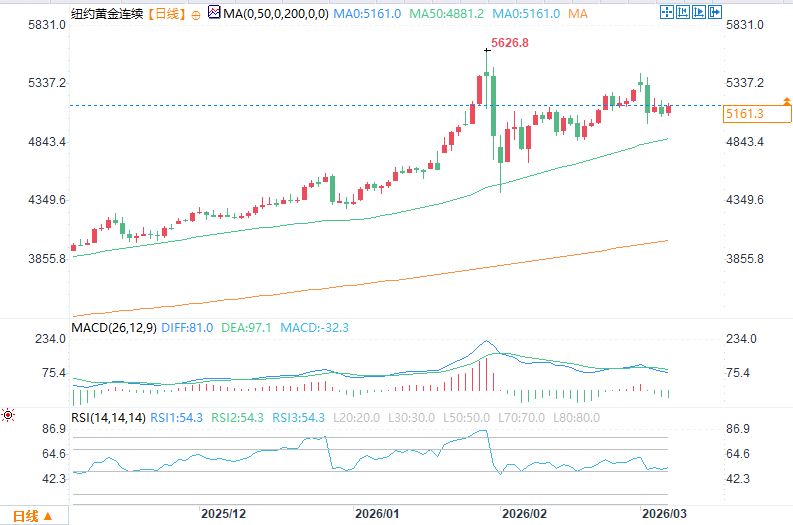
(COMEX Gold Daily Chart Source: FX678)
The precious metals market performed strongly. April gold futures rose $49 to $5,128 per ounce, while May silver futures rose $1.934 to $84.10 per ounce. Technically, the short-term upside target for gold bulls is a close above this week's high of $5,434.10, with key resistance at $5,200 and further resistance at $5,250 ; support is at $5,000 and further support at $4,900. Silver bulls target a break above this week's high of $95.86, with resistance at $85 and $87.50 ; support is at $80 and this week's low of $78.06. Weak employment and geopolitical risk aversion have pushed precious metals away from dollar pressure, resulting in strong short-term upward momentum.
Editor's Summary
The unexpected negative growth in US non-farm payrolls in February highlighted signs of a cooling labor market, primarily due to one-off factors such as the healthcare strike. However, this, coupled with soaring oil prices and inflationary pressures caused by Middle East conflicts, has created a double challenge for global markets. Precious metals, as traditional safe-haven assets, have benefited significantly, with prices rising substantially. The Federal Reserve faces increased difficulty in balancing policy, with dovish employment signals and energy inflation risks coexisting, suggesting heightened market volatility in the short term. Investors should closely monitor the rebound in March data and developments in the geopolitical situation. Overall, structural resilience remains, but external uncertainties dominate the short-term narrative.
Frequently Asked Questions
Keywords: Non-farm payrolls report, gold and silver, Middle East conflict, Strait of Hormuz, Federal Reserve interest rate cut
At 23:50 Beijing time, spot gold was trading at $5,142.04 per ounce, up 1.20%.
The impact of employment data on Federal Reserve policy
Weak employment data aligns with the Federal Reserve's dovish stance, supporting a swift interest rate cut to mitigate economic slowdown pressures, weakening the dollar and benefiting safe-haven assets like gold and silver. However, the surge in oil prices and inflation risks triggered by the Middle East conflict have made the market more cautious about the Fed's path. Money market data shows that the probability of the European Central Bank raising interest rates this year has reached 100%, with the yield on German two-year government bonds surging 30 basis points to 2.30%. In the US, the yield on 10-year Treasury bonds climbed more than 20 basis points to 4.17%, with options traders betting that the Fed's room for rate cuts in 2026 will narrow. The dollar index fell slightly, but overall liquidity demand increased, and the coexistence of dovish employment signals and energy inflation risks makes it more difficult for the Fed to strike a balance.
Latest developments in Middle East geopolitical conflicts and energy shocks
The escalating situation in Iran, with the US and Israel launching large-scale strikes against the country, has led to a near-complete shutdown or even closure of shipping in the Strait of Hormuz. Brent crude futures prices surged, breaking through $86 per barrel and reaching a two-year high. A senior official of the Iranian Revolutionary Guard stated that the strait is closed and any ships attempting to pass will be attacked, disrupting approximately 20% of global crude oil transport. Supply disruptions at Asian refineries have led some Chinese refineries to suspend diesel and gasoline exports, and the average retail price of gasoline in the US has soared to $3.32 per gallon, a new high since September 2024. Qatar warned that it would not resume crude oil production if the conflict continues, and shipping giants such as Maersk suspended services, causing emerging market currencies and stock markets to plummet. These events have amplified global uncertainty, exacerbating the energy supply disruptions, especially for Europe, which is highly dependent on Middle Eastern oil and gas, raising concerns about a repeat of the 2022 energy crisis.
Dubai's gold trade disruptions and their global impact
Dubai, a major global gold trading center, has been severely hampered by flight cancellations and high shipping insurance costs, leading to significant disruptions to gold exports. Local gold prices are trading at a discount to the London benchmark, reaching as high as $30 per ounce. Many buyers have suspended new orders, and the Indian market is experiencing weak short-term demand and inventory buildup. Despite these localized logistical issues, strong global safe-haven buying is supporting an overall rise in precious metal prices, with such supply disruptions actually enhancing gold's appeal as a safe-haven asset.
Precious Metals Price Trends and Technical Analysis
(COMEX Gold Daily Chart Source: FX678)
The precious metals market performed strongly. April gold futures rose $49 to $5,128 per ounce, while May silver futures rose $1.934 to $84.10 per ounce. Technically, the short-term upside target for gold bulls is a close above this week's high of $5,434.10, with key resistance at $5,200 and further resistance at $5,250 ; support is at $5,000 and further support at $4,900. Silver bulls target a break above this week's high of $95.86, with resistance at $85 and $87.50 ; support is at $80 and this week's low of $78.06. Weak employment and geopolitical risk aversion have pushed precious metals away from dollar pressure, resulting in strong short-term upward momentum.
Editor's Summary
The unexpected negative growth in US non-farm payrolls in February highlighted signs of a cooling labor market, primarily due to one-off factors such as the healthcare strike. However, this, coupled with soaring oil prices and inflationary pressures caused by Middle East conflicts, has created a double challenge for global markets. Precious metals, as traditional safe-haven assets, have benefited significantly, with prices rising substantially. The Federal Reserve faces increased difficulty in balancing policy, with dovish employment signals and energy inflation risks coexisting, suggesting heightened market volatility in the short term. Investors should closely monitor the rebound in March data and developments in the geopolitical situation. Overall, structural resilience remains, but external uncertainties dominate the short-term narrative.
Frequently Asked Questions
Q1: Why did such poor US non-farm payroll data in February directly lead to a surge in gold and silver prices?
A: The 92,000 job losses were far below expectations, and the unemployment rate rose to 4.4%, indicating a slowdown in the labor market. This typically supports expectations of interest rate cuts, weakens the dollar, and supports gold and silver. However, this surge was primarily driven by escalating conflicts in the Middle East, with the Strait of Hormuz disruption pushing up oil prices and inflation, thus reinforcing risk aversion. While the employment data was a catalyst, geopolitical risks were the dominant driving force.
Q2: How exactly do the Middle East wars affect the prices of gold and silver?
A: Iran's retaliation led to the closure of the Strait of Hormuz, disrupting 20% of global oil shipments. The resulting surge in oil prices amplified inflation and uncertainty. Investors flocked to gold and silver as safe havens. While the disruption to gold shipments from Dubai caused localized price drops, stronger global demand pushed up futures prices. If the war continues, safe-haven buying will continue to provide support.
Q3: Will the Federal Reserve cut interest rates immediately because of this jobs report?
A: Weak employment supports a dovish stance, but the inflationary risks from soaring oil prices are making the Fed more cautious. The probability of a rate hike by the ECB is 100%, US Treasury yields are rising, and the market is betting on a narrowing of the room for rate cuts in 2026. The probability of a short-term rate cut has rebounded, but the March data and the sustainability of the energy shock need to be observed.
Q4: What is the Dubai gold discount, and what impact does it have on the global market?
A: Flight cancellations and high insurance costs have disrupted the normal export of gold from Dubai, causing local prices to be discounted by up to $30 per ounce compared to international benchmarks. Buyers in countries like India have suspended orders, but this is a short-term logistical issue and does not change the global demand for safe-haven assets. On the contrary, it strengthens gold's appeal as a safe-haven asset.
Q5: Will precious metal prices continue to rise in the future, or is there a risk of a correction?
A: In the short term, gold is expected to benefit from weak employment and geopolitical safe-haven demand, with targets at $5200-$5250 and silver at $85-$87.50. However, if the conflict eases or the Fed adopts an unexpectedly hawkish stance, a dollar rebound could trigger a pullback. Investors should pay attention to oil prices, inflation data, and the rebound in March's non-farm payrolls. In the long term, structural factors continue to support precious metals.
Keywords: Non-farm payrolls report, gold and silver, Middle East conflict, Strait of Hormuz, Federal Reserve interest rate cut
- Risk Warning and Disclaimer
- The market involves risk, and trading may not be suitable for all investors. This article is for reference only and does not constitute personal investment advice, nor does it take into account certain users’ specific investment objectives, financial situation, or other needs. Any investment decisions made based on this information are at your own risk.