Oil prices have skyrocketed out of control, causing a "bottleneck" in the Middle East. Will the price go crazy next week?
2026-03-07 16:30:42
This week, the global oil market experienced a historic upheaval triggered by a geopolitical storm. With the start of military action by the US and Israel against Iran over the weekend, and Iran's subsequent announcement of the de facto closure of the Strait of Hormuz, fears of supply disruptions quickly swept the market. Oil prices surged uncontrollably this week, with WTI crude rising more than 51% since late February and Brent crude rising more than 44%, both marking their largest weekly gains since 1991 and 1983, respectively. Market focus has shifted entirely from supply and demand fundamentals to the navigability of the Strait of Hormuz and the duration of the Middle East conflict.
The following is a panoramic view and in-depth analysis of the international crude oil market up to the week ending March 6.
The week's crude oil market movement can be divided into two phases. At the beginning of the week, the market was still in a period of shock reaction to unexpected events. On Monday, March 2nd, Brent crude futures surged as much as 13%, reaching $82 per barrel, and WTI also rose sharply. At that time, although shipping in the Strait of Hormuz was suspended, some traders were still assessing whether the OPEC+ emergency production increase meeting could quell the situation, and oil prices retreated somewhat after the surge.
However, as the situation continued to escalate, market optimism was shattered by reality. Iran firmly stated that it would "not allow a single drop of oil to flow out of the region," and ship tracking data showed a complete freeze on navigation in the Strait of Hormuz. Meanwhile, the conflict began to spread to major energy-producing regions. By Friday's (March 6) close, the situation had reached its peak. The main contract for US WTI crude oil futures closed at $90.90 per barrel, a single-day surge of 12.21%; Brent crude oil futures closed at $92.69 per barrel, an increase of 8.52%, both breaking through the $90 mark during the session, with the former even reaching its highest level since September 2023.
As the Strait of Hormuz enters its seventh day of de facto closure, the crisis begins to trigger deeper chain reactions—Gulf oil-producing countries face a severe risk of "tank blockage."
Storage facilities along the Persian Gulf coast are rapidly filling up as 140 million barrels of crude oil per day, representing about 20% of global oil demand, cannot be shipped out. Following Iraq's earlier cut of production by 700,000 barrels per day at its largest oil field, Rumaila, Kuwait has also begun reducing output as its storage capacity nears depletion. Major storage facilities in Saudi Arabia and the UAE are also filling at an extremely rapid pace, and data provider Kpler estimates that, without improvement, both countries will reach their storage limits within three weeks.
UBS commodities strategist Giovanni Staunovo points out that the Middle East has limited storage capacity, and the only way to avoid tank overflows is to cut production. He warns that even if geopolitical conflicts are resolved within days, the operational aftereffects of oil field shutdowns (such as reservoir pressure recovery and high restart costs) will ensure suppressed supply and a prolonged period of high prices.
1. Strait of Hormuz Blockade and Production Disruption <br />The absolute dominant factor in the market this week. The strait has been effectively paralyzed for seven days since Iran announced a ban on shipping passage on February 28. It is estimated that this has prevented approximately 1.4 days' worth of global crude oil demand (about 140 million barrels) from entering the market. Iraq and Kuwait have been forced to cut production as a result.
2. Symbolic production increase by OPEC+
On March 1, eight OPEC+ oil-producing countries held a video conference and decided to increase production by 206,000 barrels per day starting in April. Although this figure far exceeded the market expectation of 137,000 barrels per day, Jorge Leon, senior vice president of Rezid Energy, pointed out that considering the global demand of over 100 million barrels per day and the disrupted supply, this move is more symbolic than substantive, aiming to demonstrate its "preparedness to use spare capacity" rather than actually injecting a large amount of liquidity into the market.
3. Trump's Response to Oil Prices <br />Faced with soaring oil prices, US President Trump expressed a completely different attitude from the market on Thursday. He stated that he was not worried about the conflict-related rise in US gasoline prices, saying, "Let it go up." This statement was interpreted by the market as tacitly approving the current rise in oil prices, further stimulating bullish sentiment in the short term.
4. Qatar's Extreme Scenario Warning <br/> Qatar's energy minister issued a stern warning, predicting that all Gulf energy producers will halt exports within weeks, which could push oil prices up to $150 per barrel.
5. Inventory and Freight Data <br/>U.S. gasoline prices jumped this week, rising to $3.32 from less than $3 a week ago, according to AAA data. Meanwhile, daily freight rates for Very Large Crude Carriers (VLCCs) from the Middle East to China have climbed to $424,000, more than double last week, reflecting tight shipping capacity and extreme risk aversion in the market.
Amid this week's extreme market conditions, major institutions have provided their respective market assessments:
UBS analyst Giovanni Staunovo points out that refiners and traders are searching for alternative crude oils globally, with the US, as the largest producer, naturally being the first choice. He predicts that to prevent US inventories from depleting too quickly due to excessive exports, the WTI-Brent price spread is returning to transportation cost levels.
Again Capital : Partner John Kilduff is extremely bullish on the market outlook, believing that all predictions of oil prices breaking through $100 a barrel will come true. He emphasizes, "The worst is yet to come."
Macquarie Group : Global energy strategist Vikas DeVidi warns that time is running out for a peace agreement. Without a swift ceasefire, the oil market could begin to collapse within days. According to his analysis, a closure of the Strait of Hormuz for several weeks could push oil prices to $150 a barrel or even higher.
Goldman Sachs : Relatively restrained. Head of oil research, Daan Struve, stated that while the risks to oil price forecasts are clearly skewed to the upside, the key variable is the duration of the lockdowns. The bank currently maintains its second-quarter target price of $76 but acknowledges the possibility of a significant upward revision.
Guojin Securities : The institution points out that the current market has already priced in a geopolitical risk premium of $8-10/barrel, and the positioning structure shows strong bullish sentiment. The price equals the fundamental price plus the geopolitical premium, exhibiting a divergence between downward supply and demand and upward premium. High volatility is expected to continue.
From a technical chart perspective, as of Friday's (March 6) close, both major benchmark crude oils were in an extremely overbought state.
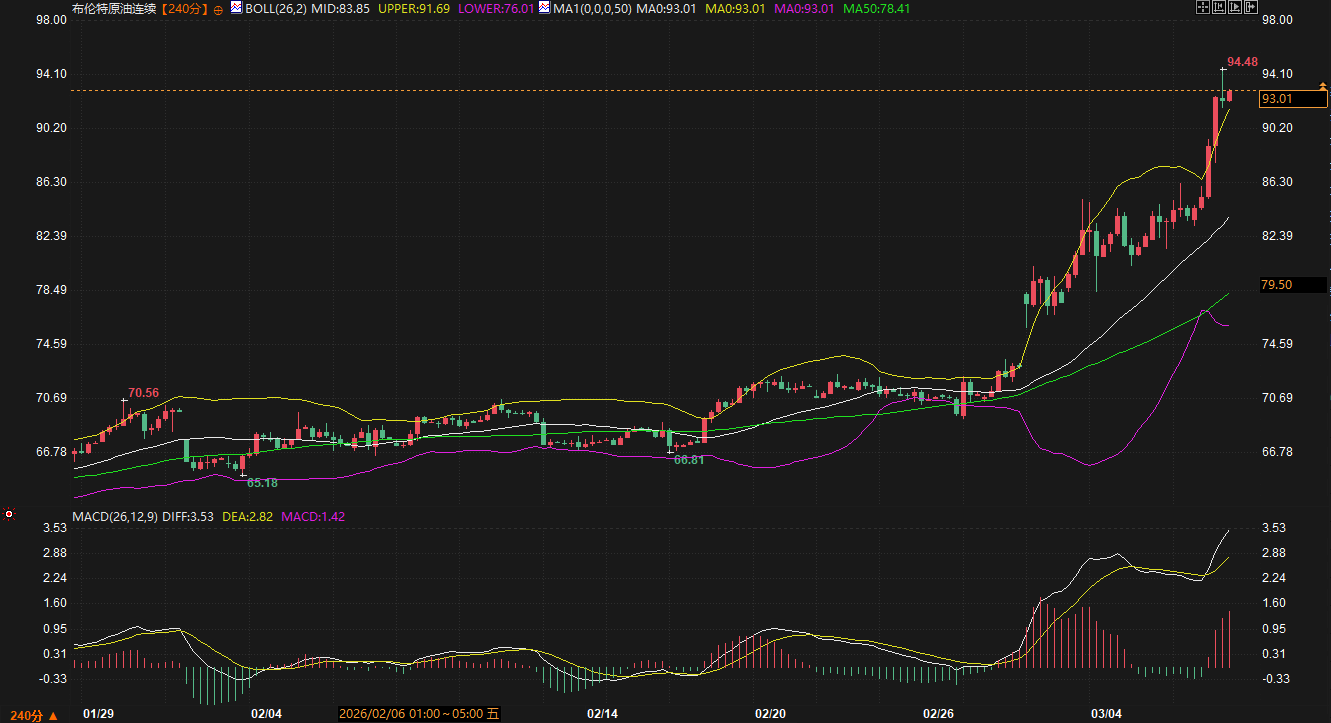
Brent crude oil : The 240-minute chart shows that the price has broken through the upper Bollinger Band ($91.69). The MACD lines have turned upwards for the second time above the zero axis, but the expansion of the red bars is weakening, suggesting that the risk of top divergence is accumulating. The first support level is at $90, and the resistance levels are at the $94.48 and $98 levels.
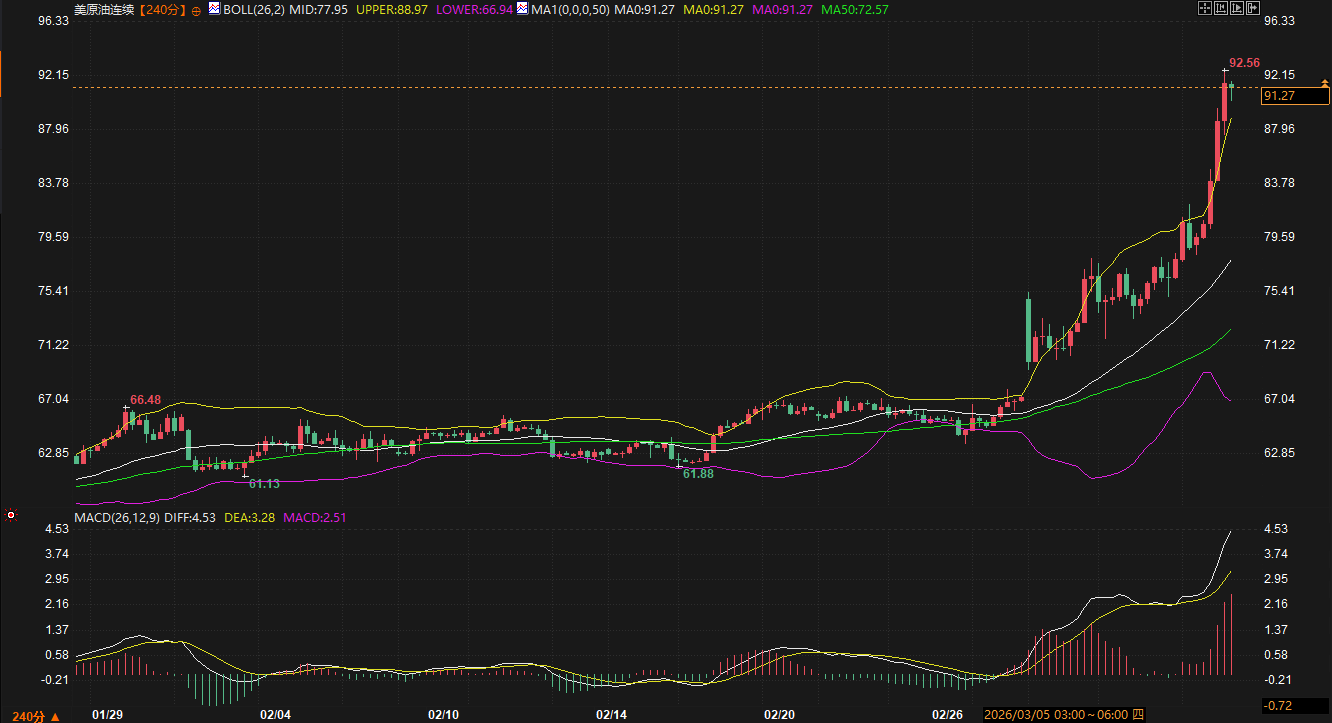
WTI crude oil : The trend is stronger than Brent crude oil. The MACD red bars on the 240-minute chart continue to lengthen, and there is no clear signal of weakening bullish momentum. However, the candlestick pattern of "large bullish candlestick + long upper shadow" indicates strong resistance in the $92-$93 range, and there is a short-term need for a pullback. The support below is at $88.
This week, the crude oil market experienced historic volatility. The "chokehold" effect of the Strait of Hormuz not only led to a technical surge in oil prices but has also substantially impacted the real economy, forcing oil-producing countries to cut production, causing tanker freight rates to skyrocket, and driving up gasoline prices at the retail level. Looking ahead, whether market panic can ease depends entirely on the course of the Middle East conflict. Although there is a strong technical need for a correction, given the substantial supply disruptions, any pullback could become an opportunity for bulls to reposition. The Trump administration's non-interventionist stance has also provided political fertile ground for the short-term strength of oil prices. Traders need to closely monitor the liquid levels in storage tanks in the Persian Gulf and the dynamics of the Strait of Hormuz, as these two factors will determine the market's direction next week.
Q: What was the immediate trigger for this week's surge in oil prices? Why did they rise so sharply?
A: The immediate trigger was the military action taken by the United States and Israel against Iran on February 28, and Iran's subsequent closure of the Strait of Hormuz in response. The Strait of Hormuz is the world's most important oil shipping route, with approximately 20 million barrels of crude oil passing through it daily, accounting for 20% of global oil trade. The de facto closure of the strait meant that about one-fifth of the world's daily seaborne oil supply was cut off, and this panic led to an uncontrollable surge in oil prices.
Q: Didn't OPEC+ announce an increase in production? Why didn't it curb oil prices?
A: OPEC+ did announce on March 1st that it would increase production by 206,000 barrels per day starting in April, but this failed to curb oil prices. There are two main reasons: First, the scale is too small. 206,000 barrels is a drop in the ocean compared to global demand of over 100 million barrels and the approximately 15-20 million barrels per day supply disruption caused by the Strait of Hormuz. Second, it's a long-term solution that doesn't address the immediate crisis. The production increase won't be implemented until April, and it only addresses production volume, while the core of the current crisis is the disruption of transportation routes. According to Ruizhi Energy Analysis, even with increased production, the inability to transport oil out of the country will not alleviate market anxiety.
Q: Why are Kuwait and Iraq cutting production? Shouldn't they be producing more given the soaring oil prices?
A: This is a classic case of "storage tank shortage." Due to the strait of Hormuz being blocked, oil tankers cannot dock to load cargo, leaving the produced crude oil with nowhere to go but to be stored in onshore tanks. Once these tanks are full, oil fields must be forced to reduce production or even shut down, otherwise they will face a situation where there is no oil to store. Data shows that oil storage facilities in Gulf countries are rapidly filling up, and Kuwait's production cuts are a reluctant measure, not a deliberate choice.
Q: What would it mean for the global economy if oil prices rose to $100 or even $120?
A: Wall Street institutions generally believe that an oil price of $100 per barrel would mark a true "oil price shock," potentially leading to a rebound in inflation, hindering the Federal Reserve's interest rate cuts, and increasing the risk of stagflation. If oil prices rise to $120 per barrel, both US hedge fund CEOs and Nobel laureate Paul Krugman have warned that this could trigger a US recession, bringing economic growth to zero and potentially raising the overall inflation rate by about one percentage point.
Q: As an ordinary consumer, what impact will this oil price increase have?
A: The impact is already evident. The most direct effect is increased refueling costs; U.S. gasoline prices have jumped from below $3 to $3.32 within a week. Furthermore, since chemical intermediates such as naphtha and jet fuel also rely on this strait for transportation, this could lead to higher airfares and increased costs for chemical products (such as plastics), ultimately passed on to the prices of various consumer goods. Net oil importers in Asia also face pressure from currency depreciation and escalating imported inflation.
The following is a panoramic view and in-depth analysis of the international crude oil market up to the week ending March 6.
Market Review: From "Slow Fermentation" to "Explosive Breakthrough"
The week's crude oil market movement can be divided into two phases. At the beginning of the week, the market was still in a period of shock reaction to unexpected events. On Monday, March 2nd, Brent crude futures surged as much as 13%, reaching $82 per barrel, and WTI also rose sharply. At that time, although shipping in the Strait of Hormuz was suspended, some traders were still assessing whether the OPEC+ emergency production increase meeting could quell the situation, and oil prices retreated somewhat after the surge.
However, as the situation continued to escalate, market optimism was shattered by reality. Iran firmly stated that it would "not allow a single drop of oil to flow out of the region," and ship tracking data showed a complete freeze on navigation in the Strait of Hormuz. Meanwhile, the conflict began to spread to major energy-producing regions. By Friday's (March 6) close, the situation had reached its peak. The main contract for US WTI crude oil futures closed at $90.90 per barrel, a single-day surge of 12.21%; Brent crude oil futures closed at $92.69 per barrel, an increase of 8.52%, both breaking through the $90 mark during the session, with the former even reaching its highest level since September 2023.
Supply crisis deepens: from "disruptions" to "stockpiling".
As the Strait of Hormuz enters its seventh day of de facto closure, the crisis begins to trigger deeper chain reactions—Gulf oil-producing countries face a severe risk of "tank blockage."
Storage facilities along the Persian Gulf coast are rapidly filling up as 140 million barrels of crude oil per day, representing about 20% of global oil demand, cannot be shipped out. Following Iraq's earlier cut of production by 700,000 barrels per day at its largest oil field, Rumaila, Kuwait has also begun reducing output as its storage capacity nears depletion. Major storage facilities in Saudi Arabia and the UAE are also filling at an extremely rapid pace, and data provider Kpler estimates that, without improvement, both countries will reach their storage limits within three weeks.
UBS commodities strategist Giovanni Staunovo points out that the Middle East has limited storage capacity, and the only way to avoid tank overflows is to cut production. He warns that even if geopolitical conflicts are resolved within days, the operational aftereffects of oil field shutdowns (such as reservoir pressure recovery and high restart costs) will ensure suppressed supply and a prolonged period of high prices.
Major Events and Data Review
1. Strait of Hormuz Blockade and Production Disruption <br />The absolute dominant factor in the market this week. The strait has been effectively paralyzed for seven days since Iran announced a ban on shipping passage on February 28. It is estimated that this has prevented approximately 1.4 days' worth of global crude oil demand (about 140 million barrels) from entering the market. Iraq and Kuwait have been forced to cut production as a result.
2. Symbolic production increase by OPEC+
On March 1, eight OPEC+ oil-producing countries held a video conference and decided to increase production by 206,000 barrels per day starting in April. Although this figure far exceeded the market expectation of 137,000 barrels per day, Jorge Leon, senior vice president of Rezid Energy, pointed out that considering the global demand of over 100 million barrels per day and the disrupted supply, this move is more symbolic than substantive, aiming to demonstrate its "preparedness to use spare capacity" rather than actually injecting a large amount of liquidity into the market.
3. Trump's Response to Oil Prices <br />Faced with soaring oil prices, US President Trump expressed a completely different attitude from the market on Thursday. He stated that he was not worried about the conflict-related rise in US gasoline prices, saying, "Let it go up." This statement was interpreted by the market as tacitly approving the current rise in oil prices, further stimulating bullish sentiment in the short term.
4. Qatar's Extreme Scenario Warning <br/> Qatar's energy minister issued a stern warning, predicting that all Gulf energy producers will halt exports within weeks, which could push oil prices up to $150 per barrel.
5. Inventory and Freight Data <br/>U.S. gasoline prices jumped this week, rising to $3.32 from less than $3 a week ago, according to AAA data. Meanwhile, daily freight rates for Very Large Crude Carriers (VLCCs) from the Middle East to China have climbed to $424,000, more than double last week, reflecting tight shipping capacity and extreme risk aversion in the market.
Collection of Institutional Views
Amid this week's extreme market conditions, major institutions have provided their respective market assessments:
UBS analyst Giovanni Staunovo points out that refiners and traders are searching for alternative crude oils globally, with the US, as the largest producer, naturally being the first choice. He predicts that to prevent US inventories from depleting too quickly due to excessive exports, the WTI-Brent price spread is returning to transportation cost levels.
Again Capital : Partner John Kilduff is extremely bullish on the market outlook, believing that all predictions of oil prices breaking through $100 a barrel will come true. He emphasizes, "The worst is yet to come."
Macquarie Group : Global energy strategist Vikas DeVidi warns that time is running out for a peace agreement. Without a swift ceasefire, the oil market could begin to collapse within days. According to his analysis, a closure of the Strait of Hormuz for several weeks could push oil prices to $150 a barrel or even higher.
Goldman Sachs : Relatively restrained. Head of oil research, Daan Struve, stated that while the risks to oil price forecasts are clearly skewed to the upside, the key variable is the duration of the lockdowns. The bank currently maintains its second-quarter target price of $76 but acknowledges the possibility of a significant upward revision.
Guojin Securities : The institution points out that the current market has already priced in a geopolitical risk premium of $8-10/barrel, and the positioning structure shows strong bullish sentiment. The price equals the fundamental price plus the geopolitical premium, exhibiting a divergence between downward supply and demand and upward premium. High volatility is expected to continue.
Technical Overview
From a technical chart perspective, as of Friday's (March 6) close, both major benchmark crude oils were in an extremely overbought state.
Brent crude oil : The 240-minute chart shows that the price has broken through the upper Bollinger Band ($91.69). The MACD lines have turned upwards for the second time above the zero axis, but the expansion of the red bars is weakening, suggesting that the risk of top divergence is accumulating. The first support level is at $90, and the resistance levels are at the $94.48 and $98 levels.
WTI crude oil : The trend is stronger than Brent crude oil. The MACD red bars on the 240-minute chart continue to lengthen, and there is no clear signal of weakening bullish momentum. However, the candlestick pattern of "large bullish candlestick + long upper shadow" indicates strong resistance in the $92-$93 range, and there is a short-term need for a pullback. The support below is at $88.
This week, the crude oil market experienced historic volatility. The "chokehold" effect of the Strait of Hormuz not only led to a technical surge in oil prices but has also substantially impacted the real economy, forcing oil-producing countries to cut production, causing tanker freight rates to skyrocket, and driving up gasoline prices at the retail level. Looking ahead, whether market panic can ease depends entirely on the course of the Middle East conflict. Although there is a strong technical need for a correction, given the substantial supply disruptions, any pullback could become an opportunity for bulls to reposition. The Trump administration's non-interventionist stance has also provided political fertile ground for the short-term strength of oil prices. Traders need to closely monitor the liquid levels in storage tanks in the Persian Gulf and the dynamics of the Strait of Hormuz, as these two factors will determine the market's direction next week.
Frequently Asked Questions
Q: What was the immediate trigger for this week's surge in oil prices? Why did they rise so sharply?
A: The immediate trigger was the military action taken by the United States and Israel against Iran on February 28, and Iran's subsequent closure of the Strait of Hormuz in response. The Strait of Hormuz is the world's most important oil shipping route, with approximately 20 million barrels of crude oil passing through it daily, accounting for 20% of global oil trade. The de facto closure of the strait meant that about one-fifth of the world's daily seaborne oil supply was cut off, and this panic led to an uncontrollable surge in oil prices.
Q: Didn't OPEC+ announce an increase in production? Why didn't it curb oil prices?
A: OPEC+ did announce on March 1st that it would increase production by 206,000 barrels per day starting in April, but this failed to curb oil prices. There are two main reasons: First, the scale is too small. 206,000 barrels is a drop in the ocean compared to global demand of over 100 million barrels and the approximately 15-20 million barrels per day supply disruption caused by the Strait of Hormuz. Second, it's a long-term solution that doesn't address the immediate crisis. The production increase won't be implemented until April, and it only addresses production volume, while the core of the current crisis is the disruption of transportation routes. According to Ruizhi Energy Analysis, even with increased production, the inability to transport oil out of the country will not alleviate market anxiety.
Q: Why are Kuwait and Iraq cutting production? Shouldn't they be producing more given the soaring oil prices?
A: This is a classic case of "storage tank shortage." Due to the strait of Hormuz being blocked, oil tankers cannot dock to load cargo, leaving the produced crude oil with nowhere to go but to be stored in onshore tanks. Once these tanks are full, oil fields must be forced to reduce production or even shut down, otherwise they will face a situation where there is no oil to store. Data shows that oil storage facilities in Gulf countries are rapidly filling up, and Kuwait's production cuts are a reluctant measure, not a deliberate choice.
Q: What would it mean for the global economy if oil prices rose to $100 or even $120?
A: Wall Street institutions generally believe that an oil price of $100 per barrel would mark a true "oil price shock," potentially leading to a rebound in inflation, hindering the Federal Reserve's interest rate cuts, and increasing the risk of stagflation. If oil prices rise to $120 per barrel, both US hedge fund CEOs and Nobel laureate Paul Krugman have warned that this could trigger a US recession, bringing economic growth to zero and potentially raising the overall inflation rate by about one percentage point.
Q: As an ordinary consumer, what impact will this oil price increase have?
A: The impact is already evident. The most direct effect is increased refueling costs; U.S. gasoline prices have jumped from below $3 to $3.32 within a week. Furthermore, since chemical intermediates such as naphtha and jet fuel also rely on this strait for transportation, this could lead to higher airfares and increased costs for chemical products (such as plastics), ultimately passed on to the prices of various consumer goods. Net oil importers in Asia also face pressure from currency depreciation and escalating imported inflation.
- Risk Warning and Disclaimer
- The market involves risk, and trading may not be suitable for all investors. This article is for reference only and does not constitute personal investment advice, nor does it take into account certain users’ specific investment objectives, financial situation, or other needs. Any investment decisions made based on this information are at your own risk.