War boosts the dollar, non-farm payrolls pull it back: this week's ups and downs depend entirely on "face changes," who should traders keep an eye on next week?
2026-03-07 17:31:49
This week, the foreign exchange market experienced dramatic fluctuations amidst the dual pressures of war and employment, with safe-haven demand and policy expectations intertwined, dominating the movements of major currencies. Geopolitically, the US-Israeli war against Iran entered its second week, with US President Trump demanding Iran's "unconditional surrender" and unusually expressing his desire to participate in the selection of Iran's next leader. This series of tough statements escalated the situation in the Middle East, directly driving buying of safe-haven currencies such as the Swiss franc. On the economic data front, the US unexpectedly lost 92,000 non-farm payroll jobs in February, far below market expectations of a 59,000 increase. This key data point completely reversed market expectations for Federal Reserve interest rates, rapidly shifting bets on rate cuts forward. This led to a significant pullback in the US dollar index on Friday after its largest weekly gain in nearly four months. Overall, war fears fueled safe-haven demand, while weak employment data revised monetary policy expectations, both contributing to the complex pattern of a rise and fall in the foreign exchange market this week.

The following is a detailed review and summary of the US dollar, Japanese yen, British pound, euro, Canadian dollar, and Swiss franc markets this week.
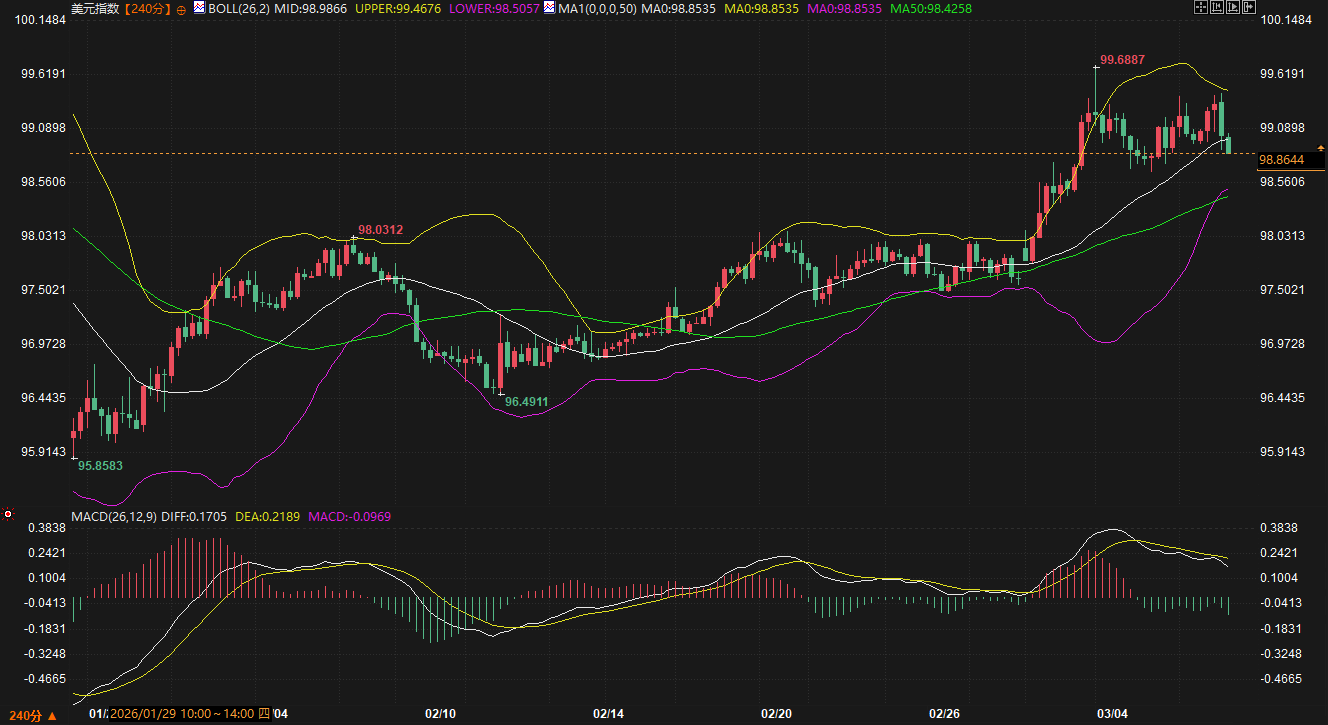
The US dollar index rose 1.26% this week, marking its largest weekly gain since mid-November 2024. However, the weekly chart shows a long upper shadow, indicating a strong pullback after the initial surge. Technically, after a sustained rise from 95.8583 to a high of 99.6887, the dollar index experienced a series of large bearish candles this week, clearly signaling a short-term top. The Bollinger Bands have broken below the middle band, and the MACD has formed a death cross above the zero line with increasing bearish momentum. Support is expected around the 50-day moving average (MA50) at 98.4258, indicating significant short-term downward pressure.
From a driving factor perspective, the US dollar's performance this week experienced a dramatic shift. In the first half of the week, supported by safe-haven demand triggered by escalating Middle East conflicts and persistently high oil prices, the dollar maintained its previous strength. However, Friday's release of the US February non-farm payrolls report became a turning point. Data from the US Bureau of Labor Statistics showed that non-farm payrolls unexpectedly decreased by 92,000 in February, while economists had previously expected an increase of 59,000, and the January figure was also revised down to an increase of 126,000. The unexpected contraction in employment data, especially reflecting the impact of the healthcare strike, significantly changed market expectations for the Federal Reserve's policy. After the data release, the US interest rate futures market predicted a 76% probability of the Fed restarting rate cuts in September, compared to an October expectation before the data release. Market expectations for the total amount of rate cuts this year also increased from approximately 39 basis points to approximately 44 basis points. It was this rapid rise in rate cut expectations that pressured the dollar's performance on Friday.
Institutional and analyst opinions
Erik Bregar, Director of FX and Precious Metals Risk Management at Silver Gold Bull, pointed out that there haven't been many fundamental changes, as oil prices remain high and there hasn't been much positive news regarding the situation in Iran. He believes that Friday's rise in other currencies against the US dollar was likely driven by technical factors. He noted that US stocks, the euro, and the Canadian dollar all attempted to refresh their weekly lows but failed, providing an opportunity for short covering and a rebound in non-US currencies. If the bears want to maintain control, they must break through the current lows.
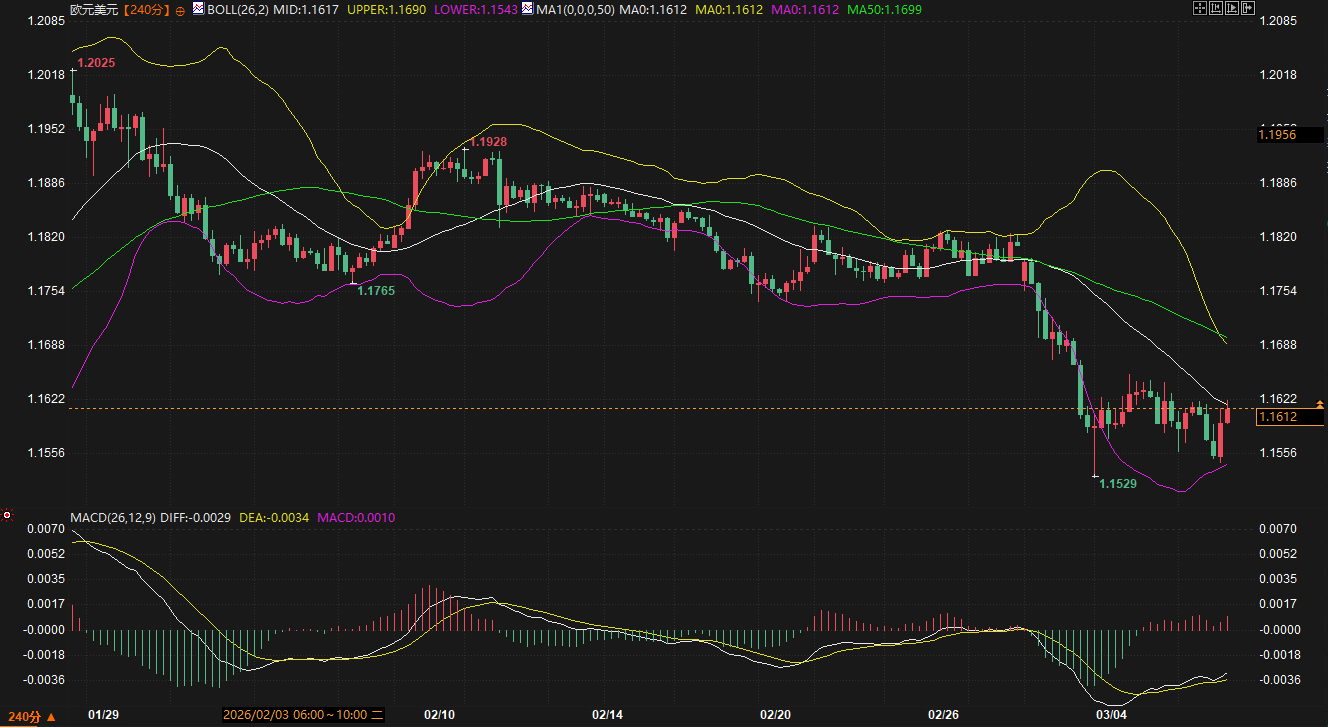
The euro suffered a sharp decline against the US dollar this week, falling 1.68% for the week, marking its largest weekly drop since April 2024. It closed near 1.1612. Technically, the euro experienced a one-sided downward trend from its high of 1.2025 to a low of 1.1529, and has recently been consolidating at these low levels. Although the MACD indicator has formed a golden cross below the zero line, and the red momentum bars are slightly increasing, suggesting a short-term need for a rebound, all moving averages remain in a bearish alignment, with significant resistance levels above. First, there's the Bollinger Band middle line (1.1617), followed by the 50-day moving average (MA50) (1.1699). The medium-term downtrend has not yet reversed.
The euro's weakness this week was due to two main factors: firstly, the strong dollar pressured the euro in the first half of the week, and secondly, the relatively fragile economic fundamentals of Europe itself, as well as the spillover effects of geopolitical risks. The ongoing conflict in the Middle East has pushed up energy prices, creating imported inflationary pressures and economic uncertainty for the Eurozone, which is heavily reliant on energy imports, thus diminishing the euro's appeal. On Friday, as the dollar weakened due to employment data, the euro temporarily recovered some of its intraday losses against the dollar, but its weekly decline remained significant, reflecting market concerns about the Eurozone's economic growth and inflation prospects.
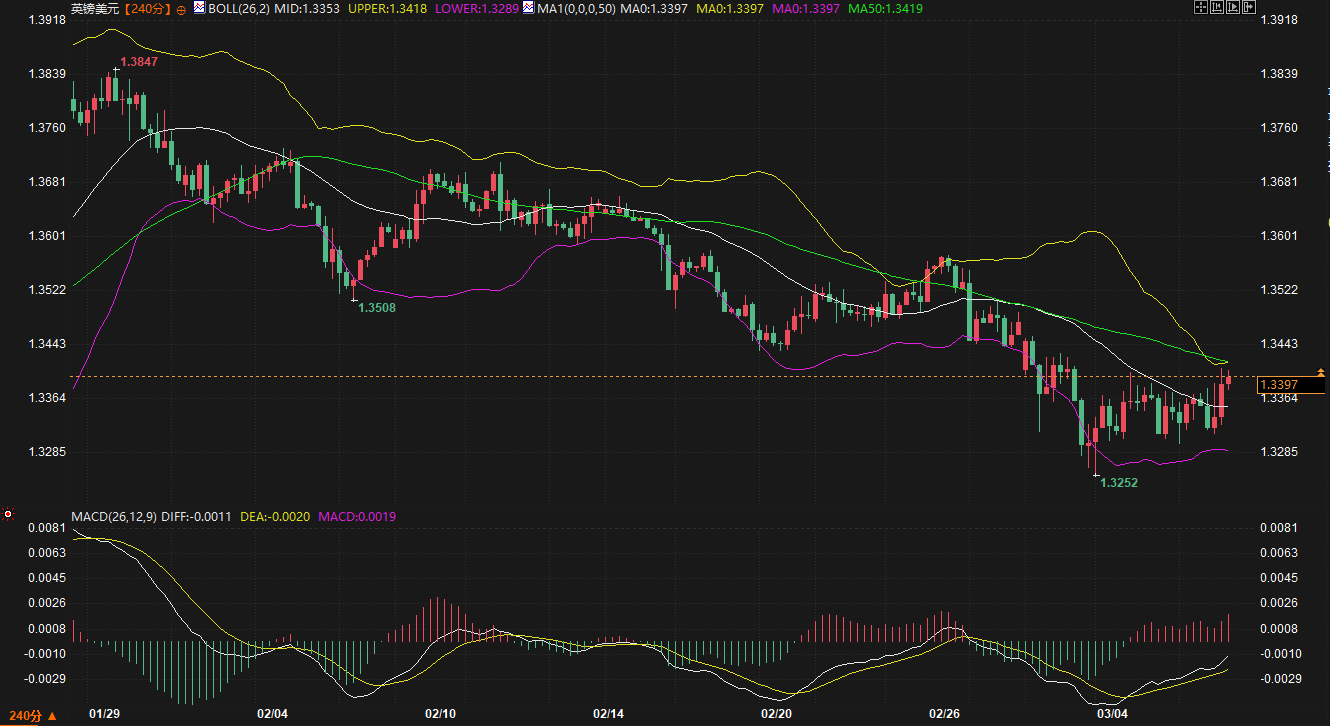
The British pound fell 0.59% against the US dollar this week, closing at 1.3397. The overall trend this week was a low-level consolidation after a downtrend, having previously fallen from 1.3847 to a low of 1.3252. Technical indicators show that the MACD has formed a golden cross below the zero line, with the red momentum bars slightly increasing, indicating a potential for a short-term oversold rebound. However, significant resistance is also present, with the 50-day moving average (1.3419) and the Bollinger Band middle line (1.3353) forming a strong resistance zone, limiting the upside potential.
The pound's movements are closely linked to the strength of the US dollar and the UK's own economic outlook. In the first half of this week, the pound remained under pressure due to both a strong dollar and tensions in the Middle East. Although it rebounded slightly on Friday as the dollar index fell, market concerns about the risk of stagflation in the UK economy persisted. Rising energy costs due to geopolitical tensions have added further uncertainty to already strained consumer spending and business activity in the UK, making investors cautious about any potential pound rebound.
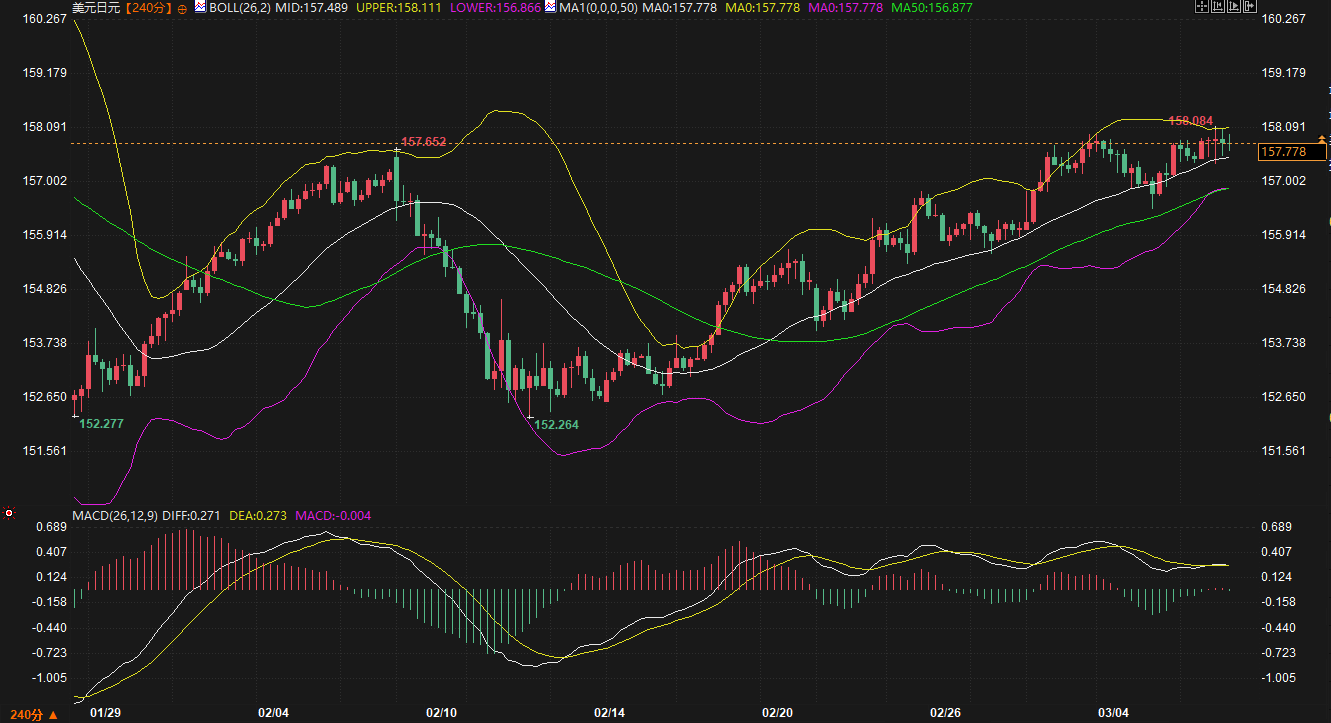
The USD/JPY pair was the only major currency pair to maintain a clear bullish trend this week, rising 1.08% to close at 157.778. Technically, the pair has been rising steadily from a low of 152.264, reaching a high of 158.084. All moving averages are in a bullish alignment, the Bollinger Bands continue to widen upwards, and the MACD indicator is flattening at high levels, indicating strong upward momentum. Market focus is on whether it can break through the previous high of 158.084 to open up further upside potential, while support is seen at the middle Bollinger Band at 157.4.
Interestingly, while the Middle East conflict escalated this week, strengthening the traditional safe-haven currency, the Swiss franc, the yen failed to show significant safe-haven buying, instead weakening against the dollar. This reflects the continued dominance of the large interest rate differential between the US and Japan. Although weak US employment data boosted expectations of interest rate cuts, the Bank of Japan maintained its extremely loose monetary policy stance, making carry trades (borrowing low-interest yen to buy high-interest dollars) still profitable. Until extreme panic emerges in the market enough to trigger large-scale risk liquidation, the interest rate differential's influence on the USD/JPY exchange rate surpasses the traditional safe-haven logic. The overall strength of the dollar this week further propelled the USD/JPY exchange rate higher.
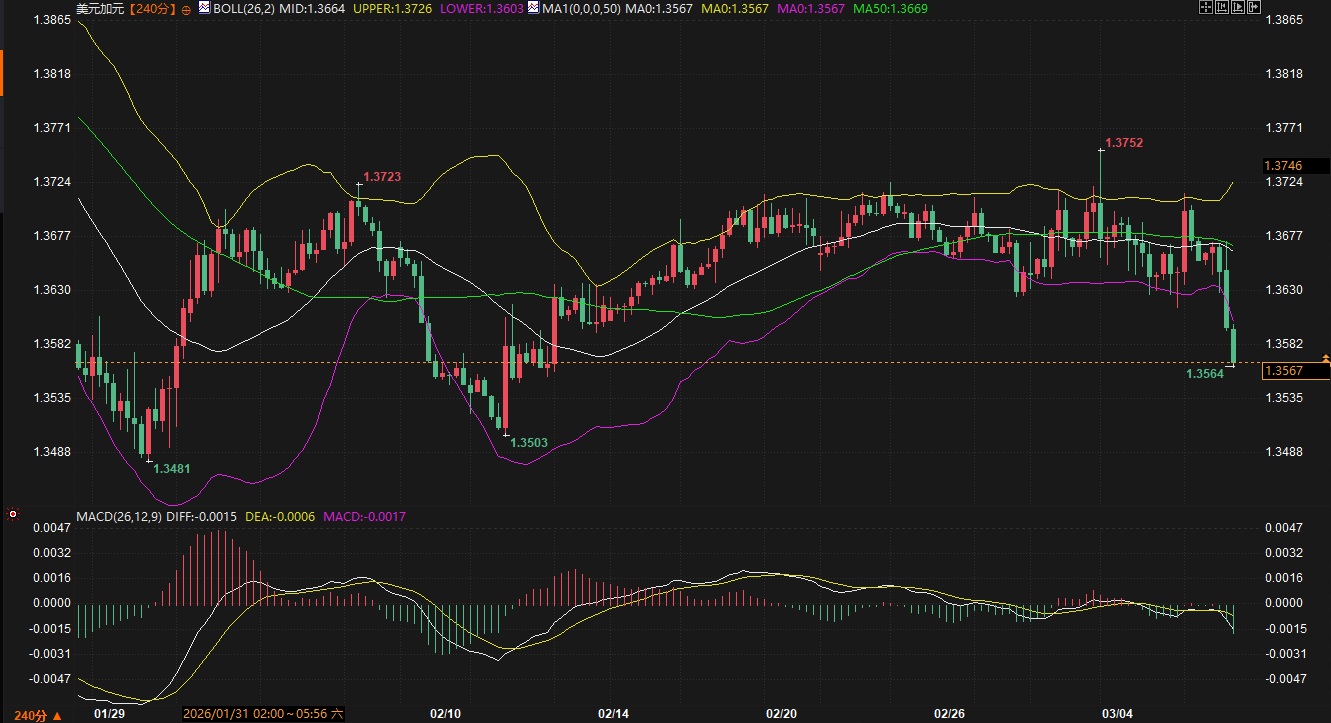
The USD/CAD pair fell 0.59% this week, closing at 1.3567. Technically, the pair has been extremely weak recently, breaking below the 1.36-1.37 consolidation range and piercing the lower Bollinger Band with three large bearish candles, indicating exceptionally strong bearish momentum. All moving averages have turned downwards, the MACD has formed a death cross below the zero line, and the green histogram continues to expand. The key support level is seen at the previous low of 1.3503. A bearish bias is recommended in the short term.
The Canadian dollar is often referred to as a commodity currency, exhibiting a strong positive correlation with oil prices. However, this week, despite the Middle East conflict pushing international oil prices to relatively high levels, the Canadian dollar failed to benefit and instead weakened. This suggests that market concerns about the Canadian economy may have outweighed the positive impact of rising oil prices. On one hand, as a major trading partner of the United States, US economic data (especially weak employment figures) has raised concerns about the overall demand outlook for North America. On the other hand, the trade war and tariff barriers initiated by the Trump administration have also cast a shadow over the Canadian economy, which heavily relies on foreign trade. Market concerns that trade tensions could impact Canadian exports and economic activity, thus putting pressure on the Canadian dollar.
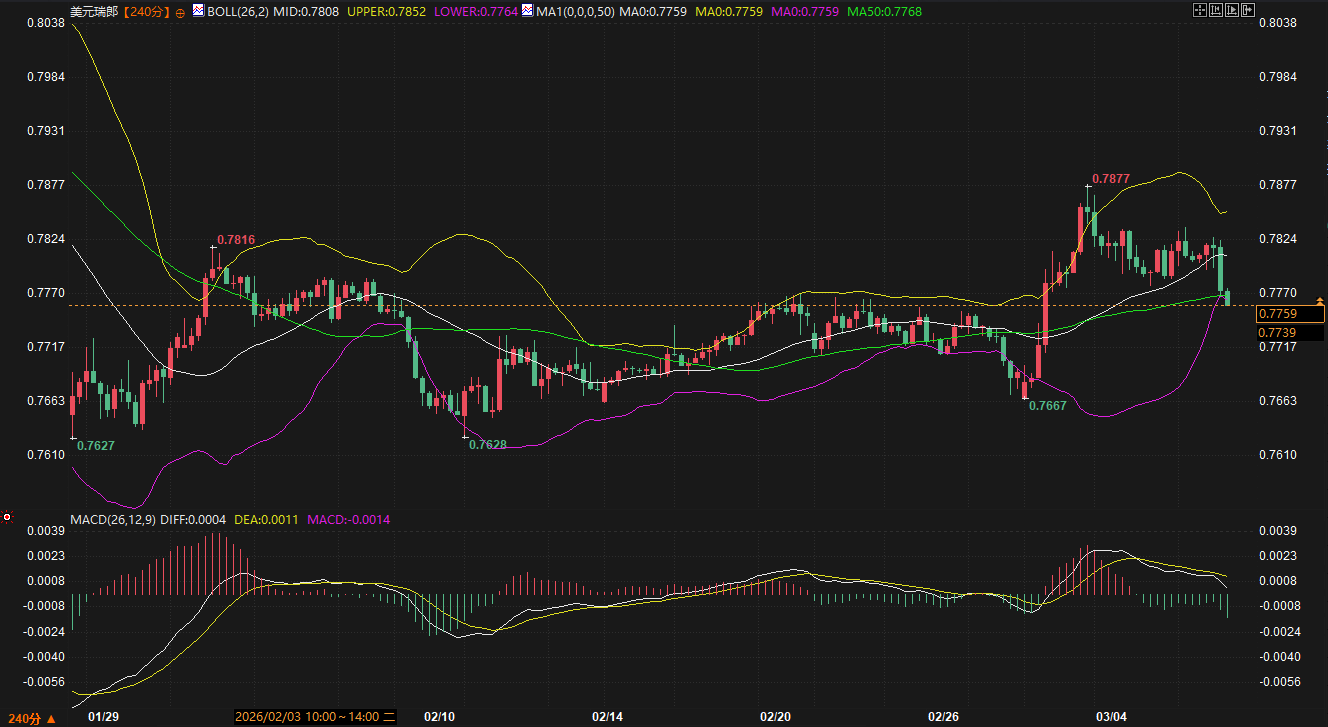
The USD/CHF pair rose 0.86% this week, closing at 0.7759, but the weekly chart also showed a long upper shadow. Its price action was characterized by a rapid surge from 0.7667 to 0.7877 in the first half of the week, followed by two consecutive days of sharp declines, almost erasing all gains, indicating a short-term top formation. Technically, the price has just broken below the MA50 (0.7768) support, and the MACD has formed a death cross above the zero line, with the green momentum bars starting to expand. If the 0.776 level is broken decisively, the next support level will be the psychological level of 0.77.
The Swiss franc's performance this week perfectly exemplifies its classic safe-haven characteristics. The core risk event for the market this week was undoubtedly the US-Israeli war against Iran. As the conflict continues, especially after US President Trump's demand on Friday for Iran's "unconditional surrender" and his remarks about participating in the selection of Iran's next leader, the intensity and uncertainty of the Middle East conflict have escalated dramatically. When international political tensions escalate sharply, funds typically flow into the Swiss franc for safety, which fueled the franc's across-the-board rise on Friday and caused the USD/CHF pair to give back most of its earlier gains this week. The Swiss franc's strength is a direct reaction to geopolitical risk premiums.
Looking back at this week, the foreign exchange market moved forward amidst the interplay of two core drivers. In the first half of the week, escalating tensions in the Middle East fueled risk aversion and concerns about oil price impacts, dominating the market tone, supporting the US dollar and pressuring European currencies. However, Friday's far weaker-than-expected US non-farm payroll data dramatically reversed the tide, quickly shifting market focus back to the Federal Reserve's monetary policy outlook. The sharp rise in interest rate cut expectations caused the US dollar index to plunge from its highs, providing a respite for previously oversold non-US currencies (especially the euro and pound). The Japanese yen, however, defied the risk aversion logic due to interest rate differentials, exhibiting an independent bullish trend; the Swiss franc successfully played the role of a safe haven; and the Canadian dollar, amid trade concerns and economic outlook worries, failed to halt its decline even with high oil prices. Looking ahead, geopolitical developments (especially the evolution of the Iranian situation) and US economic data (and their guidance on Federal Reserve policy expectations) will continue to be the two key forces driving the foreign exchange market, with market volatility expected to remain high.
Question 1: Why did the US dollar rise on the weekly chart despite such poor US non-farm payroll data?
A: This is a question about the timeliness of data and market expectations. You need to distinguish between "weekly gains" and "intraday losses." The US dollar index rose 1.26% overall this week, mainly accumulating from Monday to Thursday, when the market's focus was on safe-haven demand triggered by the Middle East wars, and expectations for employment data were relatively optimistic. However, the poor non-farm payroll data was released on Friday, directly causing a sharp drop in the US dollar index that day, erasing some of the week's gains. Therefore, what we are seeing is a pattern of "still closing higher on the week, but suffering a sharp decline on Friday," a rise followed by a fall. Weekly gains reflect the overall situation for the entire week, while Friday's decline is an immediate reaction to the negative data.
Question 2: With the escalation of the Middle East conflict, why did the traditional safe-haven currency, the Japanese yen, not rise, but the Swiss franc did?
A: Your observation is very insightful. The underlying reason is the different driving logics behind different safe-haven currencies. The Swiss franc's safe-haven status is more purely symbolic; whenever geopolitical risks erupt in Europe or the Middle East, Switzerland, as a traditionally neutral country, often attracts direct inflows of safe-haven funds. The Japanese yen's safe-haven logic, on the other hand, is sometimes more related to a reversal in risk appetite in global financial markets (such as carry trade unwinding triggered by a sharp drop in US stocks). This week, despite the tense situation in the Middle East, global stock markets did not experience a collapse-style panic, and market sentiment has not yet reached the point of triggering large-scale unwinding. More importantly, the huge interest rate differential between the US and Japan (high US interest rates, low Japanese interest rates) remains the strongest force dominating the USD/JPY exchange rate, attracting carry trade funds and outweighing the current level of safe-haven demand.
Question 3: Oil prices rose because of the war, so why did the Canadian dollar, the currency of oil-producing countries, fall?
A: This reflects the complexity of market trading logic. Generally, rising oil prices are beneficial to the Canadian dollar, but this positive correlation doesn't always hold. When rising oil prices are due to supply concerns stemming from geopolitical risks, it also implies a potential shock to the global economy, thus dampening demand prospects. For an economy like Canada, heavily reliant on trade (especially with the US), the market may be more concerned about the downside risks to the economy from war and trade wars, outweighing the improved terms of trade brought about by high oil prices. Furthermore, weak US economic data directly triggered concerns about slowing demand from Canada's largest trading partner, becoming the dominant factor suppressing the Canadian dollar. Therefore, the weakening of the Canadian dollar this week reflects that "recession concerns" outweighed "commodity price benefits."
Question 4: The euro suffered its biggest weekly drop in nearly two years. Besides the strong dollar, what problems does the eurozone itself have?
A: The sharp drop in the euro was indeed the result of a combination of internal and external factors. The external factor was naturally the strength of the US dollar in the first half of the week. Internally, there were two main points: First, the Eurozone economy itself was weak, with manufacturing in a prolonged period of contraction. Market expectations persisted that the European Central Bank might have to follow the Federal Reserve in cutting interest rates to boost the economy. Second, the escalation of the conflict in the Middle East pushed up energy prices. For the Eurozone, which is heavily reliant on energy imports, this was a typical "stagflation" shock, both hindering economic growth (stagnation) and driving up inflation (inflation), putting the European Central Bank in a policy dilemma and greatly weakening the euro's attractiveness. Therefore, when the US dollar strengthened due to safe-haven demand, the euro became one of the weakest counterparties.
Question 5: The Fed's rate cut expectations have been brought forward significantly. What does this mean for the future trend of the US dollar?
A: The earlier-than-expected interest rate cuts constitute a clear medium-term negative for the US dollar. Interest rates represent the rate of return on holding currency. When the market anticipates earlier and larger rate cuts from the Federal Reserve, it means the future "yield" of the US dollar will decline. This weakens the attractiveness of dollar assets, prompting capital to flow to other currencies with higher yields or appreciation potential. However, short-term trends also need to consider other factors. If inflation data remains stubbornly high, or geopolitical risks continue to escalate, market expectations for rate cuts may be revised again. Therefore, the non-farm payroll data has initiated a repricing of the Fed's policy path, which will be one of the core drivers influencing the dollar's trajectory in the coming weeks and even months. However, the process will not be smooth sailing and will fluctuate with subsequent economic data and events.
The following is a detailed review and summary of the US dollar, Japanese yen, British pound, euro, Canadian dollar, and Swiss franc markets this week.
US Dollar: Unexpectedly weak jobs data ends dollar's weekly winning streak.
The US dollar index rose 1.26% this week, marking its largest weekly gain since mid-November 2024. However, the weekly chart shows a long upper shadow, indicating a strong pullback after the initial surge. Technically, after a sustained rise from 95.8583 to a high of 99.6887, the dollar index experienced a series of large bearish candles this week, clearly signaling a short-term top. The Bollinger Bands have broken below the middle band, and the MACD has formed a death cross above the zero line with increasing bearish momentum. Support is expected around the 50-day moving average (MA50) at 98.4258, indicating significant short-term downward pressure.
From a driving factor perspective, the US dollar's performance this week experienced a dramatic shift. In the first half of the week, supported by safe-haven demand triggered by escalating Middle East conflicts and persistently high oil prices, the dollar maintained its previous strength. However, Friday's release of the US February non-farm payrolls report became a turning point. Data from the US Bureau of Labor Statistics showed that non-farm payrolls unexpectedly decreased by 92,000 in February, while economists had previously expected an increase of 59,000, and the January figure was also revised down to an increase of 126,000. The unexpected contraction in employment data, especially reflecting the impact of the healthcare strike, significantly changed market expectations for the Federal Reserve's policy. After the data release, the US interest rate futures market predicted a 76% probability of the Fed restarting rate cuts in September, compared to an October expectation before the data release. Market expectations for the total amount of rate cuts this year also increased from approximately 39 basis points to approximately 44 basis points. It was this rapid rise in rate cut expectations that pressured the dollar's performance on Friday.
Institutional and analyst opinions
Erik Bregar, Director of FX and Precious Metals Risk Management at Silver Gold Bull, pointed out that there haven't been many fundamental changes, as oil prices remain high and there hasn't been much positive news regarding the situation in Iran. He believes that Friday's rise in other currencies against the US dollar was likely driven by technical factors. He noted that US stocks, the euro, and the Canadian dollar all attempted to refresh their weekly lows but failed, providing an opportunity for short covering and a rebound in non-US currencies. If the bears want to maintain control, they must break through the current lows.
Euro: Posts biggest weekly drop in nearly two years, seeking respite at lower levels.
The euro suffered a sharp decline against the US dollar this week, falling 1.68% for the week, marking its largest weekly drop since April 2024. It closed near 1.1612. Technically, the euro experienced a one-sided downward trend from its high of 1.2025 to a low of 1.1529, and has recently been consolidating at these low levels. Although the MACD indicator has formed a golden cross below the zero line, and the red momentum bars are slightly increasing, suggesting a short-term need for a rebound, all moving averages remain in a bearish alignment, with significant resistance levels above. First, there's the Bollinger Band middle line (1.1617), followed by the 50-day moving average (MA50) (1.1699). The medium-term downtrend has not yet reversed.
The euro's weakness this week was due to two main factors: firstly, the strong dollar pressured the euro in the first half of the week, and secondly, the relatively fragile economic fundamentals of Europe itself, as well as the spillover effects of geopolitical risks. The ongoing conflict in the Middle East has pushed up energy prices, creating imported inflationary pressures and economic uncertainty for the Eurozone, which is heavily reliant on energy imports, thus diminishing the euro's appeal. On Friday, as the dollar weakened due to employment data, the euro temporarily recovered some of its intraday losses against the dollar, but its weekly decline remained significant, reflecting market concerns about the Eurozone's economic growth and inflation prospects.
British Pound: Consolidating at low levels, with limited upside potential.
The British pound fell 0.59% against the US dollar this week, closing at 1.3397. The overall trend this week was a low-level consolidation after a downtrend, having previously fallen from 1.3847 to a low of 1.3252. Technical indicators show that the MACD has formed a golden cross below the zero line, with the red momentum bars slightly increasing, indicating a potential for a short-term oversold rebound. However, significant resistance is also present, with the 50-day moving average (1.3419) and the Bollinger Band middle line (1.3353) forming a strong resistance zone, limiting the upside potential.
The pound's movements are closely linked to the strength of the US dollar and the UK's own economic outlook. In the first half of this week, the pound remained under pressure due to both a strong dollar and tensions in the Middle East. Although it rebounded slightly on Friday as the dollar index fell, market concerns about the risk of stagflation in the UK economy persisted. Rising energy costs due to geopolitical tensions have added further uncertainty to already strained consumer spending and business activity in the UK, making investors cautious about any potential pound rebound.
Japanese Yen: The only clearly bullish currency, why is its safe-haven attribute missing?
The USD/JPY pair was the only major currency pair to maintain a clear bullish trend this week, rising 1.08% to close at 157.778. Technically, the pair has been rising steadily from a low of 152.264, reaching a high of 158.084. All moving averages are in a bullish alignment, the Bollinger Bands continue to widen upwards, and the MACD indicator is flattening at high levels, indicating strong upward momentum. Market focus is on whether it can break through the previous high of 158.084 to open up further upside potential, while support is seen at the middle Bollinger Band at 157.4.
Interestingly, while the Middle East conflict escalated this week, strengthening the traditional safe-haven currency, the Swiss franc, the yen failed to show significant safe-haven buying, instead weakening against the dollar. This reflects the continued dominance of the large interest rate differential between the US and Japan. Although weak US employment data boosted expectations of interest rate cuts, the Bank of Japan maintained its extremely loose monetary policy stance, making carry trades (borrowing low-interest yen to buy high-interest dollars) still profitable. Until extreme panic emerges in the market enough to trigger large-scale risk liquidation, the interest rate differential's influence on the USD/JPY exchange rate surpasses the traditional safe-haven logic. The overall strength of the dollar this week further propelled the USD/JPY exchange rate higher.
Canadian Dollar: High Oil Prices Fails to Resist Downward Trend, Economic Concerns are the Main Reason
The USD/CAD pair fell 0.59% this week, closing at 1.3567. Technically, the pair has been extremely weak recently, breaking below the 1.36-1.37 consolidation range and piercing the lower Bollinger Band with three large bearish candles, indicating exceptionally strong bearish momentum. All moving averages have turned downwards, the MACD has formed a death cross below the zero line, and the green histogram continues to expand. The key support level is seen at the previous low of 1.3503. A bearish bias is recommended in the short term.
The Canadian dollar is often referred to as a commodity currency, exhibiting a strong positive correlation with oil prices. However, this week, despite the Middle East conflict pushing international oil prices to relatively high levels, the Canadian dollar failed to benefit and instead weakened. This suggests that market concerns about the Canadian economy may have outweighed the positive impact of rising oil prices. On one hand, as a major trading partner of the United States, US economic data (especially weak employment figures) has raised concerns about the overall demand outlook for North America. On the other hand, the trade war and tariff barriers initiated by the Trump administration have also cast a shadow over the Canadian economy, which heavily relies on foreign trade. Market concerns that trade tensions could impact Canadian exports and economic activity, thus putting pressure on the Canadian dollar.
Swiss Franc: Classic Safe-Haven Buying Re-emerges Amid Geopolitical Conflicts
The USD/CHF pair rose 0.86% this week, closing at 0.7759, but the weekly chart also showed a long upper shadow. Its price action was characterized by a rapid surge from 0.7667 to 0.7877 in the first half of the week, followed by two consecutive days of sharp declines, almost erasing all gains, indicating a short-term top formation. Technically, the price has just broken below the MA50 (0.7768) support, and the MACD has formed a death cross above the zero line, with the green momentum bars starting to expand. If the 0.776 level is broken decisively, the next support level will be the psychological level of 0.77.
The Swiss franc's performance this week perfectly exemplifies its classic safe-haven characteristics. The core risk event for the market this week was undoubtedly the US-Israeli war against Iran. As the conflict continues, especially after US President Trump's demand on Friday for Iran's "unconditional surrender" and his remarks about participating in the selection of Iran's next leader, the intensity and uncertainty of the Middle East conflict have escalated dramatically. When international political tensions escalate sharply, funds typically flow into the Swiss franc for safety, which fueled the franc's across-the-board rise on Friday and caused the USD/CHF pair to give back most of its earlier gains this week. The Swiss franc's strength is a direct reaction to geopolitical risk premiums.
Market Summary and Outlook for This Week
Looking back at this week, the foreign exchange market moved forward amidst the interplay of two core drivers. In the first half of the week, escalating tensions in the Middle East fueled risk aversion and concerns about oil price impacts, dominating the market tone, supporting the US dollar and pressuring European currencies. However, Friday's far weaker-than-expected US non-farm payroll data dramatically reversed the tide, quickly shifting market focus back to the Federal Reserve's monetary policy outlook. The sharp rise in interest rate cut expectations caused the US dollar index to plunge from its highs, providing a respite for previously oversold non-US currencies (especially the euro and pound). The Japanese yen, however, defied the risk aversion logic due to interest rate differentials, exhibiting an independent bullish trend; the Swiss franc successfully played the role of a safe haven; and the Canadian dollar, amid trade concerns and economic outlook worries, failed to halt its decline even with high oil prices. Looking ahead, geopolitical developments (especially the evolution of the Iranian situation) and US economic data (and their guidance on Federal Reserve policy expectations) will continue to be the two key forces driving the foreign exchange market, with market volatility expected to remain high.
Frequently Asked Questions
Question 1: Why did the US dollar rise on the weekly chart despite such poor US non-farm payroll data?
A: This is a question about the timeliness of data and market expectations. You need to distinguish between "weekly gains" and "intraday losses." The US dollar index rose 1.26% overall this week, mainly accumulating from Monday to Thursday, when the market's focus was on safe-haven demand triggered by the Middle East wars, and expectations for employment data were relatively optimistic. However, the poor non-farm payroll data was released on Friday, directly causing a sharp drop in the US dollar index that day, erasing some of the week's gains. Therefore, what we are seeing is a pattern of "still closing higher on the week, but suffering a sharp decline on Friday," a rise followed by a fall. Weekly gains reflect the overall situation for the entire week, while Friday's decline is an immediate reaction to the negative data.
Question 2: With the escalation of the Middle East conflict, why did the traditional safe-haven currency, the Japanese yen, not rise, but the Swiss franc did?
A: Your observation is very insightful. The underlying reason is the different driving logics behind different safe-haven currencies. The Swiss franc's safe-haven status is more purely symbolic; whenever geopolitical risks erupt in Europe or the Middle East, Switzerland, as a traditionally neutral country, often attracts direct inflows of safe-haven funds. The Japanese yen's safe-haven logic, on the other hand, is sometimes more related to a reversal in risk appetite in global financial markets (such as carry trade unwinding triggered by a sharp drop in US stocks). This week, despite the tense situation in the Middle East, global stock markets did not experience a collapse-style panic, and market sentiment has not yet reached the point of triggering large-scale unwinding. More importantly, the huge interest rate differential between the US and Japan (high US interest rates, low Japanese interest rates) remains the strongest force dominating the USD/JPY exchange rate, attracting carry trade funds and outweighing the current level of safe-haven demand.
Question 3: Oil prices rose because of the war, so why did the Canadian dollar, the currency of oil-producing countries, fall?
A: This reflects the complexity of market trading logic. Generally, rising oil prices are beneficial to the Canadian dollar, but this positive correlation doesn't always hold. When rising oil prices are due to supply concerns stemming from geopolitical risks, it also implies a potential shock to the global economy, thus dampening demand prospects. For an economy like Canada, heavily reliant on trade (especially with the US), the market may be more concerned about the downside risks to the economy from war and trade wars, outweighing the improved terms of trade brought about by high oil prices. Furthermore, weak US economic data directly triggered concerns about slowing demand from Canada's largest trading partner, becoming the dominant factor suppressing the Canadian dollar. Therefore, the weakening of the Canadian dollar this week reflects that "recession concerns" outweighed "commodity price benefits."
Question 4: The euro suffered its biggest weekly drop in nearly two years. Besides the strong dollar, what problems does the eurozone itself have?
A: The sharp drop in the euro was indeed the result of a combination of internal and external factors. The external factor was naturally the strength of the US dollar in the first half of the week. Internally, there were two main points: First, the Eurozone economy itself was weak, with manufacturing in a prolonged period of contraction. Market expectations persisted that the European Central Bank might have to follow the Federal Reserve in cutting interest rates to boost the economy. Second, the escalation of the conflict in the Middle East pushed up energy prices. For the Eurozone, which is heavily reliant on energy imports, this was a typical "stagflation" shock, both hindering economic growth (stagnation) and driving up inflation (inflation), putting the European Central Bank in a policy dilemma and greatly weakening the euro's attractiveness. Therefore, when the US dollar strengthened due to safe-haven demand, the euro became one of the weakest counterparties.
Question 5: The Fed's rate cut expectations have been brought forward significantly. What does this mean for the future trend of the US dollar?
A: The earlier-than-expected interest rate cuts constitute a clear medium-term negative for the US dollar. Interest rates represent the rate of return on holding currency. When the market anticipates earlier and larger rate cuts from the Federal Reserve, it means the future "yield" of the US dollar will decline. This weakens the attractiveness of dollar assets, prompting capital to flow to other currencies with higher yields or appreciation potential. However, short-term trends also need to consider other factors. If inflation data remains stubbornly high, or geopolitical risks continue to escalate, market expectations for rate cuts may be revised again. Therefore, the non-farm payroll data has initiated a repricing of the Fed's policy path, which will be one of the core drivers influencing the dollar's trajectory in the coming weeks and even months. However, the process will not be smooth sailing and will fluctuate with subsequent economic data and events.
- Risk Warning and Disclaimer
- The market involves risk, and trading may not be suitable for all investors. This article is for reference only and does not constitute personal investment advice, nor does it take into account certain users’ specific investment objectives, financial situation, or other needs. Any investment decisions made based on this information are at your own risk.