Brent crude oil futures spreads widen to as high as $9 per barrel, exacerbating global supply shortages and market panic.
2026-03-09 11:34:42
According to APP, escalating tensions in the global oil market have triggered a significant futures price spread. Currently, the Brent crude oil May delivery contract is priced at $116.48 per barrel, while the June delivery contract is at $107.61 per barrel, widening the price difference to approximately $8.87 per barrel, close to $9.
This price spread structure, known as the spot premium , indicates that the price of the near-month contract is higher than that of the far-month contract, reflecting strong market concerns about short-term supply shortages. The main factors contributing to this phenomenon stem from escalating geopolitical conflicts in the Middle East, including high-level leadership changes in Iran and the expansion of Israeli military operations, coupled with the risk of disruption to shipping through the Strait of Hormuz.

The Strait of Hormuz carries approximately 20% of the world's daily oil traffic. A blockade or disruption would result in a daily supply gap of up to 21 million barrels, amplifying global inventory pressure in the short term. The US Navy has announced escort duties for oil tankers, but soaring logistics costs and rising insurance rates will maintain a high risk premium in the market.
Historically, this price spread has reached a recent high. Last week, Brent crude oil spot prices surged to $109.25 per barrel, a daily increase of 17.87% and a monthly increase of 58.80%. In contrast, longer-term contracts, such as the July contract, traded at $99.64 per barrel, indicating a steepening of the price spread curve.
Analysts believe that this spot premium structure typically occurs during periods of supply crisis, such as the early stages of the Russia-Ukraine conflict in 2022, when the price difference exceeded $10. This widening of the price difference is not only driven by immediate events but also reflects structural problems in the global energy transition: OPEC+ production cuts have failed to fully offset the demand recovery, while non-OPEC oil-producing countries, such as US shale oil producers, have lagged behind in increasing production.
A recent report from the International Energy Agency (IEA) warns that if the conflict continues, global oil demand will exceed supply by approximately 1.5 million barrels per day in 2026, pushing average oil prices above $120 per barrel. The hardline stance of Iran's new Supreme Leader , Mojtaba Khamenei , has further exacerbated uncertainty.
In a recent speech, he stated, "Iran will defend its sovereignty at all costs, including control of the Strait of Hormuz." This statement contrasts sharply with the response from US President Trump, who said, "Iran's blockade threat will be met with devastating consequences, and our navy is in position." The escalating bilateral confrontation has led to Israeli airstrikes extending to Beirut, Lebanon, disrupting Iranian proxy networks and oil infrastructure. Hezbollah's retaliation resulted in the evacuation of northern Israel, with the death toll nearing 400. The spillover effects of the conflict have impacted global shipping, with several shipping companies, such as Maersk, announcing detours around the Cape of Good Hope, extending transit times by 15-20 days and increasing costs by over 30%.
Even if a ceasefire is achieved in the short term, the price differential in the oil market could persist for months. Suppliers face multiple challenges, including facility repairs, inventory rebuilding, and risk assessments. Major importers in Europe and Asia are expected to bear higher energy costs, potentially triggering supply chain disruptions. In contrast, the United States, as a net exporter, benefits from high oil prices, with shale oil production potentially increasing to 14 million barrels per day, but the risk of global inflation transmission cannot be ignored.
The following table compares recent Brent crude oil futures contract prices:
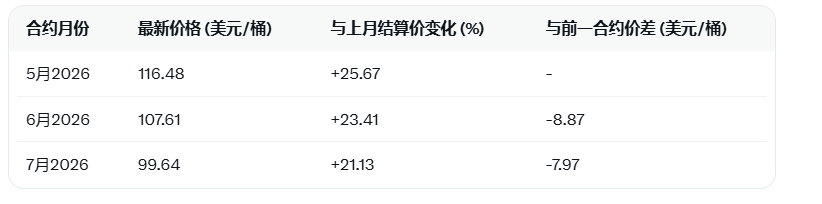
This price spread is not only a product of short-term panic but also stems from broader geopolitical and economic factors. The probability of disruption in the Strait of Hormuz has risen to a historical high, similar to the 2019 tanker attacks, when the spread rapidly widened to $7. Currently, global inventory levels have fallen to a five-year low, with OECD commercial inventories at only 2.7 billion barrels, far below the safe threshold of 3 billion barrels. If Iranian retaliation involves Iraqi or Saudi oil-producing regions, the spread could widen further to over $12. On the other hand, high spreads stimulate arbitrage trading, with traders profiting by storing crude oil from distant months, but this depends on sufficient storage capacity.
Currently, Cushing, Oklahoma's inventory utilization rate is at 80%, limiting the recovery of the structure where longer-term contracts are higher than near-term contracts. The market needs to focus on the next OPEC+ meeting; if an additional production cut of 1 million barrels per day is announced, it could partially alleviate the pressure on spot premiums. Overall, this phenomenon highlights the fragility of the oil market, and investors should turn to defensive assets such as gold or renewable energy to hedge against volatility.
Editor's Summary:
The widening global oil futures spread reflects the immediate impact of the Middle East conflict on supply chains, while the spot premium structure suggests a continued high-risk premium in the short term. The leadership change in Iran and US-Israeli military action have deepened uncertainty, potentially triggering rising global energy costs and economic volatility. Diplomatic intervention and OPEC+ coordination will be key to easing market tensions and preventing a wider supply crisis.
Frequently Asked Questions
Question 1: What are the causes of the Brent crude oil futures price spread?
The widening spread was primarily driven by geopolitical tensions in the Middle East, including Iran's threat to close the Strait of Hormuz and the escalation of Israeli airstrikes, triggering fears of short-term supply disruptions. The spot premium structure indicates market expectations of strong demand in the near-month contract and a recovery in supply in the far-month contract, resulting in the May contract being approximately $9 higher than the June contract. Historical data shows that spreads often reach this level during periods of similar conflict.
Question 2: What impact does this price difference have on the global economy?
High price differentials are pushing up oil prices, increasing transportation and manufacturing costs, and intensifying inflationary pressures in importing countries such as Asia and Europe, potentially dragging down GDP growth by 0.5%-1%. Businesses are facing higher fuel costs, and consumers are facing higher gasoline prices; however, oil-producing countries like the United States are benefiting, with investment being stimulated. High oil prices may accelerate the energy transition, but the risk of short-term supply chain disruptions is significant.
Question 3: What is the difference between spot premium and futures premium?
A spot premium refers to a price increase in the near month compared to the far month, reflecting tight supply; a futures premium, on the other hand, is often due to excess inventory. Currently, the spot premium dominates, as uncertainty surrounding the conflict outweighs long-term demand expectations. A shift in supply requires stability, such as increased OPEC production or a de-escalation of the conflict; otherwise, the price spread will persist.
Question 4: How to assess the risk of disruption in the Strait of Hormuz?
The risk is extremely high. The Strait of Hormuz carries 20% of the world's oil, and a disruption would result in a daily shortfall of 21 million barrels. The hardline rhetoric of Iran's new leader increases the likelihood of a blockade, while US naval escorts could alleviate the situation. However, GPS interference and explosions have already driven up insurance costs by 20-30%. Analysts estimate that a week-long blockade could cause oil prices to surge to $150 per barrel.
Question 5: When might the price difference phenomenon ease?
Easing depends on diplomatic progress, such as UN mediation or a demand for Iran's surrender from Trump. If a ceasefire occurs, the price spread may narrow to within $5; otherwise, it could persist for months. OPEC+ production cuts or increased US production could provide a buffer, but low global inventories limit a rapid recovery, and the market needs to monitor statements from Iran's new leader and naval operations.
This price spread structure, known as the spot premium , indicates that the price of the near-month contract is higher than that of the far-month contract, reflecting strong market concerns about short-term supply shortages. The main factors contributing to this phenomenon stem from escalating geopolitical conflicts in the Middle East, including high-level leadership changes in Iran and the expansion of Israeli military operations, coupled with the risk of disruption to shipping through the Strait of Hormuz.
The Strait of Hormuz carries approximately 20% of the world's daily oil traffic. A blockade or disruption would result in a daily supply gap of up to 21 million barrels, amplifying global inventory pressure in the short term. The US Navy has announced escort duties for oil tankers, but soaring logistics costs and rising insurance rates will maintain a high risk premium in the market.
Historically, this price spread has reached a recent high. Last week, Brent crude oil spot prices surged to $109.25 per barrel, a daily increase of 17.87% and a monthly increase of 58.80%. In contrast, longer-term contracts, such as the July contract, traded at $99.64 per barrel, indicating a steepening of the price spread curve.
Analysts believe that this spot premium structure typically occurs during periods of supply crisis, such as the early stages of the Russia-Ukraine conflict in 2022, when the price difference exceeded $10. This widening of the price difference is not only driven by immediate events but also reflects structural problems in the global energy transition: OPEC+ production cuts have failed to fully offset the demand recovery, while non-OPEC oil-producing countries, such as US shale oil producers, have lagged behind in increasing production.
A recent report from the International Energy Agency (IEA) warns that if the conflict continues, global oil demand will exceed supply by approximately 1.5 million barrels per day in 2026, pushing average oil prices above $120 per barrel. The hardline stance of Iran's new Supreme Leader , Mojtaba Khamenei , has further exacerbated uncertainty.
In a recent speech, he stated, "Iran will defend its sovereignty at all costs, including control of the Strait of Hormuz." This statement contrasts sharply with the response from US President Trump, who said, "Iran's blockade threat will be met with devastating consequences, and our navy is in position." The escalating bilateral confrontation has led to Israeli airstrikes extending to Beirut, Lebanon, disrupting Iranian proxy networks and oil infrastructure. Hezbollah's retaliation resulted in the evacuation of northern Israel, with the death toll nearing 400. The spillover effects of the conflict have impacted global shipping, with several shipping companies, such as Maersk, announcing detours around the Cape of Good Hope, extending transit times by 15-20 days and increasing costs by over 30%.
Even if a ceasefire is achieved in the short term, the price differential in the oil market could persist for months. Suppliers face multiple challenges, including facility repairs, inventory rebuilding, and risk assessments. Major importers in Europe and Asia are expected to bear higher energy costs, potentially triggering supply chain disruptions. In contrast, the United States, as a net exporter, benefits from high oil prices, with shale oil production potentially increasing to 14 million barrels per day, but the risk of global inflation transmission cannot be ignored.
The following table compares recent Brent crude oil futures contract prices:
This price spread is not only a product of short-term panic but also stems from broader geopolitical and economic factors. The probability of disruption in the Strait of Hormuz has risen to a historical high, similar to the 2019 tanker attacks, when the spread rapidly widened to $7. Currently, global inventory levels have fallen to a five-year low, with OECD commercial inventories at only 2.7 billion barrels, far below the safe threshold of 3 billion barrels. If Iranian retaliation involves Iraqi or Saudi oil-producing regions, the spread could widen further to over $12. On the other hand, high spreads stimulate arbitrage trading, with traders profiting by storing crude oil from distant months, but this depends on sufficient storage capacity.
Currently, Cushing, Oklahoma's inventory utilization rate is at 80%, limiting the recovery of the structure where longer-term contracts are higher than near-term contracts. The market needs to focus on the next OPEC+ meeting; if an additional production cut of 1 million barrels per day is announced, it could partially alleviate the pressure on spot premiums. Overall, this phenomenon highlights the fragility of the oil market, and investors should turn to defensive assets such as gold or renewable energy to hedge against volatility.
Editor's Summary:
The widening global oil futures spread reflects the immediate impact of the Middle East conflict on supply chains, while the spot premium structure suggests a continued high-risk premium in the short term. The leadership change in Iran and US-Israeli military action have deepened uncertainty, potentially triggering rising global energy costs and economic volatility. Diplomatic intervention and OPEC+ coordination will be key to easing market tensions and preventing a wider supply crisis.
Frequently Asked Questions
Question 1: What are the causes of the Brent crude oil futures price spread?
The widening spread was primarily driven by geopolitical tensions in the Middle East, including Iran's threat to close the Strait of Hormuz and the escalation of Israeli airstrikes, triggering fears of short-term supply disruptions. The spot premium structure indicates market expectations of strong demand in the near-month contract and a recovery in supply in the far-month contract, resulting in the May contract being approximately $9 higher than the June contract. Historical data shows that spreads often reach this level during periods of similar conflict.
Question 2: What impact does this price difference have on the global economy?
High price differentials are pushing up oil prices, increasing transportation and manufacturing costs, and intensifying inflationary pressures in importing countries such as Asia and Europe, potentially dragging down GDP growth by 0.5%-1%. Businesses are facing higher fuel costs, and consumers are facing higher gasoline prices; however, oil-producing countries like the United States are benefiting, with investment being stimulated. High oil prices may accelerate the energy transition, but the risk of short-term supply chain disruptions is significant.
Question 3: What is the difference between spot premium and futures premium?
A spot premium refers to a price increase in the near month compared to the far month, reflecting tight supply; a futures premium, on the other hand, is often due to excess inventory. Currently, the spot premium dominates, as uncertainty surrounding the conflict outweighs long-term demand expectations. A shift in supply requires stability, such as increased OPEC production or a de-escalation of the conflict; otherwise, the price spread will persist.
Question 4: How to assess the risk of disruption in the Strait of Hormuz?
The risk is extremely high. The Strait of Hormuz carries 20% of the world's oil, and a disruption would result in a daily shortfall of 21 million barrels. The hardline rhetoric of Iran's new leader increases the likelihood of a blockade, while US naval escorts could alleviate the situation. However, GPS interference and explosions have already driven up insurance costs by 20-30%. Analysts estimate that a week-long blockade could cause oil prices to surge to $150 per barrel.
Question 5: When might the price difference phenomenon ease?
Easing depends on diplomatic progress, such as UN mediation or a demand for Iran's surrender from Trump. If a ceasefire occurs, the price spread may narrow to within $5; otherwise, it could persist for months. OPEC+ production cuts or increased US production could provide a buffer, but low global inventories limit a rapid recovery, and the market needs to monitor statements from Iran's new leader and naval operations.
- Risk Warning and Disclaimer
- The market involves risk, and trading may not be suitable for all investors. This article is for reference only and does not constitute personal investment advice, nor does it take into account certain users’ specific investment objectives, financial situation, or other needs. Any investment decisions made based on this information are at your own risk.