Demand for the US dollar as a safe haven, coupled with rising UK inflation expectations, caused the pound to fluctuate at low levels against the dollar.
2026-04-07 13:40:22
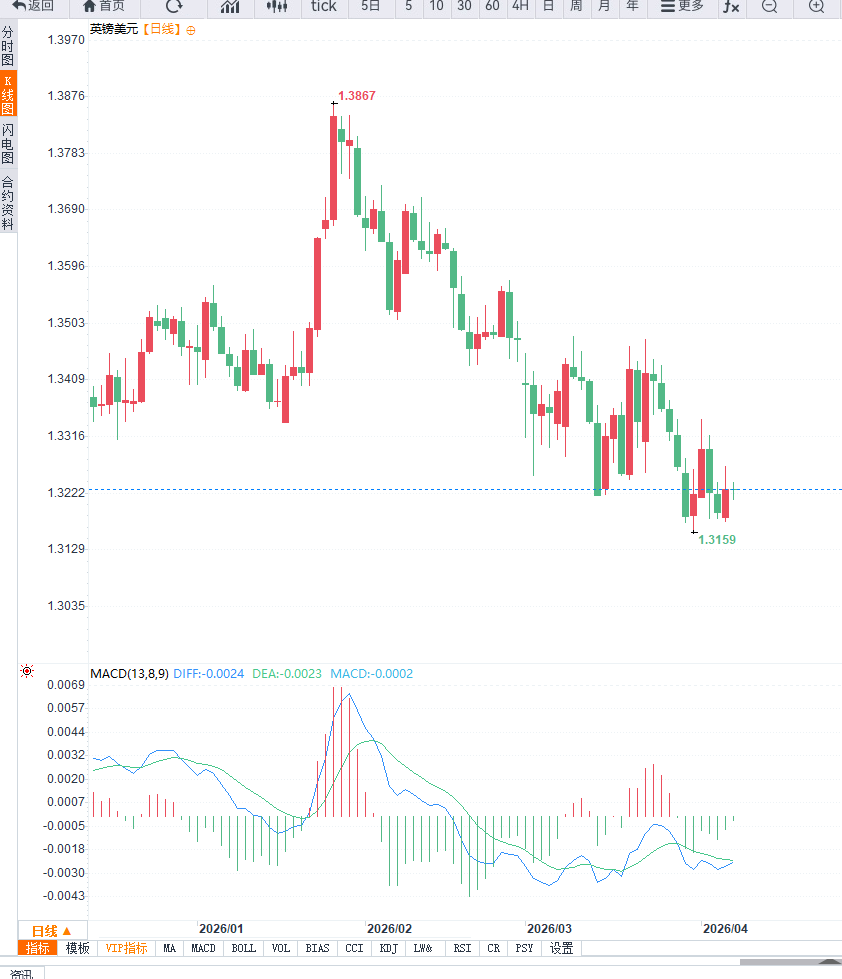
During Tuesday's Asian session, GBP/USD retreated to around 1.3220 , as the previous upward momentum weakened. Overall, the exchange rate is consolidating under the influence of multiple factors, and the short-term direction remains unclear.
From an external perspective, the continued tensions in the Middle East have become a major factor dominating market sentiment. Risks surrounding the Strait of Hormuz remain unresolved, with US President Donald Trump emphasizing that the current ceasefire proposal is "insufficient" and setting a deadline, threatening further action. This uncertainty has driven safe-haven flows into the US dollar, thus putting downward pressure on the pound.
Meanwhile, US economic data was slightly weak. According to data released by the Institute for Supply Management, the services PMI fell to 54.0 in March, below market expectations, indicating a slowdown in the expansion momentum of the services sector. This limited the upside potential of the dollar to some extent, keeping the decline in the pound relatively controlled.
In the UK, monetary policy expectations have become a significant factor supporting the pound. Some policymakers at the Bank of England have shifted from supporting interest rate cuts to favoring maintaining current rates. Meanwhile, driven by rising energy prices, UK inflation expectations have clearly increased, with the market anticipating that the CPI may rise to the 3%-3.5% range in the coming quarters. This expectation reinforces the likelihood of interest rates remaining high, thus providing some support for the pound.
However, from an overall structural perspective, the safe-haven attribute of the US dollar is more dominant at the current stage, especially given that geopolitical risks have not yet eased, and funds tend to flow into US dollar assets, which limits the upside potential of the pound.
From a technical perspective, on the daily chart, GBP/USD is still in a consolidation phase after an overall upward trend. The price encountered resistance near previous highs and retreated, indicating heavy selling pressure. The key resistance level is currently in the 1.3300-1.3350 range ; failure to break through this level may lead to continued consolidation. Support lies at 1.3150 , with further support at 1.3050 . Momentum indicators suggest weakening upward momentum, indicating a short-term bias towards consolidation.
On the 4-hour chart, the exchange rate is showing a downward trend with gradually lower highs, indicating a weak short-term trend. The moving average system is trending bearish, and the RSI is operating in the neutral to weak zone, suggesting a short-term bearish market. A break below 1.3150 could lead to a further test of 1.3050; a rebound above 1.3300 could potentially lead to a renewed strengthening.
Editor's Summary:
The current GBP/USD exchange rate is influenced by both "safe-haven demand for the US dollar" and "UK interest rate expectations." Although the Middle East situation is driving the dollar higher, rising UK inflation and policy shifts are providing support for the pound, preventing a significant decline. In the short term, against the backdrop of intertwined geopolitical risks and macroeconomic data, GBP/USD may maintain a range-bound trading pattern, with its future direction depending on the dollar's performance and changes in policy expectations.
From an external perspective, the continued tensions in the Middle East have become a major factor dominating market sentiment. Risks surrounding the Strait of Hormuz remain unresolved, with US President Donald Trump emphasizing that the current ceasefire proposal is "insufficient" and setting a deadline, threatening further action. This uncertainty has driven safe-haven flows into the US dollar, thus putting downward pressure on the pound.
Meanwhile, US economic data was slightly weak. According to data released by the Institute for Supply Management, the services PMI fell to 54.0 in March, below market expectations, indicating a slowdown in the expansion momentum of the services sector. This limited the upside potential of the dollar to some extent, keeping the decline in the pound relatively controlled.
In the UK, monetary policy expectations have become a significant factor supporting the pound. Some policymakers at the Bank of England have shifted from supporting interest rate cuts to favoring maintaining current rates. Meanwhile, driven by rising energy prices, UK inflation expectations have clearly increased, with the market anticipating that the CPI may rise to the 3%-3.5% range in the coming quarters. This expectation reinforces the likelihood of interest rates remaining high, thus providing some support for the pound.
However, from an overall structural perspective, the safe-haven attribute of the US dollar is more dominant at the current stage, especially given that geopolitical risks have not yet eased, and funds tend to flow into US dollar assets, which limits the upside potential of the pound.
From a technical perspective, on the daily chart, GBP/USD is still in a consolidation phase after an overall upward trend. The price encountered resistance near previous highs and retreated, indicating heavy selling pressure. The key resistance level is currently in the 1.3300-1.3350 range ; failure to break through this level may lead to continued consolidation. Support lies at 1.3150 , with further support at 1.3050 . Momentum indicators suggest weakening upward momentum, indicating a short-term bias towards consolidation.
On the 4-hour chart, the exchange rate is showing a downward trend with gradually lower highs, indicating a weak short-term trend. The moving average system is trending bearish, and the RSI is operating in the neutral to weak zone, suggesting a short-term bearish market. A break below 1.3150 could lead to a further test of 1.3050; a rebound above 1.3300 could potentially lead to a renewed strengthening.
Editor's Summary:
The current GBP/USD exchange rate is influenced by both "safe-haven demand for the US dollar" and "UK interest rate expectations." Although the Middle East situation is driving the dollar higher, rising UK inflation and policy shifts are providing support for the pound, preventing a significant decline. In the short term, against the backdrop of intertwined geopolitical risks and macroeconomic data, GBP/USD may maintain a range-bound trading pattern, with its future direction depending on the dollar's performance and changes in policy expectations.
- Risk Warning and Disclaimer
- The market involves risk, and trading may not be suitable for all investors. This article is for reference only and does not constitute personal investment advice, nor does it take into account certain users’ specific investment objectives, financial situation, or other needs. Any investment decisions made based on this information are at your own risk.