Gold is caught in a battle between surging oil prices and safe-haven demand.
2026-03-10 02:03:17
Gold prices have recently shown a somewhat volatile and weakening trend, especially against the backdrop of a sharp rise in oil prices, leading to a tug-of-war between bulls and bears in the gold market. The dramatic fluctuations in oil prices have also caused the US dollar and US Treasury yields to rise in tandem, becoming one of the main factors suppressing gold prices. Nevertheless, due to geopolitical tensions in the Middle East, demand for gold as a safe-haven asset remains, supporting some of the upward momentum in gold prices. Market focus is gradually shifting to oil price trends and the evolution of the Middle East situation, and gold prices are expected to continue to be influenced by these factors in the short term.

The downward pressure on gold prices from soaring oil prices
The recent surge in oil prices has directly impacted gold prices. In particular, crude oil prices briefly broke through $118 per barrel, reaching a new high in recent years. This directly boosted the US dollar and drove up US Treasury yields. This situation typically puts pressure on gold, as high yields attract investors to withdraw funds from non-yielding precious metals such as gold. However, gold has shown remarkable resilience in a high-yield environment, especially as tensions escalate in the Middle East, boosting demand for safe-haven assets.
In the early stages of the oil price surge, gold was pressured by the decline, but the subsequent oil price correction provided some support for gold. In particular, when oil prices fell by more than $20 from $118 (a drop of approximately 18%), market concerns about oil supply disruptions eased slightly, allowing both stock and gold prices to recover some of their gains. This indicates that while oil price fluctuations directly affect gold prices, risk aversion in the market has not completely subsided against the backdrop of ongoing geopolitical tensions in the Middle East.
Geopolitical factors and safe-haven demand support gold
The escalating conflict in the Middle East has provided another layer of support for gold. While the conflict has pushed up oil prices, it has also strengthened market demand for gold as a safe haven. Historical experience shows that geopolitical tensions typically spur investors to flock to the gold market to mitigate potential risks. Therefore, although the sharp rise in oil prices has had a restraining effect on gold, safe-haven buying remains, limiting the downside potential for gold prices.
Furthermore, if oil prices decline due to the global release of strategic petroleum reserves, this will alleviate upward pressure on US Treasury yields and the US dollar, potentially allowing gold to regain room for appreciation. In this scenario, gold could not only attract safe-haven funds but also rise further due to market concerns about rising inflation and an economic recession.
Technical Analysis
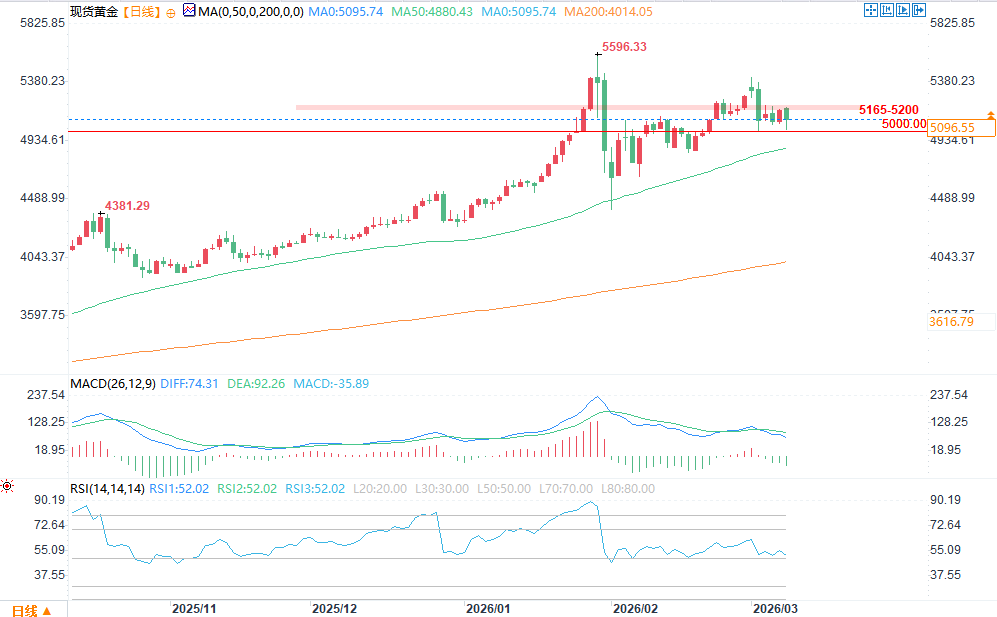
(Spot gold daily chart source: FX678)
From a technical perspective, gold is currently trading between key support and resistance levels. The current support level is in the $5000-$5050 range, a price level that has been tested multiple times recently, attracting buying interest each time. As long as gold prices can stabilize above $5000, market sentiment remains bullish. However, if gold prices decisively break below this support level, a short-term downtrend may emerge, leading to further pullbacks.
As for the resistance levels above, the key resistance zone for gold is between $5165 and $5200. Gold prices have tested this range multiple times recently but have failed to break through. If gold prices break through the $5200 resistance level, it could resume its upward trend and head towards higher target prices. Until then, the market may continue to consolidate sideways, awaiting new catalysts to push gold prices above key technical levels.
Overall Outlook
In summary, the sharp fluctuations in oil prices and the conflicts in the Middle East will continue to influence the price trend of gold. In the short term, gold may fluctuate around $5,000, both pressured by rising oil prices and supported by safe-haven inflows. For investors, the current gold market is at a critical juncture of bullish and bearish struggles, requiring close monitoring of oil price changes and the evolution of the global economic and political situation.
In the medium term, if the conflict in the Middle East escalates further, or oil prices remain high, the safe-haven demand for gold may strengthen, pushing gold prices higher. Conversely, if oil prices decline in the short term, the upward pressure on the US dollar and US Treasury yields may gradually weaken, and gold is expected to rebound. Therefore, the short-term trend of the gold market will be highly dependent on further developments in oil prices and the global political and economic situation, and investors need to carefully manage market timing.
At 01:56 Beijing time, spot gold was trading at $5,098.15 per ounce, down 1.41%.
The downward pressure on gold prices from soaring oil prices
The recent surge in oil prices has directly impacted gold prices. In particular, crude oil prices briefly broke through $118 per barrel, reaching a new high in recent years. This directly boosted the US dollar and drove up US Treasury yields. This situation typically puts pressure on gold, as high yields attract investors to withdraw funds from non-yielding precious metals such as gold. However, gold has shown remarkable resilience in a high-yield environment, especially as tensions escalate in the Middle East, boosting demand for safe-haven assets.
In the early stages of the oil price surge, gold was pressured by the decline, but the subsequent oil price correction provided some support for gold. In particular, when oil prices fell by more than $20 from $118 (a drop of approximately 18%), market concerns about oil supply disruptions eased slightly, allowing both stock and gold prices to recover some of their gains. This indicates that while oil price fluctuations directly affect gold prices, risk aversion in the market has not completely subsided against the backdrop of ongoing geopolitical tensions in the Middle East.
Geopolitical factors and safe-haven demand support gold
The escalating conflict in the Middle East has provided another layer of support for gold. While the conflict has pushed up oil prices, it has also strengthened market demand for gold as a safe haven. Historical experience shows that geopolitical tensions typically spur investors to flock to the gold market to mitigate potential risks. Therefore, although the sharp rise in oil prices has had a restraining effect on gold, safe-haven buying remains, limiting the downside potential for gold prices.
Furthermore, if oil prices decline due to the global release of strategic petroleum reserves, this will alleviate upward pressure on US Treasury yields and the US dollar, potentially allowing gold to regain room for appreciation. In this scenario, gold could not only attract safe-haven funds but also rise further due to market concerns about rising inflation and an economic recession.
Technical Analysis
(Spot gold daily chart source: FX678)
From a technical perspective, gold is currently trading between key support and resistance levels. The current support level is in the $5000-$5050 range, a price level that has been tested multiple times recently, attracting buying interest each time. As long as gold prices can stabilize above $5000, market sentiment remains bullish. However, if gold prices decisively break below this support level, a short-term downtrend may emerge, leading to further pullbacks.
As for the resistance levels above, the key resistance zone for gold is between $5165 and $5200. Gold prices have tested this range multiple times recently but have failed to break through. If gold prices break through the $5200 resistance level, it could resume its upward trend and head towards higher target prices. Until then, the market may continue to consolidate sideways, awaiting new catalysts to push gold prices above key technical levels.
Overall Outlook
In summary, the sharp fluctuations in oil prices and the conflicts in the Middle East will continue to influence the price trend of gold. In the short term, gold may fluctuate around $5,000, both pressured by rising oil prices and supported by safe-haven inflows. For investors, the current gold market is at a critical juncture of bullish and bearish struggles, requiring close monitoring of oil price changes and the evolution of the global economic and political situation.
In the medium term, if the conflict in the Middle East escalates further, or oil prices remain high, the safe-haven demand for gold may strengthen, pushing gold prices higher. Conversely, if oil prices decline in the short term, the upward pressure on the US dollar and US Treasury yields may gradually weaken, and gold is expected to rebound. Therefore, the short-term trend of the gold market will be highly dependent on further developments in oil prices and the global political and economic situation, and investors need to carefully manage market timing.
At 01:56 Beijing time, spot gold was trading at $5,098.15 per ounce, down 1.41%.
- Risk Warning and Disclaimer
- The market involves risk, and trading may not be suitable for all investors. This article is for reference only and does not constitute personal investment advice, nor does it take into account certain users’ specific investment objectives, financial situation, or other needs. Any investment decisions made based on this information are at your own risk.