One chart: The Baltic Dry Index rises along with the strength of the Capesize sector.
2026-03-09 22:41:10
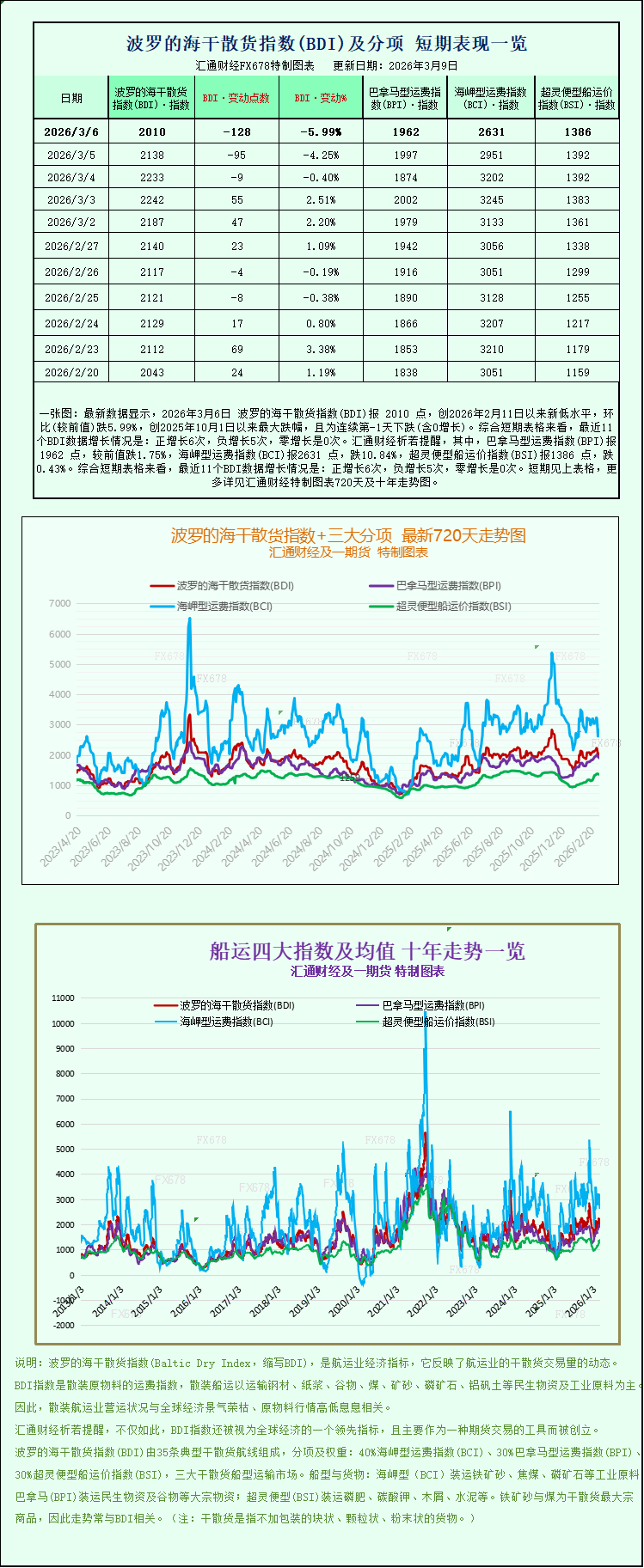
Latest data shows that the Baltic Dry Index (BDI) closed at 2010 points on March 6, 2026, a new low since February 11, 2026, down 5.99% month-on-month (compared to the previous value), marking the largest drop since October 1, 2025, and the first consecutive day of decline (including zero growth). Looking at the short-term charts, the BDI has seen positive growth 6 times, negative growth 5 times, and zero growth in the last 11 BDI data points. Specifically, the Panamax Freight Index (BPI) closed at 1962 points, down 1.75% from the previous value; the Capesize Freight Index (BCI) closed at 2631 points, down 10.84%; and the Supramax Freight Index (BSI) closed at 1386 points, down 0.43%. For detailed 720-day and 10-year trend charts of the Baltic Dry Index and its three main sub-indices, please refer to the specially designed charts.
On March 9th, the Baltic Dry Index saw a significant rise, ending a three-day losing streak. The core driver of this rebound was the overall strength of the Capesize shipping sector. As a key indicator of the global dry bulk shipping market, the index accurately monitors ocean freight rates for various vessels carrying bulk commodities such as iron ore, coal, and grain. Its fluctuations directly reflect changes in supply and demand and the overall health of the global dry bulk shipping market.
The Baltic Dry Index (BDI), a key indicator for measuring the overall market trend, covers freight rates for three major categories of dry bulk carriers: Capesize, Panamax, and Supramax. On that day, the index rose sharply by 56 points, an increase of 2.8%, and finally closed at 2066 points, becoming an important signal that the market had ended its short-term downturn and ushered in a rebound.
The Capesize index stood out in this index rebound, becoming the undisputed leading sector with a single-day increase of 7.8%, rising 204 points to close at 2835 points. The strong upward trend not only boosted the composite index but also highlighted the short-term heat of the Capesize shipping market.
In line with the index trend, the average daily earnings of Capesize vessels also surged, increasing by $1,852 in a single day to reach $22,207. These vessels are large ships in the dry bulk shipping sector, with a single ship carrying up to 150,000 tons of cargo. They mainly undertake the ocean transport of core industrial commodities such as iron ore and coal, and their earnings changes are highly correlated with global commodity trade demand.
It is worth noting that the strength of the Capesize vessel sector is closely related to the booming iron ore market. Affected by the geopolitical impact of the conflict in Iran, global energy prices have recently surged, leading to a corresponding increase in shipping costs. These multiple factors combined to push iron ore futures prices to a monthly high on March 9th. Dalian iron ore futures, in particular, continued their strong performance, achieving a sixth consecutive day of gains. The active iron ore trading directly boosted demand for Capesize vessels, becoming a crucial fundamental support for the sector's strength.
In stark contrast to the strong performance of the Capesize sector, the Panamax index weakened on the day, falling 48 points, or 2.5%, to close at 1914. This weakness in the sector, against the backdrop of an upward-trending composite index, reflects the divergent characteristics of the shipping market for different vessel types.
The average daily earnings of Panamax vessels declined in tandem with the index, decreasing by $433 to $17,223 in a single day. These vessels, with a cargo capacity ranging from 60,000 to 70,000 tons, are one of the mainstays of the international dry bulk shipping market, primarily responsible for the short-to-medium-distance transport of consumer goods such as coal and grain, as well as industrial raw materials. The decline in their earnings reflects the weak short-term demand in this cargo transportation market.
The Supramax index also failed to follow the rise in the Capesize sector, showing a slight decline on the day. The index fell 13 points, a drop of 0.9%, closing at 1373 points. This slight weakening trend made this sector another downward branch of the dry bulk shipping market that day. Trademarks are protected by relevant laws.
On March 9th, the Baltic Dry Index saw a significant rise, ending a three-day losing streak. The core driver of this rebound was the overall strength of the Capesize shipping sector. As a key indicator of the global dry bulk shipping market, the index accurately monitors ocean freight rates for various vessels carrying bulk commodities such as iron ore, coal, and grain. Its fluctuations directly reflect changes in supply and demand and the overall health of the global dry bulk shipping market.
The Baltic Dry Index (BDI), a key indicator for measuring the overall market trend, covers freight rates for three major categories of dry bulk carriers: Capesize, Panamax, and Supramax. On that day, the index rose sharply by 56 points, an increase of 2.8%, and finally closed at 2066 points, becoming an important signal that the market had ended its short-term downturn and ushered in a rebound.
The Capesize index stood out in this index rebound, becoming the undisputed leading sector with a single-day increase of 7.8%, rising 204 points to close at 2835 points. The strong upward trend not only boosted the composite index but also highlighted the short-term heat of the Capesize shipping market.
In line with the index trend, the average daily earnings of Capesize vessels also surged, increasing by $1,852 in a single day to reach $22,207. These vessels are large ships in the dry bulk shipping sector, with a single ship carrying up to 150,000 tons of cargo. They mainly undertake the ocean transport of core industrial commodities such as iron ore and coal, and their earnings changes are highly correlated with global commodity trade demand.
It is worth noting that the strength of the Capesize vessel sector is closely related to the booming iron ore market. Affected by the geopolitical impact of the conflict in Iran, global energy prices have recently surged, leading to a corresponding increase in shipping costs. These multiple factors combined to push iron ore futures prices to a monthly high on March 9th. Dalian iron ore futures, in particular, continued their strong performance, achieving a sixth consecutive day of gains. The active iron ore trading directly boosted demand for Capesize vessels, becoming a crucial fundamental support for the sector's strength.
In stark contrast to the strong performance of the Capesize sector, the Panamax index weakened on the day, falling 48 points, or 2.5%, to close at 1914. This weakness in the sector, against the backdrop of an upward-trending composite index, reflects the divergent characteristics of the shipping market for different vessel types.
The average daily earnings of Panamax vessels declined in tandem with the index, decreasing by $433 to $17,223 in a single day. These vessels, with a cargo capacity ranging from 60,000 to 70,000 tons, are one of the mainstays of the international dry bulk shipping market, primarily responsible for the short-to-medium-distance transport of consumer goods such as coal and grain, as well as industrial raw materials. The decline in their earnings reflects the weak short-term demand in this cargo transportation market.
The Supramax index also failed to follow the rise in the Capesize sector, showing a slight decline on the day. The index fell 13 points, a drop of 0.9%, closing at 1373 points. This slight weakening trend made this sector another downward branch of the dry bulk shipping market that day. Trademarks are protected by relevant laws.
- Risk Warning and Disclaimer
- The market involves risk, and trading may not be suitable for all investors. This article is for reference only and does not constitute personal investment advice, nor does it take into account certain users’ specific investment objectives, financial situation, or other needs. Any investment decisions made based on this information are at your own risk.