Easing geopolitical risks and falling oil prices drove a rapid recovery in market sentiment, with the fear index dropping sharply.
2026-03-10 16:22:56
According to APP, the VIX (Chicago Options Exchange Volatility Index) has seen a significant decline, falling 2.49 points to 23.07 . This drop indicates a rapid cooling of market panic and a marked recovery in risk appetite, suggesting a window of opportunity for a phase of recovery for US stocks and global risk assets.

The recent sharp decline in the VIX was mainly driven by a confluence of positive factors:
1. Geopolitical risks have significantly eased (most direct trigger)
Trump's recent statement that "the war on Iran will end soon," coupled with signs of easing tensions in the Middle East, has significantly reduced extreme market concerns about potential supply disruptions and escalating global conflicts. International oil prices (Brent crude) have fallen rapidly by more than 10% from their highs, leading to a sharp decrease in safe-haven demand and a direct result in a rapid compression of implied volatility in options.
2. Falling oil prices ease inflation and stagflation concerns. The surge in oil prices had fueled market fears of imported inflation and stagflation, pushing the VIX to recent highs. The price decline directly reduced energy cost pressures, alleviating the Federal Reserve's policy dilemma (both combating inflation and preventing recession). Market pessimism regarding interest rate cuts this year has eased somewhat, and the VIX has subsequently fallen rapidly.
3. A technical rebound in the stock market and short covering, coupled with previous geopolitical tensions that triggered a sharp drop in US stocks, led to the VIX rising to the 25-28 range, resulting in a surge of hedging demand in the options market. Following the shift in risk appetite, short covering and bargain hunting funds poured in, causing futures for indices such as the S&P 500 and Nasdaq to rebound, with implied volatility declining in tandem, forming a typical positive feedback loop of "downward risk - downward volatility".
4. Technical indicators show oversold conditions are being corrected.
The VIX has fallen from its recent high to 23.07 , breaking below short-term moving average resistance, easing its technical oversold condition. Historically, a VIX in the 20-25 range often corresponds to a shift in market sentiment from panic to neutral; the current level is approaching the center of this corrective channel.
The following table compares recent key VIX levels with market sentiment (based on the latest data):
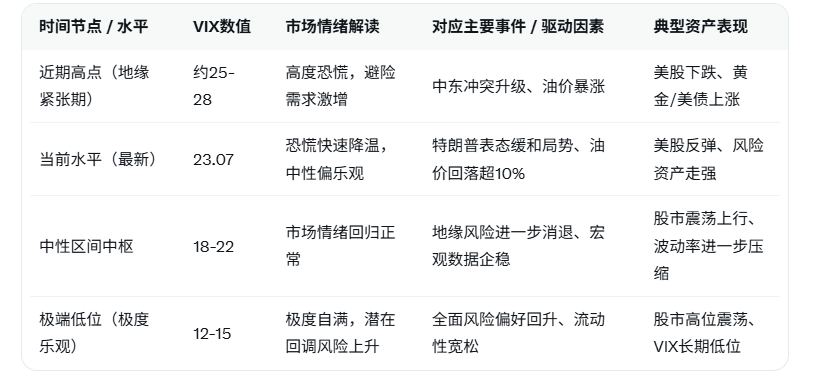
In the short term, the VIX still has room to fall further, but the 23.07 level is close to the recent consolidation range, providing strong support below. If the geopolitical situation remains stable and oil prices stabilize in the $90-$95 range, the VIX is expected to move towards the 20 level or even lower, supporting a continued rebound in US stocks.
The medium-term perspective leans towards cautious optimism. The VIX pullback reflects the market's rapid digestion of short-term risks, but geopolitical uncertainties, the Fed's course of action, and labor market data could still cause repeated disturbances. A prolonged period of the VIX below 20 often corresponds to a market complacency phase, and a potential resurgence in volatility after a period of relative calm should be anticipated. Key areas to watch: ① Oil price stabilization and developments in geopolitical events; ② Next week's CPI and PPI inflation data; ③ Non-farm payrolls and unemployment rate, among other employment indicators.
Risk Warning: Sudden and recurring geopolitical tensions, a rebound in oil prices leading to a rapid increase in the VIX, higher-than-expected inflation data, strengthened hawkish expectations from the Federal Reserve, renewed pressure on risk appetite, profit-taking in US stocks at high levels, and technical corrections amplifying volatility.
Editor's Summary : The VIX volatility index fell 2.49 points to 23.07 during the day, primarily driven by easing geopolitical risks in the Middle East and a sharp drop in oil prices. Previously accumulated safe-haven premiums were quickly dissipated, and market sentiment shifted from panic to neutral-to-optimistic. In the short term, the VIX is expected to continue moving towards the 20 level, supporting a rebound in risk assets. However, in the medium term, repeated disturbances from geopolitical and macroeconomic data should be monitored, and the period of low volatility should not be prolonged.
Frequently Asked Questions
1. Question: What changes in market sentiment are indicated by the VIX falling 2.49 points to 23.07?
A: The VIX (Volatility Index) is a measure of the expected volatility of the S&P 500 over the next 30 days. A drop of 2.49 points to 23.07 indicates a significant cooling of market panic, shifting rapidly from "high fear" (VIX > 25) to "neutral to optimistic." This typically corresponds to a phase where risk assets (such as US stocks) rebound and safe-haven assets (such as gold and US Treasuries) correct.
2. Question: Why does the drop in oil prices directly lead to a sharp decline in the VIX?
A: The recent surge in oil prices is one of the main drivers of the VIX, as high oil prices amplify inflationary pressures, increase the risk of stagflation, raise US Treasury yields, and suppress stock market valuations. When oil prices fall by more than 10% , concerns about imported inflation ease, the Fed's policy dilemma is reduced, and extreme market expectations for recession/hard landing cool down. Simultaneously, implied volatility of options compresses rapidly, leading to a sharp drop in the VIX.
3. Question: Where does the current VIX level of 23.07 stand historically?
A: The long-term average VIX is around 19-20, with the 20-25 range typically corresponding to market sentiment ranging from neutral to mild panic. The VIX of 23.07 has fallen from its recent high (25-28) but remains above the long-term average, indicating that market sentiment has significantly recovered but has not yet fully returned to "extreme calm" (VIX < 18). Historically, this level has often been a window for rebounds, but it is also prone to fluctuations.
4. Question: What impact will the decline in the VIX have on the future of the US stock market?
A: A decline in the VIX is typically positively correlated with a rise in US stocks, as lower volatility indicates reduced investor concern about tail risks and a recovery in risk appetite. In the short term, the VIX's continued move towards the 20 level will support a continued rebound in indices such as the S&P 500 and Nasdaq. However, if the VIX remains below 20 for an extended period, it could foster market complacency and increase the risk of a subsequent correction.
5. Question: How should investors view the investment opportunities presented by the current decline in the VIX?
A: In the short term, it's advisable to increase the allocation to risky assets, especially in the previously oversold technology, consumer, and industrial sectors, participating in the rebound through ETFs or index funds. Dynamically monitor oil price stabilization, CPI/PPI inflation data, and non-farm payroll indicators as signals for adding to or reducing positions. In the medium term, remain cautious. A prolonged period of VIX in the 18-22 range often corresponds to a "calm period" followed by a rebound in volatility. It is recommended to set wide stop-loss/take-profit levels, control overall position size, and avoid excessive chasing of rallies.
The recent sharp decline in the VIX was mainly driven by a confluence of positive factors:
1. Geopolitical risks have significantly eased (most direct trigger)
Trump's recent statement that "the war on Iran will end soon," coupled with signs of easing tensions in the Middle East, has significantly reduced extreme market concerns about potential supply disruptions and escalating global conflicts. International oil prices (Brent crude) have fallen rapidly by more than 10% from their highs, leading to a sharp decrease in safe-haven demand and a direct result in a rapid compression of implied volatility in options.
2. Falling oil prices ease inflation and stagflation concerns. The surge in oil prices had fueled market fears of imported inflation and stagflation, pushing the VIX to recent highs. The price decline directly reduced energy cost pressures, alleviating the Federal Reserve's policy dilemma (both combating inflation and preventing recession). Market pessimism regarding interest rate cuts this year has eased somewhat, and the VIX has subsequently fallen rapidly.
3. A technical rebound in the stock market and short covering, coupled with previous geopolitical tensions that triggered a sharp drop in US stocks, led to the VIX rising to the 25-28 range, resulting in a surge of hedging demand in the options market. Following the shift in risk appetite, short covering and bargain hunting funds poured in, causing futures for indices such as the S&P 500 and Nasdaq to rebound, with implied volatility declining in tandem, forming a typical positive feedback loop of "downward risk - downward volatility".
4. Technical indicators show oversold conditions are being corrected.
The VIX has fallen from its recent high to 23.07 , breaking below short-term moving average resistance, easing its technical oversold condition. Historically, a VIX in the 20-25 range often corresponds to a shift in market sentiment from panic to neutral; the current level is approaching the center of this corrective channel.
The following table compares recent key VIX levels with market sentiment (based on the latest data):
In the short term, the VIX still has room to fall further, but the 23.07 level is close to the recent consolidation range, providing strong support below. If the geopolitical situation remains stable and oil prices stabilize in the $90-$95 range, the VIX is expected to move towards the 20 level or even lower, supporting a continued rebound in US stocks.
The medium-term perspective leans towards cautious optimism. The VIX pullback reflects the market's rapid digestion of short-term risks, but geopolitical uncertainties, the Fed's course of action, and labor market data could still cause repeated disturbances. A prolonged period of the VIX below 20 often corresponds to a market complacency phase, and a potential resurgence in volatility after a period of relative calm should be anticipated. Key areas to watch: ① Oil price stabilization and developments in geopolitical events; ② Next week's CPI and PPI inflation data; ③ Non-farm payrolls and unemployment rate, among other employment indicators.
Risk Warning: Sudden and recurring geopolitical tensions, a rebound in oil prices leading to a rapid increase in the VIX, higher-than-expected inflation data, strengthened hawkish expectations from the Federal Reserve, renewed pressure on risk appetite, profit-taking in US stocks at high levels, and technical corrections amplifying volatility.
Editor's Summary : The VIX volatility index fell 2.49 points to 23.07 during the day, primarily driven by easing geopolitical risks in the Middle East and a sharp drop in oil prices. Previously accumulated safe-haven premiums were quickly dissipated, and market sentiment shifted from panic to neutral-to-optimistic. In the short term, the VIX is expected to continue moving towards the 20 level, supporting a rebound in risk assets. However, in the medium term, repeated disturbances from geopolitical and macroeconomic data should be monitored, and the period of low volatility should not be prolonged.
Frequently Asked Questions
1. Question: What changes in market sentiment are indicated by the VIX falling 2.49 points to 23.07?
A: The VIX (Volatility Index) is a measure of the expected volatility of the S&P 500 over the next 30 days. A drop of 2.49 points to 23.07 indicates a significant cooling of market panic, shifting rapidly from "high fear" (VIX > 25) to "neutral to optimistic." This typically corresponds to a phase where risk assets (such as US stocks) rebound and safe-haven assets (such as gold and US Treasuries) correct.
2. Question: Why does the drop in oil prices directly lead to a sharp decline in the VIX?
A: The recent surge in oil prices is one of the main drivers of the VIX, as high oil prices amplify inflationary pressures, increase the risk of stagflation, raise US Treasury yields, and suppress stock market valuations. When oil prices fall by more than 10% , concerns about imported inflation ease, the Fed's policy dilemma is reduced, and extreme market expectations for recession/hard landing cool down. Simultaneously, implied volatility of options compresses rapidly, leading to a sharp drop in the VIX.
3. Question: Where does the current VIX level of 23.07 stand historically?
A: The long-term average VIX is around 19-20, with the 20-25 range typically corresponding to market sentiment ranging from neutral to mild panic. The VIX of 23.07 has fallen from its recent high (25-28) but remains above the long-term average, indicating that market sentiment has significantly recovered but has not yet fully returned to "extreme calm" (VIX < 18). Historically, this level has often been a window for rebounds, but it is also prone to fluctuations.
4. Question: What impact will the decline in the VIX have on the future of the US stock market?
A: A decline in the VIX is typically positively correlated with a rise in US stocks, as lower volatility indicates reduced investor concern about tail risks and a recovery in risk appetite. In the short term, the VIX's continued move towards the 20 level will support a continued rebound in indices such as the S&P 500 and Nasdaq. However, if the VIX remains below 20 for an extended period, it could foster market complacency and increase the risk of a subsequent correction.
5. Question: How should investors view the investment opportunities presented by the current decline in the VIX?
A: In the short term, it's advisable to increase the allocation to risky assets, especially in the previously oversold technology, consumer, and industrial sectors, participating in the rebound through ETFs or index funds. Dynamically monitor oil price stabilization, CPI/PPI inflation data, and non-farm payroll indicators as signals for adding to or reducing positions. In the medium term, remain cautious. A prolonged period of VIX in the 18-22 range often corresponds to a "calm period" followed by a rebound in volatility. It is recommended to set wide stop-loss/take-profit levels, control overall position size, and avoid excessive chasing of rallies.
- Risk Warning and Disclaimer
- The market involves risk, and trading may not be suitable for all investors. This article is for reference only and does not constitute personal investment advice, nor does it take into account certain users’ specific investment objectives, financial situation, or other needs. Any investment decisions made based on this information are at your own risk.