Multiple factors at play in oil prices: Trump says it will "end soon" to put downward pressure on prices, while Israel remains firm in its stance.
2026-03-10 19:36:22
On Tuesday (March 10, 2026), international oil prices surged to a high of $100-120 per barrel due to the US-Israel military action against Iran, before suddenly retracing sharply. WTI crude oil fell by more than 10% to around $85 per barrel, while Brent crude oil retreated to around $88-90 per barrel. WTI crude oil fell as low as $84.43 per barrel, and Brent crude oil touched a low of $88.05 per barrel, staging a reversal from a surge to a sharp decline. This rapid de-escalation is not a signal of a genuine easing of the conflict, but rather a short-term release of sentiment due to a combination of factors.
The core factors behind the decline in oil prices
Key factors contributing to the decline in oil prices include: Trump's public statement on the 9th that the military operation would be "very soon" and the announcement of the lifting of some oil-related sanctions; when asked if this would end this week, Trump explicitly stated "no"; the G7 energy ministers' emergency meeting on the 10th to discuss jointly releasing strategic petroleum reserves under the coordination of the International Energy Agency (IEA) to buffer supply disruption panic; in addition, the global oil fundamentals still face oversupply pressure, high oil prices have suppressed demand, and profit-taking by speculative funds has further accelerated the correction.
However, these positive developments are more about calming the market and public sentiment. Trump's optimistic remarks come at a time when soaring oil prices have triggered inflation concerns and stock market turmoil; similar statements from historical leaders often carry the intention of stabilizing financial markets. But actual military progress may not be so optimistic—"ending soon" could just be diplomatic rhetoric, and real negotiations will still take time. If this is merely a matter of emotional reassurance, the risk of a rebound in oil prices remains significant.
The possibility of a complete end to the conflict is extremely low.
Given the stances of the US, Iran, and Israel, the possibility of a complete end to the conflict within the next week or two is extremely low. The US/Israel position is hardline; Trump previously stated that "no agreement will be reached unless Iran surrenders unconditionally," but his statements have been contradictory. Last week, he said he wouldn't rule out sending ground troops into Iran, but on March 9th, he stated that it was "far from" time to issue such an order. The Iranian Revolutionary Guard declared that as long as the attacks continue, "not a single drop of oil" will be allowed to be exported from the region, and responded after Trump signaled a "ceasefire" by saying that the end of the conflict would be decided by Iran. Both sides are still exchanging harsh words, and the conflict has entered its 11th day, involving core issues such as nuclear facilities and missile bases. On March 10th local time, the Israeli Air Force also launched an airstrike on Iran's nuclear test facility in Tehran, the capital. A ceasefire is unlikely in the short term. Concerns about logistical security (surge in tanker insurance, shipping disruptions) will not subside quickly, and the market needs to prepare for a protracted battle.
A recent Wall Street Journal report further exposes internal divisions: some of Trump's senior advisors are privately urging him to develop a withdrawal plan from the war with Iran, fearing that persistently high oil prices will drive up inflation, lead to a decline in public approval ratings (some polls show disapproval rates exceeding 70%), and damage the Republican Party's image as the midterm elections approach. Economic advisor Stephen Moore frankly stated, "When gasoline and oil prices go up, everything else goes up too. This presents a real challenge when affordability is already an issue." The advisors suggest packaging the current actions as a "major success" (severely damaging the Iranian navy, missiles, and nuclear facilities), then declaring a "victory" and gradually pulling back to avoid a protracted war. Trump's statements at his Florida press conference on the 9th are highly consistent with this line of thinking.
Even if the United States unilaterally downgrades or withdraws, it will still be extremely difficult for Israel to end the conflict. Its core objective is to resolve the "existential threat" from Iran once and for all, including the complete destruction of its nuclear program, missile stockpile, and "axis of resistance." The Israel Defense Forces have previously struck Iranian nuclear-related facilities multiple times and explicitly stated that they destroyed a "secret" underground nuclear weapons research and development site in Iran, while retaining the "freedom to bomb." Even if the United States reduces direct support, Israel will most likely continue to act unilaterally, making it difficult to completely eliminate the geopolitical risk premium.
Several concrete measures taken by the United States to lower oil prices
To proactively lower oil prices, the United States has taken several concrete measures. In an interview with the New York Post, Trump explicitly emphasized, "I have a plan for everything!" He stated that the public would be "very happy," directly causing oil prices to plummet nearly 30% from their intraday high. Specific measures include:
Partial lifting of oil-related sanctions: This includes the possible temporary easing of sanctions on Russian oil in order to increase global supply;
Naval escort and marine insurance: The U.S. Navy pledged to provide escort for oil tankers in the Strait of Hormuz and to provide marine risk insurance guarantees to ensure the smooth flow of energy transportation. Trump also threatened on social media that if Iran blocked oil transportation in the Strait of Hormuz, he would strike it "20 times more violently than before".
Strategic Petroleum Reserve (SPR) Release: Review and possible joint release of reserves in coordination with the G7/IEA. The US SPR currently holds approximately 415 million barrels (previously reported in February as approximately 371 million barrels, but this may be adjusted recently). Historically, multiple emergency releases have effectively stabilized the market. The Biden administration has previously released strategic petroleum reserves multiple times to address rising oil prices.
Other supporting options include restricting U.S. oil exports, intervening in the futures market, exempting fuel blending requirements, and relaxing restrictions on the flags of domestic fuel transport vessels. The Treasury Department and the Department of Energy are urgently assessing these options.
Trump has repeatedly emphasized that these plans "will bring oil prices down quickly," calling it "a short-term price to buy long-term peace and energy dominance." If the disruption to the Strait of Hormuz continues for an extended period, the consequences will be catastrophic. Saudi Aramco CEO Amin Nasser stated bluntly that this is the "biggest crisis to date" for the region's oil and gas industry, and its continuation will have "catastrophic consequences," with a global economic impact far exceeding any previous event. Saudi Aramco has already shut down two major super-oil fields due to storage saturation (reducing daily production by approximately 2 million barrels) and is using the East-West pipeline for emergency diversion. However, the Red Sea ports have a daily transport capacity of only about 6.5 million barrels, which can only handle about 40% of the crude oil trade through the Strait of Hormuz, and transportation costs have increased significantly, resulting in limited production capacity.
Risk of repeating the oil crisis
Goldman Sachs and other institutions have warned that if the situation continues until the end of March, oil prices may break the historical record of $147. The institutions have also previously predicted that the current supply gap could reach 3 million to 6 million barrels per day. The shortage of refined oil products, runaway inflation, and soaring air transport costs could even increase the probability of a global recession. Energy historian Daniel Yergin also believes that the world is currently facing "the biggest supply disruption in history." If it continues for several weeks, it will trigger a chain reaction in the global economy, repeating the situation in history where the oil crisis led to a global recession.
In summary, the US's intensive price cuts and Trump's assertive "I have a plan" stance have successfully created a short-term "breathing room" for oil prices. However, the divergence of goals between the US and Israel (the US prioritizing economic and political costs, while Israel seeking the complete eradication of the threat) coupled with Iran's hardline stance means that a complete end to the crisis remains a long way off. Geopolitical risks dominate the market; any signal of a "US withdrawal" or a "victory declaration" may bring temporary benefits, but it cannot mask the repeated fluctuations caused by Israel's continued actions. Investors need to closely monitor the aftermath of the G7 meeting, the next statements from the US and Israel, and the dynamics of Iranian retaliation—true oil price stability can only be achieved with signals of lasting peace.
Technical Analysis
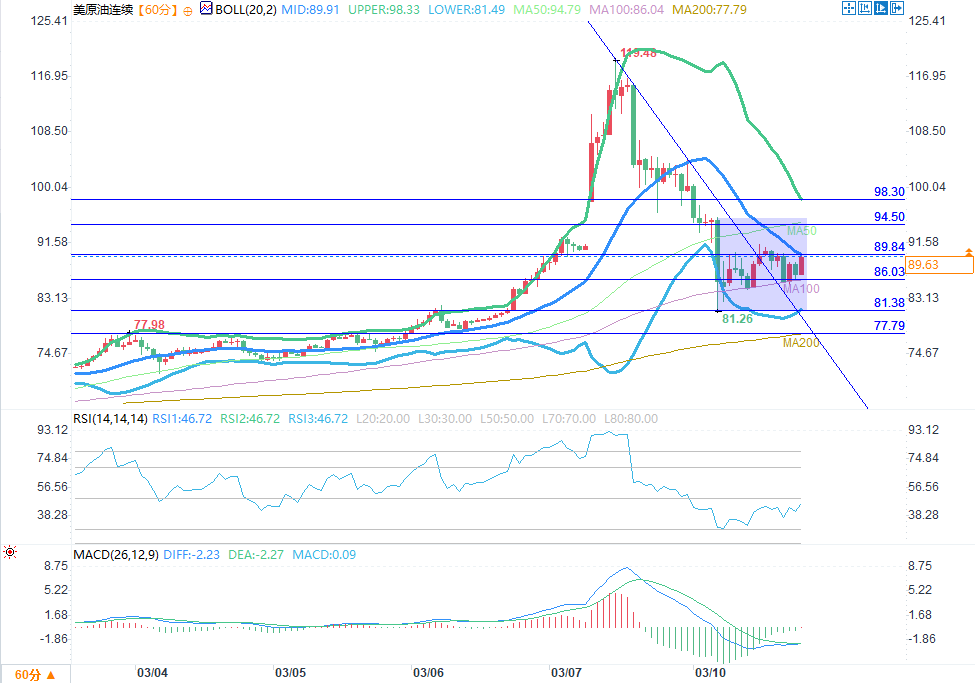
(US crude oil 1-hour chart source: FX678)
From a trend perspective, WTI crude oil has broken below the previous downtrend line on the 60-minute chart, halting the short-term bearish momentum and allowing the bulls to attempt a recovery. Simultaneously, the price has risen above the 50-day and 100-day moving averages (MA50 and MA100), and these moving averages are beginning to flatten and turn upwards, indicating that the bulls have regained market dominance in the short term, with the moving averages providing temporary support. However, the price remains well above the 200-day moving average (MA200), and the medium- to long-term trend remains bullish; the current movement is merely a correction after a pullback from higher levels.
The current price is trading below the Bollinger Middle Band (89.88), indicating that the rebound is a weak correction and has not yet entered a strong bullish phase, with the Middle Band providing significant resistance. Coupled with the RSI (45.79) being in a neutral range, the balance between bullish and bearish forces is temporarily balanced. The MACD has just turned from green to red, and the DIFF and DEA are about to form a golden cross, representing that bearish momentum has exhausted and bullish momentum has just begun to accumulate, but a clear upward signal has not yet formed. Overall, the rebound is weak and still needs time to accumulate momentum.
The core trading range is clear: support levels are at 86.03 (MA100) and 81.26 (recent low), while resistance levels are at 89.88 (Bollinger Band middle line) and 94.50 (previous platform). If the price retraces to the MA100 and stabilizes, then breaks through the Bollinger Band middle line with increased volume, the rebound will extend towards 94.50; if it fails to break through the middle line and the MACD crosses downwards again, there is a high probability of a second test of the 81.26 bottom. Currently, we are in a critical window of "strengthening trend but insufficient momentum," and the direction of the subsequent breakout will determine the short-term market trend.
The core factors behind the decline in oil prices
Key factors contributing to the decline in oil prices include: Trump's public statement on the 9th that the military operation would be "very soon" and the announcement of the lifting of some oil-related sanctions; when asked if this would end this week, Trump explicitly stated "no"; the G7 energy ministers' emergency meeting on the 10th to discuss jointly releasing strategic petroleum reserves under the coordination of the International Energy Agency (IEA) to buffer supply disruption panic; in addition, the global oil fundamentals still face oversupply pressure, high oil prices have suppressed demand, and profit-taking by speculative funds has further accelerated the correction.
However, these positive developments are more about calming the market and public sentiment. Trump's optimistic remarks come at a time when soaring oil prices have triggered inflation concerns and stock market turmoil; similar statements from historical leaders often carry the intention of stabilizing financial markets. But actual military progress may not be so optimistic—"ending soon" could just be diplomatic rhetoric, and real negotiations will still take time. If this is merely a matter of emotional reassurance, the risk of a rebound in oil prices remains significant.
The possibility of a complete end to the conflict is extremely low.
Given the stances of the US, Iran, and Israel, the possibility of a complete end to the conflict within the next week or two is extremely low. The US/Israel position is hardline; Trump previously stated that "no agreement will be reached unless Iran surrenders unconditionally," but his statements have been contradictory. Last week, he said he wouldn't rule out sending ground troops into Iran, but on March 9th, he stated that it was "far from" time to issue such an order. The Iranian Revolutionary Guard declared that as long as the attacks continue, "not a single drop of oil" will be allowed to be exported from the region, and responded after Trump signaled a "ceasefire" by saying that the end of the conflict would be decided by Iran. Both sides are still exchanging harsh words, and the conflict has entered its 11th day, involving core issues such as nuclear facilities and missile bases. On March 10th local time, the Israeli Air Force also launched an airstrike on Iran's nuclear test facility in Tehran, the capital. A ceasefire is unlikely in the short term. Concerns about logistical security (surge in tanker insurance, shipping disruptions) will not subside quickly, and the market needs to prepare for a protracted battle.
A recent Wall Street Journal report further exposes internal divisions: some of Trump's senior advisors are privately urging him to develop a withdrawal plan from the war with Iran, fearing that persistently high oil prices will drive up inflation, lead to a decline in public approval ratings (some polls show disapproval rates exceeding 70%), and damage the Republican Party's image as the midterm elections approach. Economic advisor Stephen Moore frankly stated, "When gasoline and oil prices go up, everything else goes up too. This presents a real challenge when affordability is already an issue." The advisors suggest packaging the current actions as a "major success" (severely damaging the Iranian navy, missiles, and nuclear facilities), then declaring a "victory" and gradually pulling back to avoid a protracted war. Trump's statements at his Florida press conference on the 9th are highly consistent with this line of thinking.
Even if the United States unilaterally downgrades or withdraws, it will still be extremely difficult for Israel to end the conflict. Its core objective is to resolve the "existential threat" from Iran once and for all, including the complete destruction of its nuclear program, missile stockpile, and "axis of resistance." The Israel Defense Forces have previously struck Iranian nuclear-related facilities multiple times and explicitly stated that they destroyed a "secret" underground nuclear weapons research and development site in Iran, while retaining the "freedom to bomb." Even if the United States reduces direct support, Israel will most likely continue to act unilaterally, making it difficult to completely eliminate the geopolitical risk premium.
Several concrete measures taken by the United States to lower oil prices
To proactively lower oil prices, the United States has taken several concrete measures. In an interview with the New York Post, Trump explicitly emphasized, "I have a plan for everything!" He stated that the public would be "very happy," directly causing oil prices to plummet nearly 30% from their intraday high. Specific measures include:
Partial lifting of oil-related sanctions: This includes the possible temporary easing of sanctions on Russian oil in order to increase global supply;
Naval escort and marine insurance: The U.S. Navy pledged to provide escort for oil tankers in the Strait of Hormuz and to provide marine risk insurance guarantees to ensure the smooth flow of energy transportation. Trump also threatened on social media that if Iran blocked oil transportation in the Strait of Hormuz, he would strike it "20 times more violently than before".
Strategic Petroleum Reserve (SPR) Release: Review and possible joint release of reserves in coordination with the G7/IEA. The US SPR currently holds approximately 415 million barrels (previously reported in February as approximately 371 million barrels, but this may be adjusted recently). Historically, multiple emergency releases have effectively stabilized the market. The Biden administration has previously released strategic petroleum reserves multiple times to address rising oil prices.
Other supporting options include restricting U.S. oil exports, intervening in the futures market, exempting fuel blending requirements, and relaxing restrictions on the flags of domestic fuel transport vessels. The Treasury Department and the Department of Energy are urgently assessing these options.
Trump has repeatedly emphasized that these plans "will bring oil prices down quickly," calling it "a short-term price to buy long-term peace and energy dominance." If the disruption to the Strait of Hormuz continues for an extended period, the consequences will be catastrophic. Saudi Aramco CEO Amin Nasser stated bluntly that this is the "biggest crisis to date" for the region's oil and gas industry, and its continuation will have "catastrophic consequences," with a global economic impact far exceeding any previous event. Saudi Aramco has already shut down two major super-oil fields due to storage saturation (reducing daily production by approximately 2 million barrels) and is using the East-West pipeline for emergency diversion. However, the Red Sea ports have a daily transport capacity of only about 6.5 million barrels, which can only handle about 40% of the crude oil trade through the Strait of Hormuz, and transportation costs have increased significantly, resulting in limited production capacity.
Risk of repeating the oil crisis
Goldman Sachs and other institutions have warned that if the situation continues until the end of March, oil prices may break the historical record of $147. The institutions have also previously predicted that the current supply gap could reach 3 million to 6 million barrels per day. The shortage of refined oil products, runaway inflation, and soaring air transport costs could even increase the probability of a global recession. Energy historian Daniel Yergin also believes that the world is currently facing "the biggest supply disruption in history." If it continues for several weeks, it will trigger a chain reaction in the global economy, repeating the situation in history where the oil crisis led to a global recession.
In summary, the US's intensive price cuts and Trump's assertive "I have a plan" stance have successfully created a short-term "breathing room" for oil prices. However, the divergence of goals between the US and Israel (the US prioritizing economic and political costs, while Israel seeking the complete eradication of the threat) coupled with Iran's hardline stance means that a complete end to the crisis remains a long way off. Geopolitical risks dominate the market; any signal of a "US withdrawal" or a "victory declaration" may bring temporary benefits, but it cannot mask the repeated fluctuations caused by Israel's continued actions. Investors need to closely monitor the aftermath of the G7 meeting, the next statements from the US and Israel, and the dynamics of Iranian retaliation—true oil price stability can only be achieved with signals of lasting peace.
Technical Analysis
(US crude oil 1-hour chart source: FX678)
From a trend perspective, WTI crude oil has broken below the previous downtrend line on the 60-minute chart, halting the short-term bearish momentum and allowing the bulls to attempt a recovery. Simultaneously, the price has risen above the 50-day and 100-day moving averages (MA50 and MA100), and these moving averages are beginning to flatten and turn upwards, indicating that the bulls have regained market dominance in the short term, with the moving averages providing temporary support. However, the price remains well above the 200-day moving average (MA200), and the medium- to long-term trend remains bullish; the current movement is merely a correction after a pullback from higher levels.
The current price is trading below the Bollinger Middle Band (89.88), indicating that the rebound is a weak correction and has not yet entered a strong bullish phase, with the Middle Band providing significant resistance. Coupled with the RSI (45.79) being in a neutral range, the balance between bullish and bearish forces is temporarily balanced. The MACD has just turned from green to red, and the DIFF and DEA are about to form a golden cross, representing that bearish momentum has exhausted and bullish momentum has just begun to accumulate, but a clear upward signal has not yet formed. Overall, the rebound is weak and still needs time to accumulate momentum.
The core trading range is clear: support levels are at 86.03 (MA100) and 81.26 (recent low), while resistance levels are at 89.88 (Bollinger Band middle line) and 94.50 (previous platform). If the price retraces to the MA100 and stabilizes, then breaks through the Bollinger Band middle line with increased volume, the rebound will extend towards 94.50; if it fails to break through the middle line and the MACD crosses downwards again, there is a high probability of a second test of the 81.26 bottom. Currently, we are in a critical window of "strengthening trend but insufficient momentum," and the direction of the subsequent breakout will determine the short-term market trend.
- Risk Warning and Disclaimer
- The market involves risk, and trading may not be suitable for all investors. This article is for reference only and does not constitute personal investment advice, nor does it take into account certain users’ specific investment objectives, financial situation, or other needs. Any investment decisions made based on this information are at your own risk.