Institutions: The precious metals bull market is in full swing; gold prices reaching $10,000 by 2029 is not a dream.
2026-03-12 12:13:25
A few years ago, predictions of gold prices breaking $10,000 per ounce were considered an unattainable fantasy by the market. However, with the continued expansion of global debt and the profound structural shifts in the geopolitical landscape, this goal has gradually transformed from a distant dream into a real possibility.
Chantelle Schieven, head of research at Capitalight Research, clearly points out that global economic uncertainty is rising at an unprecedented rate, providing a solid foundation for gold prices to reach $10,000 within the next 5 to 7 years. She states that given the current upward trend in gold, if this momentum continues, reaching $10,000 by 2029 will no longer be an unthinkable scenario.
Chantelle Schieven emphasizes that the long-term bull market momentum for gold has far exceeded traditional macroeconomic factors.
She pointed out that the core force driving up gold prices is a "tectonic shift" in the global financial and political system. This shift is not a short-term event, but the result of years of accumulation, which has accelerated, especially against the backdrop of large-scale Western sanctions following the outbreak of the Russia-Ukraine conflict. Sanctions have forced countries to re-examine the safety of dollar-denominated assets, leading central banks, governments, and high-net-worth individuals to proactively reduce their holdings of potentially frozen dollar assets and instead favor gold, which has no counterparty risk.
She added that the recent sharp fluctuations in gold prices are a result of the combined effects of geopolitical uncertainty and unforeseen events. For example, in February, gold prices fluctuated by less than $50 on only four trading days, while they fluctuated by more than $100 on 12 trading days.
Despite increased short-term market volatility, Chantelle Schieven says long-term investors can still benefit from the overall upward trend. She points out that retail investors who focus on longer investment horizons are typically in a better position than short-term traders trying to capture daily fluctuations.
Chantelle Schieven stated that gold's long-term momentum remains upward.
She added that recent price movements have frustrated some speculative forces in the futures market, as traders have struggled to accurately predict short-term directional changes. Although precious metal prices are currently consolidating, she believes the downside risk for gold and silver is extremely limited. She explicitly stated that she sees no possibility of gold and silver falling below $5,000 per ounce or below $60 per ounce, respectively.
She added, "To end the current bull market cycle, a major reversal in geopolitical sentiment is needed, and I don't see any signs of that at the moment. I also don't see a substantial reduction in government debt in the short term."
She further explained that the continued rise in global debt levels has severely limited the room for central banks to significantly tighten monetary policy. Government debt, personal debt, and mortgage costs are all at historically high levels, and further interest rate hikes would place unbearable pressure on the overall economy. Chantelle Schieven stated that central banks remain caught in the middle; due to the excessive debt burden within the system, significant interest rate hikes are no longer a realistic option.
Chantelle Schieven observes that the global economy is entering a new phase characterized by prolonged geopolitical tensions and fragmentation. The ongoing conflict in the Middle East, tensions in Asia, and the trend towards deglobalization are all contributing to global instability. She adds that distrust among governments will persist for a considerable period, with countries increasingly retreating into regional economic blocs and strategic alliances.
This combination of factors—geopolitical risks, debt inflation, and political polarization—forms a solid backdrop for the gold bull market. She described it this way: “It feels like a storm is brewing everywhere, and gold continues to benefit from this uncertainty.”
Furthermore, she pointed out that as gold prices become increasingly expensive for ordinary investors, silver may see more opportunities for retail investors to participate. Those investors who are excluded due to high gold prices often view silver as a more affordable entry point into the precious metal market. She added that since ordinary consumers can no longer afford an ounce of gold, silver has become their preferred entry point for seeking assets to preserve value.
While accurately predicting the exact timing of gold's next major breakout is challenging, Chantelle Schieven believes that the structural forces driving the current bull market are strong enough to ensure gold's long-term trajectory remains firmly upward.
The global debt crisis, geopolitical fragmentation, a crisis of confidence in the financial system, and limited policy space for central banks are all intertwined, pushing gold to record highs.
In the current environment, gold is no longer simply a traditional safe-haven asset, but is regarded as the ultimate asset against systemic risk.
Overall, the path for gold prices to reach $10,000 is becoming increasingly clear due to the dual upheavals in global debt and geopolitics. Whether it's the Strait of Hormuz crisis, escalating conflicts in the Middle East, or further deterioration of other geopolitical events, all could accelerate this process.
Chantelle Schieven's analysis reminds market participants that the core driver of the gold bull market has shifted from short-term macroeconomic factors to long-term structural changes. While paying attention to short-term fluctuations, investors should seize this historic opportunity and address the challenges of escalating global uncertainty by rationally allocating gold and silver.
In the next 5 to 7 years, gold may experience an unprecedented revaluation, and the underlying cause of this shift is the new global landscape intertwined with debt inflation and a crisis of trust.
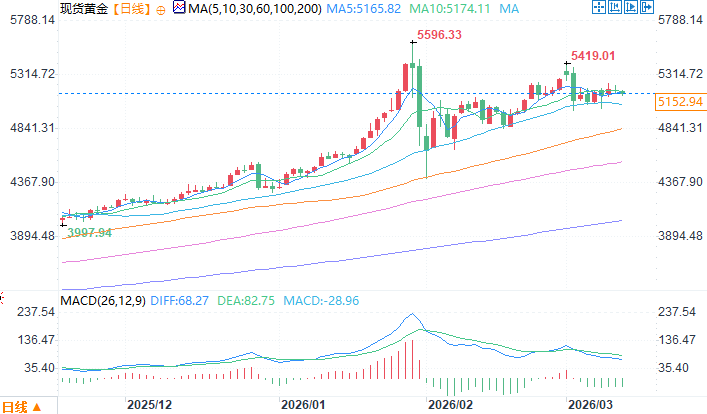
Spot gold daily chart source: EasyForex
At 12:13 Beijing time on March 12, spot gold was trading at $5151.94 per ounce.
Chantelle Schieven, head of research at Capitalight Research, clearly points out that global economic uncertainty is rising at an unprecedented rate, providing a solid foundation for gold prices to reach $10,000 within the next 5 to 7 years. She states that given the current upward trend in gold, if this momentum continues, reaching $10,000 by 2029 will no longer be an unthinkable scenario.
Gold's strength stems from a "structural shift" in the global financial system.
Chantelle Schieven emphasizes that the long-term bull market momentum for gold has far exceeded traditional macroeconomic factors.
She pointed out that the core force driving up gold prices is a "tectonic shift" in the global financial and political system. This shift is not a short-term event, but the result of years of accumulation, which has accelerated, especially against the backdrop of large-scale Western sanctions following the outbreak of the Russia-Ukraine conflict. Sanctions have forced countries to re-examine the safety of dollar-denominated assets, leading central banks, governments, and high-net-worth individuals to proactively reduce their holdings of potentially frozen dollar assets and instead favor gold, which has no counterparty risk.
She added that the recent sharp fluctuations in gold prices are a result of the combined effects of geopolitical uncertainty and unforeseen events. For example, in February, gold prices fluctuated by less than $50 on only four trading days, while they fluctuated by more than $100 on 12 trading days.
Despite increased short-term market volatility, Chantelle Schieven says long-term investors can still benefit from the overall upward trend. She points out that retail investors who focus on longer investment horizons are typically in a better position than short-term traders trying to capture daily fluctuations.
Long-term momentum is upward, speculative activity is suppressed, and downside risks are limited.
Chantelle Schieven stated that gold's long-term momentum remains upward.
She added that recent price movements have frustrated some speculative forces in the futures market, as traders have struggled to accurately predict short-term directional changes. Although precious metal prices are currently consolidating, she believes the downside risk for gold and silver is extremely limited. She explicitly stated that she sees no possibility of gold and silver falling below $5,000 per ounce or below $60 per ounce, respectively.
She added, "To end the current bull market cycle, a major reversal in geopolitical sentiment is needed, and I don't see any signs of that at the moment. I also don't see a substantial reduction in government debt in the short term."
She further explained that the continued rise in global debt levels has severely limited the room for central banks to significantly tighten monetary policy. Government debt, personal debt, and mortgage costs are all at historically high levels, and further interest rate hikes would place unbearable pressure on the overall economy. Chantelle Schieven stated that central banks remain caught in the middle; due to the excessive debt burden within the system, significant interest rate hikes are no longer a realistic option.
Geopolitical fragmentation and heightened global distrust support gold prices.
Chantelle Schieven observes that the global economy is entering a new phase characterized by prolonged geopolitical tensions and fragmentation. The ongoing conflict in the Middle East, tensions in Asia, and the trend towards deglobalization are all contributing to global instability. She adds that distrust among governments will persist for a considerable period, with countries increasingly retreating into regional economic blocs and strategic alliances.
This combination of factors—geopolitical risks, debt inflation, and political polarization—forms a solid backdrop for the gold bull market. She described it this way: “It feels like a storm is brewing everywhere, and gold continues to benefit from this uncertainty.”
Furthermore, she pointed out that as gold prices become increasingly expensive for ordinary investors, silver may see more opportunities for retail investors to participate. Those investors who are excluded due to high gold prices often view silver as a more affordable entry point into the precious metal market. She added that since ordinary consumers can no longer afford an ounce of gold, silver has become their preferred entry point for seeking assets to preserve value.
Structural forces are locking in gold's long-term upward trajectory.
While accurately predicting the exact timing of gold's next major breakout is challenging, Chantelle Schieven believes that the structural forces driving the current bull market are strong enough to ensure gold's long-term trajectory remains firmly upward.
The global debt crisis, geopolitical fragmentation, a crisis of confidence in the financial system, and limited policy space for central banks are all intertwined, pushing gold to record highs.
In the current environment, gold is no longer simply a traditional safe-haven asset, but is regarded as the ultimate asset against systemic risk.
Overall, the path for gold prices to reach $10,000 is becoming increasingly clear due to the dual upheavals in global debt and geopolitics. Whether it's the Strait of Hormuz crisis, escalating conflicts in the Middle East, or further deterioration of other geopolitical events, all could accelerate this process.
Chantelle Schieven's analysis reminds market participants that the core driver of the gold bull market has shifted from short-term macroeconomic factors to long-term structural changes. While paying attention to short-term fluctuations, investors should seize this historic opportunity and address the challenges of escalating global uncertainty by rationally allocating gold and silver.
In the next 5 to 7 years, gold may experience an unprecedented revaluation, and the underlying cause of this shift is the new global landscape intertwined with debt inflation and a crisis of trust.
Spot gold daily chart source: EasyForex
At 12:13 Beijing time on March 12, spot gold was trading at $5151.94 per ounce.
- Risk Warning and Disclaimer
- The market involves risk, and trading may not be suitable for all investors. This article is for reference only and does not constitute personal investment advice, nor does it take into account certain users’ specific investment objectives, financial situation, or other needs. Any investment decisions made based on this information are at your own risk.