ANZ strategists say the recent drop in gold prices is only temporary; Fed rate cut to 3% at the end of the year supports gold bulls.
2026-03-12 17:18:46
According to APP, ANZ strategists Soni Kumari and Daniel Hynes believe the recent decline in gold prices may be temporary. In their latest report, they noted that while the US dollar has rebounded due to its safe-haven status, the currency remains overvalued, and this strength is likely temporary. They emphasized that the Federal Reserve is also unlikely to reverse its monetary policy stance, as the disinflationary trend remains intact. Although rising oil prices increase the likelihood of renewed inflationary pressures, this is expected to be temporary. ANZ's base case scenario is that the Federal Reserve's policy rate will fall to 3.0% by the end of December 2026. They added that lower interest rates and a weaker US dollar should support investment inflows into the gold market.
Further analysis suggests that the recent pullback in gold prices was primarily driven by the recent rebound of the US dollar index to around 99.5, while high-level volatility in oil prices exacerbated short-term inflation expectations, leading some investors to take profits. Latest futures data shows that spot gold prices have stabilized around $5180 per ounce, down about 7% from the January high of over $5600, but trading volume has increased moderately, indicating strong buying support. Soni Kumari and Daniel Hynes recently stated in a research report that "central bank demand for gold may further expand this year, and there are no signs of a reversal in the structural support." This view aligns with the current trend of central bank gold purchases amid geopolitical uncertainty, reinforcing gold's position as a long-term safe-haven asset.
From a medium- to long-term perspective, the Federal Reserve's policy path is the core driver of gold prices. Currently, the federal funds rate remains in the 3.50-3.75% range, and market pricing indicates ample room for cumulative rate cuts before the end of 2026. ANZ's 3.0% target is more optimistic than market consensus, significantly reducing the opportunity cost of holding gold. The overvaluation of the US dollar is equally crucial: although the DXY has rebounded in the short term, fundamentals show it faces downward pressure amid diverging global economic growth, and it is expected to gradually fall back to the low 90 range by 2026. Historical data shows that gold often records double-digit gains during similar periods of dollar weakness. While the current oil-driven inflationary pressures have temporarily pushed up yields, the anti-inflationary trend remains intact, and central banks will not hastily tighten policy. The recovery in industrial and investment demand in major Asian countries further amplifies the attractiveness of gold allocation, and investment inflows are expected to drive prices back to higher levels.
To clearly compare gold prices with policy expectations, the following table presents key scenarios:
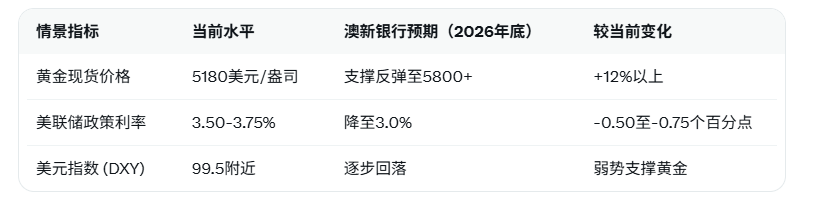
The above data highlights the decisive support that the Fed's rate cuts and the dollar's performance have for gold. Short-term pullbacks provide entry windows, and the medium-term bullish logic is strengthened, but the risks of sustained higher-than-expected oil prices or a hawkish stance from the Fed should be noted. Overall, ANZ strategists' optimistic assessment underscores the continued value of gold in the current macroeconomic environment, with anticipated investment inflows expected to dominate the price recovery path.
Editor's Summary: The short-term pullback in gold prices stemmed from temporary factors related to the US dollar and inflation. However, ANZ Bank expects the Federal Reserve's easing measures and a weaker dollar to provide strong support. The market needs to pay attention to policy data developments to seize structural opportunities.
Frequently Asked Questions
Question 1: Why do ANZ strategists believe that the recent decline in gold prices is only a temporary correction?
Answer: Soni Kumari and Daniel Hynes point out that while the safe-haven rebound of the US dollar has pushed the DXY to 99.5, the currency remains overvalued, and its strength is unlikely to be sustained. Meanwhile, the inflationary pressure from rising oil prices is expected to be only temporary, and the anti-inflationary trend remains intact. The latest gold price is stable at $5180/ounce, down 7% from its high, but the increased demand for gold from central banks and structural support have not reversed; the pullback presents a buying opportunity.
Question 2: What specific support will the Fed's decision to lower interest rates to 3.0% by the end of the year provide for gold?
Answer: ANZ's baseline scenario indicates that the policy rate will fall to 3.0% by the end of December 2026, a cumulative reduction of 0.50-0.75 percentage points from the current range of 3.50-3.75%. This will significantly reduce the opportunity cost of holding gold and stimulate investment inflows. The report emphasizes that a lower interest rate environment directly benefits non-yielding assets, and combined with a weaker US dollar, it is expected to push gold prices back above $5,800/ounce.
Question 3: How does the logic of an overvalued US dollar affect the price path of gold?
Answer: Although the US dollar has rebounded in the short term due to safe-haven demand, ANZ believes its fundamentals are significantly overvalued and expects it to gradually decline in 2026. A drop in the DXY from its current level of 99.5 will weaken the dollar's pricing power; historical data shows that gold has risen by an average of over 15% during periods of dollar weakness. While temporary inflationary pressures on oil prices are pushing up yields, they will not reverse the Fed's easing path, and gold's safe-haven appeal will reappear.
Question 4: What are the short-term effects of rising oil prices on inflation and gold?
Answer: While high oil prices increase the risk of renewed inflation, strategists expect this to be temporary and will not change the overall anti-inflationary trend. The Federal Reserve is unlikely to reverse its stance. Rising short-term yields may suppress gold prices, but once oil price pressures are confirmed to ease, investment inflows will accelerate. Recent reports indicate that increased central bank demand will buffer any temporary volatility.
Question 5: How can investors seize the allocation opportunities under ANZ Bank's gold outlook?
Answer: In the short term, consider buying spot gold or ETFs on dips, paying attention to the Fed's March meeting and oil price and inventory data. In the medium term, lock in a 3.0% interest rate scenario by the end of the year, and combine this with expectations of a weaker dollar, diversifying your portfolio with physical gold and mining stocks. The report cautions that the continued trend of central bank gold purchases provides support, but stop-loss orders should be set to guard against unexpected geopolitical or policy risks. Overall, this view provides a clear framework for a medium- to long-term bullish outlook on gold, and it is recommended to dynamically adjust positions based on the latest price level of $5180.
Further analysis suggests that the recent pullback in gold prices was primarily driven by the recent rebound of the US dollar index to around 99.5, while high-level volatility in oil prices exacerbated short-term inflation expectations, leading some investors to take profits. Latest futures data shows that spot gold prices have stabilized around $5180 per ounce, down about 7% from the January high of over $5600, but trading volume has increased moderately, indicating strong buying support. Soni Kumari and Daniel Hynes recently stated in a research report that "central bank demand for gold may further expand this year, and there are no signs of a reversal in the structural support." This view aligns with the current trend of central bank gold purchases amid geopolitical uncertainty, reinforcing gold's position as a long-term safe-haven asset.
From a medium- to long-term perspective, the Federal Reserve's policy path is the core driver of gold prices. Currently, the federal funds rate remains in the 3.50-3.75% range, and market pricing indicates ample room for cumulative rate cuts before the end of 2026. ANZ's 3.0% target is more optimistic than market consensus, significantly reducing the opportunity cost of holding gold. The overvaluation of the US dollar is equally crucial: although the DXY has rebounded in the short term, fundamentals show it faces downward pressure amid diverging global economic growth, and it is expected to gradually fall back to the low 90 range by 2026. Historical data shows that gold often records double-digit gains during similar periods of dollar weakness. While the current oil-driven inflationary pressures have temporarily pushed up yields, the anti-inflationary trend remains intact, and central banks will not hastily tighten policy. The recovery in industrial and investment demand in major Asian countries further amplifies the attractiveness of gold allocation, and investment inflows are expected to drive prices back to higher levels.
To clearly compare gold prices with policy expectations, the following table presents key scenarios:
The above data highlights the decisive support that the Fed's rate cuts and the dollar's performance have for gold. Short-term pullbacks provide entry windows, and the medium-term bullish logic is strengthened, but the risks of sustained higher-than-expected oil prices or a hawkish stance from the Fed should be noted. Overall, ANZ strategists' optimistic assessment underscores the continued value of gold in the current macroeconomic environment, with anticipated investment inflows expected to dominate the price recovery path.
Editor's Summary: The short-term pullback in gold prices stemmed from temporary factors related to the US dollar and inflation. However, ANZ Bank expects the Federal Reserve's easing measures and a weaker dollar to provide strong support. The market needs to pay attention to policy data developments to seize structural opportunities.
Frequently Asked Questions
Question 1: Why do ANZ strategists believe that the recent decline in gold prices is only a temporary correction?
Answer: Soni Kumari and Daniel Hynes point out that while the safe-haven rebound of the US dollar has pushed the DXY to 99.5, the currency remains overvalued, and its strength is unlikely to be sustained. Meanwhile, the inflationary pressure from rising oil prices is expected to be only temporary, and the anti-inflationary trend remains intact. The latest gold price is stable at $5180/ounce, down 7% from its high, but the increased demand for gold from central banks and structural support have not reversed; the pullback presents a buying opportunity.
Question 2: What specific support will the Fed's decision to lower interest rates to 3.0% by the end of the year provide for gold?
Answer: ANZ's baseline scenario indicates that the policy rate will fall to 3.0% by the end of December 2026, a cumulative reduction of 0.50-0.75 percentage points from the current range of 3.50-3.75%. This will significantly reduce the opportunity cost of holding gold and stimulate investment inflows. The report emphasizes that a lower interest rate environment directly benefits non-yielding assets, and combined with a weaker US dollar, it is expected to push gold prices back above $5,800/ounce.
Question 3: How does the logic of an overvalued US dollar affect the price path of gold?
Answer: Although the US dollar has rebounded in the short term due to safe-haven demand, ANZ believes its fundamentals are significantly overvalued and expects it to gradually decline in 2026. A drop in the DXY from its current level of 99.5 will weaken the dollar's pricing power; historical data shows that gold has risen by an average of over 15% during periods of dollar weakness. While temporary inflationary pressures on oil prices are pushing up yields, they will not reverse the Fed's easing path, and gold's safe-haven appeal will reappear.
Question 4: What are the short-term effects of rising oil prices on inflation and gold?
Answer: While high oil prices increase the risk of renewed inflation, strategists expect this to be temporary and will not change the overall anti-inflationary trend. The Federal Reserve is unlikely to reverse its stance. Rising short-term yields may suppress gold prices, but once oil price pressures are confirmed to ease, investment inflows will accelerate. Recent reports indicate that increased central bank demand will buffer any temporary volatility.
Question 5: How can investors seize the allocation opportunities under ANZ Bank's gold outlook?
Answer: In the short term, consider buying spot gold or ETFs on dips, paying attention to the Fed's March meeting and oil price and inventory data. In the medium term, lock in a 3.0% interest rate scenario by the end of the year, and combine this with expectations of a weaker dollar, diversifying your portfolio with physical gold and mining stocks. The report cautions that the continued trend of central bank gold purchases provides support, but stop-loss orders should be set to guard against unexpected geopolitical or policy risks. Overall, this view provides a clear framework for a medium- to long-term bullish outlook on gold, and it is recommended to dynamically adjust positions based on the latest price level of $5180.
- Risk Warning and Disclaimer
- The market involves risk, and trading may not be suitable for all investors. This article is for reference only and does not constitute personal investment advice, nor does it take into account certain users’ specific investment objectives, financial situation, or other needs. Any investment decisions made based on this information are at your own risk.