Gold prices fluctuated at high levels: A rebound in the US dollar and adjustments in interest rate cut expectations led the market into a consolidation period.
2026-03-12 20:23:20
The international gold market experienced significantly increased volatility this week. After a continuous rise and reaching new highs, spot gold saw a pullback from its peak on March 11th to 12th. During the session, prices briefly tested the previous high area again, but with the rebound of the US dollar index and the rise in US Treasury yields, the bullish momentum clearly slowed, and gold prices gradually fell back into a high-level consolidation range.

From an overall structural perspective, gold remains at high levels, but the pace of increase has clearly slowed. The rapid rise previously driven by geopolitical risks and safe-haven demand is gradually transforming into a more complex battle between bulls and bears. As the market begins to reassess US economic data and monetary policy path, gold is experiencing a noticeable tug-of-war at its high levels.
Adjustment in interest rate cut expectations: Inflation resilience suppresses short-term sentiment.
Recent US inflation data has become a key variable influencing the market. Data shows that the US Consumer Price Index (CPI) for February was generally in line with market expectations. Although inflation has declined from its previous highs, core inflation still shows some resilience.
This result has cooled market expectations for a rapid rate cut by the Federal Reserve in the short term. The Fed is likely to maintain a relatively cautious stance until inflation fully returns to its policy target. The repricing of the interest rate path has reduced some investors' willingness to chase gold prices higher in the short term, and some early profit-taking funds have begun to adjust their positions, leading to a temporary pullback in gold prices from their highs.
Meanwhile, as expectations of interest rate cuts have cooled, US Treasury yields have recently rebounded, and the US dollar index has also strengthened. For gold, this creates a typical "opportunity cost effect." Since gold itself does not generate interest income, the attractiveness of holding gold decreases relatively when bond yields rise; while a stronger dollar increases the cost for non-dollar investors to buy gold, putting some downward pressure on gold prices.
Geopolitical premiums are cooling, and market logic is returning to macroeconomics.
Although tensions in the Middle East have not fully eased, market sensitivity to related news has noticeably decreased. The previous surge in gold prices largely reflected a geopolitical risk premium, and as the conflict entered a phase of sustained but non-escalating conflict, market sentiment gradually calmed.
Meanwhile, international oil prices have recently risen again due to geopolitical factors, which theoretically could strengthen inflation expectations and benefit gold. However, in the current environment, rising oil prices may instead reinforce market expectations that the Federal Reserve will maintain high interest rates. If energy prices remain high, the pace of inflation decline may be affected, making monetary policy more cautious about interest rate cuts.
Therefore, with interest rate expectations rising again, gold is facing some pressure in the short term.
From a funding perspective: Profit-taking at high levels exacerbates volatility.
From a funding perspective, gold's previous continuous rise and record highs led to a large accumulation of long positions in the market. When macroeconomic expectations subtly shifted, some investors chose to lock in profits at higher levels, which pushed gold prices into a technical correction phase.
However, most institutions still believe that the current pullback is more likely a phase of consolidation within a bull market than a trend reversal. Continued gold purchases by global central banks, geopolitical risks, and the potential for future monetary easing cycles continue to provide medium- to long-term support for gold.
Technical Structure: Awaiting a directional breakout within a key range.
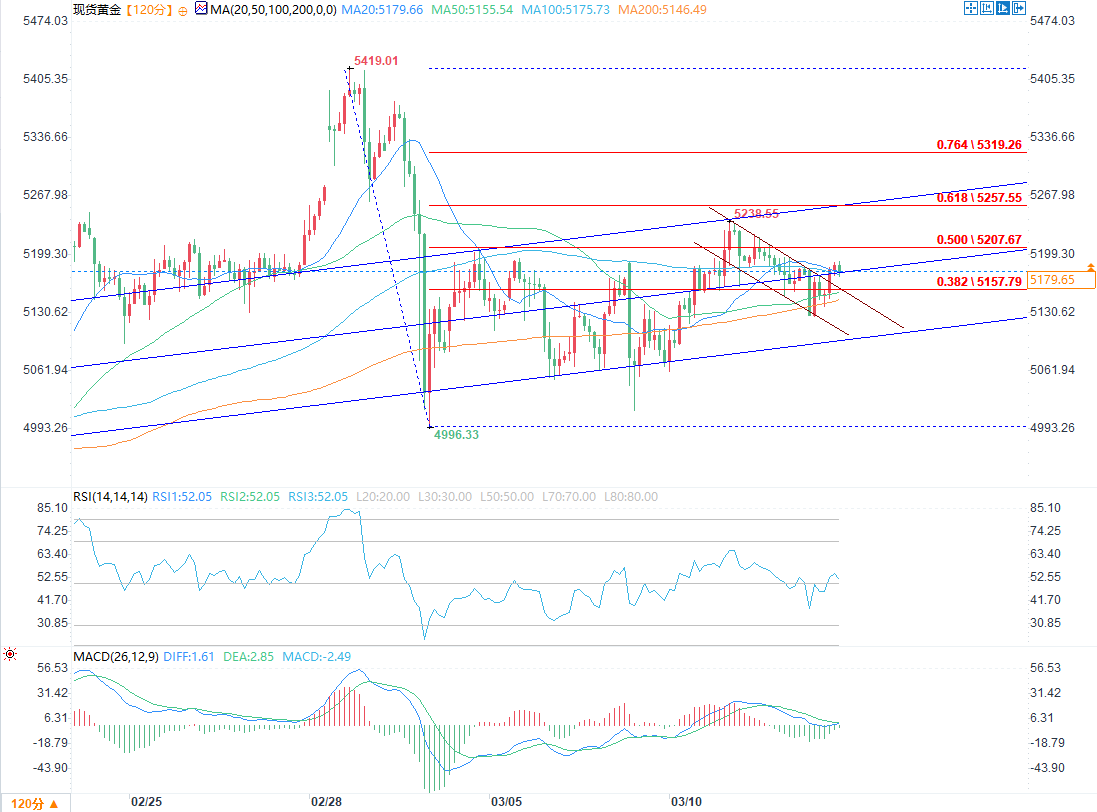
(2-hour chart of spot gold source: EasyForex)
From a short-term perspective, the price action of spot gold this week on the two-hour chart is relatively clear. After testing the 50% retracement level following the previous sharp decline, the price pulled back, but overall it maintains a slightly bullish, oscillating pattern. The previous rebound has broken above the downtrend structure, and the price has briefly climbed back above the uptrend line, indicating that short-term downward momentum has weakened.
The most significant resistance level remains around 5200, which is both a psychological level and the 50% retracement of the previous downtrend. If the price can break through this level effectively, the next upside target could be around 5250, which coincides with the upper trendline and the 61.8% Fibonacci retracement level. Further up is the previous high of 5320.
The key support level is around 5150, where multiple moving averages, including the 20-day and 50-day moving averages, converge, coinciding with the upward trend line and the 38.2% Fibonacci retracement level. Prices have found support in this area multiple times this week, and as long as this level is not decisively broken, the short-term rebound structure is likely to continue.
From an indicator perspective, the 100-period moving average (MA100) and 200-period moving average (MA200) on the two-hour chart are still diverging upwards, indicating a continued bullish medium-term trend. The RSI is currently trading near the neutral zone, without any obvious oversold signal. Although the MACD is still below the zero line, the green bars are gradually shortening, suggesting that bearish momentum is weakening.
In summary, the current gold market appears to be consolidating at high levels. The key in the short term lies in the direction of the breakout between the 5150 support and 5200 resistance levels. If the price can hold above 5150 and regain 5200, the bulls may attempt to push towards 5250 or even higher; however, if 5150 is decisively broken, the market may enter a deeper technical correction.
From an overall structural perspective, gold remains at high levels, but the pace of increase has clearly slowed. The rapid rise previously driven by geopolitical risks and safe-haven demand is gradually transforming into a more complex battle between bulls and bears. As the market begins to reassess US economic data and monetary policy path, gold is experiencing a noticeable tug-of-war at its high levels.
Adjustment in interest rate cut expectations: Inflation resilience suppresses short-term sentiment.
Recent US inflation data has become a key variable influencing the market. Data shows that the US Consumer Price Index (CPI) for February was generally in line with market expectations. Although inflation has declined from its previous highs, core inflation still shows some resilience.
This result has cooled market expectations for a rapid rate cut by the Federal Reserve in the short term. The Fed is likely to maintain a relatively cautious stance until inflation fully returns to its policy target. The repricing of the interest rate path has reduced some investors' willingness to chase gold prices higher in the short term, and some early profit-taking funds have begun to adjust their positions, leading to a temporary pullback in gold prices from their highs.
Meanwhile, as expectations of interest rate cuts have cooled, US Treasury yields have recently rebounded, and the US dollar index has also strengthened. For gold, this creates a typical "opportunity cost effect." Since gold itself does not generate interest income, the attractiveness of holding gold decreases relatively when bond yields rise; while a stronger dollar increases the cost for non-dollar investors to buy gold, putting some downward pressure on gold prices.
Geopolitical premiums are cooling, and market logic is returning to macroeconomics.
Although tensions in the Middle East have not fully eased, market sensitivity to related news has noticeably decreased. The previous surge in gold prices largely reflected a geopolitical risk premium, and as the conflict entered a phase of sustained but non-escalating conflict, market sentiment gradually calmed.
Meanwhile, international oil prices have recently risen again due to geopolitical factors, which theoretically could strengthen inflation expectations and benefit gold. However, in the current environment, rising oil prices may instead reinforce market expectations that the Federal Reserve will maintain high interest rates. If energy prices remain high, the pace of inflation decline may be affected, making monetary policy more cautious about interest rate cuts.
Therefore, with interest rate expectations rising again, gold is facing some pressure in the short term.
From a funding perspective: Profit-taking at high levels exacerbates volatility.
From a funding perspective, gold's previous continuous rise and record highs led to a large accumulation of long positions in the market. When macroeconomic expectations subtly shifted, some investors chose to lock in profits at higher levels, which pushed gold prices into a technical correction phase.
However, most institutions still believe that the current pullback is more likely a phase of consolidation within a bull market than a trend reversal. Continued gold purchases by global central banks, geopolitical risks, and the potential for future monetary easing cycles continue to provide medium- to long-term support for gold.
Technical Structure: Awaiting a directional breakout within a key range.
(2-hour chart of spot gold source: EasyForex)
From a short-term perspective, the price action of spot gold this week on the two-hour chart is relatively clear. After testing the 50% retracement level following the previous sharp decline, the price pulled back, but overall it maintains a slightly bullish, oscillating pattern. The previous rebound has broken above the downtrend structure, and the price has briefly climbed back above the uptrend line, indicating that short-term downward momentum has weakened.
The most significant resistance level remains around 5200, which is both a psychological level and the 50% retracement of the previous downtrend. If the price can break through this level effectively, the next upside target could be around 5250, which coincides with the upper trendline and the 61.8% Fibonacci retracement level. Further up is the previous high of 5320.
The key support level is around 5150, where multiple moving averages, including the 20-day and 50-day moving averages, converge, coinciding with the upward trend line and the 38.2% Fibonacci retracement level. Prices have found support in this area multiple times this week, and as long as this level is not decisively broken, the short-term rebound structure is likely to continue.
From an indicator perspective, the 100-period moving average (MA100) and 200-period moving average (MA200) on the two-hour chart are still diverging upwards, indicating a continued bullish medium-term trend. The RSI is currently trading near the neutral zone, without any obvious oversold signal. Although the MACD is still below the zero line, the green bars are gradually shortening, suggesting that bearish momentum is weakening.
In summary, the current gold market appears to be consolidating at high levels. The key in the short term lies in the direction of the breakout between the 5150 support and 5200 resistance levels. If the price can hold above 5150 and regain 5200, the bulls may attempt to push towards 5250 or even higher; however, if 5150 is decisively broken, the market may enter a deeper technical correction.
- Risk Warning and Disclaimer
- The market involves risk, and trading may not be suitable for all investors. This article is for reference only and does not constitute personal investment advice, nor does it take into account certain users’ specific investment objectives, financial situation, or other needs. Any investment decisions made based on this information are at your own risk.