Experts' painful truth: US Treasury bonds are unreliable! Global investors are forced to buy them against their will.
2026-03-13 10:32:18
Foreign investors' holdings of U.S. Treasury bonds have fallen from 50% in the early 2010s to about 30%, but there are still no obvious signs of them leaving, mainly due to the lack of alternative assets with equivalent depth and liquidity globally. Martha Kimbell, executive director of the Yale Budget Lab, used a vivid analogy at a Senate hearing to describe the current awkward situation in the U.S. Treasury market: U.S. Treasury bonds are like the boyfriend in a romantic movie who "knows something's wrong but stays with him anyway," because there are no better options.
Kimbell points out that the US Treasury market is facing a paradoxical situation of "decreasing attractiveness but investors being forced to continue holding." The continued deterioration of the deficit, the explosive growth of interest payments, and doubts about long-term fiscal sustainability are making investors increasingly uneasy .

Foreign investors’ share of U.S. Treasury bonds has fallen from 50% in the early 2010s to about 30%, indicating growing concerns about the sustainability of U.S. fiscal policy.
Over the next decade, the US deficit as a percentage of GDP will average over 6% annually, far exceeding the international warning line of 3%. This persistently high deficit will further increase the debt burden, raise fiscal risk premiums, and make it more likely that long-term US Treasury yields will rise than fall.
The United States' annual interest payments have exceeded $1 trillion and are projected to more than double to $2 trillion by 2036. In a high-interest-rate environment, debt interest payments are growing exponentially, becoming one of the biggest sources of pressure on the federal budget.
The surge in interest expenses has squeezed resources in other areas, further worsening the fiscal structure and creating a vicious cycle.
Kimbell points out that the Eurozone is making initial efforts to attract investors, attempting to play the role of a "well-meaning firefighter." However, the depth, liquidity, and global acceptance of the Eurozone bond market are still far inferior to those of US Treasuries. US Treasuries are unlikely to be replaced in the short term, and although investors are dissatisfied, they have "no choice" but to continue holding them.
Budget experts are urging Congress to implement a two-pronged approach of tax increases and spending cuts as soon as possible. While bipartisan senators recently proposed establishing a Finance Committee to provide political cover, experts admit that significant cuts are unlikely to materialize without a major crisis. The UK bond market crash in 2022, Japan's currency and bond market collapse last year, and the political turmoil in France serve as cautionary tales. Substantial fiscal reforms are only likely to be driven by severe market volatility or an imminent debt ceiling crisis.
The conflict with Iran has further increased the US deficit. The Pentagon said the cost in the first six days reached $11.3 billion; Oxford Economics predicts the deficit will reach $2.13 trillion this fiscal year, rising to 6.6% of GDP. The deficit will widen further if a war spending bill is passed.
Under the dual pressures of war spending and high oil prices, the issue of US fiscal sustainability has become more prominent, and market concerns about the long-term risk premium of US Treasury bonds continue to rise .
The attractiveness of US Treasury bonds has diminished, but investors currently have "no other choice" but to continue holding them. The Yale Budget Lab vividly describes this awkward situation as "a boyfriend who knows something is wrong but stays with his girlfriend." Foreign holdings have fallen from 50% to 30%, the annual deficit is averaging over 6% of the warning line, and annual interest payments have exceeded $1 trillion and are expected to double. Budget experts are urging tax increases and spending cuts, but these are unlikely to be implemented before the crisis.
The conflict in Iran is further pushing up the deficit, which may reach $2.13 trillion (6.6% of GDP) this fiscal year, exacerbating the problem of fiscal sustainability. Investors need to be wary of rising long-term risk premiums and the likelihood of US Treasury yields falling, and pay attention to the progress of fiscal reforms and the evolution of geopolitical conflicts. The market consensus is that the long-term attractiveness of US Treasuries continues to weaken.
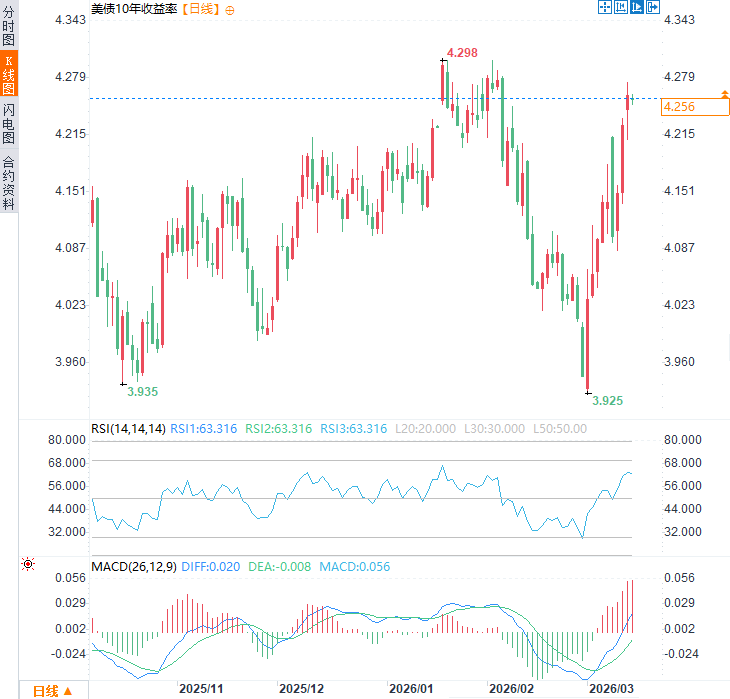
(Daily chart of 10-year US Treasury yield, source: EasyTrade)
At 10:31 Beijing time, the yield on 10-year US Treasury bonds is currently at 4.26%.
Kimbell points out that the US Treasury market is facing a paradoxical situation of "decreasing attractiveness but investors being forced to continue holding." The continued deterioration of the deficit, the explosive growth of interest payments, and doubts about long-term fiscal sustainability are making investors increasingly uneasy .
Foreign shareholding decreased from 50% to 30%, and the annual deficit exceeded the warning line of 6%.
Foreign investors’ share of U.S. Treasury bonds has fallen from 50% in the early 2010s to about 30%, indicating growing concerns about the sustainability of U.S. fiscal policy.
Over the next decade, the US deficit as a percentage of GDP will average over 6% annually, far exceeding the international warning line of 3%. This persistently high deficit will further increase the debt burden, raise fiscal risk premiums, and make it more likely that long-term US Treasury yields will rise than fall.
Annual interest expenses have exceeded 1 trillion yuan, and may double to 2 trillion yuan by 2036.
The United States' annual interest payments have exceeded $1 trillion and are projected to more than double to $2 trillion by 2036. In a high-interest-rate environment, debt interest payments are growing exponentially, becoming one of the biggest sources of pressure on the federal budget.
The surge in interest expenses has squeezed resources in other areas, further worsening the fiscal structure and creating a vicious cycle.
The Eurozone is trying to attract investors
Kimbell points out that the Eurozone is making initial efforts to attract investors, attempting to play the role of a "well-meaning firefighter." However, the depth, liquidity, and global acceptance of the Eurozone bond market are still far inferior to those of US Treasuries. US Treasuries are unlikely to be replaced in the short term, and although investors are dissatisfied, they have "no choice" but to continue holding them.
Budget experts urge tax increases and spending cuts, but these measures are unlikely to be implemented before the crisis.
Budget experts are urging Congress to implement a two-pronged approach of tax increases and spending cuts as soon as possible. While bipartisan senators recently proposed establishing a Finance Committee to provide political cover, experts admit that significant cuts are unlikely to materialize without a major crisis. The UK bond market crash in 2022, Japan's currency and bond market collapse last year, and the political turmoil in France serve as cautionary tales. Substantial fiscal reforms are only likely to be driven by severe market volatility or an imminent debt ceiling crisis.
The conflict with Iran is pushing up the deficit, which may reach 2.13 trillion this fiscal year, accounting for 6.6% of GDP.
The conflict with Iran has further increased the US deficit. The Pentagon said the cost in the first six days reached $11.3 billion; Oxford Economics predicts the deficit will reach $2.13 trillion this fiscal year, rising to 6.6% of GDP. The deficit will widen further if a war spending bill is passed.
Under the dual pressures of war spending and high oil prices, the issue of US fiscal sustainability has become more prominent, and market concerns about the long-term risk premium of US Treasury bonds continue to rise .
Editor's Summary
The attractiveness of US Treasury bonds has diminished, but investors currently have "no other choice" but to continue holding them. The Yale Budget Lab vividly describes this awkward situation as "a boyfriend who knows something is wrong but stays with his girlfriend." Foreign holdings have fallen from 50% to 30%, the annual deficit is averaging over 6% of the warning line, and annual interest payments have exceeded $1 trillion and are expected to double. Budget experts are urging tax increases and spending cuts, but these are unlikely to be implemented before the crisis.
The conflict in Iran is further pushing up the deficit, which may reach $2.13 trillion (6.6% of GDP) this fiscal year, exacerbating the problem of fiscal sustainability. Investors need to be wary of rising long-term risk premiums and the likelihood of US Treasury yields falling, and pay attention to the progress of fiscal reforms and the evolution of geopolitical conflicts. The market consensus is that the long-term attractiveness of US Treasuries continues to weaken.
(Daily chart of 10-year US Treasury yield, source: EasyTrade)
At 10:31 Beijing time, the yield on 10-year US Treasury bonds is currently at 4.26%.
- Risk Warning and Disclaimer
- The market involves risk, and trading may not be suitable for all investors. This article is for reference only and does not constitute personal investment advice, nor does it take into account certain users’ specific investment objectives, financial situation, or other needs. Any investment decisions made based on this information are at your own risk.