March 16th Financial Breakfast: Gold prices under pressure test the $5000 mark; Iran sets two conditions for ending the war; US oil returns above $100.
2026-03-16 07:16:52
On Monday (March 16, Beijing time) in early Asian trading, spot gold was trading around $5,000 per ounce, pressured by market expectations that the Federal Reserve would keep interest rates unchanged this week and the continued strengthening of the US dollar; US crude oil rose, trading around $100 per barrel, as Iran put forward two conditions for ending the war, Iran's Supreme Leader made another tough statement, and US oil giants warned the government that the energy crisis could worsen.

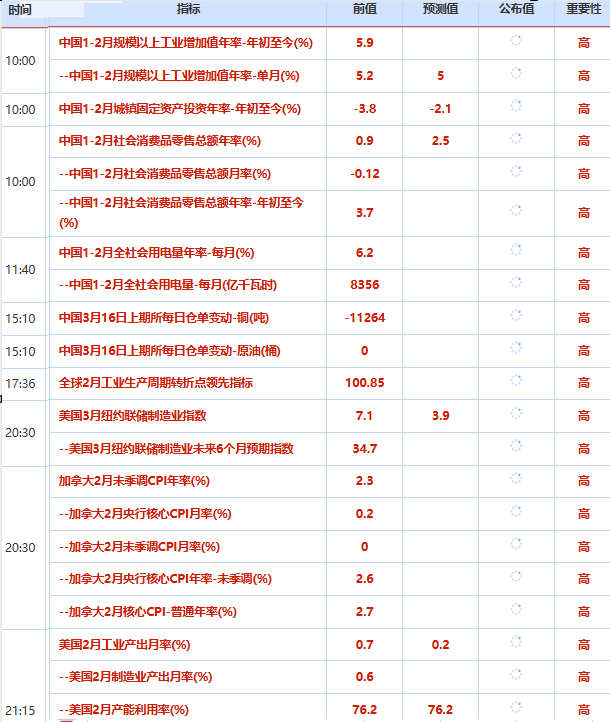
U.S. stocks closed lower on Friday and continued to decline this week, mainly due to concerns about inflation stemming from the Iran war. The Dow Jones Industrial Average fell 0.26%, the S&P 500 fell 0.61%, the Nasdaq Composite fell 0.93%, and the Russell 2000 small-cap index closed at its lowest point so far this year.
Despite US President Trump's temporary easing of sanctions on Russian oil to alleviate supply concerns, crude oil prices have risen sharply. Trump has vowed to launch a major attack on Iran, and the conflict has spread to Lebanon, Kuwait, Iraq, the UAE, Bahrain, and Oman, prompting Iran to tighten its control over the Strait of Hormuz. The International Energy Agency (IEA) says the war would cause the most severe disruption to global crude oil supplies in history.
Meanwhile, the U.S. Commerce Department significantly lowered its fourth-quarter GDP growth forecast, and the Personal Consumption Expenditures (PCE) report showed that the Fed's preferred inflation gauge remained high and demand for durable goods was weakening. Despite the weak economic data, the market expects the Fed to keep key interest rates unchanged at this week's meeting as soaring oil prices further push up inflation, reducing the likelihood of a rate cut in the short term.
Among the 11 major sectors of the S&P 500, technology stocks suffered the biggest decline, utilities stocks saw the biggest gains, and the financial sector fell 3.4% last week due to concerns about credit quality.
In terms of individual stocks, design software maker Adobe fell 7.6% as its longtime CEO announced his departure, raising concerns about the disruptive impact of artificial intelligence. Social media giant Meta Platforms fell 3.8% after reports that the release of its AI model "Avocado" was delayed until at least May.
Gold prices fell slightly on Friday, marking their second consecutive weekly decline. Spot gold fell 0.5% to $5,052.15 per ounce, after a nearly 3% drop last week. U.S. gold futures closed down 1.3% at $5,061.70, mainly due to a stronger dollar that rose to a near four-month high and inflation concerns stemming from the Iran war. These factors dampened market expectations for interest rate cuts.
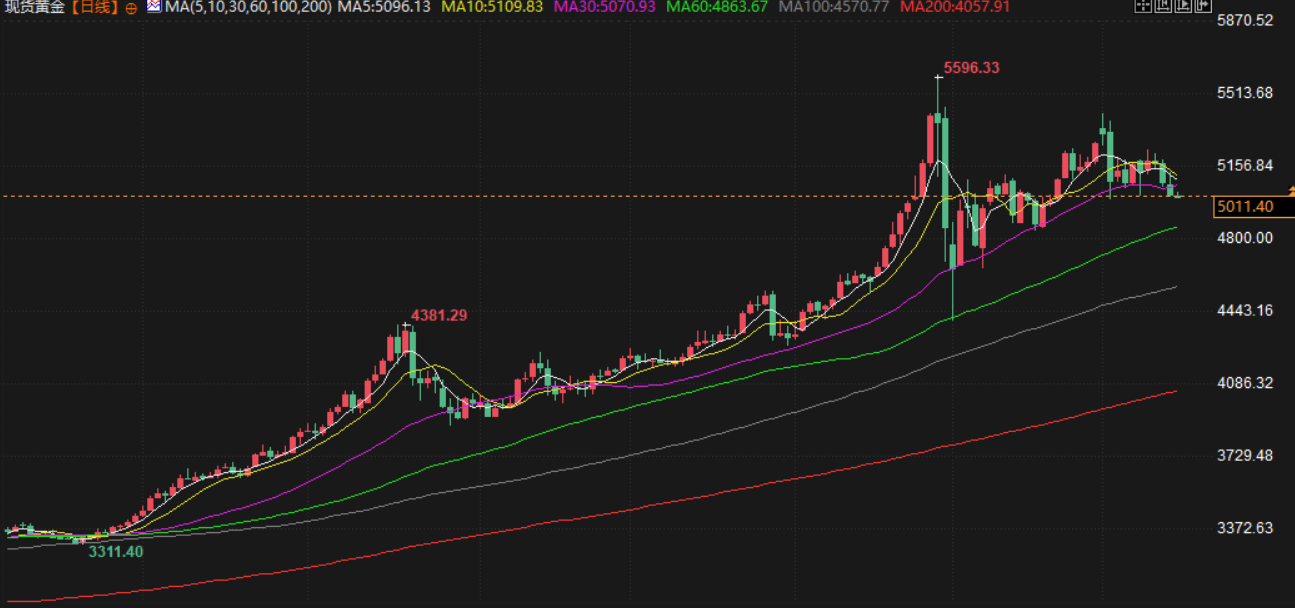
Independent precious metals traders say that although the market remains bullish on the long-term outlook for gold, prices have continued to fall since the outbreak of the conflict in Iran. Commerzbank also pointed out that market expectations of a tightening monetary policy are the main reason for the pressure on gold prices. Although gold is considered a traditional tool for hedging against inflation and uncertain times, rising interest rates usually diminish its appeal.
Data showed that U.S. consumer spending rose slightly more than expected in January, and coupled with continued strong core inflation and tensions in the Middle East, this reinforced economists' view that the Federal Reserve will not resume interest rate cuts for a considerable period of time.
Meanwhile, US President Trump stated that he would take "very strong action" against Iran "within the next week," and although oil prices have retreated somewhat, they are still expected to rise this week. In addition, with the resumption of some flights to Dubai, the outflow of gold from this major global trading hub last week has partially resumed. In other precious metals, spot silver fell 3.3% to $81.00, platinum fell 4% to $2047.20, and palladium fell 2.5% to $1569.00, and all three metals are expected to record weekly declines this week.
Oil prices climbed on Friday, with the Strait of Hormuz remaining blocked. Brent crude futures for May settled at $103.14 a barrel, up 2.67%, while U.S. crude futures for April settled at $98.71 a barrel, up 3.11%. Brent crude rose 11.27% and U.S. crude rose 8% last week.
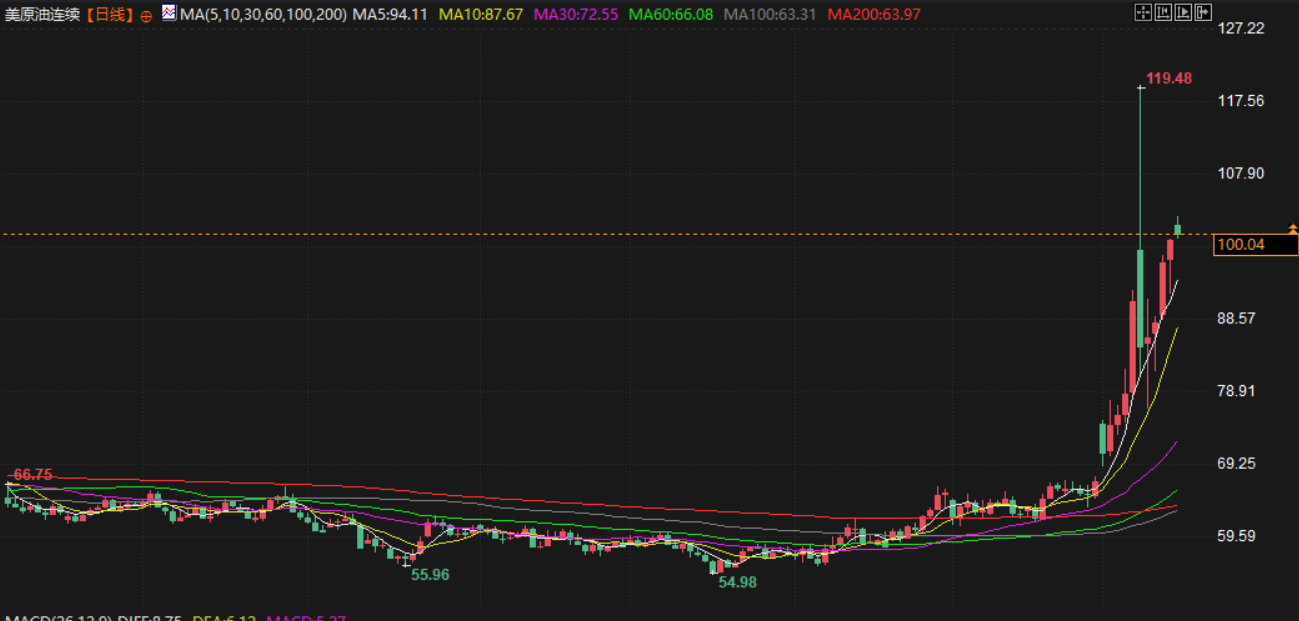
Iran's new Supreme Leader, Mojtaba Khamenei, stated that Iran will continue the fight and maintain its blockade of the Strait of Hormuz as a tool against the United States and Israel. Meanwhile, Iraqi security officials revealed that two oil tankers anchored in Iraqi waters were attacked by Iranian vessels carrying explosives, and the country's oil ports have completely ceased operations. To alleviate supply shortages, the United States issued a 30-day license allowing countries to purchase Russian crude oil and petroleum products stranded at sea. The US Treasury Secretary stated that this was a step towards stabilizing the global energy market, which has been destabilized by war. A Russian presidential envoy revealed that this move would involve approximately 100 million barrels of Russian crude oil. Analysts pointed out that while this did not bring more supply to the market, it did reduce friction. The biggest concern in the market is that severe damage to oil infrastructure could lead to long-term supply losses.
The dollar climbed across the board on Friday, reaching its highest level since November and marking its second consecutive weekly gain. This was mainly due to the Middle East conflict prompting investors to flock to safe-haven assets and putting pressure on energy-sensitive currencies such as the euro.
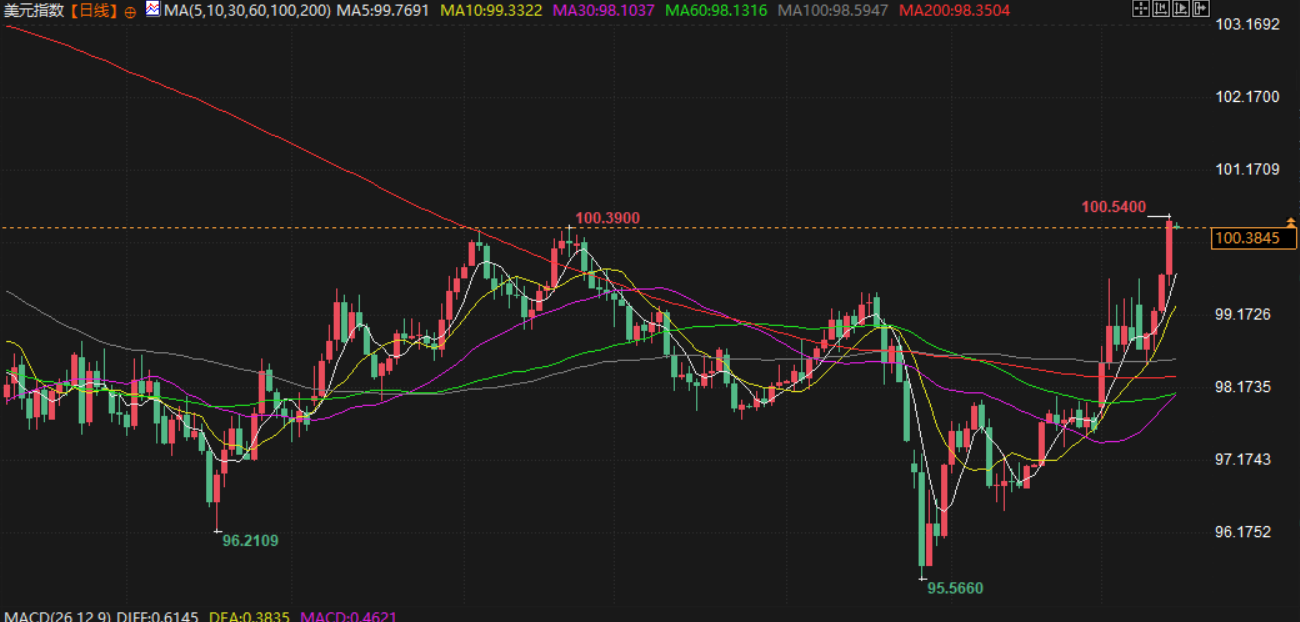
President Trump stated that the United States will take very strong action against Iran within the next week, following his recent granting of a 30-day partial waiver for Russian oil purchases under sanctions to ease oil prices. Market strategists point out that global investors are reducing their cross-border exposure and shifting funds to safe-haven assets, while also selling off currencies of net energy importers, as a sharp rise in oil prices will severely impact the economies of Japan and the Eurozone, which are highly dependent on crude oil imports, while the United States, as a net exporter of crude oil, will be relatively less affected.
Data showed that U.S. consumer spending rose slightly more than expected in January, coupled with persistently high core inflation and protracted conflicts in the Middle East, reinforcing economists' view that the Federal Reserve will not resume interest rate cuts for a considerable period. The euro fell 0.6% against the dollar to $1.14395 as investors awaited Thursday's European Central Bank policy meeting. Economists are cautious about tightening monetary policy in economies reliant on fuel imports, prompting Rabobank to lower its euro/dollar forecast.
The dollar rose 0.2% against the yen to 159.67 yen, after earlier hitting its highest level since July 2024. Japan's finance minister said he was prepared to take necessary measures to deal with sharp fluctuations in the currency market. Strategists said policymakers are cautious about rising import bills due to a weaker exchange rate, and pressure to intervene to support the yen may increase in the future.
The probability of the Federal Reserve keeping interest rates unchanged this week is 99.2%.
According to CME's "FedWatch": the probability of the Federal Reserve cutting interest rates by 25 basis points this week is 0.8%, while the probability of keeping rates unchanged is 99.2%. The probability of a cumulative 25 basis point rate cut by the Fed by April is 6.9%, the probability of keeping rates unchanged is 93%, and the probability of a cumulative 50 basis point rate cut is 0%. The probability of a cumulative 25 basis point rate cut by June is 24.7%.
Iranian senior commander: There are two conditions for ending the war
According to Iranian sources on the 14th, Major General Mohsen Rezaei, a senior commander of the Iranian Islamic Revolutionary Guard Corps, said that Iran would consider ending the war under two conditions: first, Iran would recover all its losses; and second, the United States would leave the Persian Gulf. (CCTV News)
The U.S. Commerce Department's withdrawal of proposed AI chip export rules reflects internal government disagreements over a strategy for global dominance.
According to foreign media reports, the U.S. Commerce Department withdrew a proposed rule on Friday regarding the export of artificial intelligence (AI) chips. The draft rule, originally intended to regulate global access to AI chips, was submitted to other agencies for comment at the end of February. The website did not specify the reason for the withdrawal, and a Commerce Department spokesperson has not yet responded. This withdrawal marks another setback for the Trump administration in rescinding and replacing the AI chip export framework released by the Biden administration in January 2025. That rule had considered making foreign investment in or security guarantees for U.S. data centers a condition for approving the export of 200,000 or more chips. A former official stated on Friday that the withdrawal of the latest proposed rule likely reflects internal government disagreements on how to achieve global AI dominance and address national security concerns.
The United States has initiated a large-scale release of its strategic petroleum reserves, with the first batch of 86 million barrels to enter the market.
The Trump administration has formally initiated the process of massively utilizing the U.S. emergency petroleum reserves, issuing a request to exchange 86 million barrels of crude oil. The Department of Energy stated in a statement Friday that oil drawn from the Strategic Petroleum Reserve, as part of the 172 million barrel release plan announced Wednesday, is expected to begin flowing into the market by the end of next week. This release of oil reserves is expected to take four months to complete and is part of a coordinated 400 million barrel action plan with other countries. Under the exchange terms, companies will return the loaned oil to the Department of Energy in the future, paying an additional amount as a premium. The Department of Energy previously stated that the Trump administration had planned to replenish the Strategic Petroleum Reserve with approximately 200 million barrels of oil over the next year, which would be 20% more than the reserves being used this time.
The U.S. Interior Secretary confirmed that the government had discussed intervening in the oil futures market to lower oil prices.
U.S. Interior Secretary Doug Bergham stated that the Trump administration had discussed curbing oil prices by participating in oil futures market trading. However, Bergham said he was unsure whether the U.S. had actually intervened in the market. He said on Saturday, "There have indeed been discussions. There are a lot of smart people in this administration—a lot of smart people in the energy trading market. Trying to manipulate and lower prices through intervention would require a huge amount of money. That's all I can say about that." Meanwhile, the head of the company that regulates West Texas Intermediate (WTI) crude oil futures trading warned that if the federal government began trading derivatives to suppress crude oil prices, it would trigger a "biblical disaster."
Iran warned that an attack on Hargh Island would trigger a "red line" conflict, prompting the US to temporarily refrain from striking energy facilities.
According to the Wall Street Journal, Iran has warned Gulf states that the attack on Harqa Island was a "red line" that could trigger retaliatory strikes against the energy infrastructure of its Arab neighbors. Therefore, while the US attack on the island last Friday may impact Iran's oil export capacity, it could also escalate the conflict further. Gulf states have recently attempted to lobby Washington against attacks on Harqa Island and energy facilities within Iran. In response, the US has told Gulf diplomats that it will avoid striking Iranian energy facilities and will pressure Israel to refrain from such actions. Trump previously stated that the US "destroyed every military target on Harqa Island, the jewel in Iran's crown," but did not target the island's oil infrastructure.
US oil giants warn government energy crisis could worsen
On March 15, local time, according to the Wall Street Journal, executives in the U.S. oil industry recently warned the Trump administration that the energy crisis triggered by the situation in Iran is likely to escalate further. Sources familiar with the matter revealed that during a series of White House meetings on March 11 and recent communications with Energy Secretary Wright and Interior Secretary Bergham, the CEOs of ExxonMobil, Chevron, and ConocoPhillips warned that disruptions to energy transport through the Strait of Hormuz will continue to cause significant volatility in the energy market. (CCTV International News)
The United States is reportedly planning to announce the formation of a "maritime escort coalition" in the Strait of Hormuz.
According to a report by the Wall Street Journal on the 15th, the US government plans to announce the formation of a so-called "maritime escort coalition" in the Strait of Hormuz soon. Informed US officials stated that some countries have agreed to provide escorts for ships passing through this crucial international shipping lane for oil. These officials indicated that whether the escort operation will begin before the US and Israel cease their large-scale military operations against Iran is still under discussion. (Xinhua)
Iran's Supreme Leader reiterated that he will seek reparations from the enemy.
Iran's Supreme Leader Mojtaba posted a message late on the 15th on his social media account, Telegram, reiterating that Iran will "demand reparations from its enemies" regardless of the circumstances. If the enemies refuse to pay, Iran will confiscate assets of equivalent value; if confiscation is impossible, Iran will destroy assets of equal value. (CCTV News)
State Grid's fixed asset investment increased by over 80% year-on-year in the first two months.
According to the State Grid Corporation of China, building on a strong start in January, the company accelerated the construction of power grids at all levels in February, resulting in a rapid increase in fixed asset investment. Statistics show that from January to February, cumulative fixed asset investment reached 75.7 billion yuan, a year-on-year increase of 80.6%, demonstrating a significant supporting role for power grid infrastructure and a strong investment-driven effect. (State Grid)
Key Focus Today
stock market
U.S. stocks closed lower on Friday and continued to decline this week, mainly due to concerns about inflation stemming from the Iran war. The Dow Jones Industrial Average fell 0.26%, the S&P 500 fell 0.61%, the Nasdaq Composite fell 0.93%, and the Russell 2000 small-cap index closed at its lowest point so far this year.
Despite US President Trump's temporary easing of sanctions on Russian oil to alleviate supply concerns, crude oil prices have risen sharply. Trump has vowed to launch a major attack on Iran, and the conflict has spread to Lebanon, Kuwait, Iraq, the UAE, Bahrain, and Oman, prompting Iran to tighten its control over the Strait of Hormuz. The International Energy Agency (IEA) says the war would cause the most severe disruption to global crude oil supplies in history.
Meanwhile, the U.S. Commerce Department significantly lowered its fourth-quarter GDP growth forecast, and the Personal Consumption Expenditures (PCE) report showed that the Fed's preferred inflation gauge remained high and demand for durable goods was weakening. Despite the weak economic data, the market expects the Fed to keep key interest rates unchanged at this week's meeting as soaring oil prices further push up inflation, reducing the likelihood of a rate cut in the short term.
Among the 11 major sectors of the S&P 500, technology stocks suffered the biggest decline, utilities stocks saw the biggest gains, and the financial sector fell 3.4% last week due to concerns about credit quality.
In terms of individual stocks, design software maker Adobe fell 7.6% as its longtime CEO announced his departure, raising concerns about the disruptive impact of artificial intelligence. Social media giant Meta Platforms fell 3.8% after reports that the release of its AI model "Avocado" was delayed until at least May.
Gold Market
Gold prices fell slightly on Friday, marking their second consecutive weekly decline. Spot gold fell 0.5% to $5,052.15 per ounce, after a nearly 3% drop last week. U.S. gold futures closed down 1.3% at $5,061.70, mainly due to a stronger dollar that rose to a near four-month high and inflation concerns stemming from the Iran war. These factors dampened market expectations for interest rate cuts.
Independent precious metals traders say that although the market remains bullish on the long-term outlook for gold, prices have continued to fall since the outbreak of the conflict in Iran. Commerzbank also pointed out that market expectations of a tightening monetary policy are the main reason for the pressure on gold prices. Although gold is considered a traditional tool for hedging against inflation and uncertain times, rising interest rates usually diminish its appeal.
Data showed that U.S. consumer spending rose slightly more than expected in January, and coupled with continued strong core inflation and tensions in the Middle East, this reinforced economists' view that the Federal Reserve will not resume interest rate cuts for a considerable period of time.
Meanwhile, US President Trump stated that he would take "very strong action" against Iran "within the next week," and although oil prices have retreated somewhat, they are still expected to rise this week. In addition, with the resumption of some flights to Dubai, the outflow of gold from this major global trading hub last week has partially resumed. In other precious metals, spot silver fell 3.3% to $81.00, platinum fell 4% to $2047.20, and palladium fell 2.5% to $1569.00, and all three metals are expected to record weekly declines this week.
oil market
Oil prices climbed on Friday, with the Strait of Hormuz remaining blocked. Brent crude futures for May settled at $103.14 a barrel, up 2.67%, while U.S. crude futures for April settled at $98.71 a barrel, up 3.11%. Brent crude rose 11.27% and U.S. crude rose 8% last week.
Iran's new Supreme Leader, Mojtaba Khamenei, stated that Iran will continue the fight and maintain its blockade of the Strait of Hormuz as a tool against the United States and Israel. Meanwhile, Iraqi security officials revealed that two oil tankers anchored in Iraqi waters were attacked by Iranian vessels carrying explosives, and the country's oil ports have completely ceased operations. To alleviate supply shortages, the United States issued a 30-day license allowing countries to purchase Russian crude oil and petroleum products stranded at sea. The US Treasury Secretary stated that this was a step towards stabilizing the global energy market, which has been destabilized by war. A Russian presidential envoy revealed that this move would involve approximately 100 million barrels of Russian crude oil. Analysts pointed out that while this did not bring more supply to the market, it did reduce friction. The biggest concern in the market is that severe damage to oil infrastructure could lead to long-term supply losses.
Foreign exchange market
The dollar climbed across the board on Friday, reaching its highest level since November and marking its second consecutive weekly gain. This was mainly due to the Middle East conflict prompting investors to flock to safe-haven assets and putting pressure on energy-sensitive currencies such as the euro.
President Trump stated that the United States will take very strong action against Iran within the next week, following his recent granting of a 30-day partial waiver for Russian oil purchases under sanctions to ease oil prices. Market strategists point out that global investors are reducing their cross-border exposure and shifting funds to safe-haven assets, while also selling off currencies of net energy importers, as a sharp rise in oil prices will severely impact the economies of Japan and the Eurozone, which are highly dependent on crude oil imports, while the United States, as a net exporter of crude oil, will be relatively less affected.
Data showed that U.S. consumer spending rose slightly more than expected in January, coupled with persistently high core inflation and protracted conflicts in the Middle East, reinforcing economists' view that the Federal Reserve will not resume interest rate cuts for a considerable period. The euro fell 0.6% against the dollar to $1.14395 as investors awaited Thursday's European Central Bank policy meeting. Economists are cautious about tightening monetary policy in economies reliant on fuel imports, prompting Rabobank to lower its euro/dollar forecast.
The dollar rose 0.2% against the yen to 159.67 yen, after earlier hitting its highest level since July 2024. Japan's finance minister said he was prepared to take necessary measures to deal with sharp fluctuations in the currency market. Strategists said policymakers are cautious about rising import bills due to a weaker exchange rate, and pressure to intervene to support the yen may increase in the future.
International News
The probability of the Federal Reserve keeping interest rates unchanged this week is 99.2%.
According to CME's "FedWatch": the probability of the Federal Reserve cutting interest rates by 25 basis points this week is 0.8%, while the probability of keeping rates unchanged is 99.2%. The probability of a cumulative 25 basis point rate cut by the Fed by April is 6.9%, the probability of keeping rates unchanged is 93%, and the probability of a cumulative 50 basis point rate cut is 0%. The probability of a cumulative 25 basis point rate cut by June is 24.7%.
Iranian senior commander: There are two conditions for ending the war
According to Iranian sources on the 14th, Major General Mohsen Rezaei, a senior commander of the Iranian Islamic Revolutionary Guard Corps, said that Iran would consider ending the war under two conditions: first, Iran would recover all its losses; and second, the United States would leave the Persian Gulf. (CCTV News)
The U.S. Commerce Department's withdrawal of proposed AI chip export rules reflects internal government disagreements over a strategy for global dominance.
According to foreign media reports, the U.S. Commerce Department withdrew a proposed rule on Friday regarding the export of artificial intelligence (AI) chips. The draft rule, originally intended to regulate global access to AI chips, was submitted to other agencies for comment at the end of February. The website did not specify the reason for the withdrawal, and a Commerce Department spokesperson has not yet responded. This withdrawal marks another setback for the Trump administration in rescinding and replacing the AI chip export framework released by the Biden administration in January 2025. That rule had considered making foreign investment in or security guarantees for U.S. data centers a condition for approving the export of 200,000 or more chips. A former official stated on Friday that the withdrawal of the latest proposed rule likely reflects internal government disagreements on how to achieve global AI dominance and address national security concerns.
The United States has initiated a large-scale release of its strategic petroleum reserves, with the first batch of 86 million barrels to enter the market.
The Trump administration has formally initiated the process of massively utilizing the U.S. emergency petroleum reserves, issuing a request to exchange 86 million barrels of crude oil. The Department of Energy stated in a statement Friday that oil drawn from the Strategic Petroleum Reserve, as part of the 172 million barrel release plan announced Wednesday, is expected to begin flowing into the market by the end of next week. This release of oil reserves is expected to take four months to complete and is part of a coordinated 400 million barrel action plan with other countries. Under the exchange terms, companies will return the loaned oil to the Department of Energy in the future, paying an additional amount as a premium. The Department of Energy previously stated that the Trump administration had planned to replenish the Strategic Petroleum Reserve with approximately 200 million barrels of oil over the next year, which would be 20% more than the reserves being used this time.
The U.S. Interior Secretary confirmed that the government had discussed intervening in the oil futures market to lower oil prices.
U.S. Interior Secretary Doug Bergham stated that the Trump administration had discussed curbing oil prices by participating in oil futures market trading. However, Bergham said he was unsure whether the U.S. had actually intervened in the market. He said on Saturday, "There have indeed been discussions. There are a lot of smart people in this administration—a lot of smart people in the energy trading market. Trying to manipulate and lower prices through intervention would require a huge amount of money. That's all I can say about that." Meanwhile, the head of the company that regulates West Texas Intermediate (WTI) crude oil futures trading warned that if the federal government began trading derivatives to suppress crude oil prices, it would trigger a "biblical disaster."
Iran warned that an attack on Hargh Island would trigger a "red line" conflict, prompting the US to temporarily refrain from striking energy facilities.
According to the Wall Street Journal, Iran has warned Gulf states that the attack on Harqa Island was a "red line" that could trigger retaliatory strikes against the energy infrastructure of its Arab neighbors. Therefore, while the US attack on the island last Friday may impact Iran's oil export capacity, it could also escalate the conflict further. Gulf states have recently attempted to lobby Washington against attacks on Harqa Island and energy facilities within Iran. In response, the US has told Gulf diplomats that it will avoid striking Iranian energy facilities and will pressure Israel to refrain from such actions. Trump previously stated that the US "destroyed every military target on Harqa Island, the jewel in Iran's crown," but did not target the island's oil infrastructure.
US oil giants warn government energy crisis could worsen
On March 15, local time, according to the Wall Street Journal, executives in the U.S. oil industry recently warned the Trump administration that the energy crisis triggered by the situation in Iran is likely to escalate further. Sources familiar with the matter revealed that during a series of White House meetings on March 11 and recent communications with Energy Secretary Wright and Interior Secretary Bergham, the CEOs of ExxonMobil, Chevron, and ConocoPhillips warned that disruptions to energy transport through the Strait of Hormuz will continue to cause significant volatility in the energy market. (CCTV International News)
The United States is reportedly planning to announce the formation of a "maritime escort coalition" in the Strait of Hormuz.
According to a report by the Wall Street Journal on the 15th, the US government plans to announce the formation of a so-called "maritime escort coalition" in the Strait of Hormuz soon. Informed US officials stated that some countries have agreed to provide escorts for ships passing through this crucial international shipping lane for oil. These officials indicated that whether the escort operation will begin before the US and Israel cease their large-scale military operations against Iran is still under discussion. (Xinhua)
Iran's Supreme Leader reiterated that he will seek reparations from the enemy.
Iran's Supreme Leader Mojtaba posted a message late on the 15th on his social media account, Telegram, reiterating that Iran will "demand reparations from its enemies" regardless of the circumstances. If the enemies refuse to pay, Iran will confiscate assets of equivalent value; if confiscation is impossible, Iran will destroy assets of equal value. (CCTV News)
Domestic News
State Grid's fixed asset investment increased by over 80% year-on-year in the first two months.
According to the State Grid Corporation of China, building on a strong start in January, the company accelerated the construction of power grids at all levels in February, resulting in a rapid increase in fixed asset investment. Statistics show that from January to February, cumulative fixed asset investment reached 75.7 billion yuan, a year-on-year increase of 80.6%, demonstrating a significant supporting role for power grid infrastructure and a strong investment-driven effect. (State Grid)
- Risk Warning and Disclaimer
- The market involves risk, and trading may not be suitable for all investors. This article is for reference only and does not constitute personal investment advice, nor does it take into account certain users’ specific investment objectives, financial situation, or other needs. Any investment decisions made based on this information are at your own risk.