Trump's tariffs are making a comeback, providing short-term support for the dollar, but the dollar may suffer a "backlash" in the medium term.
2026-03-16 10:19:46
The United States has initiated a new round of Section 301 tariffs, citing "overcapacity" and "trade surplus" as grounds for imposing additional tariffs on several trading partners. This move is seen as a long-term solution to replace the soon-to-expire temporary global tariffs.
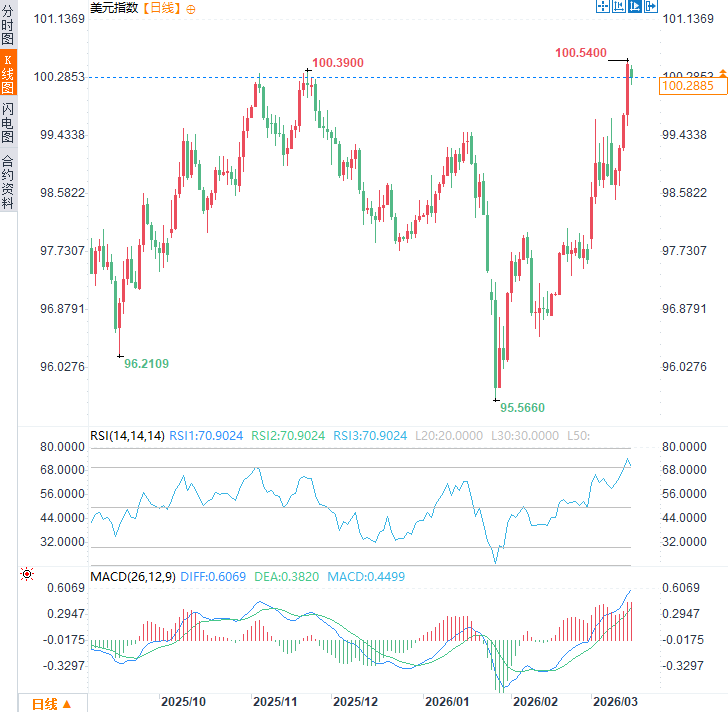
The US dollar has received temporary support due to increased predictability resulting from the policy shift, but medium-term pressure on the dollar may emerge if trading partners react strongly. Global trade uncertainty is intensifying, with supply chain restructuring and inflation risks rising simultaneously. The dollar index fluctuated downwards on Monday, currently trading around 100.25, down about 0.25% on the day, after reaching a nine-and-a-half-month high of 100.54 in the previous trading session.
Following the U.S. Trade Representative's (USTR) launch of a new Section 301 investigation, major trading partners have urged the Trump administration to abide by previously reached tariff agreements.
While countries expressed some understanding of the United States' intention to restore tariff levels before the Supreme Court ruling, they also expressed strong dissatisfaction with the US's investigation based on reasons such as "overcapacity" and "trade surplus," believing that this move deviates from the spirit of existing agreements and foreshadows a new round of legal and trade disputes in the future.
In February of this year, the Supreme Court ruled that tariffs imposed by Trump under the international emergency laws of the 1970s were illegal. Trump subsequently invoked Section 122 of the Trade Act of 1974 to temporarily impose a 10% global tariff, which is about to expire after 150 days.
Last week, USTR Greer initiated an investigation under Section 301, citing “unfair practices” such as structural overcapacity and trade surpluses. This move is seen as a long-term solution to replace temporary tariffs.
Greer stated that the United States seeks policy continuity and intends to abide by previous agreements reached with South Korea, Japan, the European Union, and others, but at the same time emphasized that Section 301 will cover structural excess capacity in the manufacturing sector and unfair trade practices.
If the investigation determines that it harms U.S. commercial interests, it will authorize targeted tariffs. The U.S. hopes to complete the investigation and take action by July, but the formal procedures under Section 301 typically take more than a year, putting significant pressure on the timeline.
South Korea's trade minister said he understands the U.S.'s intention to restore tariffs to pre-Supreme Court ruling levels. This week, the South Korean National Assembly approved a deal under the South Korea-U.S. agreement reached last year to clear obstacles for $350 billion in South Korean investment in the U.S. As part of the agreement, South Korea expects the U.S. to abide by its commitments.
Japan and the EU have also reached similar tariff ceiling agreements with the US (a 15% cap on most EU goods), hoping the US will honor its commitments. Allies are generally concerned that Section 301 will become a new tool to circumvent the agreement.
Singaporean officials and experts strongly refuted the US claim that Singapore enjoys a trade surplus with the US, pointing out that the actual situation is that the US enjoys a trade surplus with Singapore.
Singaporean experts say that "anticipating tariffs" and "being suddenly accused of unfair trade" are two different things, with the latter having a greater impact. The region is generally surprised and confused, believing that the Section 301 charges lack sufficient grounds.
Section 301 requires a formal investigation, public comment period, hearings, and consultations with trading partners, which typically takes more than a year. The U.S. hopes to expedite the process and complete it by July, but the rigidity of the procedures is a significant constraint.
Trading partners may initiate WTO complaints or retaliatory measures, increasing the risk of legal battles. Allies are urging the United States to abide by existing agreements and avoid unilateral actions that could undermine mutual trust. In the short term, global trade uncertainty is heightened, and supply chain restructuring and inflationary pressures may further increase.
The impact of this policy shift on the US dollar has evolved into a complex narrative involving US fiscal credibility, monetary policy independence, and global investor confidence. Initially, under Section 301, the market will focus on the positive aspects of the policy shift (increased predictability), and the dollar may receive temporary support.
However, as the investigation deepens and the reactions of trading partners become clearer, the pressure on the US dollar will gradually emerge if large-scale countermeasures or WTO lawsuits occur.
Following the US initiation of Section 301, major trading partners urged the Trump administration to abide by previous tariff agreements. South Korea, Japan, and the EU understand the US intention to restore tariff levels pre-Supreme Court rulings but expect the US to honor its commitments. Singapore strongly refuted US accusations of a trade surplus, stating that the reality is the opposite.
The USTR initiated its investigation based on overcapacity and trade surplus, which is seen as a long-term solution to replace the temporary 10% global tariff. Allies are concerned that Section 301 could be used as a new tool to circumvent the agreement, increasing the risk of legal battles. The US hopes to complete the investigation by July, but the formal process is lengthy, and trading partners may retaliate or resort to the WTO.
Increased global trade uncertainty could further exacerbate supply chain restructuring and inflationary pressures. Investors should closely monitor the progress of the investigation, responses from trading partners, and the outcome of high-level meetings between China and the US, and be wary of the risk of a new round of tariff wars.
At 10:19 Beijing time, the US dollar index is currently at 100.25.
The US dollar has received temporary support due to increased predictability resulting from the policy shift, but medium-term pressure on the dollar may emerge if trading partners react strongly. Global trade uncertainty is intensifying, with supply chain restructuring and inflation risks rising simultaneously. The dollar index fluctuated downwards on Monday, currently trading around 100.25, down about 0.25% on the day, after reaching a nine-and-a-half-month high of 100.54 in the previous trading session.
The US launches a Section 301 investigation to replace tariffs that were previously eliminated; allies call for adherence to existing agreements.
Following the U.S. Trade Representative's (USTR) launch of a new Section 301 investigation, major trading partners have urged the Trump administration to abide by previously reached tariff agreements.
While countries expressed some understanding of the United States' intention to restore tariff levels before the Supreme Court ruling, they also expressed strong dissatisfaction with the US's investigation based on reasons such as "overcapacity" and "trade surplus," believing that this move deviates from the spirit of existing agreements and foreshadows a new round of legal and trade disputes in the future.
The temporary 10% global tariff is about to expire following the Supreme Court ruling.
In February of this year, the Supreme Court ruled that tariffs imposed by Trump under the international emergency laws of the 1970s were illegal. Trump subsequently invoked Section 122 of the Trade Act of 1974 to temporarily impose a 10% global tariff, which is about to expire after 150 days.
Last week, USTR Greer initiated an investigation under Section 301, citing “unfair practices” such as structural overcapacity and trade surpluses. This move is seen as a long-term solution to replace temporary tariffs.
The USTR may impose tariffs on most of its trading partners, citing overcapacity and trade surpluses.
Greer stated that the United States seeks policy continuity and intends to abide by previous agreements reached with South Korea, Japan, the European Union, and others, but at the same time emphasized that Section 301 will cover structural excess capacity in the manufacturing sector and unfair trade practices.
If the investigation determines that it harms U.S. commercial interests, it will authorize targeted tariffs. The U.S. hopes to complete the investigation and take action by July, but the formal procedures under Section 301 typically take more than a year, putting significant pressure on the timeline.
South Korea understands the US's intentions but expects compliance with the agreement; Japan and the EU hold similar positions.
South Korea's trade minister said he understands the U.S.'s intention to restore tariffs to pre-Supreme Court ruling levels. This week, the South Korean National Assembly approved a deal under the South Korea-U.S. agreement reached last year to clear obstacles for $350 billion in South Korean investment in the U.S. As part of the agreement, South Korea expects the U.S. to abide by its commitments.
Japan and the EU have also reached similar tariff ceiling agreements with the US (a 15% cap on most EU goods), hoping the US will honor its commitments. Allies are generally concerned that Section 301 will become a new tool to circumvent the agreement.
Singapore strongly refutes US accusations of trade surplus.
Singaporean officials and experts strongly refuted the US claim that Singapore enjoys a trade surplus with the US, pointing out that the actual situation is that the US enjoys a trade surplus with Singapore.
Singaporean experts say that "anticipating tariffs" and "being suddenly accused of unfair trade" are two different things, with the latter having a greater impact. The region is generally surprised and confused, believing that the Section 301 charges lack sufficient grounds.
A legal battle may be brewing; the investigation will be lengthy, and the US hopes to complete it by July.
Section 301 requires a formal investigation, public comment period, hearings, and consultations with trading partners, which typically takes more than a year. The U.S. hopes to expedite the process and complete it by July, but the rigidity of the procedures is a significant constraint.
Trading partners may initiate WTO complaints or retaliatory measures, increasing the risk of legal battles. Allies are urging the United States to abide by existing agreements and avoid unilateral actions that could undermine mutual trust. In the short term, global trade uncertainty is heightened, and supply chain restructuring and inflationary pressures may further increase.
The impact of this policy shift on the US dollar has evolved into a complex narrative involving US fiscal credibility, monetary policy independence, and global investor confidence. Initially, under Section 301, the market will focus on the positive aspects of the policy shift (increased predictability), and the dollar may receive temporary support.
However, as the investigation deepens and the reactions of trading partners become clearer, the pressure on the US dollar will gradually emerge if large-scale countermeasures or WTO lawsuits occur.
Editor's Summary
Following the US initiation of Section 301, major trading partners urged the Trump administration to abide by previous tariff agreements. South Korea, Japan, and the EU understand the US intention to restore tariff levels pre-Supreme Court rulings but expect the US to honor its commitments. Singapore strongly refuted US accusations of a trade surplus, stating that the reality is the opposite.
The USTR initiated its investigation based on overcapacity and trade surplus, which is seen as a long-term solution to replace the temporary 10% global tariff. Allies are concerned that Section 301 could be used as a new tool to circumvent the agreement, increasing the risk of legal battles. The US hopes to complete the investigation by July, but the formal process is lengthy, and trading partners may retaliate or resort to the WTO.
Increased global trade uncertainty could further exacerbate supply chain restructuring and inflationary pressures. Investors should closely monitor the progress of the investigation, responses from trading partners, and the outcome of high-level meetings between China and the US, and be wary of the risk of a new round of tariff wars.
At 10:19 Beijing time, the US dollar index is currently at 100.25.
- Risk Warning and Disclaimer
- The market involves risk, and trading may not be suitable for all investors. This article is for reference only and does not constitute personal investment advice, nor does it take into account certain users’ specific investment objectives, financial situation, or other needs. Any investment decisions made based on this information are at your own risk.