The Middle East conflict has driven up energy costs, and expectations for a Federal Reserve rate cut have continued to slow, causing gold to fall below the $5,000 mark.
2026-03-16 09:27:30
Gold prices retreated during Monday's Asian morning trading session. Spot gold (XAU/USD) fell to around $4,980 at one point. Despite continued tensions in the Middle East, gold failed to continue its previous safe-haven rally and instead faced significant selling pressure at higher levels.
The market's primary focus remains on developments in the Middle East. Military action by the US and Israel against Iran continued to escalate over the weekend. According to public reports, the US military launched strikes on Kharg Island, home to key Iranian energy facilities and a crucial hub for Iranian oil exports. The market widely believes that approximately 90% of Iran's oil exports pass through this region , and this event has rapidly heightened tensions in the energy market.

Meanwhile, Iran warned that it might retaliate against US-linked oil facilities if the conflict escalates. This significantly increased energy supply risks, causing international oil prices to rise sharply in early trading this week.
While geopolitical conflicts typically increase demand for gold as a safe haven, the current market structure has undergone more complex changes. Rising energy prices are fueling inflation expectations, which indirectly impacts the gold market. Higher oil prices mean higher global energy costs, and the market is beginning to worry about potentially renewed inflationary pressures.
As inflation expectations rise, market assessments of US monetary policy are also shifting. Investors are increasingly believing that the Federal Reserve may not cut interest rates as quickly as previously anticipated, leading to a renewed rise in US interest rate expectations. Since gold itself does not generate interest income, its investment appeal tends to decrease when interest rate expectations rise.
From a policy perspective, the Trump administration has stated that it expects the conflict with Iran to end within the next few weeks , or even sooner. However, the Israeli military has indicated that its military operations could last at least three weeks . This difference in policy expectations has led to significant divergence in market views regarding the duration of the conflict and has exacerbated uncertainty in financial markets.
At the macro level, the gold market is currently caught between two forces. On the one hand, the escalating situation in the Middle East is creating safe-haven demand; on the other hand, rising energy prices are leading to increased inflation expectations, thereby reinforcing expectations that interest rates will remain high. These contradictory factors make the short-term trend of gold more complex.
From a technical perspective, gold maintains a strong long-term upward structure on the daily chart. After a period of continuous gains, gold prices reached a temporary high, but a pullback occurred as the market began to reassess interest rate paths. Currently, the $5000 level has become the most important psychological dividing line for the market. If gold prices can regain and stabilize above this level, the bullish trend still has a chance to continue, and it may once again challenge the $5050 to $5100 area .
On the support side, key short-term support lies around $4,950 , which corresponds to the lower edge of the recent consolidation range. If the market retraces further, the next support level could be around $4,900 .
Momentum indicators also show signs of slowing, suggesting that some funds are beginning to take profits after the continuous rise. If gold prices break below the $4,950 support level in the short term, the market may enter a period of consolidation. However, as long as prices remain above $4,900, the overall upward trend remains intact.
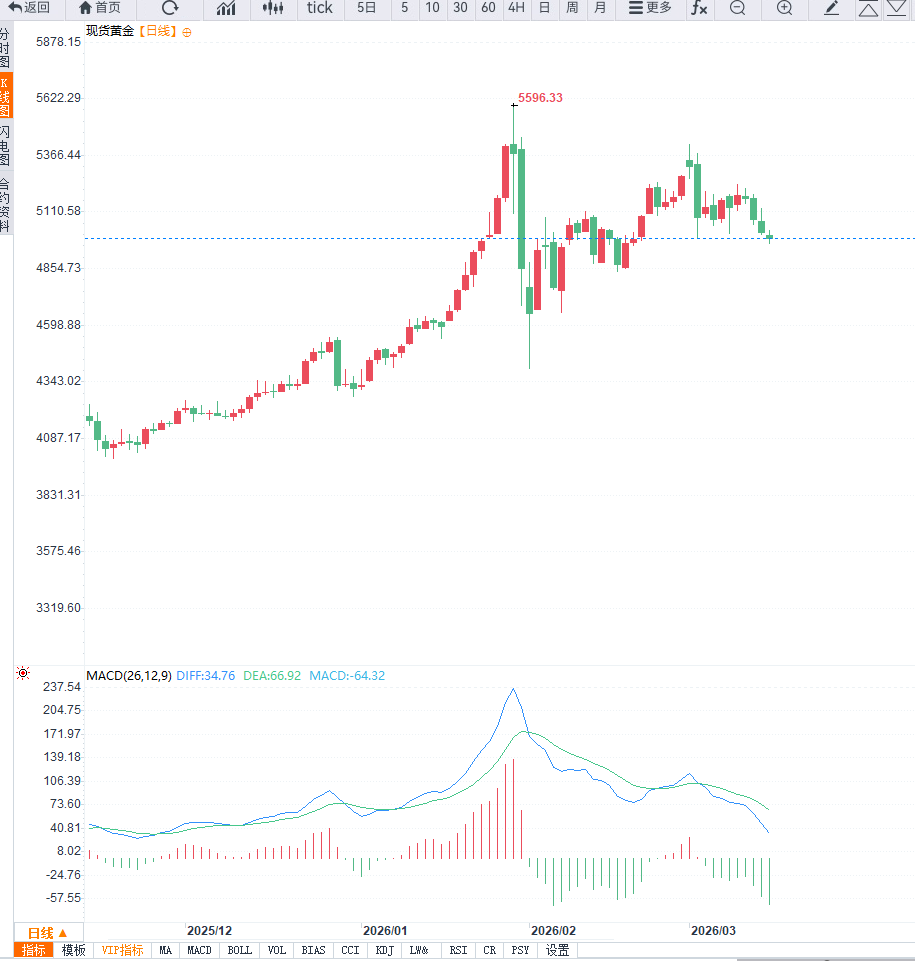
Overall, gold's short-term trend will depend more on two key factors: whether the situation in the Middle East escalates further, and how the market reprices the Federal Reserve's interest rate path. If inflation expectations continue to rise and the timing of interest rate cuts is delayed, gold may continue to face some pressure in the short term.
Editor's Summary : The current gold market is in a typical phase of macroeconomic game theory. Geopolitical conflicts typically drive safe-haven demand, but inflationary pressures from rising energy prices may reinforce expectations of high interest rates, thereby weakening gold's appeal. It is precisely these contradictory factors that cause short-term fluctuations in gold prices.
From a market structure perspective, $5,000 remains a significant psychological level for gold. If gold prices can regain and stabilize above this level, the market may resume its upward trend. However, if interest rate expectations continue to rise, gold may enter a period of consolidation at high levels.
For investors, the key factors to watch going forward include energy price trends, expectations for Federal Reserve policy, and changes in the Middle East situation. These factors will collectively determine the direction of the gold market in the next phase.
Frequently Asked Questions (FAQ)
1. Why do Middle East conflicts sometimes drive up gold prices, and sometimes cause them to fall?
Middle East conflicts typically boost safe-haven demand, leading to a rise in gold prices in most cases due to safe-haven inflows. However, gold prices are not solely influenced by safe-haven sentiment; they are also affected by macroeconomic factors and monetary policy expectations. In the current market environment, conflict has led to higher oil prices, which in turn pushes up global inflation expectations. When inflation expectations rise, the market may perceive that central banks need to maintain higher interest rates to control prices. In this scenario, gold may actually be suppressed. Therefore, when safe-haven demand conflicts with interest rate expectations, gold prices may not rise according to traditional logic, but rather experience fluctuations or even a correction.
2. Why does rising oil prices put pressure on gold?
Rising oil prices typically drive up global energy costs, leading to increased inflationary pressures. For central banks, sustained inflation usually necessitates maintaining higher interest rates to curb inflation. When interest rates are high, investors may prefer to hold assets that generate interest income, such as bonds or deposits. Gold, however, does not generate interest income, thus its attractiveness decreases in a high-interest-rate environment. Therefore, when rising oil prices drive up inflation expectations, the market tends to postpone expectations of interest rate cuts, putting downward pressure on gold prices.
3. Why is $5,000 a key level for gold?
In financial markets, round numbers often carry strong psychological significance. $5,000 is not only a psychologically significant price level, but also a crucial price area near historical highs for gold. Many institutional investors and traders consider this key price level an important technical resistance. When prices approach this level, the market often sees increased trading activity, including profit-taking, breakout trades, or short-selling counterattacks. If gold can reliably break through $5,000, it usually indicates strong bullish momentum, and the price may enter a new upward phase. Conversely, if it fails to break through this level multiple times, the market may enter a period of consolidation.
4. What factors will affect the short-term trend of gold?
Gold's short-term price movement is primarily influenced by three factors. First, global geopolitical risks. If conflicts escalate further, market demand for safe-haven assets may increase, thus driving up gold prices. Second, expectations regarding the Federal Reserve's monetary policy. If the market anticipates an imminent interest rate cut, gold typically finds support. However, if the market expects interest rates to remain high, gold may face downward pressure. The third factor is the US dollar's performance. Gold generally moves inversely to the dollar. When the dollar strengthens, gold prices tend to be suppressed; conversely, when the dollar weakens, gold typically gains upward momentum.
5. Is there still room for gold to rise in the future?
In the long term, gold still has upward potential. Global central banks have been continuously increasing their gold reserves in recent years, while geopolitical risks and inflationary pressures remain, all of which are likely to support gold prices. Furthermore, the continued rise in global debt levels may also drive investors to increase their gold holdings to hedge against financial risks in the future. However, in the short term, gold's price movement will still be influenced by interest rate expectations and the dollar's performance. If the Federal Reserve begins a rate-cutting cycle in the future, gold will typically enter a new upward phase. Therefore, the gold market still has room for future growth, but short-term price movements may experience some volatility.
The market's primary focus remains on developments in the Middle East. Military action by the US and Israel against Iran continued to escalate over the weekend. According to public reports, the US military launched strikes on Kharg Island, home to key Iranian energy facilities and a crucial hub for Iranian oil exports. The market widely believes that approximately 90% of Iran's oil exports pass through this region , and this event has rapidly heightened tensions in the energy market.
Meanwhile, Iran warned that it might retaliate against US-linked oil facilities if the conflict escalates. This significantly increased energy supply risks, causing international oil prices to rise sharply in early trading this week.
While geopolitical conflicts typically increase demand for gold as a safe haven, the current market structure has undergone more complex changes. Rising energy prices are fueling inflation expectations, which indirectly impacts the gold market. Higher oil prices mean higher global energy costs, and the market is beginning to worry about potentially renewed inflationary pressures.
As inflation expectations rise, market assessments of US monetary policy are also shifting. Investors are increasingly believing that the Federal Reserve may not cut interest rates as quickly as previously anticipated, leading to a renewed rise in US interest rate expectations. Since gold itself does not generate interest income, its investment appeal tends to decrease when interest rate expectations rise.
From a policy perspective, the Trump administration has stated that it expects the conflict with Iran to end within the next few weeks , or even sooner. However, the Israeli military has indicated that its military operations could last at least three weeks . This difference in policy expectations has led to significant divergence in market views regarding the duration of the conflict and has exacerbated uncertainty in financial markets.
At the macro level, the gold market is currently caught between two forces. On the one hand, the escalating situation in the Middle East is creating safe-haven demand; on the other hand, rising energy prices are leading to increased inflation expectations, thereby reinforcing expectations that interest rates will remain high. These contradictory factors make the short-term trend of gold more complex.
From a technical perspective, gold maintains a strong long-term upward structure on the daily chart. After a period of continuous gains, gold prices reached a temporary high, but a pullback occurred as the market began to reassess interest rate paths. Currently, the $5000 level has become the most important psychological dividing line for the market. If gold prices can regain and stabilize above this level, the bullish trend still has a chance to continue, and it may once again challenge the $5050 to $5100 area .
On the support side, key short-term support lies around $4,950 , which corresponds to the lower edge of the recent consolidation range. If the market retraces further, the next support level could be around $4,900 .
Momentum indicators also show signs of slowing, suggesting that some funds are beginning to take profits after the continuous rise. If gold prices break below the $4,950 support level in the short term, the market may enter a period of consolidation. However, as long as prices remain above $4,900, the overall upward trend remains intact.
Overall, gold's short-term trend will depend more on two key factors: whether the situation in the Middle East escalates further, and how the market reprices the Federal Reserve's interest rate path. If inflation expectations continue to rise and the timing of interest rate cuts is delayed, gold may continue to face some pressure in the short term.
Editor's Summary : The current gold market is in a typical phase of macroeconomic game theory. Geopolitical conflicts typically drive safe-haven demand, but inflationary pressures from rising energy prices may reinforce expectations of high interest rates, thereby weakening gold's appeal. It is precisely these contradictory factors that cause short-term fluctuations in gold prices.
From a market structure perspective, $5,000 remains a significant psychological level for gold. If gold prices can regain and stabilize above this level, the market may resume its upward trend. However, if interest rate expectations continue to rise, gold may enter a period of consolidation at high levels.
For investors, the key factors to watch going forward include energy price trends, expectations for Federal Reserve policy, and changes in the Middle East situation. These factors will collectively determine the direction of the gold market in the next phase.
Frequently Asked Questions (FAQ)
1. Why do Middle East conflicts sometimes drive up gold prices, and sometimes cause them to fall?
Middle East conflicts typically boost safe-haven demand, leading to a rise in gold prices in most cases due to safe-haven inflows. However, gold prices are not solely influenced by safe-haven sentiment; they are also affected by macroeconomic factors and monetary policy expectations. In the current market environment, conflict has led to higher oil prices, which in turn pushes up global inflation expectations. When inflation expectations rise, the market may perceive that central banks need to maintain higher interest rates to control prices. In this scenario, gold may actually be suppressed. Therefore, when safe-haven demand conflicts with interest rate expectations, gold prices may not rise according to traditional logic, but rather experience fluctuations or even a correction.
2. Why does rising oil prices put pressure on gold?
Rising oil prices typically drive up global energy costs, leading to increased inflationary pressures. For central banks, sustained inflation usually necessitates maintaining higher interest rates to curb inflation. When interest rates are high, investors may prefer to hold assets that generate interest income, such as bonds or deposits. Gold, however, does not generate interest income, thus its attractiveness decreases in a high-interest-rate environment. Therefore, when rising oil prices drive up inflation expectations, the market tends to postpone expectations of interest rate cuts, putting downward pressure on gold prices.
3. Why is $5,000 a key level for gold?
In financial markets, round numbers often carry strong psychological significance. $5,000 is not only a psychologically significant price level, but also a crucial price area near historical highs for gold. Many institutional investors and traders consider this key price level an important technical resistance. When prices approach this level, the market often sees increased trading activity, including profit-taking, breakout trades, or short-selling counterattacks. If gold can reliably break through $5,000, it usually indicates strong bullish momentum, and the price may enter a new upward phase. Conversely, if it fails to break through this level multiple times, the market may enter a period of consolidation.
4. What factors will affect the short-term trend of gold?
Gold's short-term price movement is primarily influenced by three factors. First, global geopolitical risks. If conflicts escalate further, market demand for safe-haven assets may increase, thus driving up gold prices. Second, expectations regarding the Federal Reserve's monetary policy. If the market anticipates an imminent interest rate cut, gold typically finds support. However, if the market expects interest rates to remain high, gold may face downward pressure. The third factor is the US dollar's performance. Gold generally moves inversely to the dollar. When the dollar strengthens, gold prices tend to be suppressed; conversely, when the dollar weakens, gold typically gains upward momentum.
5. Is there still room for gold to rise in the future?
In the long term, gold still has upward potential. Global central banks have been continuously increasing their gold reserves in recent years, while geopolitical risks and inflationary pressures remain, all of which are likely to support gold prices. Furthermore, the continued rise in global debt levels may also drive investors to increase their gold holdings to hedge against financial risks in the future. However, in the short term, gold's price movement will still be influenced by interest rate expectations and the dollar's performance. If the Federal Reserve begins a rate-cutting cycle in the future, gold will typically enter a new upward phase. Therefore, the gold market still has room for future growth, but short-term price movements may experience some volatility.
- Risk Warning and Disclaimer
- The market involves risk, and trading may not be suitable for all investors. This article is for reference only and does not constitute personal investment advice, nor does it take into account certain users’ specific investment objectives, financial situation, or other needs. Any investment decisions made based on this information are at your own risk.