Silver fell below $80 to a three-week low as expectations of a delayed Federal Reserve rate cut and rising oil prices pushed up inflation expectations.
2026-03-16 13:36:54
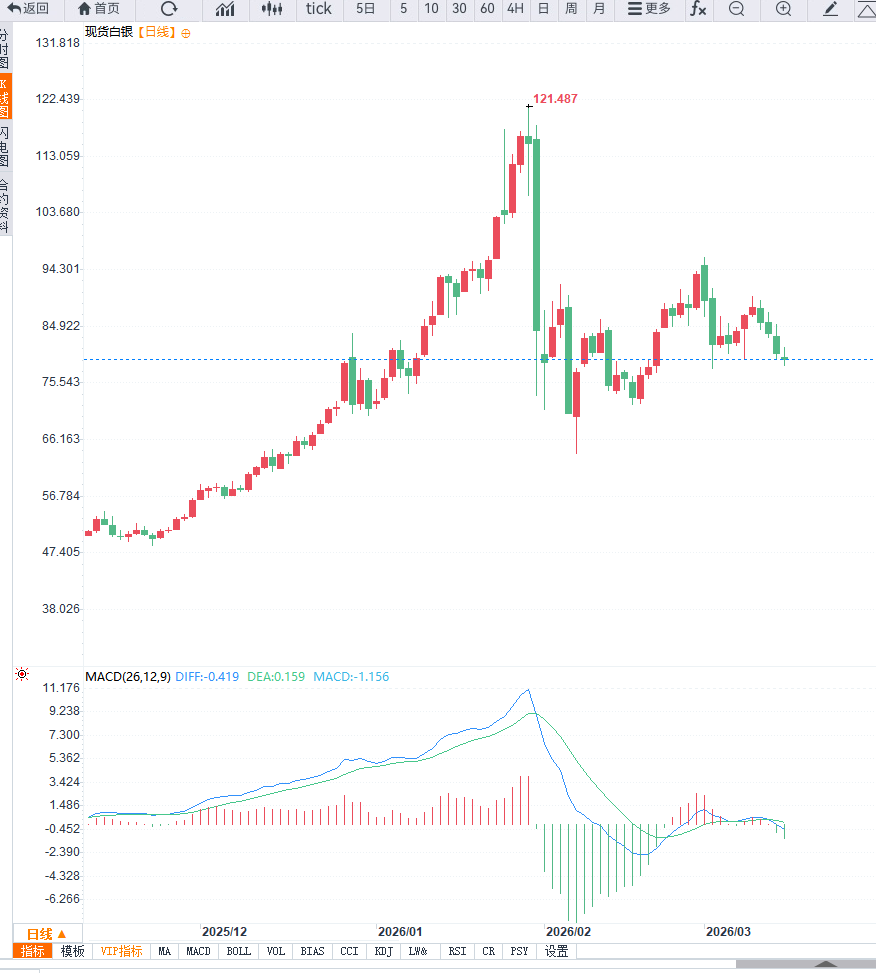
The silver market continued its downward trend during Monday's Asian trading session. Spot silver (XAG/USD) fell approximately 0.8% intraday, retreating to around $79.80 , and briefly testing a three-week low near $78 . Market sentiment was cautious ahead of the Federal Reserve's interest rate decision, with investors reassessing the interest rate outlook and the impact of rising energy prices on inflation expectations.
The market widely expects the Federal Reserve to maintain its interest rate range at 3.50% to 3.75% at this week's policy meeting. According to the CME Group rate watch tool, traders generally anticipate the Fed will keep rates stable for the second consecutive meeting. For the precious metals market, higher interest rates tend to diminish their appeal, as silver, like gold, is an asset that does not generate interest income.
Market sentiment regarding the outlook for monetary policy is also shifting. Previously, the market had anticipated that the Federal Reserve might begin cutting interest rates earlier this year, but as inflation concerns stemming from rising energy prices intensified, investors gradually adjusted their expectations. Currently, the market generally believes that the likelihood of the Fed cutting rates before its October policy meeting is low , which is putting temporary pressure on precious metal prices.
One of the key factors driving changes in inflation expectations comes from the energy market. Recent tensions in the Middle East have led to a significant rise in international oil prices. Higher oil prices not only increase energy costs but also directly affect price expectations among consumers. Currently, gasoline prices in the United States have risen significantly, increasing the cost of living for residents and reinforcing market concerns about a resurgence of inflation.
At the macro level, rising energy prices typically transmit to overall price levels through transportation, manufacturing, and consumption. If inflation rises again, central banks may need to maintain a high-interest-rate environment for an extended period, which is one of the key reasons for the recent pressure on the precious metals market.
However, from a global market perspective, the downside potential for silver may be somewhat limited. Uncertainty surrounding the Middle East situation remains high, and risk aversion persists in the market. Amidst increased volatility in global financial markets, some investors still prefer to allocate to precious metal assets, thus providing some support for silver prices.
From a technical perspective, silver is currently in a short-term correction phase. The daily chart shows that silver prices have broken below the 20-day exponential moving average of approximately $84.30 , indicating a downward breakout from the previous consolidation range and a weakening short-term trend. Simultaneously, the price structure exhibits a pattern of progressively lower highs, suggesting that bearish momentum is strengthening.
In terms of technical indicators, the 14-day Relative Strength Index (RSI) is currently trading between 40 and 60. This range is generally considered a consolidation range, indicating that while the market is slightly weak, it has not yet entered a clearly oversold state. From a trend perspective, as long as the RSI remains within this range, prices are likely to continue to fluctuate within this range.
From a key price perspective, short-term resistance is mainly concentrated in the $82-$83 area. This area not only represents the recent rebound high but also coincides with the 20-day moving average. If silver prices can break through this level, the market may retest the resistance near $85 and weaken the current bearish structure.
On the support side, the key short-term support level is around $77.47 , which corresponds to the previous low. If the price breaks below this level, the market may test the $72 area further, which would imply a deeper technical correction.
Overall, given the uncertainty surrounding Federal Reserve policy and rising energy prices, silver is likely to maintain a weak and volatile trend in the short term. However, amid increased global uncertainty, safe-haven demand may limit further price declines.
Editor's Summary : The current silver market is influenced by both macroeconomic policy expectations and geopolitical risks. On the one hand, rising oil prices are pushing up inflation expectations, leading the market to believe that the Federal Reserve may extend the high-interest-rate cycle, which puts significant pressure on precious metals such as silver. On the other hand, the uncertainty of the global geopolitical situation is providing some support for safe-haven assets.
From a technical perspective, silver has broken below key moving averages, indicating a weak short-term structure, but important support levels have not yet been completely breached. Future market movements will depend on Federal Reserve policy signals, the dollar's performance, and changes in the energy market. If inflationary pressures continue to rise, precious metals may continue to face downward pressure, but if market risk sentiment improves, silver may still find some support in the short term.
Frequently Asked Questions (FAQ)
Question 1: Why does the Federal Reserve's interest rate policy have a significant impact on silver prices?
Silver, a typical precious metal asset, is similar to gold in that it does not generate interest income. Therefore, when global interest rates rise, investors tend to allocate funds to assets that offer fixed income, such as bonds or money market instruments, reducing demand for silver. Conversely, when interest rates fall or the market anticipates an impending central bank rate cut, precious metals tend to attract more investment. Furthermore, interest rate changes also affect the US dollar's performance. Generally, when the Federal Reserve maintains higher interest rates, the US dollar tends to strengthen, putting pressure on dollar-denominated commodities as it increases the cost for holders of other currencies to purchase these assets. Conversely, when interest rates fall, the US dollar may weaken, thus supporting precious metals. Therefore, the Federal Reserve's interest rate policy not only affects capital flows but also indirectly influences silver prices through exchange rates and investor sentiment. Currently, the market widely expects the Federal Reserve to maintain stable interest rates, which is one of the important reasons for the recent pullback in silver prices.
Question 2: Why does rising oil prices affect the precious metals market?
Rising oil prices typically impact the precious metals market through multiple channels. First, energy prices are a significant component of global inflation. When oil prices rise sharply, transportation, manufacturing, and logistics costs increase, potentially pushing up overall price levels and exacerbating inflationary pressures. When inflation expectations rise, central banks often need to adopt more cautious monetary policies. If inflationary pressures persist, central banks may delay interest rate cuts or even maintain higher interest rates, which is generally detrimental to non-yielding assets like precious metals. On the other hand, rising oil prices sometimes reflect increased geopolitical risks. For example, escalating conflicts in the Middle East could affect global energy supplies. When geopolitical risks rise, market risk aversion increases, and precious metals, often considered traditional safe-haven assets, may receive some support. Therefore, the impact of oil prices on silver is often two-way. On one hand, it can put pressure on silver through inflation and interest rate expectations; on the other hand, if rising oil prices reflect geopolitical risks, it may provide safe-haven support for silver.
Question 3: Why does geopolitical tension support silver prices?
In global financial markets, precious metals are generally considered safe-haven assets. When international uncertainties arise, such as regional conflicts, energy supply risks, or financial market volatility, investors tend to reduce their allocation to riskier assets and shift towards assets with stronger value-preserving properties. Silver and gold typically attract attention in such environments. Although silver has stronger industrial applications, investors still consider it a precious metal asset when market risk aversion intensifies. Especially when the global economic outlook is uncertain, precious metals often attract some capital inflows. Furthermore, geopolitical tensions can affect energy supplies and global trade transportation, increasing economic uncertainty. Markets tend to be more cautious in such situations, which can also drive up safe-haven demand. However, compared to gold, silver's safe-haven properties are relatively weaker because its price is also influenced by industrial demand. Therefore, while silver may receive support during periods of heightened geopolitical risk, its volatility is generally greater than that of gold.
Question 4: Why is the 20-day moving average important in technical analysis?
In technical analysis, moving averages are an important tool for judging market trends. The 20-day moving average is often considered a key indicator of short-term trends. Many traders use this moving average to determine whether the market is in an uptrend or downtrend. When the price is above the 20-day moving average, it usually indicates a strong short-term trend and sufficient buying power. Conversely, if the price falls below this moving average and continues to trade below it, it suggests the market may be entering a correction phase, with selling pressure gradually increasing. Furthermore, moving averages often act as dynamic support or resistance. When the price is above the moving average, it may act as support; when the price falls below the moving average, it often becomes resistance. In the current market, silver prices have fallen below the 20-day moving average, indicating a weakening short-term trend. If the price fails to regain its footing above this moving average, the market may continue its weak and volatile pattern.
Question 5: What are the key factors to watch for in the future price trend of silver?
The future trend of the silver market will be mainly influenced by three factors. First, the direction of the Federal Reserve's monetary policy. If future economic data weakens and prompts central banks to cut interest rates, the precious metals market may receive significant support. Conversely, if inflation continues to exceed expectations, central banks may maintain a high-interest-rate environment for an extended period, which will put pressure on silver prices. The second key factor is the US dollar's performance. Since silver is priced in US dollars, a stronger dollar tends to put downward pressure on silver prices, while a weaker dollar may drive up precious metal prices. Therefore, investors typically pay close attention to changes in the US dollar index. The third factor is the global macroeconomic risk environment, including energy market volatility and changes in geopolitical situations. Increased uncertainty in the global economy or financial markets could drive up precious metal prices due to safe-haven demand. In summary, the future trend of silver is likely to be a tug-of-war between macroeconomic policies, the US dollar's performance, and global risk sentiment. Investors need to pay attention to changes in these factors simultaneously when analyzing the market.
The market widely expects the Federal Reserve to maintain its interest rate range at 3.50% to 3.75% at this week's policy meeting. According to the CME Group rate watch tool, traders generally anticipate the Fed will keep rates stable for the second consecutive meeting. For the precious metals market, higher interest rates tend to diminish their appeal, as silver, like gold, is an asset that does not generate interest income.
Market sentiment regarding the outlook for monetary policy is also shifting. Previously, the market had anticipated that the Federal Reserve might begin cutting interest rates earlier this year, but as inflation concerns stemming from rising energy prices intensified, investors gradually adjusted their expectations. Currently, the market generally believes that the likelihood of the Fed cutting rates before its October policy meeting is low , which is putting temporary pressure on precious metal prices.
One of the key factors driving changes in inflation expectations comes from the energy market. Recent tensions in the Middle East have led to a significant rise in international oil prices. Higher oil prices not only increase energy costs but also directly affect price expectations among consumers. Currently, gasoline prices in the United States have risen significantly, increasing the cost of living for residents and reinforcing market concerns about a resurgence of inflation.
At the macro level, rising energy prices typically transmit to overall price levels through transportation, manufacturing, and consumption. If inflation rises again, central banks may need to maintain a high-interest-rate environment for an extended period, which is one of the key reasons for the recent pressure on the precious metals market.
However, from a global market perspective, the downside potential for silver may be somewhat limited. Uncertainty surrounding the Middle East situation remains high, and risk aversion persists in the market. Amidst increased volatility in global financial markets, some investors still prefer to allocate to precious metal assets, thus providing some support for silver prices.
From a technical perspective, silver is currently in a short-term correction phase. The daily chart shows that silver prices have broken below the 20-day exponential moving average of approximately $84.30 , indicating a downward breakout from the previous consolidation range and a weakening short-term trend. Simultaneously, the price structure exhibits a pattern of progressively lower highs, suggesting that bearish momentum is strengthening.
In terms of technical indicators, the 14-day Relative Strength Index (RSI) is currently trading between 40 and 60. This range is generally considered a consolidation range, indicating that while the market is slightly weak, it has not yet entered a clearly oversold state. From a trend perspective, as long as the RSI remains within this range, prices are likely to continue to fluctuate within this range.
From a key price perspective, short-term resistance is mainly concentrated in the $82-$83 area. This area not only represents the recent rebound high but also coincides with the 20-day moving average. If silver prices can break through this level, the market may retest the resistance near $85 and weaken the current bearish structure.
On the support side, the key short-term support level is around $77.47 , which corresponds to the previous low. If the price breaks below this level, the market may test the $72 area further, which would imply a deeper technical correction.
Overall, given the uncertainty surrounding Federal Reserve policy and rising energy prices, silver is likely to maintain a weak and volatile trend in the short term. However, amid increased global uncertainty, safe-haven demand may limit further price declines.
Editor's Summary : The current silver market is influenced by both macroeconomic policy expectations and geopolitical risks. On the one hand, rising oil prices are pushing up inflation expectations, leading the market to believe that the Federal Reserve may extend the high-interest-rate cycle, which puts significant pressure on precious metals such as silver. On the other hand, the uncertainty of the global geopolitical situation is providing some support for safe-haven assets.
From a technical perspective, silver has broken below key moving averages, indicating a weak short-term structure, but important support levels have not yet been completely breached. Future market movements will depend on Federal Reserve policy signals, the dollar's performance, and changes in the energy market. If inflationary pressures continue to rise, precious metals may continue to face downward pressure, but if market risk sentiment improves, silver may still find some support in the short term.
Frequently Asked Questions (FAQ)
Question 1: Why does the Federal Reserve's interest rate policy have a significant impact on silver prices?
Silver, a typical precious metal asset, is similar to gold in that it does not generate interest income. Therefore, when global interest rates rise, investors tend to allocate funds to assets that offer fixed income, such as bonds or money market instruments, reducing demand for silver. Conversely, when interest rates fall or the market anticipates an impending central bank rate cut, precious metals tend to attract more investment. Furthermore, interest rate changes also affect the US dollar's performance. Generally, when the Federal Reserve maintains higher interest rates, the US dollar tends to strengthen, putting pressure on dollar-denominated commodities as it increases the cost for holders of other currencies to purchase these assets. Conversely, when interest rates fall, the US dollar may weaken, thus supporting precious metals. Therefore, the Federal Reserve's interest rate policy not only affects capital flows but also indirectly influences silver prices through exchange rates and investor sentiment. Currently, the market widely expects the Federal Reserve to maintain stable interest rates, which is one of the important reasons for the recent pullback in silver prices.
Question 2: Why does rising oil prices affect the precious metals market?
Rising oil prices typically impact the precious metals market through multiple channels. First, energy prices are a significant component of global inflation. When oil prices rise sharply, transportation, manufacturing, and logistics costs increase, potentially pushing up overall price levels and exacerbating inflationary pressures. When inflation expectations rise, central banks often need to adopt more cautious monetary policies. If inflationary pressures persist, central banks may delay interest rate cuts or even maintain higher interest rates, which is generally detrimental to non-yielding assets like precious metals. On the other hand, rising oil prices sometimes reflect increased geopolitical risks. For example, escalating conflicts in the Middle East could affect global energy supplies. When geopolitical risks rise, market risk aversion increases, and precious metals, often considered traditional safe-haven assets, may receive some support. Therefore, the impact of oil prices on silver is often two-way. On one hand, it can put pressure on silver through inflation and interest rate expectations; on the other hand, if rising oil prices reflect geopolitical risks, it may provide safe-haven support for silver.
Question 3: Why does geopolitical tension support silver prices?
In global financial markets, precious metals are generally considered safe-haven assets. When international uncertainties arise, such as regional conflicts, energy supply risks, or financial market volatility, investors tend to reduce their allocation to riskier assets and shift towards assets with stronger value-preserving properties. Silver and gold typically attract attention in such environments. Although silver has stronger industrial applications, investors still consider it a precious metal asset when market risk aversion intensifies. Especially when the global economic outlook is uncertain, precious metals often attract some capital inflows. Furthermore, geopolitical tensions can affect energy supplies and global trade transportation, increasing economic uncertainty. Markets tend to be more cautious in such situations, which can also drive up safe-haven demand. However, compared to gold, silver's safe-haven properties are relatively weaker because its price is also influenced by industrial demand. Therefore, while silver may receive support during periods of heightened geopolitical risk, its volatility is generally greater than that of gold.
Question 4: Why is the 20-day moving average important in technical analysis?
In technical analysis, moving averages are an important tool for judging market trends. The 20-day moving average is often considered a key indicator of short-term trends. Many traders use this moving average to determine whether the market is in an uptrend or downtrend. When the price is above the 20-day moving average, it usually indicates a strong short-term trend and sufficient buying power. Conversely, if the price falls below this moving average and continues to trade below it, it suggests the market may be entering a correction phase, with selling pressure gradually increasing. Furthermore, moving averages often act as dynamic support or resistance. When the price is above the moving average, it may act as support; when the price falls below the moving average, it often becomes resistance. In the current market, silver prices have fallen below the 20-day moving average, indicating a weakening short-term trend. If the price fails to regain its footing above this moving average, the market may continue its weak and volatile pattern.
Question 5: What are the key factors to watch for in the future price trend of silver?
The future trend of the silver market will be mainly influenced by three factors. First, the direction of the Federal Reserve's monetary policy. If future economic data weakens and prompts central banks to cut interest rates, the precious metals market may receive significant support. Conversely, if inflation continues to exceed expectations, central banks may maintain a high-interest-rate environment for an extended period, which will put pressure on silver prices. The second key factor is the US dollar's performance. Since silver is priced in US dollars, a stronger dollar tends to put downward pressure on silver prices, while a weaker dollar may drive up precious metal prices. Therefore, investors typically pay close attention to changes in the US dollar index. The third factor is the global macroeconomic risk environment, including energy market volatility and changes in geopolitical situations. Increased uncertainty in the global economy or financial markets could drive up precious metal prices due to safe-haven demand. In summary, the future trend of silver is likely to be a tug-of-war between macroeconomic policies, the US dollar's performance, and global risk sentiment. Investors need to pay attention to changes in these factors simultaneously when analyzing the market.
- Risk Warning and Disclaimer
- The market involves risk, and trading may not be suitable for all investors. This article is for reference only and does not constitute personal investment advice, nor does it take into account certain users’ specific investment objectives, financial situation, or other needs. Any investment decisions made based on this information are at your own risk.