Trump warns: Next shot aimed at Halg Island oil facilities; risk premium could be permanently embedded in oil prices.
2026-03-16 14:52:03
Trump explicitly warned that if Iran continues to attack merchant ships in the Strait of Hormuz, the next target for the US military will be Kharg Island, the lifeline of Iran's oil exports. The island handles approximately 90% of Iran's oil exports, with a daily loading capacity of 7 million barrels. If destroyed, Iran's daily exports of 1.5 million barrels would be instantly paralyzed, its war funding would be cut off, and reconstruction would take years.
Analysts point out that this move not only cuts off Iran's military leverage to generate revenue but will also have a direct impact on the global oil market, pushing oil prices back to the $150-$200 range. The war risk premium will be permanently embedded in commodity pricing, accelerating the restructuring of the global energy supply chain and amplifying the risks of inflation and economic slowdown.
On Monday (March 16), during the Asian and European sessions, US crude oil prices rose and then fell back, currently trading around $99.30 per barrel, with a daily increase of about 0.6%.
After ordering strikes against Iranian military facilities on Kharg Island, US President Trump issued a clear warning: if Iran continues to attack merchant ships in the Strait of Hormuz, the US may turn its next target to the island's oil facilities.
Vandana Hari, founder of Vanda Insights, pointed out that the strike was intended as a "warning shot," and that if Iran does not reopen the Strait of Hormuz, the oil infrastructure on Kharg Island will be a direct target. Trump emphasized that "stopping the Iranian empire" is more important than oil prices, demonstrating that the US has used energy infrastructure as a strategic lever.
Kharg Island is located in the northern Persian Gulf, about 24 kilometers from the Iranian mainland coast, and is approximately 8 kilometers long. The island is one of Iran's most sensitive economic targets, handling about 90% of its crude oil exports, with a daily loading capacity of about 7 million barrels.
According to JPMorgan data, a direct strike on export terminals would instantly paralyze Iran's 1.5 million barrels per day of crude oil exports. The island, with its large oil storage tanks, berths, and loading facilities, is the most crucial gateway to Iran's energy revenue.
Vandana Hari emphasized that destroying the Kharg Island oil infrastructure would deprive Iran of its most critical source of revenue, and reconstruction would take years.
While other Iranian ports (such as the Gore-Jask pipeline) can provide partial alternatives (approximately 1.5 million barrels per day), large-scale operation of alternatives bypassing the strait is difficult in the current conflict environment. The destruction of Kharg Island would severely deplete Iran's war funds and drastically increase the regime's survival pressures.
Josh Young (Chief Investment Officer of Bison Interests) points out that after destroying or taking control of Kharg Island, the United States could take the same action against other Iranian export facilities, completely cutting off its oil revenues.
Andy Lipow (President of Lipow Oil Associates) stated that despite limited alternatives for Iran, an attack on Kharg Island would still constitute a significant escalation and would substantially disrupt exports. Washington's focus on the island serves both as military leverage (cutting off Iran's financial resources) and as a direct impact on the global oil market ( a sharp decline in Iranian exports would drive up international oil prices ).
Edward Fishman (senior fellow at the Council on Foreign Relations) warned that Iran may escalate its retaliation by attacking energy infrastructure in regions such as Saudi Arabia's Abqaiq.
Jeff Currie (Chief Strategist at Carlyle Energy Pathways) points out that the damage to Halke Island cannot be repaired in the heat of war, war risk insurance premiums will remain high for a long time, and changes in supply chain behavior (stockpiling, contract renegotiation, and finding alternative suppliers) will permanently reshape pricing. An attack on the island would trigger a full-blown global energy crisis, and oil prices could return to the $150-$200 range.
Currie emphasizes that conflict is accelerating a structural shift in energy supply chain pricing. Any commodity that must pass through key chokepoints will be subject to a "security premium."
For the oil market, the threat from Harker Island is almost as significant as an actual attack. Global supply chains will diversify more rapidly, strategic reserve construction will accelerate, and Asian importers will face greater geopolitical and cost pressures. Prolonged high oil price volatility may become the new normal, while the risks of inflation and economic slowdown will continue to amplify.
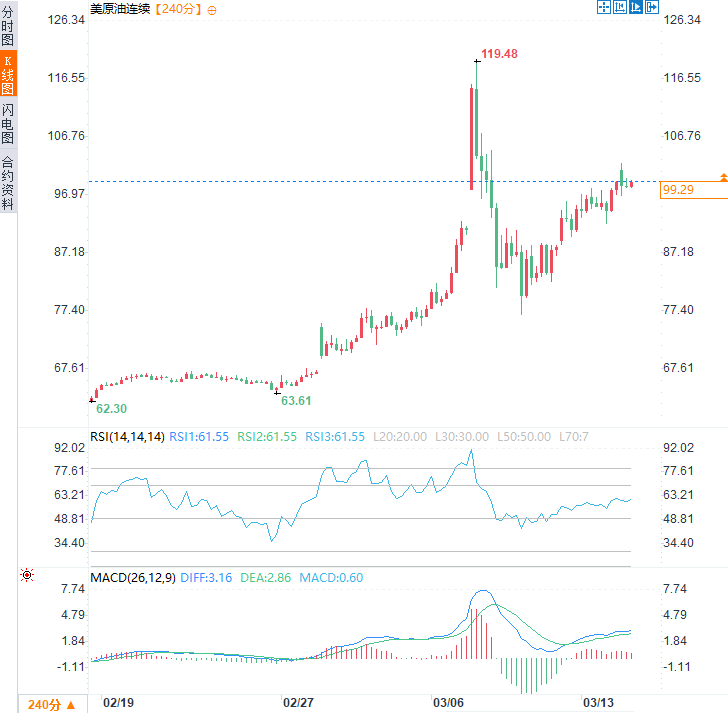
(US crude oil 4-hour chart, source: FX678)
Trump has targeted Iran's Kharg Island—a vital artery for 90% of its crude oil exports, with a daily loading capacity of 7 million barrels. Destroying the island would instantly cripple 1.5 million barrels per day of Iranian exports, severely damage war finances, and require years to rebuild. This move by the US is both a military lever (cutting off Iranian revenue) and a direct impact on the global oil market. An attack could trigger extreme Iranian retaliation (such as attacks on Saudi facilities or a complete blockade of the Strait of Hormuz), potentially pushing oil prices back to the $150-$200 range.
War risk insurance premiums remain persistently high, and changes in supply chain behavior will permanently embed a "security premium," accelerating the restructuring of the energy supply chain. Global inflation and economic slowdown risks continue to amplify; although the US is a net exporter, high oil prices on the consumption side will still suppress growth. Investors need to be wary that the threat to Kharg Island is almost as important as an actual attack, and should pay close attention to Iran's response and progress on navigation in the Strait of Hormuz; the energy market is highly uncertain.
At 14:51 Beijing time, US crude oil futures were trading at $99.35 per barrel.
Analysts point out that this move not only cuts off Iran's military leverage to generate revenue but will also have a direct impact on the global oil market, pushing oil prices back to the $150-$200 range. The war risk premium will be permanently embedded in commodity pricing, accelerating the restructuring of the global energy supply chain and amplifying the risks of inflation and economic slowdown.
On Monday (March 16), during the Asian and European sessions, US crude oil prices rose and then fell back, currently trading around $99.30 per barrel, with a daily increase of about 0.6%.
Why did Trump target Halg Island? Is he warning of his next target?
After ordering strikes against Iranian military facilities on Kharg Island, US President Trump issued a clear warning: if Iran continues to attack merchant ships in the Strait of Hormuz, the US may turn its next target to the island's oil facilities.
Vandana Hari, founder of Vanda Insights, pointed out that the strike was intended as a "warning shot," and that if Iran does not reopen the Strait of Hormuz, the oil infrastructure on Kharg Island will be a direct target. Trump emphasized that "stopping the Iranian empire" is more important than oil prices, demonstrating that the US has used energy infrastructure as a strategic lever.
Kharg Island: The lifeline for 90% of Iran's crude oil exports, with a daily loading capacity of 7 million barrels.
Kharg Island is located in the northern Persian Gulf, about 24 kilometers from the Iranian mainland coast, and is approximately 8 kilometers long. The island is one of Iran's most sensitive economic targets, handling about 90% of its crude oil exports, with a daily loading capacity of about 7 million barrels.
According to JPMorgan data, a direct strike on export terminals would instantly paralyze Iran's 1.5 million barrels per day of crude oil exports. The island, with its large oil storage tanks, berths, and loading facilities, is the most crucial gateway to Iran's energy revenue.
Destroying Kharg Island would cut off Iran's war funding, and reconstruction would take years.
Vandana Hari emphasized that destroying the Kharg Island oil infrastructure would deprive Iran of its most critical source of revenue, and reconstruction would take years.
While other Iranian ports (such as the Gore-Jask pipeline) can provide partial alternatives (approximately 1.5 million barrels per day), large-scale operation of alternatives bypassing the strait is difficult in the current conflict environment. The destruction of Kharg Island would severely deplete Iran's war funds and drastically increase the regime's survival pressures.
Why is Washington focusing on this island? Military leverage and its impact on the global oil market.
Josh Young (Chief Investment Officer of Bison Interests) points out that after destroying or taking control of Kharg Island, the United States could take the same action against other Iranian export facilities, completely cutting off its oil revenues.
Andy Lipow (President of Lipow Oil Associates) stated that despite limited alternatives for Iran, an attack on Kharg Island would still constitute a significant escalation and would substantially disrupt exports. Washington's focus on the island serves both as military leverage (cutting off Iran's financial resources) and as a direct impact on the global oil market ( a sharp decline in Iranian exports would drive up international oil prices ).
Attacking Kharg Island would trigger extreme retaliation from Iran and trigger a full-blown global energy crisis.
Edward Fishman (senior fellow at the Council on Foreign Relations) warned that Iran may escalate its retaliation by attacking energy infrastructure in regions such as Saudi Arabia's Abqaiq.
Jeff Currie (Chief Strategist at Carlyle Energy Pathways) points out that the damage to Halke Island cannot be repaired in the heat of war, war risk insurance premiums will remain high for a long time, and changes in supply chain behavior (stockpiling, contract renegotiation, and finding alternative suppliers) will permanently reshape pricing. An attack on the island would trigger a full-blown global energy crisis, and oil prices could return to the $150-$200 range.
Safety premiums are permanently embedded in commodity pricing, accelerating the restructuring of the energy supply chain.
Currie emphasizes that conflict is accelerating a structural shift in energy supply chain pricing. Any commodity that must pass through key chokepoints will be subject to a "security premium."
For the oil market, the threat from Harker Island is almost as significant as an actual attack. Global supply chains will diversify more rapidly, strategic reserve construction will accelerate, and Asian importers will face greater geopolitical and cost pressures. Prolonged high oil price volatility may become the new normal, while the risks of inflation and economic slowdown will continue to amplify.
(US crude oil 4-hour chart, source: FX678)
Editor's Summary
Trump has targeted Iran's Kharg Island—a vital artery for 90% of its crude oil exports, with a daily loading capacity of 7 million barrels. Destroying the island would instantly cripple 1.5 million barrels per day of Iranian exports, severely damage war finances, and require years to rebuild. This move by the US is both a military lever (cutting off Iranian revenue) and a direct impact on the global oil market. An attack could trigger extreme Iranian retaliation (such as attacks on Saudi facilities or a complete blockade of the Strait of Hormuz), potentially pushing oil prices back to the $150-$200 range.
War risk insurance premiums remain persistently high, and changes in supply chain behavior will permanently embed a "security premium," accelerating the restructuring of the energy supply chain. Global inflation and economic slowdown risks continue to amplify; although the US is a net exporter, high oil prices on the consumption side will still suppress growth. Investors need to be wary that the threat to Kharg Island is almost as important as an actual attack, and should pay close attention to Iran's response and progress on navigation in the Strait of Hormuz; the energy market is highly uncertain.
At 14:51 Beijing time, US crude oil futures were trading at $99.35 per barrel.
- Risk Warning and Disclaimer
- The market involves risk, and trading may not be suitable for all investors. This article is for reference only and does not constitute personal investment advice, nor does it take into account certain users’ specific investment objectives, financial situation, or other needs. Any investment decisions made based on this information are at your own risk.