Trump has changed his tune! He used to criticize high oil prices, but now he's praising them, revealing the true purpose of the war?
2026-03-16 14:03:47
According to estimates by investment bank Jefferies, cited by the Financial Times, the United States could be one of the biggest beneficiaries of a global energy price surge caused by a US-Israel war against Iran. Market concerns about a prolonged disruption in the Strait of Hormuz have intensified, leading to volatile oil prices. While US consumers face pressure from high oil prices, US energy companies, as the world's largest oil producer, are significantly benefiting from these high prices.
On Monday (March 16) during the Asian session, US crude oil prices rose and then fell back, currently trading around $98.40 per barrel, down about 0.3% on the day.
According to energy research firm Rystad, if oil prices remain high this year, U.S. companies will gain an additional $63.4 billion from oil production. This figure is based on the assumption of current oil price levels and continued growth in U.S. shale oil production.
Jefferies points out that as a net energy exporter, the United States benefits from high oil prices, which directly translate into corporate profits and tax revenue, partially offsetting domestic inflationary pressures and becoming an unexpected "economic dividend" from the war.
Trump tweeted on Truth Social, "The United States is by far the world's largest oil producer, so when oil prices go up, we make a lot of money." This statement marks a shift from his narrative of "maintaining low oil prices" to "high oil prices are good," attempting to turn the energy crisis into domestic political capital.
However, the White House still lacks a coherent plan for reopening the Strait of Hormuz, which Iran claims is closed to U.S. and Israeli ships, despite the absence of a permanent physical barrier.
Reports indicate that over 1,000 cargo ships (mainly oil tankers and gas carriers) have been blocked from passing through the Strait of Hormuz. Iranian threats and attacks have led to a mass exodus of shipowners, causing insurance premiums to skyrocket and shipping costs to surge.
With approximately 20% of global oil and a significant amount of LNG exports blocked, Gulf oil-producing countries are forced to reduce production due to saturated oil reserves, leading to a continued widening supply gap.
Earlier this week, The Economist wrote that if the Hormuz closure continues until the end of the month, some analysts believe crude oil prices could surge to $150 or even $200 per barrel.
Rystad and other institutions warn that prolonged disruptions could trigger a global energy crisis, runaway inflation, and supply chain disruptions, sharply increasing the risk of stagflation. Although the United States is a net exporter, high oil prices will still be passed on to consumers, suppressing economic growth.
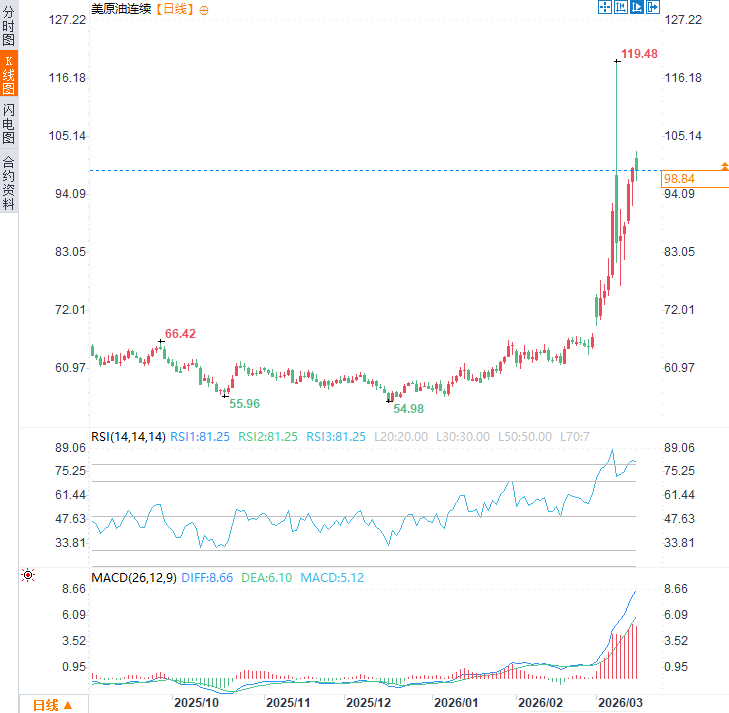
(US crude oil daily chart, source: FX678)
The Wall Street Journal emphasizes that rising oil prices are putting dual pressure on the U.S. economy: on the one hand, they benefit shale oil production and energy company profits; on the other hand, they push up gasoline, diesel, and commodity prices, harming consumers and non-energy industries.
With the average price of gasoline in the United States now exceeding $3.68 per gallon, inflation expectations are rising, further limiting the Federal Reserve's room for interest rate cuts. Whether the benefits of war can cover the domestic economic costs remains the biggest uncertainty.
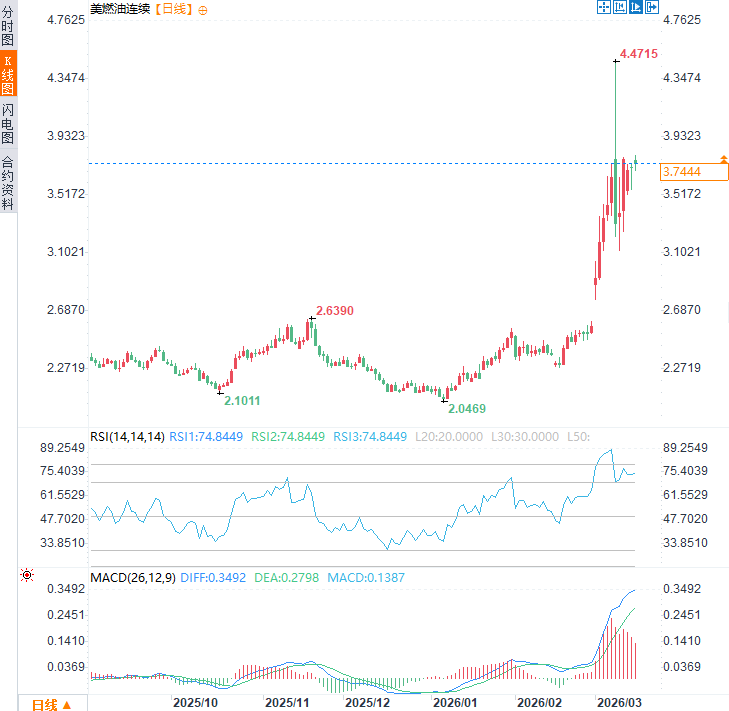
(US fuel oil daily chart, source: FX678)
The Financial Times, citing Jefferies estimates, suggests that the US could be one of the biggest beneficiaries of the US-Israel war against Iran, which has driven up oil prices. If oil prices remain high, US companies could earn an additional $63.4 billion. Trump has shifted to a narrative of "high oil prices are good," downplaying domestic inflationary pressures. However, the ongoing disruption to shipping in the Strait of Hormuz has blocked over 1,000 oil tankers and gas carriers, and analysts warn that if the disruption continues until the end of the month, oil prices could surge to $150-$200.
The US economy faces dual pressures: energy companies are reaping huge profits, but consumers and non-energy sectors are under pressure. Whether the war dividends can cover the domestic costs remains the biggest uncertainty. Investors need to be wary of the risks of prolonged high oil prices, inflation transmission, and a shift in Federal Reserve policy, and pay attention to the resumption of air traffic around the Strait of Hormuz and the progress of G7/IEA reserve releases.
At 14:03 Beijing time, US crude oil futures were trading at $98.50 per barrel.
On Monday (March 16) during the Asian session, US crude oil prices rose and then fell back, currently trading around $98.40 per barrel, down about 0.3% on the day.
Jefferies estimates that US companies will gain an additional $63.4 billion due to high oil prices.
According to energy research firm Rystad, if oil prices remain high this year, U.S. companies will gain an additional $63.4 billion from oil production. This figure is based on the assumption of current oil price levels and continued growth in U.S. shale oil production.
Jefferies points out that as a net energy exporter, the United States benefits from high oil prices, which directly translate into corporate profits and tax revenue, partially offsetting domestic inflationary pressures and becoming an unexpected "economic dividend" from the war.
Trump shifts to a narrative of positive oil prices, downplaying domestic inflationary pressures in the United States.
Trump tweeted on Truth Social, "The United States is by far the world's largest oil producer, so when oil prices go up, we make a lot of money." This statement marks a shift from his narrative of "maintaining low oil prices" to "high oil prices are good," attempting to turn the energy crisis into domestic political capital.
However, the White House still lacks a coherent plan for reopening the Strait of Hormuz, which Iran claims is closed to U.S. and Israeli ships, despite the absence of a permanent physical barrier.
Shipping disruptions continue in the Hormuz region, blocking over 1,000 oil tankers and gas carriers.
Reports indicate that over 1,000 cargo ships (mainly oil tankers and gas carriers) have been blocked from passing through the Strait of Hormuz. Iranian threats and attacks have led to a mass exodus of shipowners, causing insurance premiums to skyrocket and shipping costs to surge.
With approximately 20% of global oil and a significant amount of LNG exports blocked, Gulf oil-producing countries are forced to reduce production due to saturated oil reserves, leading to a continued widening supply gap.
Analysts warn that if the disruption continues until the end of the month, oil prices could surge to $150-200.
Earlier this week, The Economist wrote that if the Hormuz closure continues until the end of the month, some analysts believe crude oil prices could surge to $150 or even $200 per barrel.
Rystad and other institutions warn that prolonged disruptions could trigger a global energy crisis, runaway inflation, and supply chain disruptions, sharply increasing the risk of stagflation. Although the United States is a net exporter, high oil prices will still be passed on to consumers, suppressing economic growth.
(US crude oil daily chart, source: FX678)
The US economy faces dual pressures: Rising oil prices benefit production but harm consumption.
The Wall Street Journal emphasizes that rising oil prices are putting dual pressure on the U.S. economy: on the one hand, they benefit shale oil production and energy company profits; on the other hand, they push up gasoline, diesel, and commodity prices, harming consumers and non-energy industries.
With the average price of gasoline in the United States now exceeding $3.68 per gallon, inflation expectations are rising, further limiting the Federal Reserve's room for interest rate cuts. Whether the benefits of war can cover the domestic economic costs remains the biggest uncertainty.
(US fuel oil daily chart, source: FX678)
Editor's Summary
The Financial Times, citing Jefferies estimates, suggests that the US could be one of the biggest beneficiaries of the US-Israel war against Iran, which has driven up oil prices. If oil prices remain high, US companies could earn an additional $63.4 billion. Trump has shifted to a narrative of "high oil prices are good," downplaying domestic inflationary pressures. However, the ongoing disruption to shipping in the Strait of Hormuz has blocked over 1,000 oil tankers and gas carriers, and analysts warn that if the disruption continues until the end of the month, oil prices could surge to $150-$200.
The US economy faces dual pressures: energy companies are reaping huge profits, but consumers and non-energy sectors are under pressure. Whether the war dividends can cover the domestic costs remains the biggest uncertainty. Investors need to be wary of the risks of prolonged high oil prices, inflation transmission, and a shift in Federal Reserve policy, and pay attention to the resumption of air traffic around the Strait of Hormuz and the progress of G7/IEA reserve releases.
At 14:03 Beijing time, US crude oil futures were trading at $98.50 per barrel.
- Risk Warning and Disclaimer
- The market involves risk, and trading may not be suitable for all investors. This article is for reference only and does not constitute personal investment advice, nor does it take into account certain users’ specific investment objectives, financial situation, or other needs. Any investment decisions made based on this information are at your own risk.