Rising oil prices are putting pressure on inflation assessments, and the European Central Bank may keep interest rates unchanged and send cautiously hawkish signals.
2026-03-16 15:14:54
With increased volatility in the energy market, the European Central Bank's interest rate decision this week has become the focus of global financial markets. The market widely expects the ECB to maintain current interest rates at its meeting this week, while remaining cautiously hawkish in its policy communications to observe the potential impact of rising energy prices on the economy and inflation.
The recent surge in international oil prices has sparked discussions about a new round of energy shocks. However, several analysts believe that the current energy price shock is relatively mild compared to historical oil crises. In absolute terms, current oil prices are still significantly lower than historical highs. Considering inflation over the past few decades, the actual energy cost pressure is even lower.

Furthermore, the structure of the European economy has undergone significant changes over the past few decades. A sustained decline in energy consumption intensity has significantly reduced the economy's dependence on oil prices. Data shows that European countries' oil consumption peaked in the 1990s, and current overall demand is about one-third lower than it was then. This structural change means that the direct impact of rising oil prices on economic growth may be smaller than in the past.
At the same time, Europe's energy structure is also undergoing a transformation. As the share of renewable energy gradually increases, the proportion of fossil fuels in electricity production continues to decline. This trend, to some extent, provides a buffer for the economy, gradually reducing the impact of energy price fluctuations on overall economic activity.
Nevertheless, the market remains closely watching the potential impact of the Middle East situation on energy supplies. Uncertainty persists regarding the Strait of Hormuz, a crucial global energy transport route. Market estimates indicate that approximately 20% of global seaborne crude oil shipments pass through this waterway . If transport through this route is subject to prolonged restrictions, energy prices could rise further, thus increasing inflationary pressures.
For the European Central Bank, the most critical issue right now is not how much oil prices have already risen, but whether this rise is sustainable. If energy prices are just experiencing short-term fluctuations, the impact on inflation may be limited. However, if supply issues persist, oil prices may need to rise further to balance market supply and demand, which will have a more lasting impact on the economy.
At the policy level, the European Central Bank (ECB) still faces a complex decision-making environment. On the one hand, rising energy prices could push up inflation expectations, requiring the central bank to maintain a cautious stance; on the other hand, if energy shocks weaken economic growth, overly tight policies could increase the downside risks to the economy. Therefore, the central bank needs to strike a balance between controlling inflation and maintaining economic growth.
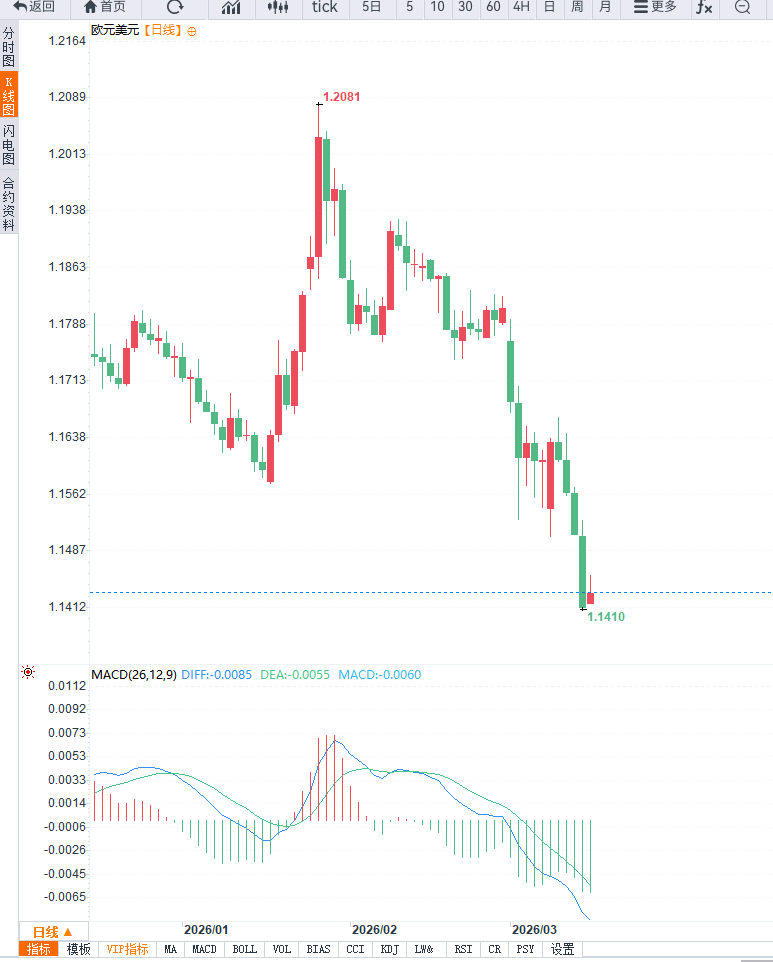
From a technical perspective, the EUR/USD daily chart is currently in a consolidation phase. The exchange rate has been fluctuating repeatedly within the 1.1400-1.1500 range recently, indicating that the market is awaiting new macroeconomic drivers. The daily chart structure shows that short-term moving averages still maintain an upward trend, but momentum indicators are beginning to flatten, suggesting a weakening of bullish momentum. If the exchange rate breaks through the 1.1500 resistance level, the upside target could be the 1.1600 area; conversely, if it falls below the 1.1380 support level, the exchange rate may retest the 1.1300 level.
From the 4-hour chart, the EUR/USD pair is showing a slightly bearish, range-bound movement in the short term. The price has encountered significant resistance on multiple rebounds to the 1.1480-1.1500 area, with the lows gradually shifting downwards, indicating continued selling pressure in the short term. In terms of momentum indicators, the RSI remains in neutral territory, suggesting that the market has not yet formed a clear trend. Ahead of the ECB meeting, the exchange rate is likely to continue to fluctuate within a range.
Overall, the core focus of the ECB's meeting this week is policy communication rather than interest rate adjustments. The market will be closely watching how the central bank assesses the impact of rising energy prices on the economic and inflation outlook. If the central bank signals a more cautious stance, the euro may receive some support in the short term; however, if the central bank emphasizes risks to economic growth, market sentiment may become more cautious.
Editor's Summary : Current uncertainties in the energy market are becoming a significant variable in global macroeconomic policy. Although oil price increases have not yet reached historical shock levels, energy prices could still impact inflation and economic growth if supply risks persist. For the European Central Bank, striking a balance between rising energy prices and slowing economic growth will be a crucial challenge for future policy decisions.
From a market perspective, investors need to pay close attention to the European Central Bank's assessment of the sustainability of the energy shock. If the central bank believes that rising oil prices are only a short-term factor, its policy stance may remain stable; however, if energy prices remain high, the ECB may need to reassess inflation risks, thereby affecting its future policy path.
Frequently Asked Questions (FAQ)
Question 1: Why do rising oil prices affect the European Central Bank's monetary policy?
Oil prices are a significant component of global inflation. When energy prices rise, transportation, manufacturing, and electricity costs increase, potentially pushing up overall price levels. For central banks, if inflation persists above their target level, tighter monetary policy is typically necessary to curb price increases. In Europe, energy prices have a significant impact on the Consumer Price Index (CPI). Historical experience shows that when oil prices rise sharply, European inflation often rises significantly in the following months. Therefore, the European Central Bank (ECB) must closely monitor energy market developments when formulating policy. However, central banks also need to consider economic growth. If rising oil prices put significant pressure on businesses and consumers, economic growth may be affected. In this situation, overly tight monetary policy could exacerbate an economic slowdown. Therefore, central banks typically need to strike a balance between controlling inflation and supporting the economy.
Question 2: Why does the Strait of Hormuz affect global oil prices?
The Strait of Hormuz is one of the world's most important energy transport routes. Large quantities of crude oil and natural gas from the Middle East are transported through this waterway to markets in Asia, Europe, and North America. Market estimates indicate that approximately 20% of global seaborne crude oil passes through this route. Disruptions to transport or security risks in this waterway could rapidly impact global energy supplies. Because the oil market is highly sensitive to supply changes, even potential risks can drive up oil prices. Historically, oil prices have fluctuated significantly whenever tensions arise in the region. Therefore, investors typically monitor developments in the region closely, as these can directly affect global energy markets and inflation expectations.
Question 3: Why is the current oil price shock considered milder than historical oil crises?
Compared to the oil crisis of the 1970s, the current energy market structure has undergone significant changes. First, many countries have reduced their dependence on oil. Increased industrial efficiency and energy restructuring have reduced the economy's sensitivity to oil price fluctuations. Second, the development of renewable energy has provided more options for energy supply. The increasing share of solar, wind, and other clean energy sources in the electricity mix has reduced the economic impact of fossil fuel price volatility. Furthermore, in terms of price levels, current oil prices are still significantly lower than historical peaks. Considering inflation over the past few decades, the actual energy cost pressure is even lower. Therefore, some economists believe that while the current rise in oil prices is noteworthy, it has not yet reached the scale of a historic energy shock.
Question 4: Why has the European economy become less dependent on oil?
For decades, European countries have been pushing for energy restructuring. Policies have emphasized improving energy efficiency, reducing reliance on fossil fuels, and increasing the proportion of renewable energy. These policies have gradually changed energy consumption patterns. Simultaneously, industrial structures have also shifted. Many energy-intensive industries have moved to other sectors, while the service sector's share of the economy has steadily increased. The service sector typically consumes less energy than manufacturing, which reduces the overall economy's sensitivity to fluctuations in oil prices. Furthermore, technological advancements have improved energy efficiency. For example, improved fuel efficiency in automobiles and advancements in building energy-saving technologies have reduced the energy required per unit of economic output.
Question 5: What is the market most focused on at the ECB meeting this week?
The market's primary focus is not on whether interest rates will be adjusted, but rather on the European Central Bank's (ECB) assessment of the future economic situation. Particularly against the backdrop of rising energy prices, how the central bank assesses the relationship between inflation and economic growth will be crucial. If the ECB believes that rising oil prices are merely a short-term fluctuation, its policy may remain stable. However, if the central bank believes that rising energy prices may persist and exert long-term pressure on inflation, its policy stance may become more cautious. Furthermore, investors will also pay attention to the central bank's view on the economic growth outlook. If the central bank believes that the European economy is resilient, the market may interpret this as a hawkish signal; but if the central bank emphasizes growth risks, the euro's exchange rate may come under some pressure.
The recent surge in international oil prices has sparked discussions about a new round of energy shocks. However, several analysts believe that the current energy price shock is relatively mild compared to historical oil crises. In absolute terms, current oil prices are still significantly lower than historical highs. Considering inflation over the past few decades, the actual energy cost pressure is even lower.
Furthermore, the structure of the European economy has undergone significant changes over the past few decades. A sustained decline in energy consumption intensity has significantly reduced the economy's dependence on oil prices. Data shows that European countries' oil consumption peaked in the 1990s, and current overall demand is about one-third lower than it was then. This structural change means that the direct impact of rising oil prices on economic growth may be smaller than in the past.
At the same time, Europe's energy structure is also undergoing a transformation. As the share of renewable energy gradually increases, the proportion of fossil fuels in electricity production continues to decline. This trend, to some extent, provides a buffer for the economy, gradually reducing the impact of energy price fluctuations on overall economic activity.
Nevertheless, the market remains closely watching the potential impact of the Middle East situation on energy supplies. Uncertainty persists regarding the Strait of Hormuz, a crucial global energy transport route. Market estimates indicate that approximately 20% of global seaborne crude oil shipments pass through this waterway . If transport through this route is subject to prolonged restrictions, energy prices could rise further, thus increasing inflationary pressures.
For the European Central Bank, the most critical issue right now is not how much oil prices have already risen, but whether this rise is sustainable. If energy prices are just experiencing short-term fluctuations, the impact on inflation may be limited. However, if supply issues persist, oil prices may need to rise further to balance market supply and demand, which will have a more lasting impact on the economy.
At the policy level, the European Central Bank (ECB) still faces a complex decision-making environment. On the one hand, rising energy prices could push up inflation expectations, requiring the central bank to maintain a cautious stance; on the other hand, if energy shocks weaken economic growth, overly tight policies could increase the downside risks to the economy. Therefore, the central bank needs to strike a balance between controlling inflation and maintaining economic growth.
From a technical perspective, the EUR/USD daily chart is currently in a consolidation phase. The exchange rate has been fluctuating repeatedly within the 1.1400-1.1500 range recently, indicating that the market is awaiting new macroeconomic drivers. The daily chart structure shows that short-term moving averages still maintain an upward trend, but momentum indicators are beginning to flatten, suggesting a weakening of bullish momentum. If the exchange rate breaks through the 1.1500 resistance level, the upside target could be the 1.1600 area; conversely, if it falls below the 1.1380 support level, the exchange rate may retest the 1.1300 level.
From the 4-hour chart, the EUR/USD pair is showing a slightly bearish, range-bound movement in the short term. The price has encountered significant resistance on multiple rebounds to the 1.1480-1.1500 area, with the lows gradually shifting downwards, indicating continued selling pressure in the short term. In terms of momentum indicators, the RSI remains in neutral territory, suggesting that the market has not yet formed a clear trend. Ahead of the ECB meeting, the exchange rate is likely to continue to fluctuate within a range.
Overall, the core focus of the ECB's meeting this week is policy communication rather than interest rate adjustments. The market will be closely watching how the central bank assesses the impact of rising energy prices on the economic and inflation outlook. If the central bank signals a more cautious stance, the euro may receive some support in the short term; however, if the central bank emphasizes risks to economic growth, market sentiment may become more cautious.
Editor's Summary : Current uncertainties in the energy market are becoming a significant variable in global macroeconomic policy. Although oil price increases have not yet reached historical shock levels, energy prices could still impact inflation and economic growth if supply risks persist. For the European Central Bank, striking a balance between rising energy prices and slowing economic growth will be a crucial challenge for future policy decisions.
From a market perspective, investors need to pay close attention to the European Central Bank's assessment of the sustainability of the energy shock. If the central bank believes that rising oil prices are only a short-term factor, its policy stance may remain stable; however, if energy prices remain high, the ECB may need to reassess inflation risks, thereby affecting its future policy path.
Frequently Asked Questions (FAQ)
Question 1: Why do rising oil prices affect the European Central Bank's monetary policy?
Oil prices are a significant component of global inflation. When energy prices rise, transportation, manufacturing, and electricity costs increase, potentially pushing up overall price levels. For central banks, if inflation persists above their target level, tighter monetary policy is typically necessary to curb price increases. In Europe, energy prices have a significant impact on the Consumer Price Index (CPI). Historical experience shows that when oil prices rise sharply, European inflation often rises significantly in the following months. Therefore, the European Central Bank (ECB) must closely monitor energy market developments when formulating policy. However, central banks also need to consider economic growth. If rising oil prices put significant pressure on businesses and consumers, economic growth may be affected. In this situation, overly tight monetary policy could exacerbate an economic slowdown. Therefore, central banks typically need to strike a balance between controlling inflation and supporting the economy.
Question 2: Why does the Strait of Hormuz affect global oil prices?
The Strait of Hormuz is one of the world's most important energy transport routes. Large quantities of crude oil and natural gas from the Middle East are transported through this waterway to markets in Asia, Europe, and North America. Market estimates indicate that approximately 20% of global seaborne crude oil passes through this route. Disruptions to transport or security risks in this waterway could rapidly impact global energy supplies. Because the oil market is highly sensitive to supply changes, even potential risks can drive up oil prices. Historically, oil prices have fluctuated significantly whenever tensions arise in the region. Therefore, investors typically monitor developments in the region closely, as these can directly affect global energy markets and inflation expectations.
Question 3: Why is the current oil price shock considered milder than historical oil crises?
Compared to the oil crisis of the 1970s, the current energy market structure has undergone significant changes. First, many countries have reduced their dependence on oil. Increased industrial efficiency and energy restructuring have reduced the economy's sensitivity to oil price fluctuations. Second, the development of renewable energy has provided more options for energy supply. The increasing share of solar, wind, and other clean energy sources in the electricity mix has reduced the economic impact of fossil fuel price volatility. Furthermore, in terms of price levels, current oil prices are still significantly lower than historical peaks. Considering inflation over the past few decades, the actual energy cost pressure is even lower. Therefore, some economists believe that while the current rise in oil prices is noteworthy, it has not yet reached the scale of a historic energy shock.
Question 4: Why has the European economy become less dependent on oil?
For decades, European countries have been pushing for energy restructuring. Policies have emphasized improving energy efficiency, reducing reliance on fossil fuels, and increasing the proportion of renewable energy. These policies have gradually changed energy consumption patterns. Simultaneously, industrial structures have also shifted. Many energy-intensive industries have moved to other sectors, while the service sector's share of the economy has steadily increased. The service sector typically consumes less energy than manufacturing, which reduces the overall economy's sensitivity to fluctuations in oil prices. Furthermore, technological advancements have improved energy efficiency. For example, improved fuel efficiency in automobiles and advancements in building energy-saving technologies have reduced the energy required per unit of economic output.
Question 5: What is the market most focused on at the ECB meeting this week?
The market's primary focus is not on whether interest rates will be adjusted, but rather on the European Central Bank's (ECB) assessment of the future economic situation. Particularly against the backdrop of rising energy prices, how the central bank assesses the relationship between inflation and economic growth will be crucial. If the ECB believes that rising oil prices are merely a short-term fluctuation, its policy may remain stable. However, if the central bank believes that rising energy prices may persist and exert long-term pressure on inflation, its policy stance may become more cautious. Furthermore, investors will also pay attention to the central bank's view on the economic growth outlook. If the central bank believes that the European economy is resilient, the market may interpret this as a hawkish signal; but if the central bank emphasizes growth risks, the euro's exchange rate may come under some pressure.
- Risk Warning and Disclaimer
- The market involves risk, and trading may not be suitable for all investors. This article is for reference only and does not constitute personal investment advice, nor does it take into account certain users’ specific investment objectives, financial situation, or other needs. Any investment decisions made based on this information are at your own risk.