The dollar fluctuated at high levels: Oil price surges were intertwined with cautious sentiment ahead of the Fed meeting.
2026-03-16 22:06:27
On Monday (March 16), during the US trading session, the US dollar index fell after the US stock market opened. The US dollar index fell from a daily high of about 100.47 to around 99.68, a drop of about 0.68%, with the intraday fluctuation range roughly between 99.81 and 100.47.
Looking at the market performance, the US dollar briefly touched a high of around 100.40 in the morning session, but then quickly fell back and broke below the 100 mark. Despite this, the overall decline did not widen further, and the index is currently still fluctuating within the high range formed over the past few months. From a market structure perspective, this appears more like a consolidation phase after a period of continuous gains, rather than a trend reversal.
The recent strengthening of the US dollar has been driven by global geopolitical tensions, as well as the relative resilience of the US economy and interest rate expectations. However, with key events approaching this week, some funds have chosen to take profits, causing a temporary "breathing out" for the dollar's rally.
Fundamentals: Geopolitical risks and policy expectations create a dual game.
The core drivers of the current foreign exchange market remain focused on two factors: the situation in the Middle East and the Federal Reserve's policy path.
First, the situation in the Middle East continues to escalate. The US-Israeli military action against Iran and the ensuing conflict have led to a temporary increase in market risk aversion. Traditionally, geopolitical risks tend to benefit safe-haven assets such as the US dollar, but the current market reaction is relatively complex. On the one hand, the conflict is pushing up energy prices and increasing global economic uncertainty; on the other hand, investors are also reassessing the resulting inflationary impact.
International oil prices have risen significantly recently. Rising energy prices often exacerbate global inflationary pressures and impact economies heavily reliant on energy imports, such as Europe and Japan. Structurally, the US, as a major energy producer, is relatively less affected by oil price fluctuations, which to some extent supports the relative advantage of the US dollar. However, in the short term, the market is more focused on digesting the macroeconomic impact of rising oil prices than simply seeking refuge in the US dollar.
Secondly, market focus is gradually shifting to the upcoming Federal Reserve interest rate decision this week. Widespread expectations indicate that the Fed will maintain interest rates at this meeting, and the expectation of a rate cut throughout the year has been compressed to approximately one. This means that monetary policy will not provide new upward momentum for the dollar in the short term. In the absence of new policy catalysts, some funds have chosen to reduce their positions before the meeting, causing a technical pullback in the dollar.
Institutional View: Dollar Pullback More Like a Pause in the Rally
Many institutions and media outlets have also made similar assessments of the current trend of the US dollar.
In its latest report, Investing.com points out that the dollar's previous upward momentum is temporarily slowing. With the ongoing conflict in Iran and investors remaining cautious about Federal Reserve policy, the dollar has generally fallen against G10 currencies, but the overall trend remains largely unchanged.
The Wall Street Journal believes that although the dollar index has retreated somewhat, the decline may be limited. The market is still closely watching energy price trends and potential changes in Japan's trade balance, factors that could continue to influence the relative performance of major currencies.
A report by Yahoo Finance also pointed out that the dollar weakened in early trading on Monday, mainly because investors turned their attention to this week's Federal Reserve meeting. Geopolitical risks and interest rate expectations remain the core variables for short-term market volatility.
Some analysts have expressed similar views. Foreign exchange strategist Marc Chandler stated that the Middle East wars remain a significant background factor in the current market, but the dollar's decline against G10 currencies and rising oil prices have further increased market uncertainty. Analysts at Oppenheimer predict that the Federal Reserve will keep interest rates unchanged this week, meaning the dollar may lack new catalysts for short-term gains, and market sentiment is leaning towards a wait-and-see approach.
Technical Analysis: Short-term pullback signals emerging
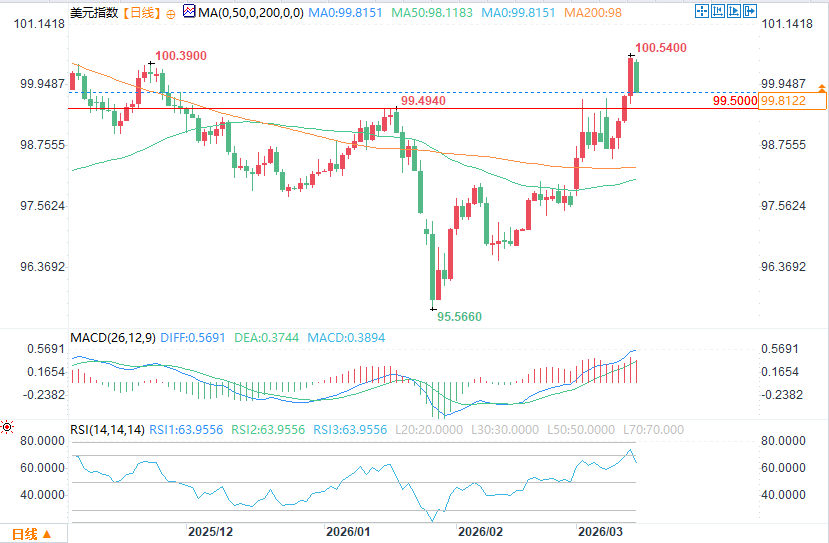
(US Dollar Index Daily Chart Source: FX678)
From a technical perspective, the short-term trend of the US dollar index does indeed show some downward pressure.
Currently, the overall technical signals for the US dollar index are biased towards "sell". On the 5-minute, 15-minute, and hourly charts, the short-term moving averages have shown a certain bearish alignment, reflecting short-term profit-taking.
Meanwhile, the daily and weekly charts remain at relatively high levels, but some momentum indicators are beginning to show signs of divergence. For example, the MACD momentum has weakened, and the RSI is gradually declining from its high range. This usually indicates that the upward momentum is starting to slow down, and the market may be entering a consolidation phase in the short term.
From a key price level perspective, the 99.50 to 99.65 area constitutes short-term support. If this level is effectively broken, the US dollar index may further decline to test the next support area near 98.80. Conversely, if the index regains its footing above 100, it may resume its previous upward momentum and challenge recent highs again.
Overall Outlook: Short-term consolidation is expected, while medium-term support remains.
Considering both fundamental and technical factors, the current pullback in the US dollar is more like a phase of correction within a high-level consolidation, rather than a trend of weakening.
On the one hand, geopolitical risks remain, and the uncertainty of the situation in the Middle East may periodically increase demand for safe-haven assets; on the other hand, the US economic fundamentals are relatively sound, and the Federal Reserve's policy path is relatively clear. These factors have limited the downside potential of the US dollar to some extent.
Against this backdrop, the market is more likely to enter a wait-and-see phase in the short term, awaiting new policy signals from the Federal Reserve meeting this week. If the policy stance remains tight or the economic outlook remains positive, the dollar may still have the potential to strengthen again.
Overall, the US dollar index is likely to fluctuate between 99.50 and 100.50 in the short term. Investors should focus on two main themes: first, the policy signals released in the Federal Reserve meeting statement and the Chairman's speech; and second, further developments in international oil prices and the situation in the Middle East. These factors will determine the direction of the dollar in the next phase.
Looking at the market performance, the US dollar briefly touched a high of around 100.40 in the morning session, but then quickly fell back and broke below the 100 mark. Despite this, the overall decline did not widen further, and the index is currently still fluctuating within the high range formed over the past few months. From a market structure perspective, this appears more like a consolidation phase after a period of continuous gains, rather than a trend reversal.
The recent strengthening of the US dollar has been driven by global geopolitical tensions, as well as the relative resilience of the US economy and interest rate expectations. However, with key events approaching this week, some funds have chosen to take profits, causing a temporary "breathing out" for the dollar's rally.
Fundamentals: Geopolitical risks and policy expectations create a dual game.
The core drivers of the current foreign exchange market remain focused on two factors: the situation in the Middle East and the Federal Reserve's policy path.
First, the situation in the Middle East continues to escalate. The US-Israeli military action against Iran and the ensuing conflict have led to a temporary increase in market risk aversion. Traditionally, geopolitical risks tend to benefit safe-haven assets such as the US dollar, but the current market reaction is relatively complex. On the one hand, the conflict is pushing up energy prices and increasing global economic uncertainty; on the other hand, investors are also reassessing the resulting inflationary impact.
International oil prices have risen significantly recently. Rising energy prices often exacerbate global inflationary pressures and impact economies heavily reliant on energy imports, such as Europe and Japan. Structurally, the US, as a major energy producer, is relatively less affected by oil price fluctuations, which to some extent supports the relative advantage of the US dollar. However, in the short term, the market is more focused on digesting the macroeconomic impact of rising oil prices than simply seeking refuge in the US dollar.
Secondly, market focus is gradually shifting to the upcoming Federal Reserve interest rate decision this week. Widespread expectations indicate that the Fed will maintain interest rates at this meeting, and the expectation of a rate cut throughout the year has been compressed to approximately one. This means that monetary policy will not provide new upward momentum for the dollar in the short term. In the absence of new policy catalysts, some funds have chosen to reduce their positions before the meeting, causing a technical pullback in the dollar.
Institutional View: Dollar Pullback More Like a Pause in the Rally
Many institutions and media outlets have also made similar assessments of the current trend of the US dollar.
In its latest report, Investing.com points out that the dollar's previous upward momentum is temporarily slowing. With the ongoing conflict in Iran and investors remaining cautious about Federal Reserve policy, the dollar has generally fallen against G10 currencies, but the overall trend remains largely unchanged.
The Wall Street Journal believes that although the dollar index has retreated somewhat, the decline may be limited. The market is still closely watching energy price trends and potential changes in Japan's trade balance, factors that could continue to influence the relative performance of major currencies.
A report by Yahoo Finance also pointed out that the dollar weakened in early trading on Monday, mainly because investors turned their attention to this week's Federal Reserve meeting. Geopolitical risks and interest rate expectations remain the core variables for short-term market volatility.
Some analysts have expressed similar views. Foreign exchange strategist Marc Chandler stated that the Middle East wars remain a significant background factor in the current market, but the dollar's decline against G10 currencies and rising oil prices have further increased market uncertainty. Analysts at Oppenheimer predict that the Federal Reserve will keep interest rates unchanged this week, meaning the dollar may lack new catalysts for short-term gains, and market sentiment is leaning towards a wait-and-see approach.
Technical Analysis: Short-term pullback signals emerging
(US Dollar Index Daily Chart Source: FX678)
From a technical perspective, the short-term trend of the US dollar index does indeed show some downward pressure.
Currently, the overall technical signals for the US dollar index are biased towards "sell". On the 5-minute, 15-minute, and hourly charts, the short-term moving averages have shown a certain bearish alignment, reflecting short-term profit-taking.
Meanwhile, the daily and weekly charts remain at relatively high levels, but some momentum indicators are beginning to show signs of divergence. For example, the MACD momentum has weakened, and the RSI is gradually declining from its high range. This usually indicates that the upward momentum is starting to slow down, and the market may be entering a consolidation phase in the short term.
From a key price level perspective, the 99.50 to 99.65 area constitutes short-term support. If this level is effectively broken, the US dollar index may further decline to test the next support area near 98.80. Conversely, if the index regains its footing above 100, it may resume its previous upward momentum and challenge recent highs again.
Overall Outlook: Short-term consolidation is expected, while medium-term support remains.
Considering both fundamental and technical factors, the current pullback in the US dollar is more like a phase of correction within a high-level consolidation, rather than a trend of weakening.
On the one hand, geopolitical risks remain, and the uncertainty of the situation in the Middle East may periodically increase demand for safe-haven assets; on the other hand, the US economic fundamentals are relatively sound, and the Federal Reserve's policy path is relatively clear. These factors have limited the downside potential of the US dollar to some extent.
Against this backdrop, the market is more likely to enter a wait-and-see phase in the short term, awaiting new policy signals from the Federal Reserve meeting this week. If the policy stance remains tight or the economic outlook remains positive, the dollar may still have the potential to strengthen again.
Overall, the US dollar index is likely to fluctuate between 99.50 and 100.50 in the short term. Investors should focus on two main themes: first, the policy signals released in the Federal Reserve meeting statement and the Chairman's speech; and second, further developments in international oil prices and the situation in the Middle East. These factors will determine the direction of the dollar in the next phase.
- Risk Warning and Disclaimer
- The market involves risk, and trading may not be suitable for all investors. This article is for reference only and does not constitute personal investment advice, nor does it take into account certain users’ specific investment objectives, financial situation, or other needs. Any investment decisions made based on this information are at your own risk.