Concerns over the Hormuz eased, causing crude oil prices to weaken; gold rebounded, revealing hidden investment opportunities.
2026-03-16 21:47:05
The U.S. military has launched airstrikes against military targets on Iran's Kharg Island. U.S. President Trump issued a strong warning that if Iran obstructs the passage of ships in the Strait of Hormuz, the U.S. will strike its oil infrastructure and called on China, Britain, France, Japan, South Korea and other countries to send warships to ensure the smooth flow of the waterway.
Iran has made it clear that the Strait of Hormuz is closed only to "enemies and countries that support their aggression," and that ships from neutral countries may pass through after obtaining coordination and permission.
The international community is paying close attention to this, and British Prime Minister Starmer has called on the international community to "quickly resolve" the relevant military conflict, emphasizing the need to restore freedom of navigation in the Strait of Hormuz as soon as possible.
The UK is working with its European allies to develop a long-term collective plan to ensure regional navigation safety and mitigate the impact on the global economy. It has already deployed unmanned surface vessels with mine identification and destruction capabilities in the relevant areas and is exploring the possibility of providing anti-drone technology support. However, Starmer also admitted that unmanned mine clearance technology has not yet been fully validated and a final decision has not yet been made.
The easing of concerns about crude oil prices will directly trigger a correction in the global crude oil market and related commodities that have seen price increases.
From a long-term perspective, Navarro points out in his 13-page report that geopolitical risks associated with Iran have artificially inflated oil prices for decades. The current situation adds a premium of $5 to $15 per barrel to crude oil prices. If Iran’s threat to regional energy infrastructure and shipping routes can be weakened, oil prices may return to equilibrium levels, or even fall significantly below $60 per barrel.
However, ING analyst Warren Paterson points out that the market is repricing for a long-term disruption to oil transport through the Strait of Hormuz. With limited spare capacity, a lagging US supply response, and limited alternative routes, oil prices will rise further under the baseline scenario.
The revised scenario forecast suggests that if energy transportation is almost completely disrupted by the end of May and gradually recovers from June to August, oil prices will hit a new historical high and will need to remain high in order to achieve market rebalancing by suppressing demand.
The persistently high oil prices are fueling inflation risks, with rising energy costs potentially being passed on to consumers, increasing the risk of stagflation and forcing major central banks around the world to recalibrate their monetary policy frameworks.
Driven by both geopolitical tensions and easing inflation concerns, gold, as a traditional safe-haven asset, has performed strongly, with spot gold (XAU/USD) stabilizing and consolidating near the $5,000 mark.
The pullback in the US dollar and US Treasury bonds from recent highs has provided some support for gold prices.
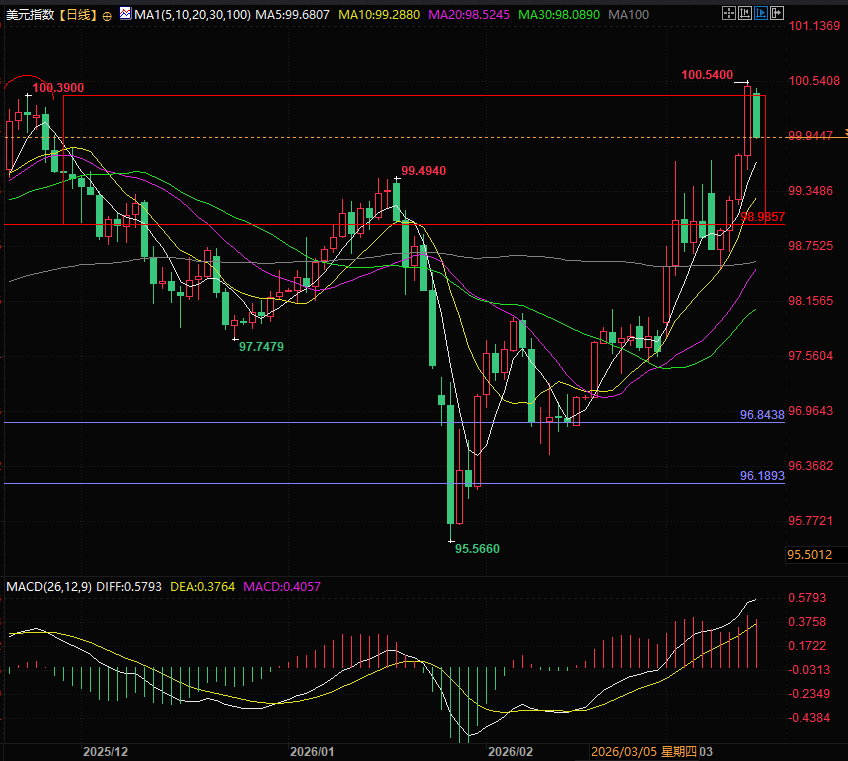
(US Dollar Index Daily Chart, Source: FX678)
This week, the market's core focus is on the Federal Reserve's interest rate decision and the policy direction of other major central banks around the world. The Fed is likely to maintain its interest rate range of 3.50%-3.75%, and investors will pay close attention to Chairman Powell's forward guidance, as well as the interest rate path signals released by the updated Summary of Economic Projections (SEP) and the dot plot.
Data from the CME Group's FedWatch Tool shows that investors' expectations for a Fed rate cut have cooled significantly. The probability of a 25 basis point rate cut in June has plummeted from 51.2% a month ago to 23.6%. The market is currently pricing in only one rate cut before the end of the year, a significant adjustment from the previous two rate cut expectations.
Apart from the Federal Reserve, the Bank of England, the European Central Bank, the Bank of Japan, and the Bank of Canada are expected to maintain their current policies, while the Reserve Bank of Australia may raise interest rates again.
As a core anchor for hedging geopolitical uncertainties, gold's allocation value continues to stand out. In the short term, it will maintain high volatility. In the medium term, as long as there are no clear signs of easing in the Middle East conflict, gold's safe-haven logic will continue to be effective.
The recent significant inverse correlation between international crude oil and gold prices is primarily linked by the inflation transmission mechanism and the resonance effect of geopolitical risks.
Gold has a natural property of hedging against geopolitical risks, but it is sensitive to real interest rates. International crude oil prices are closely related to global inflation levels. Rising oil prices can quickly push up market inflation expectations, thereby affecting real interest rates and thus influencing the price of gold.
In this US-Iran conflict, the disruption of shipping in the Strait of Hormuz has impacted crude oil supply and market risk appetite, creating a transmission chain of "crude oil price increases → rising inflation expectations → higher real interest rates → weaker gold prices".
From a market perspective, fluctuations in crude oil prices indirectly affect the gold market by influencing inflation expectations, while geopolitical risks act as a common catalyst for both to strengthen simultaneously.
In the current situation, if the conflict escalates further and leads to a long-term blockade of the Strait of Hormuz, crude oil prices may rise by 50%-100%, triggering a scenario similar to the historical oil crisis. Gold is caught between safe-haven demand and rising real interest rates, resulting in a rather volatile price trend.
If the geopolitical premium for crude oil subsides, gold may rebound, returning to a volatility logic driven by real interest rates.
The correlation between the two not only reflects the current risk appetite of the global market, but also reveals the profound impact of geopolitical conflicts on asset allocation, becoming a core clue for investors to grasp the pulse of the market.
Spot gold rebounded after touching the lower rail of its upward channel.
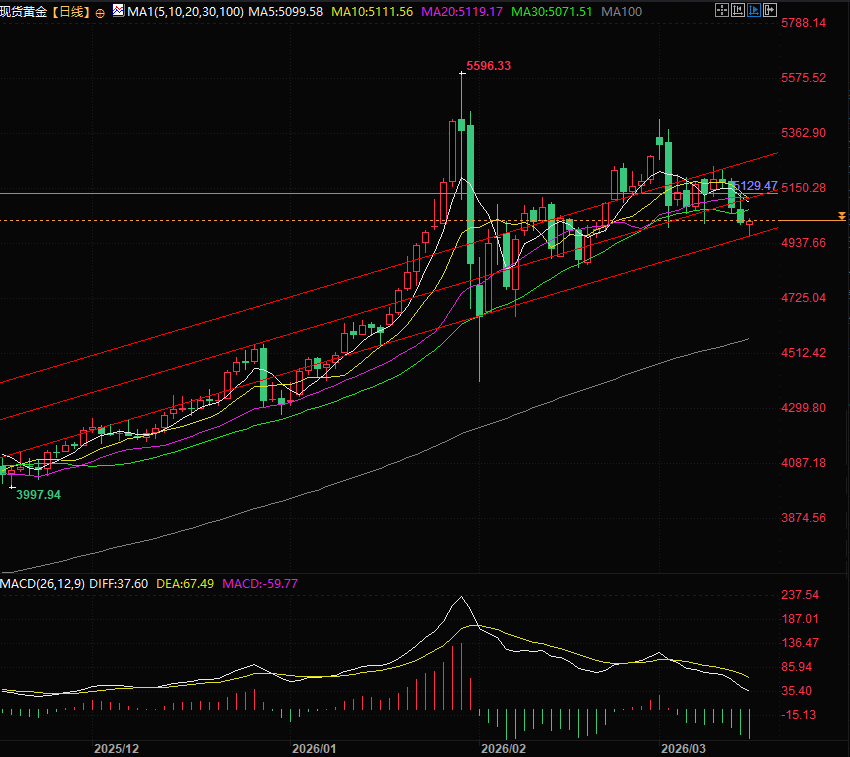
(Spot gold daily chart, source: FX678)
WTI crude oil futures have repeatedly retraced to the 0.618 percentile.
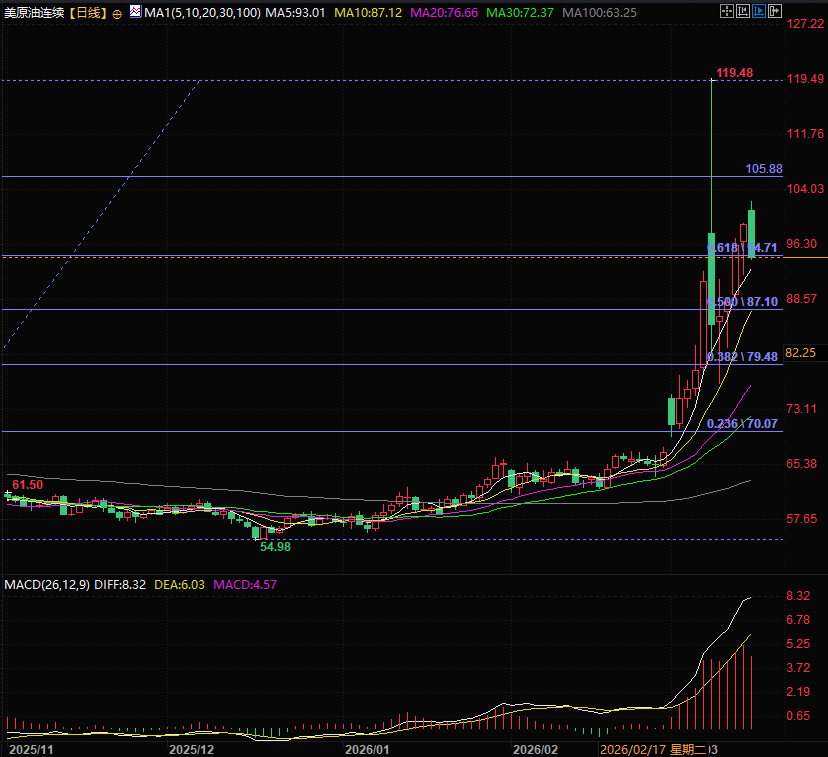
(WTI crude oil futures daily chart, source: EasyForex)
At 21:45 Beijing time, spot gold was trading at $5,032 per ounce, and WTI crude oil futures were trading at $94.66 per barrel.
Iran has made it clear that the Strait of Hormuz is closed only to "enemies and countries that support their aggression," and that ships from neutral countries may pass through after obtaining coordination and permission.
The international community is paying close attention to this, and British Prime Minister Starmer has called on the international community to "quickly resolve" the relevant military conflict, emphasizing the need to restore freedom of navigation in the Strait of Hormuz as soon as possible.
The UK is working with its European allies to develop a long-term collective plan to ensure regional navigation safety and mitigate the impact on the global economy. It has already deployed unmanned surface vessels with mine identification and destruction capabilities in the relevant areas and is exploring the possibility of providing anti-drone technology support. However, Starmer also admitted that unmanned mine clearance technology has not yet been fully validated and a final decision has not yet been made.
The narrative of falling oil prices emerges, and the crude oil market weakens.
The easing of concerns about crude oil prices will directly trigger a correction in the global crude oil market and related commodities that have seen price increases.
From a long-term perspective, Navarro points out in his 13-page report that geopolitical risks associated with Iran have artificially inflated oil prices for decades. The current situation adds a premium of $5 to $15 per barrel to crude oil prices. If Iran’s threat to regional energy infrastructure and shipping routes can be weakened, oil prices may return to equilibrium levels, or even fall significantly below $60 per barrel.
However, ING analyst Warren Paterson points out that the market is repricing for a long-term disruption to oil transport through the Strait of Hormuz. With limited spare capacity, a lagging US supply response, and limited alternative routes, oil prices will rise further under the baseline scenario.
The revised scenario forecast suggests that if energy transportation is almost completely disrupted by the end of May and gradually recovers from June to August, oil prices will hit a new historical high and will need to remain high in order to achieve market rebalancing by suppressing demand.
The persistently high oil prices are fueling inflation risks, with rising energy costs potentially being passed on to consumers, increasing the risk of stagflation and forcing major central banks around the world to recalibrate their monetary policy frameworks.
Gold holds firm on key support levels, driven by both safe-haven demand and inflationary pressures.
Driven by both geopolitical tensions and easing inflation concerns, gold, as a traditional safe-haven asset, has performed strongly, with spot gold (XAU/USD) stabilizing and consolidating near the $5,000 mark.
The pullback in the US dollar and US Treasury bonds from recent highs has provided some support for gold prices.
(US Dollar Index Daily Chart, Source: FX678)
This week, the market's core focus is on the Federal Reserve's interest rate decision and the policy direction of other major central banks around the world. The Fed is likely to maintain its interest rate range of 3.50%-3.75%, and investors will pay close attention to Chairman Powell's forward guidance, as well as the interest rate path signals released by the updated Summary of Economic Projections (SEP) and the dot plot.
Data from the CME Group's FedWatch Tool shows that investors' expectations for a Fed rate cut have cooled significantly. The probability of a 25 basis point rate cut in June has plummeted from 51.2% a month ago to 23.6%. The market is currently pricing in only one rate cut before the end of the year, a significant adjustment from the previous two rate cut expectations.
Apart from the Federal Reserve, the Bank of England, the European Central Bank, the Bank of Japan, and the Bank of Canada are expected to maintain their current policies, while the Reserve Bank of Australia may raise interest rates again.
As a core anchor for hedging geopolitical uncertainties, gold's allocation value continues to stand out. In the short term, it will maintain high volatility. In the medium term, as long as there are no clear signs of easing in the Middle East conflict, gold's safe-haven logic will continue to be effective.
The correlation between crude oil and gold: the resonance of inflation transmission and safe-haven demand.
The recent significant inverse correlation between international crude oil and gold prices is primarily linked by the inflation transmission mechanism and the resonance effect of geopolitical risks.
Gold has a natural property of hedging against geopolitical risks, but it is sensitive to real interest rates. International crude oil prices are closely related to global inflation levels. Rising oil prices can quickly push up market inflation expectations, thereby affecting real interest rates and thus influencing the price of gold.
In this US-Iran conflict, the disruption of shipping in the Strait of Hormuz has impacted crude oil supply and market risk appetite, creating a transmission chain of "crude oil price increases → rising inflation expectations → higher real interest rates → weaker gold prices".
Summary and Technical Analysis:
From a market perspective, fluctuations in crude oil prices indirectly affect the gold market by influencing inflation expectations, while geopolitical risks act as a common catalyst for both to strengthen simultaneously.
In the current situation, if the conflict escalates further and leads to a long-term blockade of the Strait of Hormuz, crude oil prices may rise by 50%-100%, triggering a scenario similar to the historical oil crisis. Gold is caught between safe-haven demand and rising real interest rates, resulting in a rather volatile price trend.
If the geopolitical premium for crude oil subsides, gold may rebound, returning to a volatility logic driven by real interest rates.
The correlation between the two not only reflects the current risk appetite of the global market, but also reveals the profound impact of geopolitical conflicts on asset allocation, becoming a core clue for investors to grasp the pulse of the market.
Technical aspects:
Spot gold rebounded after touching the lower rail of its upward channel.
(Spot gold daily chart, source: FX678)
WTI crude oil futures have repeatedly retraced to the 0.618 percentile.
(WTI crude oil futures daily chart, source: EasyForex)
At 21:45 Beijing time, spot gold was trading at $5,032 per ounce, and WTI crude oil futures were trading at $94.66 per barrel.
- Risk Warning and Disclaimer
- The market involves risk, and trading may not be suitable for all investors. This article is for reference only and does not constitute personal investment advice, nor does it take into account certain users’ specific investment objectives, financial situation, or other needs. Any investment decisions made based on this information are at your own risk.