Continued tensions in the Middle East have fueled concerns about oil price inflation, putting pressure on gold at key resistance levels.
2026-03-17 13:35:48
XAU/USD maintained a slight intraday gain in Asian trading on Tuesday, but failed to break through the $5,050 level, indicating a lack of bullish confidence. As the US-Israel conflict extends to southern Lebanon and the ground offensive against Hezbollah-controlled areas intensifies, geopolitical safe-haven demand continues to support gold prices.

Meanwhile, Iran continues its missile and drone attacks on civilian infrastructure in six Gulf states, including airports, ports, oil facilities, and commercial centers. The Strait of Hormuz, a key shipping route supplying approximately one-fifth of the world's crude oil, remains under threat, maintaining high oil prices. Inflationary concerns stemming from high oil prices may force the Federal Reserve to maintain high interest rates or even consider raising them, thus putting pressure on gold, a non-yielding asset.
The US dollar found support after a short-term pullback due to hawkish expectations stemming from the Middle East conflict, limiting the upside potential of XAU/USD. However, the market remains awaiting policy updates from the upcoming two-day FOMC meeting, as well as policy announcements from the European Central Bank, the Bank of Japan, and the Bank of England, with investors highly sensitive to subsequent policy developments.
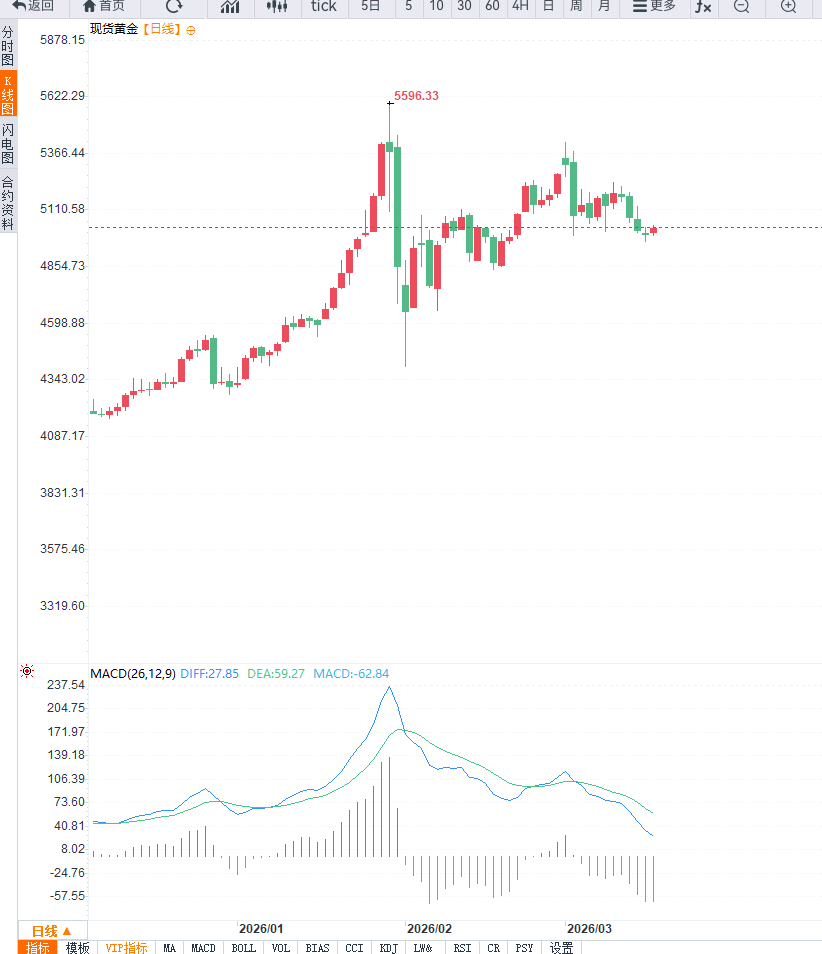
The daily chart shows that gold remains in a weak consolidation range in the short term, fluctuating between $5000 and $5050 . On the 4-hour chart, XAU/USD broke below the 200-period simple moving average (SMA) and is holding below the 38.2% Fibonacci retracement level of the February-March rally, indicating that bears are in control. The MACD indicator is below the zero line, with the red bars continuing to be negative, and the RSI is at 41, leaning towards weakness, suggesting that sellers still have the upper hand.
Initial resistance is at the 38.2% Fibonacci retracement level of $5040 , followed by the 200-period SMA around $5063 . A break above this level could lead to a test of the 23.6% retracement level at $5186 . Support is first at the psychological level of $5000 , then at the recent lows of $4995-$4985 . A break below this level could lead to a test of the 50% retracement level at $4921 .
Editor's Summary
XAU/USD remained range-bound, supported by geopolitical risks, but inflationary pressures from high oil prices and temporary dollar support limited gold's upward momentum. In the short term, prices may consolidate in the $5,000-$5,050 range, awaiting policy signals from the Federal Reserve and other major central banks. In the medium term, if the dollar weakens and oil risk premiums ease, gold is expected to re-enter bullish territory. Investors should pay attention to key technical levels and policy developments to seize trading opportunities.
Frequently Asked Questions (FAQ)
Q1: How does the current situation in the Middle East affect gold prices?
A1: The conflict in the Middle East has led to concerns about oil supply and increased geopolitical risks, thus stimulating safe-haven funds to flow into the gold market. However, at the same time, high oil prices may trigger inflation concerns, prompting the Federal Reserve to maintain or raise interest rates, which puts pressure on gold, a non-yielding asset, resulting in a volatile price adjustment.
Q2: Why is XAU/USD still relatively weak in the short term?
A2: Gold failed to break through the $5,050 resistance level and also fell below the 200-period SMA and the 38.2% Fibonacci retracement level on the 4-hour chart. The MACD is negative and the RSI is weak, indicating that bearish momentum is dominant. Short-term support from the US dollar further limits gold's upside potential, and it is expected to remain in a weak consolidation phase in the short term.
Q3: How should investors respond to the upcoming FOMC meeting?
A3: The market is highly focused on the Federal Reserve's interest rate decision and Chairman Powell's statement. If the policy is hawkish or interest rates remain stable, it will suppress gold's upward movement; if it releases dovish signals or hints at future rate cuts, it may trigger a gold rebound. Traders should wait for clear policy signals before making any moves.
Q4: What is the transmission logic of crude oil prices to gold?
A4: High oil prices will raise inflation expectations, potentially forcing central banks to maintain high interest rates, putting pressure on gold, a non-interest-bearing asset; however, Middle East risks are leading to increased safe-haven demand, providing support for gold buying. The interaction of these two factors causes gold prices to fluctuate.
Meanwhile, Iran continues its missile and drone attacks on civilian infrastructure in six Gulf states, including airports, ports, oil facilities, and commercial centers. The Strait of Hormuz, a key shipping route supplying approximately one-fifth of the world's crude oil, remains under threat, maintaining high oil prices. Inflationary concerns stemming from high oil prices may force the Federal Reserve to maintain high interest rates or even consider raising them, thus putting pressure on gold, a non-yielding asset.
The US dollar found support after a short-term pullback due to hawkish expectations stemming from the Middle East conflict, limiting the upside potential of XAU/USD. However, the market remains awaiting policy updates from the upcoming two-day FOMC meeting, as well as policy announcements from the European Central Bank, the Bank of Japan, and the Bank of England, with investors highly sensitive to subsequent policy developments.
The daily chart shows that gold remains in a weak consolidation range in the short term, fluctuating between $5000 and $5050 . On the 4-hour chart, XAU/USD broke below the 200-period simple moving average (SMA) and is holding below the 38.2% Fibonacci retracement level of the February-March rally, indicating that bears are in control. The MACD indicator is below the zero line, with the red bars continuing to be negative, and the RSI is at 41, leaning towards weakness, suggesting that sellers still have the upper hand.
Initial resistance is at the 38.2% Fibonacci retracement level of $5040 , followed by the 200-period SMA around $5063 . A break above this level could lead to a test of the 23.6% retracement level at $5186 . Support is first at the psychological level of $5000 , then at the recent lows of $4995-$4985 . A break below this level could lead to a test of the 50% retracement level at $4921 .
Editor's Summary
XAU/USD remained range-bound, supported by geopolitical risks, but inflationary pressures from high oil prices and temporary dollar support limited gold's upward momentum. In the short term, prices may consolidate in the $5,000-$5,050 range, awaiting policy signals from the Federal Reserve and other major central banks. In the medium term, if the dollar weakens and oil risk premiums ease, gold is expected to re-enter bullish territory. Investors should pay attention to key technical levels and policy developments to seize trading opportunities.
Frequently Asked Questions (FAQ)
Q1: How does the current situation in the Middle East affect gold prices?
A1: The conflict in the Middle East has led to concerns about oil supply and increased geopolitical risks, thus stimulating safe-haven funds to flow into the gold market. However, at the same time, high oil prices may trigger inflation concerns, prompting the Federal Reserve to maintain or raise interest rates, which puts pressure on gold, a non-yielding asset, resulting in a volatile price adjustment.
Q2: Why is XAU/USD still relatively weak in the short term?
A2: Gold failed to break through the $5,050 resistance level and also fell below the 200-period SMA and the 38.2% Fibonacci retracement level on the 4-hour chart. The MACD is negative and the RSI is weak, indicating that bearish momentum is dominant. Short-term support from the US dollar further limits gold's upside potential, and it is expected to remain in a weak consolidation phase in the short term.
Q3: How should investors respond to the upcoming FOMC meeting?
A3: The market is highly focused on the Federal Reserve's interest rate decision and Chairman Powell's statement. If the policy is hawkish or interest rates remain stable, it will suppress gold's upward movement; if it releases dovish signals or hints at future rate cuts, it may trigger a gold rebound. Traders should wait for clear policy signals before making any moves.
Q4: What is the transmission logic of crude oil prices to gold?
A4: High oil prices will raise inflation expectations, potentially forcing central banks to maintain high interest rates, putting pressure on gold, a non-interest-bearing asset; however, Middle East risks are leading to increased safe-haven demand, providing support for gold buying. The interaction of these two factors causes gold prices to fluctuate.
- Risk Warning and Disclaimer
- The market involves risk, and trading may not be suitable for all investors. This article is for reference only and does not constitute personal investment advice, nor does it take into account certain users’ specific investment objectives, financial situation, or other needs. Any investment decisions made based on this information are at your own risk.