Experts warn that if oil futures prices reflect a long-term risk premium, the overall economy will suffer.
2026-03-17 14:06:59
Despite oil prices surging to their third-highest level in the past two weeks, crude oil futures prices have remained relatively restrained.
However, Sean Lusk, co-director of commercial hedging at Walsh Trading, warned that if the conflict with Iran continues beyond mid-April, its spillover effects will be significantly amplified, causing substantial impacts on U.S. Treasury yields, the stock market, precious metals, and the broader economy.
Lasker stated that he is closely monitoring the interplay between stocks, gold, energy, and U.S. Treasury yields. He noted, "When yields rise and stocks fall, precious metals follow the stock market down, just as they have followed the stock market up over the past three years." He added, "There is almost no demand for safe-haven assets here, or very little, because we haven't broken to new highs, or even come close to them."

He further observed: "Over the past two weeks, when oil prices fell, the stock market rebounded, and precious metals rose accordingly; conversely, when the market declined, precious metals also followed the stock market lower. The magnitude wasn't extreme; gold prices didn't fall much below $5,000 per ounce, but there hasn't been a decent rebound yet, and any rebound is immediately followed by selling. Gold prices are fluctuating between $5,000 and $5,200, while silver is hovering around the mid-$80 area."
When asked whether Asian countries and other developing economies had begun selling off US Treasury bonds and other dollar assets in response to high oil prices, Lasker said it was too early to say.
He pointed out, "We haven't seen that kind of panic yet." He added, "This conflict has only lasted two weeks. We had a significant increase before, but historically, pre-war oil prices are not high. Not long ago, it was $50, and it closed at $60 before the war started. On the 24th, crude oil closed at $71 per barrel."
He stated, " If we set the benchmark here, and oil prices remain at or above $90 for a considerable period, perhaps another month or so, then the situation will be different. Only then will we see a sell-off of US Treasury bonds to cope with rising energy costs , but we haven't reached that point yet."
Lasker points out that the price difference between near and far months in market pricing (spot premium and futures premium) indicates that currently, more oil that has been sold but is stuck on the surface cannot reach its destination, and the price of the transaction is locked in.
He said, "Looking at this price spread, the near-month contract is priced at $96 per barrel, while the September contract is at $82. As you can see, the price of the far-month contract has started to recover, but it was still at the $74 level a few days ago, which shows a serious spot premium."
He added, "This could change; the market is fluctuating, and spreads will unwind. If the conflict continues for a few more weeks, value opportunities may emerge in longer-term contracts ."
Lasker emphasized that the current situation is extremely difficult to predict because the narrative can be reversed in an instant.
He stated, "We are currently in a wait-and-see phase in the market, observing the direction of the conflict and, more importantly, how long it will last." He added, "They say 30 days, four or five weeks, let's see how it actually goes. But judging from their rhetoric, reaching an agreement doesn't seem to be imminent."
He pointed out that many investors and traders hold extremely long positions in precious metals, so it is understandable that they would reduce their positions when the stock market falls and uncertainty increases. He reiterated: "Over the past three years, gold and silver have often followed the stock market upwards rather than inversely, and this is what is being unraveled now: when the stock market falls and pulls back, precious metals also fall."
Lasker points out: "Energy has been mostly depressed in the past few years, especially since 2022, with supply far exceeding demand, except for a few events such as the June bombing of Iranian nuclear facilities. Now the direction has reversed because of the war, and these things will reset over time."
Lasker predicts that gold prices will fall further below $5,000 in the short term before selling pressure emerges again.
He said, "I think selling will continue." He added, "Currently, it's tied to the stock market and moves in tandem, so I don't know what will break that correlation."
Overall, Sean Lusk's analysis suggests that despite the recent surge in oil prices, forward futures contracts have not yet fully reflected long-term risk premiums, and the market remains in a wait-and-see phase. If the conflict ends by mid-April, the impact may be limited; however, if it drags on, the energy crisis will have significant spillover effects through rising US Treasury yields, stock market volatility, a decline in precious metals, and a broader economic slowdown.
Currently, gold and silver lack independent safe-haven demand and mainly follow stock market trends, still facing downward pressure in the short term. Investors need to be wary of rapidly changing narratives and pay attention to developments in the Strait of Hormuz, actual oil price movements, and the Fed's response to inflation. Short-term corrections may intensify, but if the conflict becomes protracted, the value of precious metals as strategic assets for hedging against inflation and currency risks will be gradually reassessed.
Lasker's view serves as a reminder to the market that the seemingly calm forward pricing may conceal greater volatility and opportunities in the coming months.
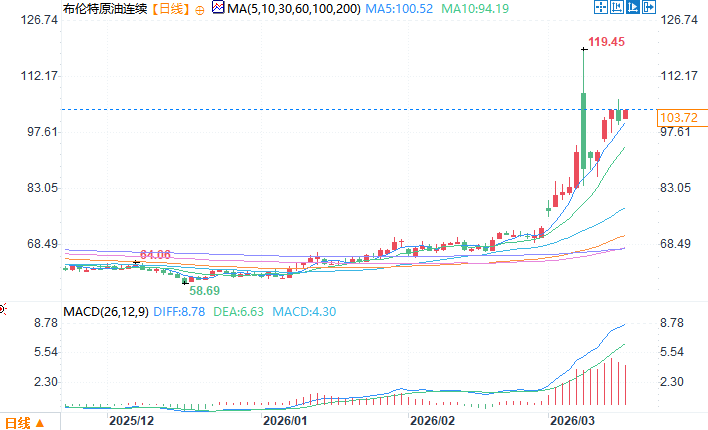
Brent crude oil daily chart source: EasyForex
At 14:06 Beijing time on March 17, Brent crude oil futures were trading at $104.75 per barrel.
However, Sean Lusk, co-director of commercial hedging at Walsh Trading, warned that if the conflict with Iran continues beyond mid-April, its spillover effects will be significantly amplified, causing substantial impacts on U.S. Treasury yields, the stock market, precious metals, and the broader economy.
Lasker stated that he is closely monitoring the interplay between stocks, gold, energy, and U.S. Treasury yields. He noted, "When yields rise and stocks fall, precious metals follow the stock market down, just as they have followed the stock market up over the past three years." He added, "There is almost no demand for safe-haven assets here, or very little, because we haven't broken to new highs, or even come close to them."
He further observed: "Over the past two weeks, when oil prices fell, the stock market rebounded, and precious metals rose accordingly; conversely, when the market declined, precious metals also followed the stock market lower. The magnitude wasn't extreme; gold prices didn't fall much below $5,000 per ounce, but there hasn't been a decent rebound yet, and any rebound is immediately followed by selling. Gold prices are fluctuating between $5,000 and $5,200, while silver is hovering around the mid-$80 area."
Are Asian countries selling off US Treasury bonds to buy oil? Lasker: It's too early.
When asked whether Asian countries and other developing economies had begun selling off US Treasury bonds and other dollar assets in response to high oil prices, Lasker said it was too early to say.
He pointed out, "We haven't seen that kind of panic yet." He added, "This conflict has only lasted two weeks. We had a significant increase before, but historically, pre-war oil prices are not high. Not long ago, it was $50, and it closed at $60 before the war started. On the 24th, crude oil closed at $71 per barrel."
He stated, " If we set the benchmark here, and oil prices remain at or above $90 for a considerable period, perhaps another month or so, then the situation will be different. Only then will we see a sell-off of US Treasury bonds to cope with rising energy costs , but we haven't reached that point yet."
Forward futures prices show that the price is starting to rise, but overall the price is still in a futures premium structure.
Lasker points out that the price difference between near and far months in market pricing (spot premium and futures premium) indicates that currently, more oil that has been sold but is stuck on the surface cannot reach its destination, and the price of the transaction is locked in.
He said, "Looking at this price spread, the near-month contract is priced at $96 per barrel, while the September contract is at $82. As you can see, the price of the far-month contract has started to recover, but it was still at the $74 level a few days ago, which shows a serious spot premium."
He added, "This could change; the market is fluctuating, and spreads will unwind. If the conflict continues for a few more weeks, value opportunities may emerge in longer-term contracts ."
Market narratives change rapidly, making prediction extremely difficult.
Lasker emphasized that the current situation is extremely difficult to predict because the narrative can be reversed in an instant.
He stated, "We are currently in a wait-and-see phase in the market, observing the direction of the conflict and, more importantly, how long it will last." He added, "They say 30 days, four or five weeks, let's see how it actually goes. But judging from their rhetoric, reaching an agreement doesn't seem to be imminent."
He pointed out that many investors and traders hold extremely long positions in precious metals, so it is understandable that they would reduce their positions when the stock market falls and uncertainty increases. He reiterated: "Over the past three years, gold and silver have often followed the stock market upwards rather than inversely, and this is what is being unraveled now: when the stock market falls and pulls back, precious metals also fall."
Energy prices were depressed in the past, but are now being reassessed due to war.
Lasker points out: "Energy has been mostly depressed in the past few years, especially since 2022, with supply far exceeding demand, except for a few events such as the June bombing of Iranian nuclear facilities. Now the direction has reversed because of the war, and these things will reset over time."
Gold prices are bearish in the short term, potentially falling below $5,000, and will continue to follow the stock market trend.
Lasker predicts that gold prices will fall further below $5,000 in the short term before selling pressure emerges again.
He said, "I think selling will continue." He added, "Currently, it's tied to the stock market and moves in tandem, so I don't know what will break that correlation."
Overall, Sean Lusk's analysis suggests that despite the recent surge in oil prices, forward futures contracts have not yet fully reflected long-term risk premiums, and the market remains in a wait-and-see phase. If the conflict ends by mid-April, the impact may be limited; however, if it drags on, the energy crisis will have significant spillover effects through rising US Treasury yields, stock market volatility, a decline in precious metals, and a broader economic slowdown.
Currently, gold and silver lack independent safe-haven demand and mainly follow stock market trends, still facing downward pressure in the short term. Investors need to be wary of rapidly changing narratives and pay attention to developments in the Strait of Hormuz, actual oil price movements, and the Fed's response to inflation. Short-term corrections may intensify, but if the conflict becomes protracted, the value of precious metals as strategic assets for hedging against inflation and currency risks will be gradually reassessed.
Lasker's view serves as a reminder to the market that the seemingly calm forward pricing may conceal greater volatility and opportunities in the coming months.
Brent crude oil daily chart source: EasyForex
At 14:06 Beijing time on March 17, Brent crude oil futures were trading at $104.75 per barrel.
- Risk Warning and Disclaimer
- The market involves risk, and trading may not be suitable for all investors. This article is for reference only and does not constitute personal investment advice, nor does it take into account certain users’ specific investment objectives, financial situation, or other needs. Any investment decisions made based on this information are at your own risk.