Ahead of the Fed meeting, a massive sell-off occurs, with short-term US Treasuries becoming a safe-haven asset.
2026-03-17 13:59:40
Amid escalating conflicts between the US and Israel in the Middle East and Iran, and sharp fluctuations in global energy prices, US bond market investors have adopted a largely defensive stance. In the past two days, many institutional and individual investors have made significant purchases of short-term US Treasuries, particularly two-year Treasuries, ahead of the Federal Reserve's March interest rate meeting, to hedge against the triple pressures of geopolitical uncertainty, persistent inflation, and a weak job market.
The market widely expects the Federal Reserve to keep the federal funds rate unchanged at 3.50%-3.75% on Wednesday, but there is still disagreement on whether to adjust policy guidance.
Short-term U.S. Treasury yields have risen sharply in the past two weeks, with the two-year Treasury yield surging 31 basis points this month, on track for its biggest monthly gain since October 2024, currently at 3.681%, reflecting market concerns that the Federal Reserve will find it difficult to ease monetary policy due to rising oil prices.

Since the outbreak of the war with Iran, risk appetite in the bond market has plummeted. "Investors are taking a more cautious approach to positioning, avoiding the riskier parts of the bond market," said Danny Zaid, portfolio manager at TwentyFour Asset Management. He added, "Interest rate volatility will remain high, and we maintain a neutral stance on the duration of the bond market, at least until the situation in the conflict becomes clearer."
A survey of JPMorgan Chase's U.S. Treasury clients shows that active clients' net short positions have risen to their highest level since early February, reflecting a strong market demand for control over interest rate risk. Many investors believe that short-term U.S. Treasuries have absorbed most of the selling pressure, and after yields rose to a seven-month high, downside potential is beginning to emerge.
Markets widely expect the Federal Open Market Committee (FOMC) to keep the benchmark overnight interest rate unchanged at 3.50%-3.75% when it concludes its two-day meeting on Wednesday. Policymakers are still assessing the potential impact of the war in Iran on the Fed's dual mandate of price stability and full employment.
Although some investors believe the conflict will be short-lived and manageable, and that rising oil prices will have a limited impact on inflation, thus leaving room for interest rate cuts later this year, the combination of geopolitical tensions, persistent inflation, and weak employment makes it difficult for the market to judge the Fed's direction.
Data from the London Stock Exchange Group (LSEG) shows that US interest rate futures are no longer pricing in rate cuts this year, currently reflecting only 24 basis points of easing space, far below the 55 basis points before the Iran war. Olumide Owolabi, head of the US interest rate team at Neuberger Berman, said, "Nobody can predict the next move at this point." He added, "I don't think the Fed will change its long-term outlook simply because of extremely high uncertainty."
U.S. crude oil futures have surged 46% this month, on track for their biggest monthly gain since May 2020. Brad Conger, chief investment officer at Hirtle Callaghan, points out that once a certain tipping point is reached, energy-driven inflation will turn into demand destruction, thereby reducing consumer spending. He states, "Whether the war ends quickly or drags on, U.S. Treasuries are a hedge against an economic slowdown."
Many investors believe that the yield on two-year US Treasury bonds has room to fall, arguing that short-term US Treasuries have already absorbed most of the selling pressure. Asset management institutions are generally optimistic about short-term US Treasuries, believing they offer both safe-haven and yield characteristics in the current environment.
The Federal Reserve will release its summary of economic projections on Wednesday, including the closely watched "dot plot." The December dot plot showed only a 25 basis point rate cut this year, when policymakers maintained their median estimate of the "neutral interest rate" at 3%.
Given the continued tensions in Iran, investors generally expect no major changes to policy guidance at the March meeting.
Overall, the energy crisis triggered by the Iran war and rising inflation expectations are forcing bond investors to shift towards a defensive stance. Short-term US Treasuries have become the preferred safe-haven asset, and although the two-year yield has risen sharply, the market believes that its downside potential has begun to emerge.
The Fed's decision on Wednesday and its dot plot will be the biggest focus this week. If the guidance maintains a cautious tone, short-term US Treasuries are still expected to attract more capital inflows.
In the coming weeks, whether the conflict de-escalates, the actual trend of oil prices, and the Fed's true attitude towards inflation will directly determine the direction of the bond market and the global asset allocation landscape. Investors need to be highly vigilant about the cascading impacts of geopolitical uncertainty on interest rates, inflation, and economic growth. Short-term US Treasuries may continue to play a key safe-haven role in the current environment.
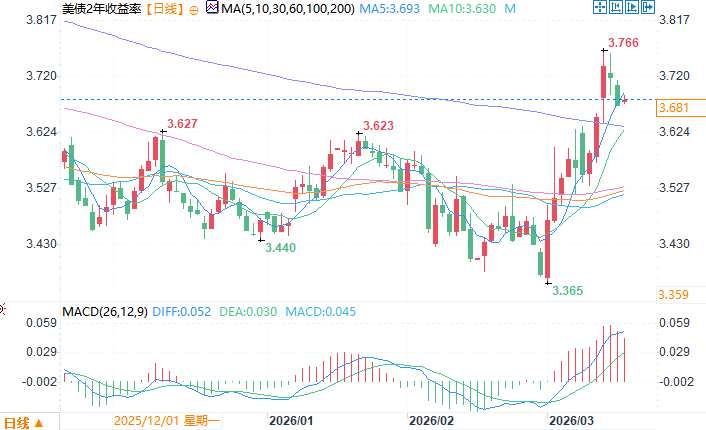
2-year US Treasury yield daily chart. Source: EasyTrade.
At 13:59 Beijing time on March 17, the yield on the two-year US Treasury note was 3.691%.
The market widely expects the Federal Reserve to keep the federal funds rate unchanged at 3.50%-3.75% on Wednesday, but there is still disagreement on whether to adjust policy guidance.
Short-term U.S. Treasury yields have risen sharply in the past two weeks, with the two-year Treasury yield surging 31 basis points this month, on track for its biggest monthly gain since October 2024, currently at 3.681%, reflecting market concerns that the Federal Reserve will find it difficult to ease monetary policy due to rising oil prices.
Investors are clearly taking a defensive stance, with short-term US Treasuries becoming the preferred safe haven.
Since the outbreak of the war with Iran, risk appetite in the bond market has plummeted. "Investors are taking a more cautious approach to positioning, avoiding the riskier parts of the bond market," said Danny Zaid, portfolio manager at TwentyFour Asset Management. He added, "Interest rate volatility will remain high, and we maintain a neutral stance on the duration of the bond market, at least until the situation in the conflict becomes clearer."
A survey of JPMorgan Chase's U.S. Treasury clients shows that active clients' net short positions have risen to their highest level since early February, reflecting a strong market demand for control over interest rate risk. Many investors believe that short-term U.S. Treasuries have absorbed most of the selling pressure, and after yields rose to a seven-month high, downside potential is beginning to emerge.
Ahead of the Fed's decision, the market expected that interest rates would remain unchanged and guidance would likely remain largely the same.
Markets widely expect the Federal Open Market Committee (FOMC) to keep the benchmark overnight interest rate unchanged at 3.50%-3.75% when it concludes its two-day meeting on Wednesday. Policymakers are still assessing the potential impact of the war in Iran on the Fed's dual mandate of price stability and full employment.
Although some investors believe the conflict will be short-lived and manageable, and that rising oil prices will have a limited impact on inflation, thus leaving room for interest rate cuts later this year, the combination of geopolitical tensions, persistent inflation, and weak employment makes it difficult for the market to judge the Fed's direction.
Data from the London Stock Exchange Group (LSEG) shows that US interest rate futures are no longer pricing in rate cuts this year, currently reflecting only 24 basis points of easing space, far below the 55 basis points before the Iran war. Olumide Owolabi, head of the US interest rate team at Neuberger Berman, said, "Nobody can predict the next move at this point." He added, "I don't think the Fed will change its long-term outlook simply because of extremely high uncertainty."
The energy crisis is fueling inflation concerns, and short-term US Treasury bonds are seen as having room for appreciation.
U.S. crude oil futures have surged 46% this month, on track for their biggest monthly gain since May 2020. Brad Conger, chief investment officer at Hirtle Callaghan, points out that once a certain tipping point is reached, energy-driven inflation will turn into demand destruction, thereby reducing consumer spending. He states, "Whether the war ends quickly or drags on, U.S. Treasuries are a hedge against an economic slowdown."
Many investors believe that the yield on two-year US Treasury bonds has room to fall, arguing that short-term US Treasuries have already absorbed most of the selling pressure. Asset management institutions are generally optimistic about short-term US Treasuries, believing they offer both safe-haven and yield characteristics in the current environment.
The Fed's policy guidance is attracting much attention; the dot plot may maintain a cautious tone.
The Federal Reserve will release its summary of economic projections on Wednesday, including the closely watched "dot plot." The December dot plot showed only a 25 basis point rate cut this year, when policymakers maintained their median estimate of the "neutral interest rate" at 3%.
Given the continued tensions in Iran, investors generally expect no major changes to policy guidance at the March meeting.
Overall, the energy crisis triggered by the Iran war and rising inflation expectations are forcing bond investors to shift towards a defensive stance. Short-term US Treasuries have become the preferred safe-haven asset, and although the two-year yield has risen sharply, the market believes that its downside potential has begun to emerge.
The Fed's decision on Wednesday and its dot plot will be the biggest focus this week. If the guidance maintains a cautious tone, short-term US Treasuries are still expected to attract more capital inflows.
In the coming weeks, whether the conflict de-escalates, the actual trend of oil prices, and the Fed's true attitude towards inflation will directly determine the direction of the bond market and the global asset allocation landscape. Investors need to be highly vigilant about the cascading impacts of geopolitical uncertainty on interest rates, inflation, and economic growth. Short-term US Treasuries may continue to play a key safe-haven role in the current environment.
2-year US Treasury yield daily chart. Source: EasyTrade.
At 13:59 Beijing time on March 17, the yield on the two-year US Treasury note was 3.691%.
- Risk Warning and Disclaimer
- The market involves risk, and trading may not be suitable for all investors. This article is for reference only and does not constitute personal investment advice, nor does it take into account certain users’ specific investment objectives, financial situation, or other needs. Any investment decisions made based on this information are at your own risk.