The Reserve Bank of Australia raised interest rates by 25 basis points as expected, putting short-term pressure on the Australian dollar, while continued rising inflation drew market attention.
2026-03-17 13:23:31
The Reserve Bank of Australia (RBA) raised its benchmark cash rate by 25 basis points to 4.1% at its latest policy meeting to address persistently rising inflationary pressures. The rate hike was approved by a narrow 5-4 majority, indicating internal disagreement within the committee on how to address inflation dynamics. The central bank noted that recent economic indicators suggest underlying inflationary pressures have risen again, partly due to increased capacity constraints within the economy. The committee believes that inflation may remain 2-3% above the target range for longer than previously anticipated, and that risks are further tilted to the upside.

The Reserve Bank of Australia (RBA) also emphasized the impact of global developments on inflation. The Middle East conflict has led to a sharp rise in energy prices, which, if they remain high, will further exacerbate inflationary pressures. This factor not only affects the Australian dollar exchange rate but may also cause volatility in commodities and risk assets. Following the interest rate hike decision, the Australian dollar came under short-term pressure, but strong economic fundamentals and changes in global risk appetite may still provide support for its medium- to long-term trend.
Market analysts believe this rate hike indicates the central bank's low concern about the risk of an economic slowdown, with its core focus remaining on curbing inflation. Investors should pay attention to changes in energy prices, Australian employment and retail data, and guidance on the interest rate path in future meetings to determine the short-term fluctuation range of the Australian dollar.
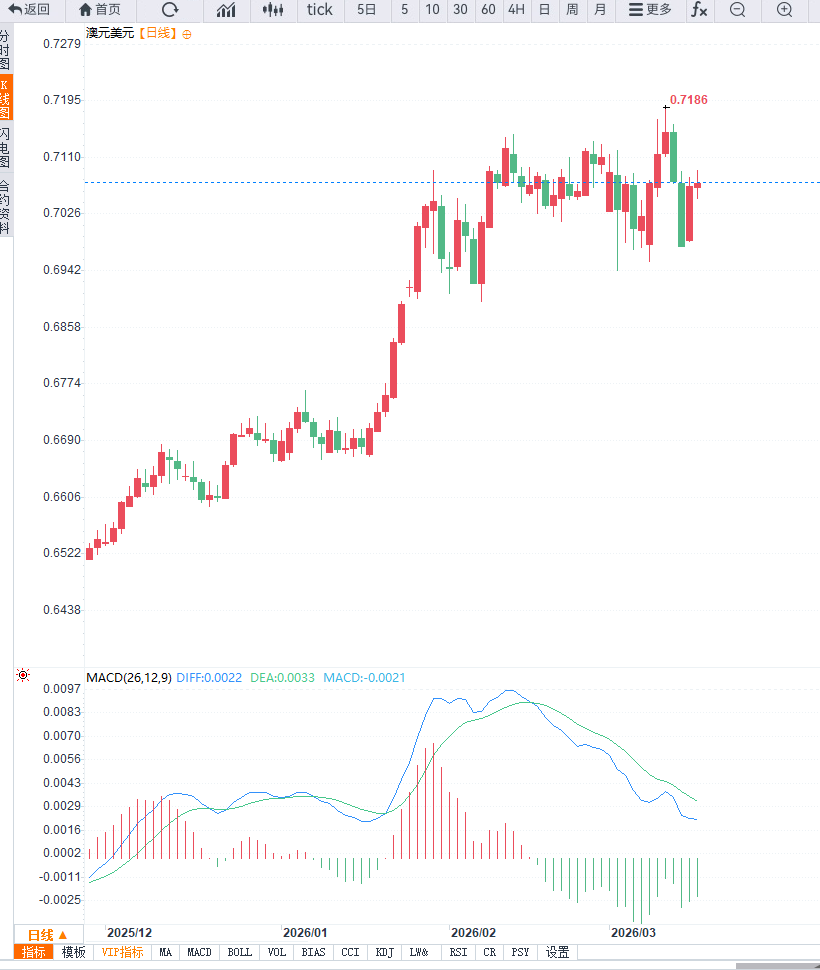
The daily chart shows the Australian dollar against the US dollar (AUD/USD) has been consolidating in the 0.7000-0.7150 range recently. The current exchange rate is around 0.7080 , under pressure in the short term due to interest rate hikes and rising oil prices. Key resistance levels are 0.7100 and 0.7150 ; a break above these levels could trigger a further rebound. Support levels are 0.7030 and 0.7000 ; a break below these levels would increase the risk of a pullback. The 4-hour chart shows short-term consolidation in the 0.6980-0.7100 range, with moving averages flattening and the MACD hovering near the zero line, indicating weak short-term momentum and a likely continuation of the sideways trading pattern.
Editor's Summary : The Reserve Bank of Australia raised interest rates by 25 basis points to 4.1% , highlighting persistent inflationary pressures and challenges posed by rising energy prices. The Australian dollar is under short-term pressure, but a robust economic fundamental provides support in the medium to long term. Investors should pay attention to the situation in the Middle East, energy prices, and future economic data.
Frequently Asked Questions (FAQ)
Question 1: What does this interest rate hike mean for the short-term trend of the Australian dollar?
The Reserve Bank of Australia's 25 basis point rate hike will widen the short-term interest rate differential, supporting the Australian dollar's strength in the medium to long term. However, in the short term, market concerns about energy prices and global risk events may lead to fluctuations and pullbacks.
Question 2: What impact will the internal disagreements within the committee have on the market?
The narrow 5-4 vote indicates internal disagreement within the committee regarding how to address inflationary pressures. This may make markets more sensitive to uncertainty about the future path of interest rates, potentially leading to greater short-term volatility.
Question 3: How do the Middle East conflict and energy prices affect the Australian dollar?
Rising energy costs will push up inflation, affecting domestic prices and expectations for the central bank's monetary policy in Australia, and increasing market uncertainty. In the short term, this may limit the Australian dollar's rebound, but if risk appetite improves, it could still support a stronger Australian dollar in the medium to long term.
Question 4: What does the risk of inflation exceeding the target range mean?
Inflation remaining above the 2%-3% target range means the central bank may extend its interest rate hike cycle or maintain high interest rates to control inflation, which supports the Australian dollar.
The Reserve Bank of Australia (RBA) also emphasized the impact of global developments on inflation. The Middle East conflict has led to a sharp rise in energy prices, which, if they remain high, will further exacerbate inflationary pressures. This factor not only affects the Australian dollar exchange rate but may also cause volatility in commodities and risk assets. Following the interest rate hike decision, the Australian dollar came under short-term pressure, but strong economic fundamentals and changes in global risk appetite may still provide support for its medium- to long-term trend.
Market analysts believe this rate hike indicates the central bank's low concern about the risk of an economic slowdown, with its core focus remaining on curbing inflation. Investors should pay attention to changes in energy prices, Australian employment and retail data, and guidance on the interest rate path in future meetings to determine the short-term fluctuation range of the Australian dollar.
The daily chart shows the Australian dollar against the US dollar (AUD/USD) has been consolidating in the 0.7000-0.7150 range recently. The current exchange rate is around 0.7080 , under pressure in the short term due to interest rate hikes and rising oil prices. Key resistance levels are 0.7100 and 0.7150 ; a break above these levels could trigger a further rebound. Support levels are 0.7030 and 0.7000 ; a break below these levels would increase the risk of a pullback. The 4-hour chart shows short-term consolidation in the 0.6980-0.7100 range, with moving averages flattening and the MACD hovering near the zero line, indicating weak short-term momentum and a likely continuation of the sideways trading pattern.
Editor's Summary : The Reserve Bank of Australia raised interest rates by 25 basis points to 4.1% , highlighting persistent inflationary pressures and challenges posed by rising energy prices. The Australian dollar is under short-term pressure, but a robust economic fundamental provides support in the medium to long term. Investors should pay attention to the situation in the Middle East, energy prices, and future economic data.
Frequently Asked Questions (FAQ)
Question 1: What does this interest rate hike mean for the short-term trend of the Australian dollar?
The Reserve Bank of Australia's 25 basis point rate hike will widen the short-term interest rate differential, supporting the Australian dollar's strength in the medium to long term. However, in the short term, market concerns about energy prices and global risk events may lead to fluctuations and pullbacks.
Question 2: What impact will the internal disagreements within the committee have on the market?
The narrow 5-4 vote indicates internal disagreement within the committee regarding how to address inflationary pressures. This may make markets more sensitive to uncertainty about the future path of interest rates, potentially leading to greater short-term volatility.
Question 3: How do the Middle East conflict and energy prices affect the Australian dollar?
Rising energy costs will push up inflation, affecting domestic prices and expectations for the central bank's monetary policy in Australia, and increasing market uncertainty. In the short term, this may limit the Australian dollar's rebound, but if risk appetite improves, it could still support a stronger Australian dollar in the medium to long term.
Question 4: What does the risk of inflation exceeding the target range mean?
Inflation remaining above the 2%-3% target range means the central bank may extend its interest rate hike cycle or maintain high interest rates to control inflation, which supports the Australian dollar.
- Risk Warning and Disclaimer
- The market involves risk, and trading may not be suitable for all investors. This article is for reference only and does not constitute personal investment advice, nor does it take into account certain users’ specific investment objectives, financial situation, or other needs. Any investment decisions made based on this information are at your own risk.