The Reserve Bank of Australia raised interest rates by 25 basis points to 4.10%, facing a tightening choice amid persistent inflation and Middle East risks.
2026-03-17 14:34:22
On Tuesday (March 17), the Reserve Bank of Australia (RBA) announced a 25 basis point increase in its cash rate target to 4.10%, marking the second consecutive rate hike and the highest level since April 2025. This rate increase was in line with market expectations, primarily due to persistent inflation and renewed upward pressure.
The Reserve Bank of Australia stated explicitly that "while inflation has fallen significantly since its peak in 2022, it is expected to pick up significantly in the second half of 2025."
Domestically in Australia, private demand growth significantly exceeded expectations, business investment was robust, and capacity pressures turned positive; the unemployment rate was slightly lower than expected, the labor market remained one of the tightest globally, and while unit labor costs declined somewhat, they still supported prices overall. The housing market saw strong activity and price growth over the past year, although the pace of growth slowed at the beginning of the year.
At the international level, the Middle East conflict has become the biggest uncertainty factor. Fuel prices have risen sharply, and if the conflict continues, it will directly push up global energy prices and be transmitted to Australia through the supply chain.
The Reserve Bank of Australia warned that "the situation in the Middle East is highly uncertain and could increase global and domestic inflationary pressures in a variety of scenarios." Short-term inflation expectations have risen, and the risk of inflation lasting longer than expected has increased significantly.
Economic fundamentals still support a tight monetary policy: Q4 2025 GDP grew by 2.6% year-on-year, exceeding expectations; credit remains readily available for businesses and households, and the lagged effects of interest rate cuts in 2025 have not yet fully translated into demand, prices, and wages. Although financial conditions have tightened in the past month (exchange rates, money market rates, and government bond yields have all risen), the extent of monetary policy constraints remains uncertain.
The meeting was clearly divided, ultimately deciding to raise interest rates by a 5-4 vote. Five members supported a 25 basis point increase, while four preferred to keep the rate unchanged at 3.85%. The committee emphasized, "All members agreed that inflation was too high; the only disagreement was on timing." Those who voted against the rate hike still acknowledged the eventual need for a rate increase, but suggested postponing it until May for observation .
The Reserve Bank of Australia noted that the rise in inflation may be partly due to temporary factors, but "inflation is likely to remain above target for some time, and the risks have shifted further to the upside."
The Middle East conflict presents a two-way risk: if the conflict prolongs or intensifies, energy prices will further push up short-term inflation; if the price increases are incorporated into long-term inflation expectations, they could continue to push up inflation in the future. Meanwhile, the uncertainty surrounding the conflict could also lead to a slowdown in economic growth for Australia's major trading partners and domestically.
Deputy Governor Andrew Hauser stated bluntly last week, "We are facing an inflation problem; it's too high." He reiterated that the Reserve Bank of Australia expects inflation to return to the 2%-3% target range by the end of 2026 or 2027, reaching its midpoint in 2028. Previous forecasts in February indicated that overall inflation would peak at 4.2% in mid-2026 and fall to "slightly below 3%" by mid-2027, but these forecasts did not yet incorporate the oil price impact of the Iran war and may need to be revised upwards.
At the press conference following the meeting, Reserve Bank of Australia Governor Michele Bullock provided a detailed explanation, the core of which can be summarized as "the time is right, and inflation can be controlled without excessive tightening."
Block emphasized: "The cash rate is still not high enough to pull inflation back to the target level," and "If we don't curb excess demand, businesses will pass it into costs and prices."
She made it clear that the situation in the Middle East was not the "trigger" for this interest rate hike; the real reason was that domestic inflation was already too high and production capacity pressure was rising . She said, "The rise in oil prices is not the reason for today's interest rate hike," and "The discussion was about timing, not policy direction; we had considered whether to postpone the action until May."
Regarding the future path that the market is most concerned about, Block repeatedly clarified: "Today's rate hike does not mean the future direction of interest rates," and "The future direction of interest rates is still unclear." She pointed out that the divergent decision itself "indicates that the Committee is actively discussing and raising questions," which contributes to policy transparency. She also reassured the market: "The market misunderstood the Vice Chairman's remarks; he did not hint at a rate hike," and "The Committee has warned of risks from the Middle East, and if a policy adjustment is necessary, we will take action."
On balancing employment and growth, Block adopted a moderate stance: "The upside risks to inflation outweigh the downside risks to employment, and we don't want to see a recession or a sharp rise in unemployment," and "Inflation can be reduced without creating a negative output gap." She also mentioned that "a stronger Australian dollar helps reduce inflation" and expressed understanding for the public: "I understand this is bad news for people with mortgages."
Overall, Block's message is one of "precautionary interest rate hikes + data dependence": it neither rules out further tightening nor predetermines a path, and the core objective remains the dual mission of achieving price stability and full employment.
The rate hike was in line with expectations, and the market reaction was mild. Following the Reserve Bank of Australia's (RBA) rate hike and Governor Bullock's remarks, the Australian dollar has generally maintained a fluctuating trend against the US dollar, currently trading around 0.7060, reflecting the market's acceptance of the RBA's vigilance regarding inflation risks.
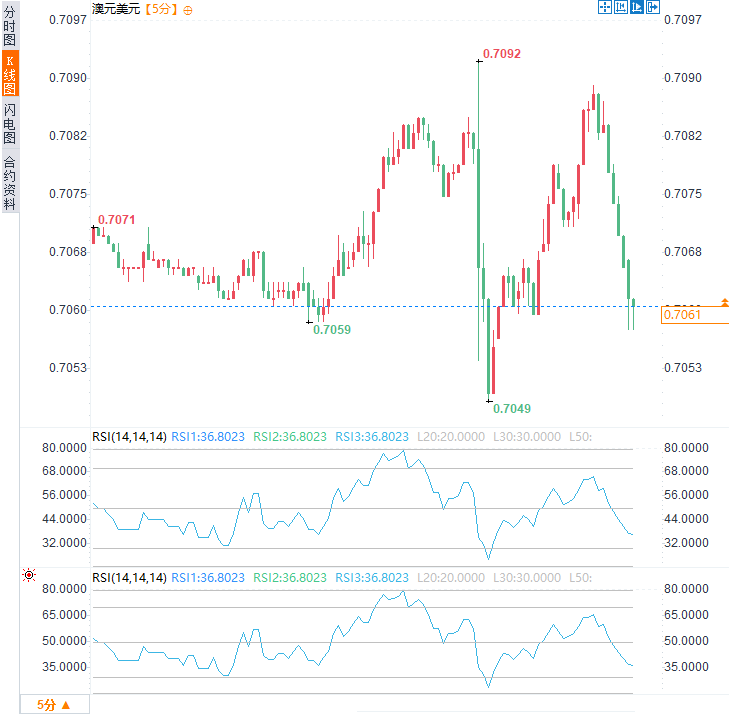
(AUD/USD 5-minute chart, source: FX678)
The Reserve Bank of Australia's (RBA) latest action underscores once again that Australia's path to controlling inflation remains long. Inflation has been above the 3% ceiling for several consecutive quarters, with a clear rebound expected in the second half of 2025, further compounded by geopolitical risks in the Middle East that have pushed uncertainty to new heights. The RBA explicitly warned that "significant risks to inflation persist beyond expectations" and that "the risks have shifted further to the upside."
Looking ahead, most analysts believe there may be 1-2 more interest rate hikes in 2026, with peak rates potentially reaching 4.35%-4.60%. However, if the Middle East conflict eases, oil prices fall, and the lagged effects of the 2025 rate cuts gradually emerge, the Reserve Bank of Australia may shift to a wait-and-see approach or even cut rates in the second half of 2026. Block's forecast remains: inflation will return to the 2%-3% range by the end of 2026 or 2027, reaching its midpoint in 2028.
For businesses and households, borrowing costs will remain high, potentially putting further pressure on the housing market. However, a strong labor market and resilient economic growth (better-than-expected GDP) provide a buffer. Key areas to watch going forward include: developments in the Middle East, whether domestic demand in Australia remains strong, whether the wage-price spiral will reappear, and the mitigating effect of the Australian dollar exchange rate on import inflation.
The Reserve Bank of Australia (RBA) has demonstrated through its actions that it prefers to tighten sooner rather than let inflation expectations become unanchored. While the road ahead is long and arduous, a clear data-dependent framework and transparent internal discussions within the committee are paving the way for an eventual return to the target range. Investors and the public should continue to monitor monthly inflation data and labor market indicators, as signals of a policy shift could emerge at any time.
At 14:33 Beijing time, the Australian dollar was trading at 0.7066/67 against the US dollar.
Background and Macroeconomic Environment of the Reserve Bank of Australia's Actions
The Reserve Bank of Australia stated explicitly that "while inflation has fallen significantly since its peak in 2022, it is expected to pick up significantly in the second half of 2025."
Domestically in Australia, private demand growth significantly exceeded expectations, business investment was robust, and capacity pressures turned positive; the unemployment rate was slightly lower than expected, the labor market remained one of the tightest globally, and while unit labor costs declined somewhat, they still supported prices overall. The housing market saw strong activity and price growth over the past year, although the pace of growth slowed at the beginning of the year.
At the international level, the Middle East conflict has become the biggest uncertainty factor. Fuel prices have risen sharply, and if the conflict continues, it will directly push up global energy prices and be transmitted to Australia through the supply chain.
The Reserve Bank of Australia warned that "the situation in the Middle East is highly uncertain and could increase global and domestic inflationary pressures in a variety of scenarios." Short-term inflation expectations have risen, and the risk of inflation lasting longer than expected has increased significantly.
Economic fundamentals still support a tight monetary policy: Q4 2025 GDP grew by 2.6% year-on-year, exceeding expectations; credit remains readily available for businesses and households, and the lagged effects of interest rate cuts in 2025 have not yet fully translated into demand, prices, and wages. Although financial conditions have tightened in the past month (exchange rates, money market rates, and government bond yields have all risen), the extent of monetary policy constraints remains uncertain.
Summary of other views from the Reserve Bank of Australia's Policy Committee
The meeting was clearly divided, ultimately deciding to raise interest rates by a 5-4 vote. Five members supported a 25 basis point increase, while four preferred to keep the rate unchanged at 3.85%. The committee emphasized, "All members agreed that inflation was too high; the only disagreement was on timing." Those who voted against the rate hike still acknowledged the eventual need for a rate increase, but suggested postponing it until May for observation .
The Reserve Bank of Australia noted that the rise in inflation may be partly due to temporary factors, but "inflation is likely to remain above target for some time, and the risks have shifted further to the upside."
The Middle East conflict presents a two-way risk: if the conflict prolongs or intensifies, energy prices will further push up short-term inflation; if the price increases are incorporated into long-term inflation expectations, they could continue to push up inflation in the future. Meanwhile, the uncertainty surrounding the conflict could also lead to a slowdown in economic growth for Australia's major trading partners and domestically.
Deputy Governor Andrew Hauser stated bluntly last week, "We are facing an inflation problem; it's too high." He reiterated that the Reserve Bank of Australia expects inflation to return to the 2%-3% target range by the end of 2026 or 2027, reaching its midpoint in 2028. Previous forecasts in February indicated that overall inflation would peak at 4.2% in mid-2026 and fall to "slightly below 3%" by mid-2027, but these forecasts did not yet incorporate the oil price impact of the Iran war and may need to be revised upwards.
Speech and Analysis by the Governor of the Reserve Bank of Australia
At the press conference following the meeting, Reserve Bank of Australia Governor Michele Bullock provided a detailed explanation, the core of which can be summarized as "the time is right, and inflation can be controlled without excessive tightening."
Block emphasized: "The cash rate is still not high enough to pull inflation back to the target level," and "If we don't curb excess demand, businesses will pass it into costs and prices."
She made it clear that the situation in the Middle East was not the "trigger" for this interest rate hike; the real reason was that domestic inflation was already too high and production capacity pressure was rising . She said, "The rise in oil prices is not the reason for today's interest rate hike," and "The discussion was about timing, not policy direction; we had considered whether to postpone the action until May."
Regarding the future path that the market is most concerned about, Block repeatedly clarified: "Today's rate hike does not mean the future direction of interest rates," and "The future direction of interest rates is still unclear." She pointed out that the divergent decision itself "indicates that the Committee is actively discussing and raising questions," which contributes to policy transparency. She also reassured the market: "The market misunderstood the Vice Chairman's remarks; he did not hint at a rate hike," and "The Committee has warned of risks from the Middle East, and if a policy adjustment is necessary, we will take action."
On balancing employment and growth, Block adopted a moderate stance: "The upside risks to inflation outweigh the downside risks to employment, and we don't want to see a recession or a sharp rise in unemployment," and "Inflation can be reduced without creating a negative output gap." She also mentioned that "a stronger Australian dollar helps reduce inflation" and expressed understanding for the public: "I understand this is bad news for people with mortgages."
Overall, Block's message is one of "precautionary interest rate hikes + data dependence": it neither rules out further tightening nor predetermines a path, and the core objective remains the dual mission of achieving price stability and full employment.
Market reaction
The rate hike was in line with expectations, and the market reaction was mild. Following the Reserve Bank of Australia's (RBA) rate hike and Governor Bullock's remarks, the Australian dollar has generally maintained a fluctuating trend against the US dollar, currently trading around 0.7060, reflecting the market's acceptance of the RBA's vigilance regarding inflation risks.
(AUD/USD 5-minute chart, source: FX678)
The path to curbing inflation and future market expectations
The Reserve Bank of Australia's (RBA) latest action underscores once again that Australia's path to controlling inflation remains long. Inflation has been above the 3% ceiling for several consecutive quarters, with a clear rebound expected in the second half of 2025, further compounded by geopolitical risks in the Middle East that have pushed uncertainty to new heights. The RBA explicitly warned that "significant risks to inflation persist beyond expectations" and that "the risks have shifted further to the upside."
Looking ahead, most analysts believe there may be 1-2 more interest rate hikes in 2026, with peak rates potentially reaching 4.35%-4.60%. However, if the Middle East conflict eases, oil prices fall, and the lagged effects of the 2025 rate cuts gradually emerge, the Reserve Bank of Australia may shift to a wait-and-see approach or even cut rates in the second half of 2026. Block's forecast remains: inflation will return to the 2%-3% range by the end of 2026 or 2027, reaching its midpoint in 2028.
For businesses and households, borrowing costs will remain high, potentially putting further pressure on the housing market. However, a strong labor market and resilient economic growth (better-than-expected GDP) provide a buffer. Key areas to watch going forward include: developments in the Middle East, whether domestic demand in Australia remains strong, whether the wage-price spiral will reappear, and the mitigating effect of the Australian dollar exchange rate on import inflation.
The Reserve Bank of Australia (RBA) has demonstrated through its actions that it prefers to tighten sooner rather than let inflation expectations become unanchored. While the road ahead is long and arduous, a clear data-dependent framework and transparent internal discussions within the committee are paving the way for an eventual return to the target range. Investors and the public should continue to monitor monthly inflation data and labor market indicators, as signals of a policy shift could emerge at any time.
At 14:33 Beijing time, the Australian dollar was trading at 0.7066/67 against the US dollar.
- Risk Warning and Disclaimer
- The market involves risk, and trading may not be suitable for all investors. This article is for reference only and does not constitute personal investment advice, nor does it take into account certain users’ specific investment objectives, financial situation, or other needs. Any investment decisions made based on this information are at your own risk.