Gold faces a major test at the $5,000 mark as bulls and bears battle ahead of the Fed decision.
2026-03-18 01:24:49
On Tuesday (March 17), during the US trading session, the international gold market exhibited a high-level consolidation with a stalemate between bulls and bears. London gold was quoted at $5005.45 per ounce, down slightly by 0.14% on the day, having tested the psychological level of $5000 multiple times, supported by geopolitical safe-haven buying. New York gold futures also traded in a narrow range around $5007 per ounce.
Gold prices have fallen rapidly since hitting a record high of $5,222.51 per ounce on March 10, reaching a low of $4,966 per ounce on March 13, with a cumulative drop of about 2% within the week. Market divergence has intensified at historical high levels, and the battle between bulls and bears has become fierce.
Federal Reserve policy and the US dollar/Treasury: The Fed's March policy meeting (March 18) is currently the core focus of the market. CME interest rate futures indicate a 99.4% probability that the Fed will maintain the 3.50%-3.75% interest rate unchanged, shifting market focus to the dot plot and policy statement. Influenced by the Middle East conflict pushing up oil prices and renewed inflation concerns, the market has postponed the first rate cut from June to September, reducing the total rate cut for the year from 75 basis points to 25 basis points, and expectations for higher interest rates to be maintained for a longer period are rising.
The US dollar index (DXY) rebounded strongly to around 100.39, a 10-month high; the US 2-year yield broke its downward trend, pushing up the cost of holding gold and directly suppressing gold prices denominated in US dollars. Mainstream media pointed out that the traditional negative correlation between the US dollar and gold has strengthened, and the short-term strength of the US dollar is a significant negative factor for gold prices.
Geopolitical conflicts and oil price inflation continue to escalate in the Middle East. Israel claimed on Tuesday the assassination of Ali Larijani, secretary of Iran's Supreme National Security Council. Iran's new Supreme Leader rejected proposals to de-escalate the situation, increasing the risk of a blockade of the Strait of Hormuz. Brent crude oil held steady above $106 per barrel, with a more than 40% increase in March. Soaring energy prices have fueled inflation expectations, and market concerns that a rebound in inflation will force the Federal Reserve to maintain high interest rates further limit the upside potential for gold.
On the other hand, rising oil prices have triggered concerns about stagflation and geopolitical risk aversion, providing gold with support as both an inflation hedge and a safe haven, creating a tug-of-war between bulls and bears. Jim Wyckoff, senior analyst at Kitco Metals, said the gold market reflects a "balance" between safe-haven demand driven by heightened geopolitical uncertainty and downward pressure from inflation.
Depreciation trading congestion and central bank gold purchases
Daniel Galli, senior commodities strategist at TD Securities, warned that devaluation trades are crowded, and gold is no longer a marginal asset for institutional investors. The most popular physically backed gold ETFs hold approximately 67% of the shares of the most popular ETFs in history. Meanwhile, money supply growth has normalized, interest rate markets expect a prolonged pause, and concerns about the Federal Reserve's independence are easing. These factors make gold vulnerable, despite continued but slowing central bank demand.
Global central banks continued their net gold purchases, but official sector buying activity declined over the past year. The Middle East conflict will further reduce official sector purchases, which is related to the impact of the war on the economies of Gulf countries.
mainstream view
TD Securities: Depreciation trading is crowded, US Treasury yields break through the downward trend, gold faces five major risks, and geopolitical conflicts may further weaken central bank gold purchase demand.
Kitco Metals: Gold is in a state of equilibrium between safe-haven demand and inflationary pressures, with bullish momentum running out and it unlikely to reach new highs in the short term.
Commerzbank: The Fed meeting is unlikely to boost gold prices, as uncertainty over the duration of the war and oil supply disruptions may keep the Fed cautious.
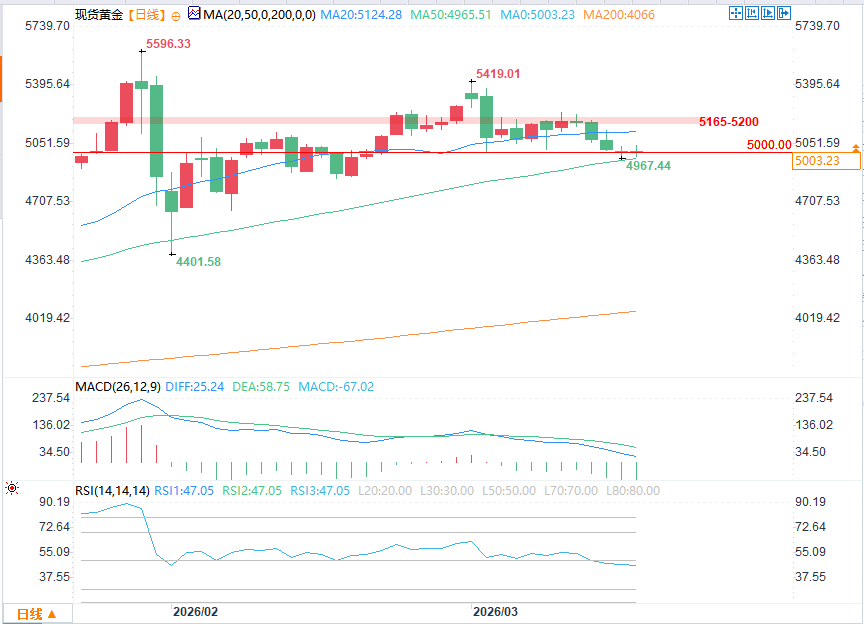
(Spot gold daily chart source: FX678)
Currently, the technical outlook for spot gold in London shows a slightly weak but volatile pattern with strong support. On the daily chart, the gold price has broken below the 5-day moving average, the MACD has formed a death cross, and the RSI has fallen back to the neutral zone, indicating that the bears are in control in the short term.
Key support levels: $5,000 (psychological level + densely traded area), $4,950 (previous consolidation platform); Key resistance levels: $5,035 (intraday rebound resistance), $5,100 (this week's high).
A triple bottom support pattern has formed in the $4,968-$4,970 range, indicating strong buying pressure and limited downward momentum in the short term. It is highly likely that the price will continue to fluctuate in the $4,950-$5,100 range, awaiting guidance from the Federal Reserve's decision.
Scenario Prediction
Hawkish Scenario (70% probability): The Federal Reserve keeps interest rates unchanged, lowers its dot plot forecast for rate cuts this year to one or fewer, and Powell emphasizes the stickiness of inflation and the necessity of high interest rates. Gold prices may test the $4,950-$5,000 support level; if $5,000 is breached, it may further test $4,900.
Neutral Scenario (20% probability): The Federal Reserve holds rates steady, maintaining its dot plot forecast of two rate cuts this year, and Powell's statements are cautious. Gold prices fluctuate between $5000 and $5100, awaiting further economic data for confirmation.
Dovish Scenario (10% probability): The Federal Reserve signals a rate cut and mentions conditions for a June rate cut. Gold prices are expected to rebound and break through $5,100, targeting the $5,150-$5,200 range.
The short-term trading strategy focuses on range-bound trading, paying close attention to the $5,000 level. Aggressive traders may consider a small long position at $4,950-$4,970, with a stop-loss at $4,900 and a target of $5,050-$5,100. Conservative traders should wait for the Fed's decision before entering the market, strictly controlling position size and risk.
The Federal Reserve FOMC will announce its interest rate decision at 02:00 on March 18.
Federal Reserve Chairman Jerome Powell held a press conference at 2:30 AM on March 18.
US Initial Jobless Claims for the Week Ending March 14, March 19, 20:30
March 20, 20:30: US February Core PCE Price Index (a key inflation indicator monitored by the Federal Reserve)
Gold prices have fallen rapidly since hitting a record high of $5,222.51 per ounce on March 10, reaching a low of $4,966 per ounce on March 13, with a cumulative drop of about 2% within the week. Market divergence has intensified at historical high levels, and the battle between bulls and bears has become fierce.
Fundamental analysis
Federal Reserve policy and the US dollar/Treasury: The Fed's March policy meeting (March 18) is currently the core focus of the market. CME interest rate futures indicate a 99.4% probability that the Fed will maintain the 3.50%-3.75% interest rate unchanged, shifting market focus to the dot plot and policy statement. Influenced by the Middle East conflict pushing up oil prices and renewed inflation concerns, the market has postponed the first rate cut from June to September, reducing the total rate cut for the year from 75 basis points to 25 basis points, and expectations for higher interest rates to be maintained for a longer period are rising.
The US dollar index (DXY) rebounded strongly to around 100.39, a 10-month high; the US 2-year yield broke its downward trend, pushing up the cost of holding gold and directly suppressing gold prices denominated in US dollars. Mainstream media pointed out that the traditional negative correlation between the US dollar and gold has strengthened, and the short-term strength of the US dollar is a significant negative factor for gold prices.
Geopolitical conflicts and oil price inflation continue to escalate in the Middle East. Israel claimed on Tuesday the assassination of Ali Larijani, secretary of Iran's Supreme National Security Council. Iran's new Supreme Leader rejected proposals to de-escalate the situation, increasing the risk of a blockade of the Strait of Hormuz. Brent crude oil held steady above $106 per barrel, with a more than 40% increase in March. Soaring energy prices have fueled inflation expectations, and market concerns that a rebound in inflation will force the Federal Reserve to maintain high interest rates further limit the upside potential for gold.
On the other hand, rising oil prices have triggered concerns about stagflation and geopolitical risk aversion, providing gold with support as both an inflation hedge and a safe haven, creating a tug-of-war between bulls and bears. Jim Wyckoff, senior analyst at Kitco Metals, said the gold market reflects a "balance" between safe-haven demand driven by heightened geopolitical uncertainty and downward pressure from inflation.
Depreciation trading congestion and central bank gold purchases
Daniel Galli, senior commodities strategist at TD Securities, warned that devaluation trades are crowded, and gold is no longer a marginal asset for institutional investors. The most popular physically backed gold ETFs hold approximately 67% of the shares of the most popular ETFs in history. Meanwhile, money supply growth has normalized, interest rate markets expect a prolonged pause, and concerns about the Federal Reserve's independence are easing. These factors make gold vulnerable, despite continued but slowing central bank demand.
Global central banks continued their net gold purchases, but official sector buying activity declined over the past year. The Middle East conflict will further reduce official sector purchases, which is related to the impact of the war on the economies of Gulf countries.
mainstream view
TD Securities: Depreciation trading is crowded, US Treasury yields break through the downward trend, gold faces five major risks, and geopolitical conflicts may further weaken central bank gold purchase demand.
Kitco Metals: Gold is in a state of equilibrium between safe-haven demand and inflationary pressures, with bullish momentum running out and it unlikely to reach new highs in the short term.
Commerzbank: The Fed meeting is unlikely to boost gold prices, as uncertainty over the duration of the war and oil supply disruptions may keep the Fed cautious.
Technical Analysis
(Spot gold daily chart source: FX678)
Currently, the technical outlook for spot gold in London shows a slightly weak but volatile pattern with strong support. On the daily chart, the gold price has broken below the 5-day moving average, the MACD has formed a death cross, and the RSI has fallen back to the neutral zone, indicating that the bears are in control in the short term.
Key support levels: $5,000 (psychological level + densely traded area), $4,950 (previous consolidation platform); Key resistance levels: $5,035 (intraday rebound resistance), $5,100 (this week's high).
A triple bottom support pattern has formed in the $4,968-$4,970 range, indicating strong buying pressure and limited downward momentum in the short term. It is highly likely that the price will continue to fluctuate in the $4,950-$5,100 range, awaiting guidance from the Federal Reserve's decision.
Market Outlook
Scenario Prediction
Hawkish Scenario (70% probability): The Federal Reserve keeps interest rates unchanged, lowers its dot plot forecast for rate cuts this year to one or fewer, and Powell emphasizes the stickiness of inflation and the necessity of high interest rates. Gold prices may test the $4,950-$5,000 support level; if $5,000 is breached, it may further test $4,900.
Neutral Scenario (20% probability): The Federal Reserve holds rates steady, maintaining its dot plot forecast of two rate cuts this year, and Powell's statements are cautious. Gold prices fluctuate between $5000 and $5100, awaiting further economic data for confirmation.
Dovish Scenario (10% probability): The Federal Reserve signals a rate cut and mentions conditions for a June rate cut. Gold prices are expected to rebound and break through $5,100, targeting the $5,150-$5,200 range.
The short-term trading strategy focuses on range-bound trading, paying close attention to the $5,000 level. Aggressive traders may consider a small long position at $4,950-$4,970, with a stop-loss at $4,900 and a target of $5,050-$5,100. Conservative traders should wait for the Fed's decision before entering the market, strictly controlling position size and risk.
Financial Calendar
The Federal Reserve FOMC will announce its interest rate decision at 02:00 on March 18.
Federal Reserve Chairman Jerome Powell held a press conference at 2:30 AM on March 18.
US Initial Jobless Claims for the Week Ending March 14, March 19, 20:30
March 20, 20:30: US February Core PCE Price Index (a key inflation indicator monitored by the Federal Reserve)
Frequently Asked Questions
Q1: What are the key factors currently influencing gold prices?
A1: The current core contradiction in the gold market is the interplay between expectations of Federal Reserve policy and geopolitical risk aversion and central bank gold purchases. Expectations of high interest rates from the Fed and crowded devaluation trades are suppressing gold prices, while Middle East conflicts and continued global central bank gold purchases are providing support. The market is in a state of equilibrium before the decision.
Q2: Why does TD Securities believe that gold is vulnerable?
A2: TD Securities points out five major risks: First, excessive crowding in devaluation trading, with institutional holdings reaching historical highs; second, money supply growth returning to normal; third, interest rate market pricing pausing interest rate hikes for an extended period; fourth, easing concerns about the Fed's independence; and fifth, the Middle East conflict potentially weakening central bank gold purchases. These multiple factors combined put pressure on gold prices.
Q3: Why do geopolitical conflicts both benefit and harm gold?
A3: Escalating geopolitical conflicts trigger risk aversion, strengthening gold's safe-haven attributes and creating a bullish factor; however, the conflict pushes up oil prices and inflation expectations, forcing the Federal Reserve to maintain high interest rates, increasing the cost of holding gold and creating a bearish factor. Ultimately, the impact depends on the market's pricing weight of policy and risk.
Q4: Why is the $5,000 mark important for gold?
A4: $5,000 is an important psychological level and a densely traded area. Multiple attempts to break through it have been supported by buying. A breach of this level would mean a collapse in bullish confidence and could trigger a further pullback. Holding above it would indicate strong buying support below, laying the foundation for a rebound. It is currently the core level in the battle between bulls and bears.
Q5: How to judge the trend of gold after the Fed's decision?
A5: Focus on two key points: first, the number of expected rate cuts this year as shown in the dot plot; and second, Powell's statements on inflation and rate cuts. A downward revision of rate cut expectations and a hawkish stance will put downward pressure on gold prices; conversely, maintaining rate cut expectations and dovish signals will lead to a rebound in gold prices. The wording of the policy decision will directly dominate the direction of gold prices in the next 1-2 weeks.
- Risk Warning and Disclaimer
- The market involves risk, and trading may not be suitable for all investors. This article is for reference only and does not constitute personal investment advice, nor does it take into account certain users’ specific investment objectives, financial situation, or other needs. Any investment decisions made based on this information are at your own risk.