The US dollar faces another test; will the pullback from its highs change its strong momentum?
2026-03-18 02:03:52
On Tuesday (March 17) during the New York session, the US dollar index retreated slightly, reaching 99.56 intraday, a drop of approximately 0.2%-0.3% from its opening high of 99.86. The intraday trading range was roughly between 99.53 and 100.12. The index had already fallen sharply by 0.65% yesterday, and continued its decline for two consecutive days today, although the rate of decline narrowed significantly, showing an overall trend of high-level consolidation and correction.
Looking at recent trends, the US dollar has retreated from its 2026 high of around 100.54 reached last week, with a cumulative monthly gain of around 1.9%, and a decline of approximately 3.5%-3.6% over the past year. The market remained cautious on the first day of the Fed's two-day FOMC meeting (with no decision announced), while the short-term easing of oil prices due to Middle East conflicts led some safe-haven funds to flow back into risk assets, putting pressure on the dollar but maintaining its overall resilience.
Fundamental analysis
Today marks the first day of the March 17-18 FOMC meeting. The market widely expects the Federal Reserve to maintain the federal funds rate unchanged (currently expected to be at a relatively high level), but the focus is on tomorrow's interest rate decision, the summary of economic projections (dot plot), and Powell's press conference. Due to the recent escalation of the Iranian situation pushing up global energy prices, inflation expectations have risen again. The Fed may reduce its forecast for the number of rate cuts in 2026 in the dot plot (previously priced in by the market), which will strengthen the dollar's interest rate advantage and safe-haven status. If the dot plot is hawkish or Powell's remarks are tightening, it will directly ignite a new round of upward momentum for the dollar; conversely, if it is unexpectedly dovish, short-term downward pressure will increase, but geopolitical risks will quickly provide hedging support.
Tensions surrounding Iran continue to dominate market sentiment. While news of increased US maritime security in the Strait of Hormuz led to a short-term pullback in oil prices (alleviating some inflation concerns), the risk of energy supply disruptions remains high. As the world's largest oil producer and net exporter, the US economy benefits relatively from a high oil price environment, while energy import-dependent economies like Europe face greater pressure. This reinforces the relative strength of the US dollar and its status as a safe-haven currency. The correlation between oil prices and the US dollar has significantly increased in the current environment.
Today's February pending home sales index came in at 72.1 (previous value 70.9), slightly better than expected, indicating some resilience in the US housing market and supporting the notion that the economy has not yet entered a full-blown recession. However, this indicator has limited influence and mainly serves as a supplementary signal to reinforce the "American exceptionalism" narrative.
The US dollar index has risen nearly 2% in the past month. Although it still records a decline on the annual chart, the dollar has solid support at the bottom due to the triple combination of geopolitical conflicts, renewed inflation, and uncertainty over the Fed's policies. It is more likely to rise than fall in the short term.
Technical Analysis
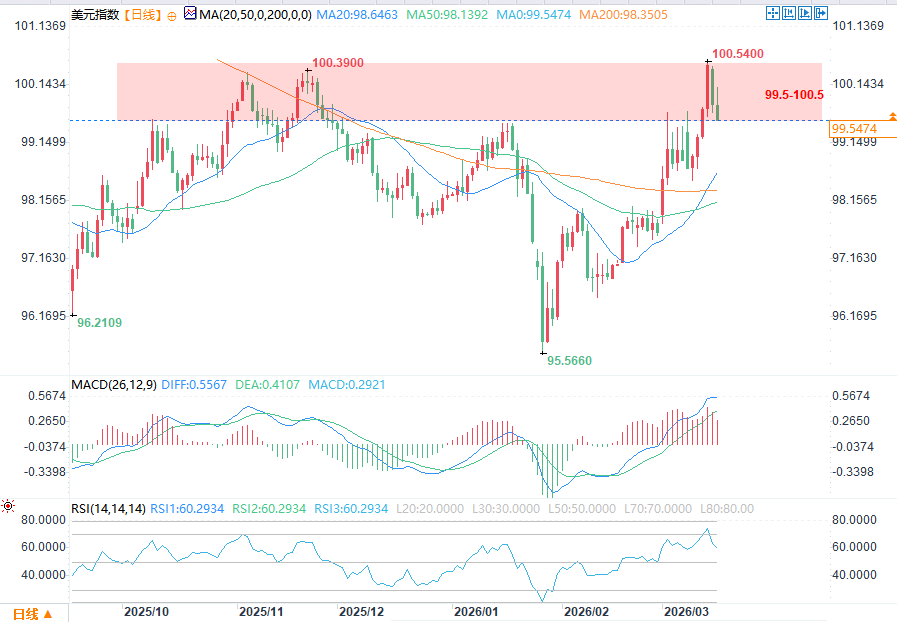
(US Dollar Index Daily Chart Source: FX678)
Short-term structure: The US dollar index is fluctuating at a high level in the 99.50-100.50 range. After a sharp drop yesterday, it has stabilized today. The MACD golden cross signal remains valid. Although the RSI is close to overbought, there is no obvious divergence. In the short term, the bullish momentum is dominant.
Key levels: Resistance is at 100.00-100.50 (psychological level + recent high), a break above this level could lead to higher levels; support is at 99.30-99.50, a break below this level could trigger an accelerated pullback to around 98.50.
Overall Outlook: Short-term buy signals are dominant, but caution is advised regarding a potential directional breakout triggered by the FOMC results.
Financial History
The first day of the Federal Reserve FOMC meeting (full day, no interest rate decision).
US 52-week Treasury auction (focus on the impact of demand on US Treasury yields).
Key reminder: Tomorrow, March 18th, the FOMC interest rate decision, the summary of economic projections (dot plot), and Powell's speech are the biggest risk events this week. Coupled with Middle East geopolitical news, the US dollar may experience sharp two-way fluctuations. It is recommended to set strict stop-loss orders.
Frequently Asked Questions
Looking at recent trends, the US dollar has retreated from its 2026 high of around 100.54 reached last week, with a cumulative monthly gain of around 1.9%, and a decline of approximately 3.5%-3.6% over the past year. The market remained cautious on the first day of the Fed's two-day FOMC meeting (with no decision announced), while the short-term easing of oil prices due to Middle East conflicts led some safe-haven funds to flow back into risk assets, putting pressure on the dollar but maintaining its overall resilience.
Fundamental analysis
Today marks the first day of the March 17-18 FOMC meeting. The market widely expects the Federal Reserve to maintain the federal funds rate unchanged (currently expected to be at a relatively high level), but the focus is on tomorrow's interest rate decision, the summary of economic projections (dot plot), and Powell's press conference. Due to the recent escalation of the Iranian situation pushing up global energy prices, inflation expectations have risen again. The Fed may reduce its forecast for the number of rate cuts in 2026 in the dot plot (previously priced in by the market), which will strengthen the dollar's interest rate advantage and safe-haven status. If the dot plot is hawkish or Powell's remarks are tightening, it will directly ignite a new round of upward momentum for the dollar; conversely, if it is unexpectedly dovish, short-term downward pressure will increase, but geopolitical risks will quickly provide hedging support.
Tensions surrounding Iran continue to dominate market sentiment. While news of increased US maritime security in the Strait of Hormuz led to a short-term pullback in oil prices (alleviating some inflation concerns), the risk of energy supply disruptions remains high. As the world's largest oil producer and net exporter, the US economy benefits relatively from a high oil price environment, while energy import-dependent economies like Europe face greater pressure. This reinforces the relative strength of the US dollar and its status as a safe-haven currency. The correlation between oil prices and the US dollar has significantly increased in the current environment.
Today's February pending home sales index came in at 72.1 (previous value 70.9), slightly better than expected, indicating some resilience in the US housing market and supporting the notion that the economy has not yet entered a full-blown recession. However, this indicator has limited influence and mainly serves as a supplementary signal to reinforce the "American exceptionalism" narrative.
The US dollar index has risen nearly 2% in the past month. Although it still records a decline on the annual chart, the dollar has solid support at the bottom due to the triple combination of geopolitical conflicts, renewed inflation, and uncertainty over the Fed's policies. It is more likely to rise than fall in the short term.
Technical Analysis
(US Dollar Index Daily Chart Source: FX678)
Short-term structure: The US dollar index is fluctuating at a high level in the 99.50-100.50 range. After a sharp drop yesterday, it has stabilized today. The MACD golden cross signal remains valid. Although the RSI is close to overbought, there is no obvious divergence. In the short term, the bullish momentum is dominant.
Key levels: Resistance is at 100.00-100.50 (psychological level + recent high), a break above this level could lead to higher levels; support is at 99.30-99.50, a break below this level could trigger an accelerated pullback to around 98.50.
Overall Outlook: Short-term buy signals are dominant, but caution is advised regarding a potential directional breakout triggered by the FOMC results.
Financial History
The first day of the Federal Reserve FOMC meeting (full day, no interest rate decision).
US 52-week Treasury auction (focus on the impact of demand on US Treasury yields).
Key reminder: Tomorrow, March 18th, the FOMC interest rate decision, the summary of economic projections (dot plot), and Powell's speech are the biggest risk events this week. Coupled with Middle East geopolitical news, the US dollar may experience sharp two-way fluctuations. It is recommended to set strict stop-loss orders.
Frequently Asked Questions
Q: Why is the US dollar index still relatively strong near its high level, even though it fell slightly today?
A: The US dollar corrected by 0.65% yesterday and only fell by about 0.2% today, which is a normal digestion. The core issue is the global inflationary pressure brought about by the Middle East conflict pushing up oil prices. The US, as a net energy exporter, benefits, while the economies of importing countries such as the Eurozone are more vulnerable, naturally leading funds to favor the safe-haven attributes of the US dollar. Even if oil prices ease in the short term due to the news of the embargo, geopolitical uncertainty still prevents the market from completely exiting the dollar bullish position, and the nearly 2% increase this month reflects this logic. Q: How exactly does the Middle East conflict affect the US dollar's trend?
A: The conflict directly disrupts energy supply, and high oil prices amplify global inflation expectations, particularly impacting major energy-importing countries like Europe and Japan. This leads to a weakening of the euro and yen, and a corresponding strengthening of the US dollar index. Meanwhile, the US dollar, as the primary currency for oil trade, naturally benefits from the energy crisis. The resilience of the US economy and a potential hawkish shift by the Federal Reserve further enhance its attractiveness, creating multiple positive feedback loops. Q: What is the biggest potential impact of this FOMC meeting on the US dollar?
A: The meeting itself will most likely keep interest rates unchanged, but the dot plot and Powell's speech will determine the path of rate cuts in 2026. If the number of rate cuts is reduced due to oil price inflation (more hawkish), it will significantly boost the dollar; if the expectation of rate cuts is maintained or increased (dovish), it may trigger a short-term pullback. However, even if it is dovish, geopolitical risks will quickly offset the downside potential, so overall it is positive for the dollar. Q: Today's improved pending home sales data, will it provide substantial help to the dollar?
A: The slight improvement in the data indicates that the housing market remains supported, indirectly proving that the US economy has not fallen into a deep recession, which is consistent with the "soft landing" narrative. However, as a secondary indicator, its direct impact on the dollar is limited. Its main role is to prevent the market from excessively worrying about a hard landing and to provide a floor support for the dollar.
Q: Will the US dollar continue its strong trend in 2026?
A: In the short to medium term, geopolitical conflicts, high oil prices, and the Federal Reserve's cautious stance provide strong support for the dollar. If the conflicts ease or the Fed clearly shifts towards easing, the dollar may experience a temporary pullback. However, the US's energy independence, its advantage as a global reserve currency, and its relative economic resilience give it a structural advantage in a high-inflation, high-uncertainty environment. Most institutions expect the dollar to remain relatively strong in 2026 unless there are significant peace developments or an unexpected collapse in US economic data.
- Risk Warning and Disclaimer
- The market involves risk, and trading may not be suitable for all investors. This article is for reference only and does not constitute personal investment advice, nor does it take into account certain users’ specific investment objectives, financial situation, or other needs. Any investment decisions made based on this information are at your own risk.