A chart shows that weak Capesize and Supramax bulk carrier freight rates dragged down the Baltic Dry Index.
2026-03-18 00:25:01
Latest data shows that on March 17, 2026, the Baltic Dry Index (BDI) was at 2024 points, a three-day low, down 0.69% from the previous day, marking the largest drop since March 10, 2026. Looking at the short-term charts, the BDI saw positive growth 6 times, negative growth 5 times, and zero growth in the last 11 BDI readings. Specifically, the Panamax Freight Index (BPI) was at 1853 points, up 0.93% from the previous day; the Capesize Freight Index (BCI) was at 2888 points, down 1.33%; and the Supramax Freight Index (BSI) was at 1256 points, down 0.95%. For detailed 720-day and 10-year trend charts of the Baltic Dry Index and its three main sub-indices, please refer to the specially designed charts.
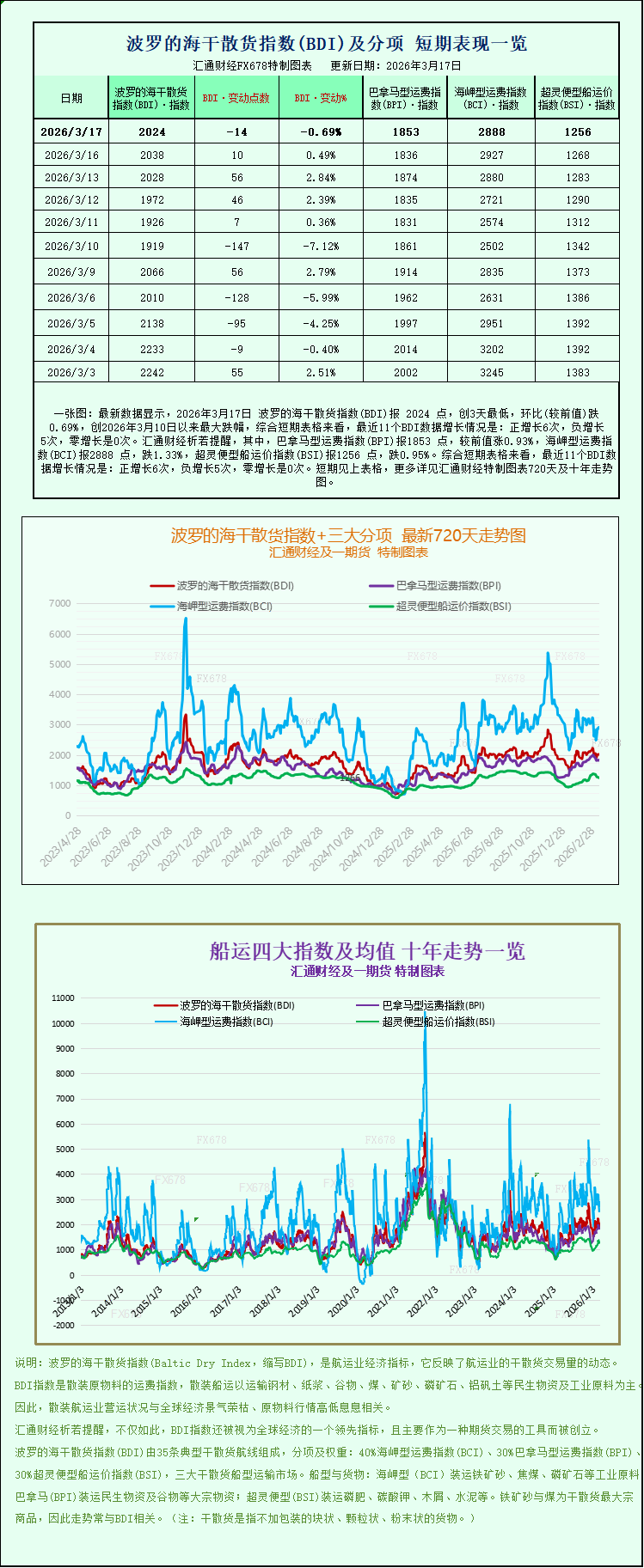
The Baltic Dry Index (BDI), a key indicator of the global dry bulk shipping market that comprehensively monitors freight rates for bulk commodities such as iron ore, coal, and grain, fell slightly on Tuesday. The overall market showed a divergent pattern, with the main drag coming from the simultaneous decline in freight rates for Capesize and Supramax vessels. Only Panamax vessel freight rates rebounded against the trend, failing to offset the downward pressure on the two main vessel types.
As a core indicator for measuring the global dry bulk shipping market, the Baltic Dry Index, which tracks freight rates for the three major vessel types—Capesize, Panamax, and Supramax—fell 14 points, or 0.7%, to close at 2024 points, ending the previous day's slight upward trend. This reflects the ongoing interplay between supply and demand in the dry bulk shipping market, and a slowdown in the overall recovery pace.
Among the various vessel types, the Capesize index, which bears the heavy responsibility of global dry bulk ocean shipping, saw the most significant single-day decline, falling 39 points, or 1.3%, to 2888 points. This type of vessel is the largest in tonnage within the dry bulk fleet, typically carrying up to 150,000 tons of cargo per voyage. Its core transport commodities include industrial bulk commodities such as iron ore and thermal coal. Its routes are concentrated on major ocean lines from Australia and Brazil to Asia, and its freight rate fluctuations directly reflect the global demand for industrial raw materials.
Dragged down by declining freight rates, the average daily earnings of Capesize vessels also fell, decreasing by $349 per day to $22,691. Although there are no significant negative factors on the shipping cost side, the recent slowdown in shipments at some iron ore export ports and the temporary easing of market capacity supply are the main reasons for the reduced earnings of Capesize vessels.
It is worth noting that there is a structural divergence in demand for dry bulk shipping: driven by the accelerated resumption of construction in China's domestic construction industry and the continued recovery of end-user demand for finished steel, iron ore futures prices have risen against the trend to a two-month high. The demand for commodities in the spot market remains resilient, but there is a certain lag in its transmission to the shipping sector, and it has not yet reversed the downward trend in Capesize freight rates.
In contrast to Capesize vessels, the Panamax index, which primarily transports medium-tonnage dry bulk cargo such as coal and grain, bucked the trend, rising 17 points, or 0.9%, to 1853 points. These vessels typically have a cargo capacity between 60,000 and 70,000 tons and are suitable for most major ports and shipping routes worldwide. Recent acceleration in global grain trade and the release of coal restocking demand have supported its stronger freight rates.
Benefiting from rising freight rates, the average daily revenue of Panamax vessels increased by US$145 to US$16,673, becoming one of the few bright spots in the dry bulk shipping market that day, highlighting the significant differences in market conditions among different vessel types and cargo types.
Meanwhile, the Supramax index, which focuses on small-volume bulk cargo and handles both near- and long-haul shipping, continued its weakness, falling 12 points, or 1%, to 1256. This type of vessel mainly transports small-volume dry bulk cargoes such as steel, building materials, and fertilizers. The current slow pace of global manufacturing recovery, coupled with overcapacity in some regions, has put continued pressure on its freight rates, further dragging down the Baltic Dry Index.
Industry insiders point out that in the short term, the dry bulk shipping market will continue to face a pattern of vessel type differentiation and supply-demand mismatch. The freight rate trend of Capesize vessels will depend on the iron ore export volume and the recovery progress of China's industrial demand, while Supramax vessels will depend on the pace of recovery of small bulk trade. The Baltic Dry Index may maintain a narrow range of fluctuations in the short term.
The Baltic Dry Index (BDI), a key indicator of the global dry bulk shipping market that comprehensively monitors freight rates for bulk commodities such as iron ore, coal, and grain, fell slightly on Tuesday. The overall market showed a divergent pattern, with the main drag coming from the simultaneous decline in freight rates for Capesize and Supramax vessels. Only Panamax vessel freight rates rebounded against the trend, failing to offset the downward pressure on the two main vessel types.
As a core indicator for measuring the global dry bulk shipping market, the Baltic Dry Index, which tracks freight rates for the three major vessel types—Capesize, Panamax, and Supramax—fell 14 points, or 0.7%, to close at 2024 points, ending the previous day's slight upward trend. This reflects the ongoing interplay between supply and demand in the dry bulk shipping market, and a slowdown in the overall recovery pace.
Among the various vessel types, the Capesize index, which bears the heavy responsibility of global dry bulk ocean shipping, saw the most significant single-day decline, falling 39 points, or 1.3%, to 2888 points. This type of vessel is the largest in tonnage within the dry bulk fleet, typically carrying up to 150,000 tons of cargo per voyage. Its core transport commodities include industrial bulk commodities such as iron ore and thermal coal. Its routes are concentrated on major ocean lines from Australia and Brazil to Asia, and its freight rate fluctuations directly reflect the global demand for industrial raw materials.
Dragged down by declining freight rates, the average daily earnings of Capesize vessels also fell, decreasing by $349 per day to $22,691. Although there are no significant negative factors on the shipping cost side, the recent slowdown in shipments at some iron ore export ports and the temporary easing of market capacity supply are the main reasons for the reduced earnings of Capesize vessels.
It is worth noting that there is a structural divergence in demand for dry bulk shipping: driven by the accelerated resumption of construction in China's domestic construction industry and the continued recovery of end-user demand for finished steel, iron ore futures prices have risen against the trend to a two-month high. The demand for commodities in the spot market remains resilient, but there is a certain lag in its transmission to the shipping sector, and it has not yet reversed the downward trend in Capesize freight rates.
In contrast to Capesize vessels, the Panamax index, which primarily transports medium-tonnage dry bulk cargo such as coal and grain, bucked the trend, rising 17 points, or 0.9%, to 1853 points. These vessels typically have a cargo capacity between 60,000 and 70,000 tons and are suitable for most major ports and shipping routes worldwide. Recent acceleration in global grain trade and the release of coal restocking demand have supported its stronger freight rates.
Benefiting from rising freight rates, the average daily revenue of Panamax vessels increased by US$145 to US$16,673, becoming one of the few bright spots in the dry bulk shipping market that day, highlighting the significant differences in market conditions among different vessel types and cargo types.
Meanwhile, the Supramax index, which focuses on small-volume bulk cargo and handles both near- and long-haul shipping, continued its weakness, falling 12 points, or 1%, to 1256. This type of vessel mainly transports small-volume dry bulk cargoes such as steel, building materials, and fertilizers. The current slow pace of global manufacturing recovery, coupled with overcapacity in some regions, has put continued pressure on its freight rates, further dragging down the Baltic Dry Index.
Industry insiders point out that in the short term, the dry bulk shipping market will continue to face a pattern of vessel type differentiation and supply-demand mismatch. The freight rate trend of Capesize vessels will depend on the iron ore export volume and the recovery progress of China's industrial demand, while Supramax vessels will depend on the pace of recovery of small bulk trade. The Baltic Dry Index may maintain a narrow range of fluctuations in the short term.
- Risk Warning and Disclaimer
- The market involves risk, and trading may not be suitable for all investors. This article is for reference only and does not constitute personal investment advice, nor does it take into account certain users’ specific investment objectives, financial situation, or other needs. Any investment decisions made based on this information are at your own risk.