Gold Trading Alert: Gold Prices Plunge Nearly 4%! Escalating Iran War + Hawkish Fed Stance: Is the Safe-Haven Myth Collapsing?
2026-03-19 07:34:25
On Wednesday (March 18), spot gold experienced significant volatility, briefly approaching the $4,800 mark before closing at $4,818.83 per ounce, down 3.73%. During the session, it hit a more than one-month low of $4,807 per ounce. On one hand, the escalating geopolitical conflict in the Middle East, particularly the attack on Iran's Pars gas field triggering a chain of retaliation, kept Brent crude oil above $110, exacerbating inflation concerns and dampening expectations of a Federal Reserve rate cut. On the other hand, the Fed's latest decision to maintain interest rates at 3.50%-3.75% and signaling persistent inflation and a cautious approach to rate cuts boosted the US dollar index, both contributing to downward pressure on gold prices. On Thursday (March 19) in early Asian trading, spot gold hovered at lower levels, currently trading at $4,838.75 per ounce.
The Federal Reserve held rates steady at its meeting, maintaining the target range for the federal funds rate. The dot plot showed policymakers expect only one rate cut (25 basis points) in 2026, consistent with their December forecast. More importantly, Chairman Powell acknowledged at the press conference that the uncertainty surrounding the Iran war has made the policy path "highly unclear," with the economic impact potentially being "much smaller or much larger," and nobody really knows. The Fed's latest forecast raises the year-end PCE inflation rate to 2.7%, up from the previous 2.4%, with core inflation also rising, reflecting that concerns about rising energy prices are now embedded in the decision-making framework.
Powell emphasized that the Fed's current stance is "good" and that it will decide on its next steps based on data and risk balance. However, he also mentioned that the possibility of "the next step being a rate hike," while not the baseline scenario, has been discussed by some officials.
The market interpreted this statement as a clear hawkish signal: expectations of an interest rate cut have been significantly delayed, with interest rate futures indicating that traders have pushed their bets on the first rate cut to April 2027. The US dollar index rose 0.72% in response, and US Treasury yields rose across the board, with the two-year yield climbing to 3.737% and the ten-year yield reaching 4.249%. A stronger dollar directly increases the cost of gold for non-dollar holders, while a high-yield environment raises the opportunity cost of holding gold—investors are more inclined to turn to interest-bearing assets rather than non-interest-bearing gold.
Independent precious metals trader Tai Wong points out that Powell's dovish hints were far from enough to boost the market, and gold's recent trading behavior is more akin to that of risk assets. If the market was expecting a Fed ready to intervene at any moment, they were disappointed this time. While the technical drop below $5,000 is worrying, the long-term bullish trend has not reversed.
For nearly three weeks, the military action by the United States and Israel against Iran has continued to escalate, and the Strait of Hormuz has been largely blocked, putting about 20% of the world's oil and liquefied natural gas supply at risk of disruption.
Just before the Federal Reserve meeting, Iran's Pars gas field in the Gulf—the Iranian part of the world's largest natural gas field—was attacked, with gas tanks and refining facilities catching fire. Iran subsequently announced that it would make all oil and gas targets in the Gulf region legitimate targets and has launched multiple missile attacks against energy facilities related to the United States.
This major upgrade directly pushed up energy prices, with Brent crude oil breaking through $110, and market panic intensified.
In theory, such high-intensity geopolitical risk should strongly stimulate safe-haven flows into gold, driving prices up. However, in reality, gold prices fell instead of rising. At the beginning of the conflict, gold briefly surged, but then quickly retreated. The reason is that the surge in oil prices was not driven by a simple safe-haven logic, but rather by strong inflationary expectations.
The surge in energy costs will be transmitted to the Producer Price Index (PPI). The US PPI in February has already significantly exceeded expectations, and the war factor has further amplified this pressure.
Investors are beginning to worry that if inflation gets out of control, the Federal Reserve will have to maintain high interest rates or even consider raising them, which would be a fatal blow to gold, a non-interest-bearing asset. In short, the "safe-haven advantage" of geopolitical conflict has been quickly offset by the "inflation poison," causing gold to behave more like a risk asset than a safe haven during risk events.
The current pressure on gold mainly stems from short-term macroeconomic dynamics: a strong dollar, high interest rate expectations, and persistent inflation combine to create a powerful bearish force. Silver, platinum, and palladium also fell sharply, declining by 4.9%, 4.7%, and 7.8% respectively, indicating overall pressure on the precious metals sector.
However, from a medium- to long-term perspective, the fundamentals supporting gold remain solid. The trend of geopolitical fragmentation is irreversible, and factors such as continued central bank gold purchases, potential inflows into ETFs, and supply constraints are still accumulating momentum.
If the oil price shock proves to be temporary, or if there are signs of easing tensions, the possibility of the Federal Reserve restarting its easing measures will rise again, and gold is expected to resume its upward trend. Several Wall Street institutions maintain their year-end gold price targets of $6,000-$6,300, indicating that their confidence in a structural bull market remains unchanged.
In short, the recent plunge in gold prices is not due to a failure of its safe-haven appeal, but rather a result of the market's balancing act between war, inflation, and monetary policy dilemmas, adopting a "hawkish then dovish" approach. In the short term, the dual pressures of high interest rates and the US dollar may continue to dominate the market, but the persistent uncertainty surrounding the Iranian conflict acts as a hidden spark; once the external environment shifts, gold is highly likely to experience a retaliatory rebound. Investors should remain vigilant and seek long-term investment opportunities amidst the volatility.
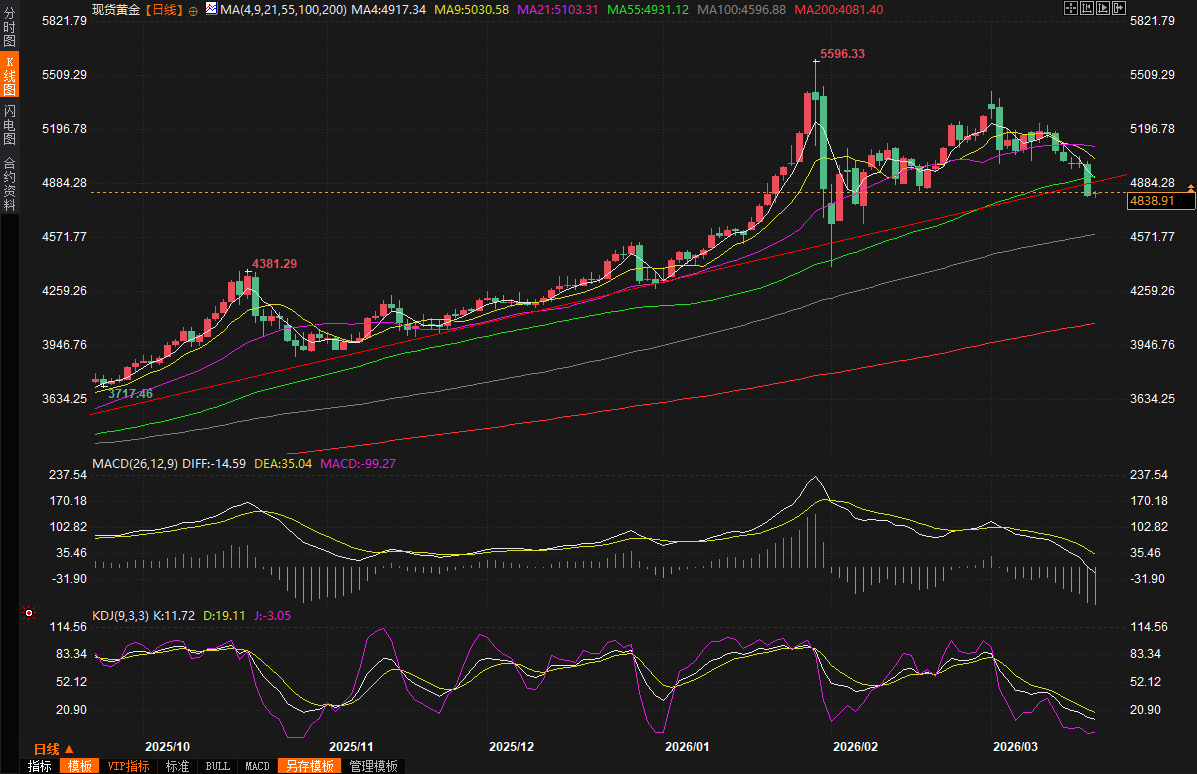
(Spot gold daily chart, source: FX678)
At 07:32 Beijing time, spot gold was trading at $4,838.52 per ounce.
The Fed's hawkish policy: High interest rate expectations weigh heavily on gold.
The Federal Reserve held rates steady at its meeting, maintaining the target range for the federal funds rate. The dot plot showed policymakers expect only one rate cut (25 basis points) in 2026, consistent with their December forecast. More importantly, Chairman Powell acknowledged at the press conference that the uncertainty surrounding the Iran war has made the policy path "highly unclear," with the economic impact potentially being "much smaller or much larger," and nobody really knows. The Fed's latest forecast raises the year-end PCE inflation rate to 2.7%, up from the previous 2.4%, with core inflation also rising, reflecting that concerns about rising energy prices are now embedded in the decision-making framework.
Powell emphasized that the Fed's current stance is "good" and that it will decide on its next steps based on data and risk balance. However, he also mentioned that the possibility of "the next step being a rate hike," while not the baseline scenario, has been discussed by some officials.
The market interpreted this statement as a clear hawkish signal: expectations of an interest rate cut have been significantly delayed, with interest rate futures indicating that traders have pushed their bets on the first rate cut to April 2027. The US dollar index rose 0.72% in response, and US Treasury yields rose across the board, with the two-year yield climbing to 3.737% and the ten-year yield reaching 4.249%. A stronger dollar directly increases the cost of gold for non-dollar holders, while a high-yield environment raises the opportunity cost of holding gold—investors are more inclined to turn to interest-bearing assets rather than non-interest-bearing gold.
Independent precious metals trader Tai Wong points out that Powell's dovish hints were far from enough to boost the market, and gold's recent trading behavior is more akin to that of risk assets. If the market was expecting a Fed ready to intervene at any moment, they were disappointed this time. While the technical drop below $5,000 is worrying, the long-term bullish trend has not reversed.
Escalating geopolitical conflicts: Soaring oil prices fail to ignite demand for gold as a safe haven
For nearly three weeks, the military action by the United States and Israel against Iran has continued to escalate, and the Strait of Hormuz has been largely blocked, putting about 20% of the world's oil and liquefied natural gas supply at risk of disruption.
Just before the Federal Reserve meeting, Iran's Pars gas field in the Gulf—the Iranian part of the world's largest natural gas field—was attacked, with gas tanks and refining facilities catching fire. Iran subsequently announced that it would make all oil and gas targets in the Gulf region legitimate targets and has launched multiple missile attacks against energy facilities related to the United States.
This major upgrade directly pushed up energy prices, with Brent crude oil breaking through $110, and market panic intensified.
In theory, such high-intensity geopolitical risk should strongly stimulate safe-haven flows into gold, driving prices up. However, in reality, gold prices fell instead of rising. At the beginning of the conflict, gold briefly surged, but then quickly retreated. The reason is that the surge in oil prices was not driven by a simple safe-haven logic, but rather by strong inflationary expectations.
The surge in energy costs will be transmitted to the Producer Price Index (PPI). The US PPI in February has already significantly exceeded expectations, and the war factor has further amplified this pressure.
Investors are beginning to worry that if inflation gets out of control, the Federal Reserve will have to maintain high interest rates or even consider raising them, which would be a fatal blow to gold, a non-interest-bearing asset. In short, the "safe-haven advantage" of geopolitical conflict has been quickly offset by the "inflation poison," causing gold to behave more like a risk asset than a safe haven during risk events.
Short-term pressure vs. long-term logic: Gold at a crossroads
The current pressure on gold mainly stems from short-term macroeconomic dynamics: a strong dollar, high interest rate expectations, and persistent inflation combine to create a powerful bearish force. Silver, platinum, and palladium also fell sharply, declining by 4.9%, 4.7%, and 7.8% respectively, indicating overall pressure on the precious metals sector.
However, from a medium- to long-term perspective, the fundamentals supporting gold remain solid. The trend of geopolitical fragmentation is irreversible, and factors such as continued central bank gold purchases, potential inflows into ETFs, and supply constraints are still accumulating momentum.
If the oil price shock proves to be temporary, or if there are signs of easing tensions, the possibility of the Federal Reserve restarting its easing measures will rise again, and gold is expected to resume its upward trend. Several Wall Street institutions maintain their year-end gold price targets of $6,000-$6,300, indicating that their confidence in a structural bull market remains unchanged.
In short, the recent plunge in gold prices is not due to a failure of its safe-haven appeal, but rather a result of the market's balancing act between war, inflation, and monetary policy dilemmas, adopting a "hawkish then dovish" approach. In the short term, the dual pressures of high interest rates and the US dollar may continue to dominate the market, but the persistent uncertainty surrounding the Iranian conflict acts as a hidden spark; once the external environment shifts, gold is highly likely to experience a retaliatory rebound. Investors should remain vigilant and seek long-term investment opportunities amidst the volatility.
(Spot gold daily chart, source: FX678)
At 07:32 Beijing time, spot gold was trading at $4,838.52 per ounce.
- Risk Warning and Disclaimer
- The market involves risk, and trading may not be suitable for all investors. This article is for reference only and does not constitute personal investment advice, nor does it take into account certain users’ specific investment objectives, financial situation, or other needs. Any investment decisions made based on this information are at your own risk.