Is the sharp drop in gold prices a trap or an opportunity? Four core reasons reveal that the "discount" moment has arrived.
2026-03-19 15:31:05
The surge in gold prices over the past year represents one of the most dramatic structural shifts in the precious metals market in recent years. Driven by inflationary pressures, geopolitical tensions, and strong institutional demand, gold prices rose steadily throughout 2025, far exceeding analysts' general expectations a year earlier. At the beginning of the year, gold prices hovered around $2,600 per ounce, but by the end of the year, they had climbed to approximately $4,300, representing a year-on-year increase of over $1,700 per ounce.
This strong momentum is expected to continue into 2026. Faced with increasing market volatility and economic uncertainty, investors continue to seek safe-haven assets, driving gold prices to new highs. In late January, gold prices touched an all-time high of $5,589.38 per ounce. However, gold prices have seen a significant pullback in recent weeks, currently trading around $4,760 per ounce, down more than 13% from the January high. This correction has made some investors cautious, but for others, it may present a rare strategic buying opportunity.
Even in the strongest bull markets, prices rarely rise in a straight line. After reaching a new all-time high, profit-taking by investors often triggers a short-term pullback, after which the overall trend continues. For long-term investors, the 13% drop in gold prices from their peak provides an opportunity to build positions at lower prices.
If the core fundamental factors driving gold prices remain solid, this correction is likely just a temporary pause. Buying gold at current prices allows investors to participate in the overall upward trend that has accumulated over the past year, while also gaining a better cost advantage at a relatively low price. Once market sentiment stabilizes or a new catalyst emerges, gold prices are expected to resume their upward trend.
Gold has long been considered an effective hedge against inflation. When the purchasing power of paper money declines, gold often preserves or even appreciates in value. Currently, although inflation has fallen from its earlier peak, it has stopped declining, and the overall price level remains significantly higher than historical norms. As long as inflation remains a major concern for the market, gold's appeal as a protective asset will not diminish.
Investors' anxieties about rising living costs and currency devaluation continue to build. Gold not only hedges against inflation but also enjoys price support amid continued increasing demand. This makes the current pullback more of a "strategic respite" than a trend reversal.
Over the past few years, central banks worldwide have significantly increased their gold reserves, aiming to diversify their reserves and reduce their reliance on the US dollar and other fiat currencies. Unlike retail investors, central bank gold purchases are typically long-term, lasting for several years once initiated. This stable institutional demand can create a clear price floor during periods of market volatility.
If central bank gold purchases continue at recent levels, even with short-term adjustments, a deep decline in gold prices is unlikely. The current pullback actually provides long-term investors with an opportunity to position themselves at more attractive prices, in an environment of continued institutional support.
The current global environment is full of complex variables: market volatility, geopolitical tensions, fluctuating monetary policy expectations, and divergent economic growth prospects. In times of high uncertainty, gold, as a reliable store of value decoupled from stocks, bonds, and individual national currencies, has historically performed exceptionally well.
The energy crisis, supply chain disruptions, persistent inflationary pressures, and escalating geopolitical rivalry stemming from the Iran war are all reinforcing market demand for safe-haven assets. As long as global uncertainty persists, gold's defensive attributes and price support will be difficult to break. This is why many institutional investors are choosing to increase their positions during the current pullback.
Gold has fallen 13% from its record high in January, which may seem worrying on the surface, but in the longer term, gold prices are still nearly 90% higher than a year ago. The core drivers that propelled its rise—inflation concerns, institutional demand, and geopolitical uncertainty—have not reversed, meaning that the current correction is likely just a normal digestion within the bullish trend, rather than a directional reversal.
For long-term investors, this may be the long-awaited "discount" opportunity. Short-term volatility is inevitable, but long-term upward momentum is steadily building. Once a new catalyst emerges—whether it's escalating geopolitical risks, higher-than-expected inflation data, or accelerated central bank gold purchases—gold is expected to regain its strength and may even challenge higher prices.
In short, the recent pullback in gold prices is not a warning of a trend reversal, but rather a strategic respite before a long-term bull market builds up. Patient investors may find the best entry point during this correction.
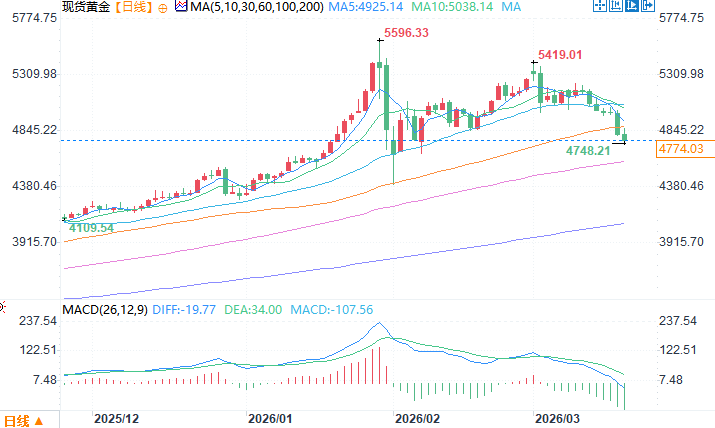
Spot gold daily chart source: EasyForex
At 15:19 Beijing time on March 19, spot gold was trading at $4774.03 per ounce.
This strong momentum is expected to continue into 2026. Faced with increasing market volatility and economic uncertainty, investors continue to seek safe-haven assets, driving gold prices to new highs. In late January, gold prices touched an all-time high of $5,589.38 per ounce. However, gold prices have seen a significant pullback in recent weeks, currently trading around $4,760 per ounce, down more than 13% from the January high. This correction has made some investors cautious, but for others, it may present a rare strategic buying opportunity.
Short-term pullback may present a strategic buying window.
Even in the strongest bull markets, prices rarely rise in a straight line. After reaching a new all-time high, profit-taking by investors often triggers a short-term pullback, after which the overall trend continues. For long-term investors, the 13% drop in gold prices from their peak provides an opportunity to build positions at lower prices.
If the core fundamental factors driving gold prices remain solid, this correction is likely just a temporary pause. Buying gold at current prices allows investors to participate in the overall upward trend that has accumulated over the past year, while also gaining a better cost advantage at a relatively low price. Once market sentiment stabilizes or a new catalyst emerges, gold prices are expected to resume their upward trend.
Inflation concerns persist, but gold's hedging properties remain unchanged.
Gold has long been considered an effective hedge against inflation. When the purchasing power of paper money declines, gold often preserves or even appreciates in value. Currently, although inflation has fallen from its earlier peak, it has stopped declining, and the overall price level remains significantly higher than historical norms. As long as inflation remains a major concern for the market, gold's appeal as a protective asset will not diminish.
Investors' anxieties about rising living costs and currency devaluation continue to build. Gold not only hedges against inflation but also enjoys price support amid continued increasing demand. This makes the current pullback more of a "strategic respite" than a trend reversal.
The central bank's continued gold purchases are building a floor, and institutional demand is providing long-term support.
Over the past few years, central banks worldwide have significantly increased their gold reserves, aiming to diversify their reserves and reduce their reliance on the US dollar and other fiat currencies. Unlike retail investors, central bank gold purchases are typically long-term, lasting for several years once initiated. This stable institutional demand can create a clear price floor during periods of market volatility.
If central bank gold purchases continue at recent levels, even with short-term adjustments, a deep decline in gold prices is unlikely. The current pullback actually provides long-term investors with an opportunity to position themselves at more attractive prices, in an environment of continued institutional support.
High global uncertainty drives long-term demand for safe-haven assets, which is a positive factor for gold.
The current global environment is full of complex variables: market volatility, geopolitical tensions, fluctuating monetary policy expectations, and divergent economic growth prospects. In times of high uncertainty, gold, as a reliable store of value decoupled from stocks, bonds, and individual national currencies, has historically performed exceptionally well.
The energy crisis, supply chain disruptions, persistent inflationary pressures, and escalating geopolitical rivalry stemming from the Iran war are all reinforcing market demand for safe-haven assets. As long as global uncertainty persists, gold's defensive attributes and price support will be difficult to break. This is why many institutional investors are choosing to increase their positions during the current pullback.
In summary: Short-term fluctuations do not change the long-term upward trend.
Gold has fallen 13% from its record high in January, which may seem worrying on the surface, but in the longer term, gold prices are still nearly 90% higher than a year ago. The core drivers that propelled its rise—inflation concerns, institutional demand, and geopolitical uncertainty—have not reversed, meaning that the current correction is likely just a normal digestion within the bullish trend, rather than a directional reversal.
For long-term investors, this may be the long-awaited "discount" opportunity. Short-term volatility is inevitable, but long-term upward momentum is steadily building. Once a new catalyst emerges—whether it's escalating geopolitical risks, higher-than-expected inflation data, or accelerated central bank gold purchases—gold is expected to regain its strength and may even challenge higher prices.
In short, the recent pullback in gold prices is not a warning of a trend reversal, but rather a strategic respite before a long-term bull market builds up. Patient investors may find the best entry point during this correction.
Spot gold daily chart source: EasyForex
At 15:19 Beijing time on March 19, spot gold was trading at $4774.03 per ounce.
- Risk Warning and Disclaimer
- The market involves risk, and trading may not be suitable for all investors. This article is for reference only and does not constitute personal investment advice, nor does it take into account certain users’ specific investment objectives, financial situation, or other needs. Any investment decisions made based on this information are at your own risk.