With Middle Eastern supply chains collapsing, $200 oil prices are no longer a joke.
2026-03-19 14:29:08
A month ago, if an analyst had publicly predicted that international oil prices could soar to $200 a barrel, they would likely have been ridiculed and kicked out of the live broadcast. However, some market participants are now seriously acknowledging that this extreme scenario is a real possibility. The reason is simple: Middle Eastern oil and fuel exports have plummeted in just a few weeks, with supply disruptions far exceeding any previous period in history.
According to Kpler data, the Middle East's daily oil and fuel exports were 25.13 million barrels in February, but by mid-March, this figure had plummeted by nearly two-thirds to just 9.71 million barrels per day. Vortexa's data is even more alarming: the average daily export was 26.1 million barrels in February, but dropped sharply to 7.5 million barrels per day by mid-March.
The situation is even worse on the production side: Middle Eastern countries are drastically cutting output, and once oil wells are shut down, restarting them takes months. Many so-called "export" tankers are actually just loading crude oil for offshore storage, not for delivery to customers. This means that about one-fifth of the global oil supply is severely paralyzed. Even if all fighting stops tomorrow, restoring normal supply will take a considerable amount of time.
A recent report from ING Commodities Strategists indicates that Iraq has cut production by approximately 2.9 million barrels per day, Saudi Arabia by 2-2.5 million barrels per day, the UAE by 1.5 million barrels per day, Kuwait by 1.3 million barrels per day, and Iran's production is about 1 million barrels per day lower than pre-war levels, resulting in a total daily supply deficit exceeding 7 million barrels. The International Energy Agency (IEA) previously predicted a global oil market surplus of 3.7 million barrels per day this year; now, not only has the surplus completely disappeared, but there is even an actual shortage in the tens of millions of barrels per day.
Onyx Capital Group CEO Greg Newman said, "We're very close to the $150 range right now, but $200 isn't far off at all. There are supply disruptions almost every day, which is like experiencing a supply crisis every day."
Chris Watling, chief market strategist at Longview Economics, bluntly stated: "If the supply shortage continues, I wouldn't be surprised at all if oil prices surged to $200, or even $250. Commodity prices tend to skyrocket during genuine shortages."
Columnist Ron Bousso points out that even if the war ends tomorrow, oil prices will not quickly return to pre-war levels. This is because physical supply shortages are a reality, and restoring shut-down wells will take months. He warns, "Traders should think twice before betting on Trump's promise of a 'rapid return to normalcy.'"
Brent crude oil prices have not yet reached $200, partly due to the temporary lifting of some US sanctions against Russia, allowing its oil to flow into the market to fill the gap. Windward maritime tracking data shows that as of March 16, there were 197.8 million barrels of Russian crude oil en route globally, greatly alleviating logistical pressure. However, this buffer is only temporary.
Despite possessing the world's largest crude oil reserves, the Asian giant has banned fuel exports and ordered Sinopec to cut refining capacity by 10%. Iraq and the Kurdish region reached an agreement to restart exports through the Kirkuk-Ceyhan pipeline, but the pipeline can only transport 250,000 barrels per day, a drop in the bucket.
What was considered a crazy $200 scenario a month ago has now become a real possibility, but it is still far from being realized, after all, an oil price of $200 per barrel would have a devastating impact on every economy in the world.
Almost all analysts believe that extreme pain will eventually force all parties to calm down and find a path to compromise.
However, the current reality is that the Strait of Hormuz blockade continues, Middle Eastern oil-producing countries have collectively reduced production, and global inventories are being depleted far faster than expected, making a physical supply shortage a reality. Even if the fighting ends tomorrow, restarting oil wells, rerouting tankers, and restoring refineries will take several months. In the short term, high-level fluctuations in oil prices are almost a certainty.
Overall , the war with Iran has pushed the global energy market into an unprecedented extreme state, with the scale, duration, and scope of supply disruptions exceeding even the most pessimistic market expectations.
The shift from "wild talk" to "serious discussion" regarding oil prices reaching $200 reflects that the current crisis has touched a systemic red line for the global economy and financial system. In the coming weeks, whether the conflict subsides substantially and whether the parties reach some form of compromise will directly determine whether oil prices continue their upward trajectory towards the $200 mark.
Investors and governments must be highly vigilant as this energy crisis has evolved from a regional conflict into a "nuclear-level" event affecting the global economy and inflation. Any misjudgment could trigger unbearable chain reactions. Whether calm thinking ultimately prevails may be the biggest variable determining the fate of the world in the coming months.
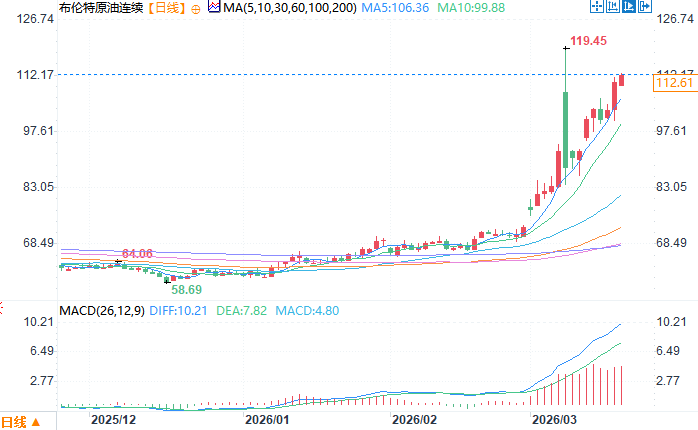
Brent crude oil daily chart source: EasyForex
At 14:28 Beijing time on March 19, Brent crude oil futures were trading at $113.03 per barrel.
According to Kpler data, the Middle East's daily oil and fuel exports were 25.13 million barrels in February, but by mid-March, this figure had plummeted by nearly two-thirds to just 9.71 million barrels per day. Vortexa's data is even more alarming: the average daily export was 26.1 million barrels in February, but dropped sharply to 7.5 million barrels per day by mid-March.
The situation is even worse on the production side: Middle Eastern countries are drastically cutting output, and once oil wells are shut down, restarting them takes months. Many so-called "export" tankers are actually just loading crude oil for offshore storage, not for delivery to customers. This means that about one-fifth of the global oil supply is severely paralyzed. Even if all fighting stops tomorrow, restoring normal supply will take a considerable amount of time.
Middle Eastern oil-producing countries have collectively cut production, resulting in a supply gap of tens of millions of barrels.
A recent report from ING Commodities Strategists indicates that Iraq has cut production by approximately 2.9 million barrels per day, Saudi Arabia by 2-2.5 million barrels per day, the UAE by 1.5 million barrels per day, Kuwait by 1.3 million barrels per day, and Iran's production is about 1 million barrels per day lower than pre-war levels, resulting in a total daily supply deficit exceeding 7 million barrels. The International Energy Agency (IEA) previously predicted a global oil market surplus of 3.7 million barrels per day this year; now, not only has the surplus completely disappeared, but there is even an actual shortage in the tens of millions of barrels per day.
Onyx Capital Group CEO Greg Newman said, "We're very close to the $150 range right now, but $200 isn't far off at all. There are supply disruptions almost every day, which is like experiencing a supply crisis every day."
Chris Watling, chief market strategist at Longview Economics, bluntly stated: "If the supply shortage continues, I wouldn't be surprised at all if oil prices surged to $200, or even $250. Commodity prices tend to skyrocket during genuine shortages."
Even after the war ends, oil prices are unlikely to return to pre-war levels.
Columnist Ron Bousso points out that even if the war ends tomorrow, oil prices will not quickly return to pre-war levels. This is because physical supply shortages are a reality, and restoring shut-down wells will take months. He warns, "Traders should think twice before betting on Trump's promise of a 'rapid return to normalcy.'"
Brent crude oil prices have not yet reached $200, partly due to the temporary lifting of some US sanctions against Russia, allowing its oil to flow into the market to fill the gap. Windward maritime tracking data shows that as of March 16, there were 197.8 million barrels of Russian crude oil en route globally, greatly alleviating logistical pressure. However, this buffer is only temporary.
Despite possessing the world's largest crude oil reserves, the Asian giant has banned fuel exports and ordered Sinopec to cut refining capacity by 10%. Iraq and the Kurdish region reached an agreement to restart exports through the Kirkuk-Ceyhan pipeline, but the pipeline can only transport 250,000 barrels per day, a drop in the bucket.
Extreme scenarios are becoming increasingly realistic: Will a cool head ultimately prevail?
What was considered a crazy $200 scenario a month ago has now become a real possibility, but it is still far from being realized, after all, an oil price of $200 per barrel would have a devastating impact on every economy in the world.
Almost all analysts believe that extreme pain will eventually force all parties to calm down and find a path to compromise.
However, the current reality is that the Strait of Hormuz blockade continues, Middle Eastern oil-producing countries have collectively reduced production, and global inventories are being depleted far faster than expected, making a physical supply shortage a reality. Even if the fighting ends tomorrow, restarting oil wells, rerouting tankers, and restoring refineries will take several months. In the short term, high-level fluctuations in oil prices are almost a certainty.
Overall , the war with Iran has pushed the global energy market into an unprecedented extreme state, with the scale, duration, and scope of supply disruptions exceeding even the most pessimistic market expectations.
The shift from "wild talk" to "serious discussion" regarding oil prices reaching $200 reflects that the current crisis has touched a systemic red line for the global economy and financial system. In the coming weeks, whether the conflict subsides substantially and whether the parties reach some form of compromise will directly determine whether oil prices continue their upward trajectory towards the $200 mark.
Investors and governments must be highly vigilant as this energy crisis has evolved from a regional conflict into a "nuclear-level" event affecting the global economy and inflation. Any misjudgment could trigger unbearable chain reactions. Whether calm thinking ultimately prevails may be the biggest variable determining the fate of the world in the coming months.
Brent crude oil daily chart source: EasyForex
At 14:28 Beijing time on March 19, Brent crude oil futures were trading at $113.03 per barrel.
- Risk Warning and Disclaimer
- The market involves risk, and trading may not be suitable for all investors. This article is for reference only and does not constitute personal investment advice, nor does it take into account certain users’ specific investment objectives, financial situation, or other needs. Any investment decisions made based on this information are at your own risk.