With the temporary tariffs set to expire soon, who is driving the direction of the US dollar?
2026-03-19 21:13:46
On Thursday, March 19th, the US dollar index hovered around the 100 mark during the North American session, showing a significant pullback from its recent high of 100.3149, but generally remaining within a narrow range. This price action is highly correlated with fundamental news, particularly Treasury Secretary Scott Bessant's explicit statement that the tariff investigation results will be released in July, coinciding with the current 150-day period of the temporary tariff mechanism. Traders are closely watching the potential policy transition risks associated with this timeframe, as well as the potential amplification effect on exchange rate volatility.

On February 20, 2026, the U.S. Supreme Court ruled 6-3 that the International Emergency Economic Powers Act (IEEPA) could not authorize the president to impose tariffs. This judicial decision directly invalidated reciprocal tariffs and related measures previously applicable to a wide range of trading partners. Hours after the ruling, the government swiftly implemented a 10% global provisional tariff under Section 122 of the Trade Act of 1974, capped at 15%, which was set to expire around July 24 unless extended by Congress. Treasury Secretary Bessant has publicly hinted that the tariff rate may soon be raised to 15%, while predicting that the overall tariff level could return to its pre-ruling state by August.
To build a more sustainable legal foundation, the Office of the United States Trade Representative (USTR) has launched two comprehensive Section 301 investigations. The first, announced on March 11, focuses on structural excess manufacturing capacity in 16 economies; the second, launched on March 12, examines potential shortcomings in enforcement of forced labor imports in approximately 60 economies. Public comments are due on April 15, and hearings will continue into early May. This compressed timeline contrasts sharply with the 12 to 18 months typically required for investigations and aims to ensure that findings are reached before the expiration of provisional tariffs, enabling a seamless policy transition. The current effective tariff rate is between 16.9% and 17.5%, the highest level since 1932, and estimates suggest this could have a drag of approximately 0.4 percentage points on U.S. GDP by 2026.
The initiation of the two Section 301 investigations marks a shift in the policy framework from temporary emergency measures to long-term compliance. The first investigation targets structural overcapacity, while the second focuses on areas of enforcement deficiency. Normally, such investigations take 12 to 18 months, but the current version, due to its expanded scope, adopts an accelerated approach, with public comment and hearings compressed into a few weeks. This design clearly aims to complete all procedures before the temporary measures expire in July, providing stronger legal support for subsequent tariffs.
However, accelerating the process also brings potential legal risks. Bessant recently acknowledged that the investigation results will precisely align with the 150-day deadline, but shortening the timeline could subject the final conclusions to further judicial review, similar to the Supreme Court's ruling on the International Emergency Economic Powers Act on February 20th. Traders need to pay attention to how such uncertainty is transmitted to the supply chain through trade costs and indirectly affects inflation paths and monetary policy expectations. The historically high effective tariff rate will also amplify import price pressures, further testing the resilience of economic growth.
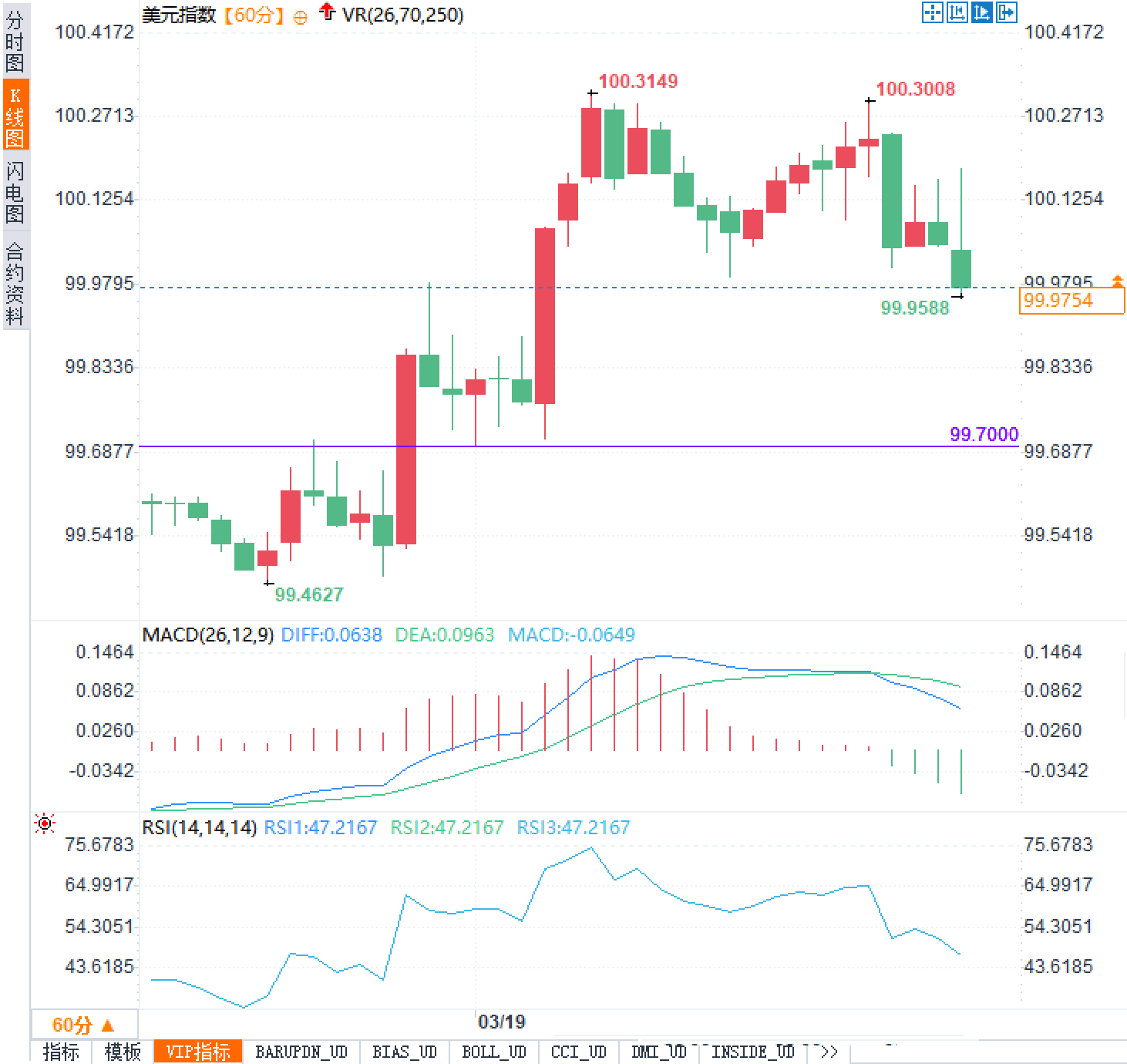
Observing the 60-minute candlestick chart, the US dollar index has entered a correction phase after completing a round of gains recently. The index formed a stage high at 100.3149 and 100.3008, followed by alternating red and green candlesticks, indicating an intensified battle between bulls and bears. The MACD indicator shows a DIFF value of 0.0638, a DEA value of 0.0963, and a MACD value of -0.0649. The slightly negative values in the histogram indicate that the short-term upward momentum has weakened. The RSI (14) reading is 47, which is in the neutral range. It has not reached overbought or oversold levels, suggesting that there is still room for technical adjustment but a lack of clear breakout signals.
Combining trading volume and candlestick patterns, selling pressure has gradually emerged recently. Traders are closely monitoring the effectiveness of the 99.7000 support level and the reversal resistance area around 100.30. If policy news releases positive signals before July, the index may regain upward momentum; conversely, legal uncertainty may amplify intraday volatility.
The evolution of tariff policy affects the exchange rate market through multiple channels. Temporary tariff increases may push up the cost of imported goods, directly impacting domestic price levels, thereby shaping inflation expectations and constraining the Federal Reserve's policy flexibility. The estimated 0.4 percentage point GDP impact will gradually manifest through business investment and consumer confidence; traders need to assess the reshaping effect of this process on the term structure of interest rates. Furthermore, the time-compressed nature of the accelerated investigation increases market concerns about the stability of the law. If the conclusions of Section 301 face new challenges, an extended policy transition period will exacerbate exchange rate volatility.
Policy shift following the Supreme Court ruling
On February 20, 2026, the U.S. Supreme Court ruled 6-3 that the International Emergency Economic Powers Act (IEEPA) could not authorize the president to impose tariffs. This judicial decision directly invalidated reciprocal tariffs and related measures previously applicable to a wide range of trading partners. Hours after the ruling, the government swiftly implemented a 10% global provisional tariff under Section 122 of the Trade Act of 1974, capped at 15%, which was set to expire around July 24 unless extended by Congress. Treasury Secretary Bessant has publicly hinted that the tariff rate may soon be raised to 15%, while predicting that the overall tariff level could return to its pre-ruling state by August.
To build a more sustainable legal foundation, the Office of the United States Trade Representative (USTR) has launched two comprehensive Section 301 investigations. The first, announced on March 11, focuses on structural excess manufacturing capacity in 16 economies; the second, launched on March 12, examines potential shortcomings in enforcement of forced labor imports in approximately 60 economies. Public comments are due on April 15, and hearings will continue into early May. This compressed timeline contrasts sharply with the 12 to 18 months typically required for investigations and aims to ensure that findings are reached before the expiration of provisional tariffs, enabling a seamless policy transition. The current effective tariff rate is between 16.9% and 17.5%, the highest level since 1932, and estimates suggest this could have a drag of approximately 0.4 percentage points on U.S. GDP by 2026.
| Types of tariffs | Current level | Expiration or transition period |
|---|---|---|
| Article 122 Provisional Customs Duties | 16.9%-17.5% | Around July 24, 2026 |
| Proposed Section 301 Tariffs | Expected to recover to previous levels | From August 2026 |
| Estimated impact on GDP in 2026 | Drag down by 0.4 percentage points | Cumulative effect throughout the year |
Detailed Arrangements and Legal Considerations for Section 301 Investigations
The initiation of the two Section 301 investigations marks a shift in the policy framework from temporary emergency measures to long-term compliance. The first investigation targets structural overcapacity, while the second focuses on areas of enforcement deficiency. Normally, such investigations take 12 to 18 months, but the current version, due to its expanded scope, adopts an accelerated approach, with public comment and hearings compressed into a few weeks. This design clearly aims to complete all procedures before the temporary measures expire in July, providing stronger legal support for subsequent tariffs.
However, accelerating the process also brings potential legal risks. Bessant recently acknowledged that the investigation results will precisely align with the 150-day deadline, but shortening the timeline could subject the final conclusions to further judicial review, similar to the Supreme Court's ruling on the International Emergency Economic Powers Act on February 20th. Traders need to pay attention to how such uncertainty is transmitted to the supply chain through trade costs and indirectly affects inflation paths and monetary policy expectations. The historically high effective tariff rate will also amplify import price pressures, further testing the resilience of economic growth.
Technical Analysis of the US Dollar Index
Observing the 60-minute candlestick chart, the US dollar index has entered a correction phase after completing a round of gains recently. The index formed a stage high at 100.3149 and 100.3008, followed by alternating red and green candlesticks, indicating an intensified battle between bulls and bears. The MACD indicator shows a DIFF value of 0.0638, a DEA value of 0.0963, and a MACD value of -0.0649. The slightly negative values in the histogram indicate that the short-term upward momentum has weakened. The RSI (14) reading is 47, which is in the neutral range. It has not reached overbought or oversold levels, suggesting that there is still room for technical adjustment but a lack of clear breakout signals.
Combining trading volume and candlestick patterns, selling pressure has gradually emerged recently. Traders are closely monitoring the effectiveness of the 99.7000 support level and the reversal resistance area around 100.30. If policy news releases positive signals before July, the index may regain upward momentum; conversely, legal uncertainty may amplify intraday volatility.
The transmission path of trade measures to the exchange rate market
The evolution of tariff policy affects the exchange rate market through multiple channels. Temporary tariff increases may push up the cost of imported goods, directly impacting domestic price levels, thereby shaping inflation expectations and constraining the Federal Reserve's policy flexibility. The estimated 0.4 percentage point GDP impact will gradually manifest through business investment and consumer confidence; traders need to assess the reshaping effect of this process on the term structure of interest rates. Furthermore, the time-compressed nature of the accelerated investigation increases market concerns about the stability of the law. If the conclusions of Section 301 face new challenges, an extended policy transition period will exacerbate exchange rate volatility.
- Risk Warning and Disclaimer
- The market involves risk, and trading may not be suitable for all investors. This article is for reference only and does not constitute personal investment advice, nor does it take into account certain users’ specific investment objectives, financial situation, or other needs. Any investment decisions made based on this information are at your own risk.