Gold Trading Alert: Gold Prices Plunge 3.5%, Marking Seven Consecutive Days of Decline! Middle East Oil War Ignites Global Inflation, Causing Gold Bulls to Flee in an Emergency?
2026-03-20 07:39:11
The global gold market is witnessing a dramatic seven-day losing streak. On Thursday (March 19), spot gold prices plummeted 3.5%, closing at $4,650 per ounce, after plunging more than 6% at one point during the session, hitting a low of $4,503.18 per ounce, the lowest since early February. US April gold futures also plunged 5.9%, ultimately closing at $4,605.70. This marks the seventh consecutive trading day of decline for gold prices. Gold, once wildly popular among institutional investors as a safe haven and hedge against inflation, now seems firmly bound by the shackles of high interest rates, with a surging downward trend that has left countless bullish investors trembling. On Friday (March 20) in early Asian trading, spot gold fluctuated slightly lower, currently trading around $4,640 per ounce.
The root of all the turmoil points to the escalating energy crisis in the Middle East. Israel's precise strike on Iran's South Pars gas field provoked a fierce retaliation from Iran—energy facilities across the Middle East were attacked one after another, from Qatar's largest natural gas plant to refineries in Saudi Arabia and Kuwait, none were spared. Brent crude oil prices once approached the $120 mark, and although they gave back their gains at the end of the session, they remained above the $100 mark, closing at $107.79 per barrel on Thursday. This supply shock came so swiftly that it directly pushed up global energy costs, causing inflation expectations to spread rapidly like wildfire.
Gold has traditionally been a safe haven from inflation and geopolitical turmoil, but this time, the situation has completely reversed. High oil prices have not only failed to stimulate gold, but have also fueled market concerns that inflation will remain high for an extended period.
TD Securities commodity strategist Daniel Ghali points out that institutional investors bought gold heavily over the past year due to concerns about currency devaluation, but the logic supporting such trades is rapidly weakening. In the short term, downside risks remain significant, and even though gold is still below the support level of the bullish trend, there is considerable room for a pullback.
In the same week that gold prices collapsed, central banks in almost all major developed economies held meetings, and without exception, interest rates remained unchanged.
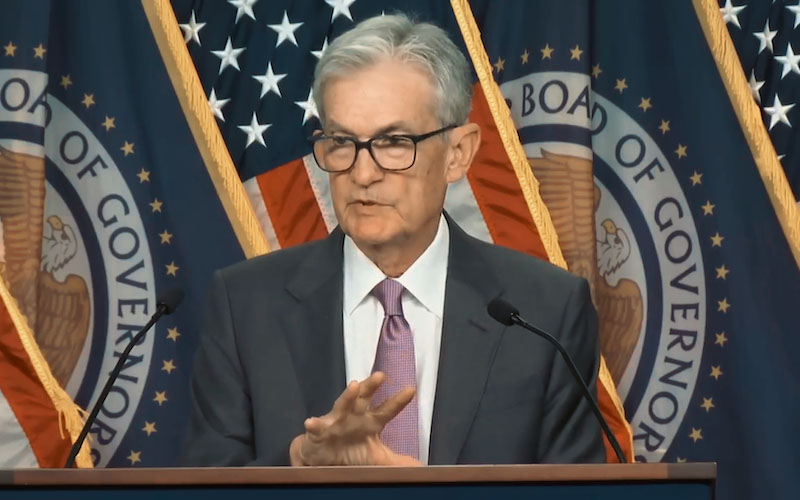
The European Central Bank kept interest rates unchanged but explicitly warned that soaring oil prices would cast a shadow over the eurozone's growth and inflation prospects; the Bank of Japan, while leaning towards tightening policy, also held its rates steady; the Bank of England unanimously voted to keep borrowing costs unchanged, with some policymakers even hinting at possible further rate hikes in the future; the Federal Reserve also kept interest rates in the 3.50%-3.75% range on Wednesday and predicted that inflation would rise and unemployment would remain stable this year, with only one symbolic rate cut.
Standard Chartered's global head, Steve Englander, bluntly stated: "Every central bank governor in the world is asking themselves, how much credibility do I still have?"
They are all closely monitoring the enormous uncertainty brought about by the Middle East energy shock, but unanimously prioritize inflation risk. Gold's biggest "enemy"—high interest rates—is thus firmly locked in. Because gold does not generate interest, its holding cost becomes exceptionally expensive in an environment of persistently high borrowing costs, naturally diminishing its attractiveness significantly.
Meanwhile, although the dollar index fell 1.1% to 99.20 on Thursday, it remained near a 10-month high. Investors flocked to safe-haven US assets, causing short-term US Treasury yields to surge: the two-year yield touched a seven-month high of 3.96% at one point, closing at 3.782%; the five-year and ten-year yields also hit recent highs. The market has almost completely erased expectations of a Fed rate cut this year—interest rate futures indicate only 7 basis points of room for rate cuts this year, and even zero rate cuts in the first half of 2027. All of this has dimmed gold's "anti-inflation" aura.
The decline in gold prices is not isolated. Spot silver plunged 3.5% to $72.76, having earlier fallen more than 12% to $65.50 per ounce; platinum fell 2.7% to $1966, and palladium also declined 2% to $1446. SP Angel analysts pointed out that this wave of profit-taking was not unexpected—after the strong rise in gold prices in 2025, traders were eager to lock in profits to meet margin calls, while simultaneously turning to trading hydrocarbons such as crude oil as market volatility intensified.
US stocks were also dragged down: the S&P 500 fell 0.27%, the Nasdaq fell 0.28%, and the Dow Jones Industrial Average fell 0.44%. Tech giants such as Micron, Tesla, and Nvidia all retreated, and volatile oil prices made investors uneasy. The bond market showed a "bear market flattening" pattern, with the spread between two-year and ten-year yields narrowing to 36.4 basis points at one point. Short-term interest rates rose much faster than long-term rates, reflecting a complete reassessment of the Federal Reserve's easing path.
In their report, Goldman Sachs analysts summarized that the seven G10 central bank meetings over the past two days yielded no major surprises. All central banks unanimously emphasized that the upside risks to inflation far outweighed the downside risks to growth, with the only difference being the degree of these risks. This Middle East energy crisis has become a "new black swan" event for global financial markets.
Several analysts have issued warnings. Daniel Ghali emphasized that gold still faces downward pressure in the short term. Zachary Griffiths, director of CreditSights, pointed out that the Federal Reserve may have to cut interest rates sometime in 2026, but current consumer purchasing power is rapidly weakening due to high oil prices, and central banks will prioritize combating inflation in the short term. Analysts in North Carolina also cautioned that while the labor market is resilient, high oil prices have begun to erode disposable income, with the one-year inflation swap rate surging to a six-month high of 3.3%, far exceeding the actual CPI data of 2.4% in February.
While demand was robust at the 10-year Treasury Inflation-Protected Securities (TIPS) auction, the winning bid rate was slightly higher than expected, reflecting market concerns about high inflation. Gold's former status as an institutional favorite is being ruthlessly stripped away by the high-interest-rate environment.
Despite the sharp short-term decline, analysts generally believe that the long-term bullish logic for gold has not completely collapsed. Geopolitical risks remain, and the Middle East conflict could escalate further at any time; the devaluation pressure on the global monetary system has not disappeared either. As long as the oil price shock eases, or central banks are forced to shift to easing in 2026, gold is still expected to resume its upward trajectory. The current key support level is still clearly visible, and although the pullback potential is significant, it also provides a potential buying opportunity for rational investors.
Of course, risks cannot be ignored: if the war with Iran continues to escalate, oil prices continue to rise, and central banks further strengthen their hawkish stance, gold may continue to face downward pressure. Investors need to closely monitor Brent crude oil prices, subsequent statements from the Federal Reserve, and changes in inflation data.
This double whammy of high interest rates and high inflation triggered by the Middle East conflict has plunged the once-king of safe-haven assets into a seven-day losing streak. But as history has repeatedly shown, crises often breed opportunities. Once the market has digested this round of panic, and when central bank signals show a subtle shift, gold may usher in a new round of strong rebound.
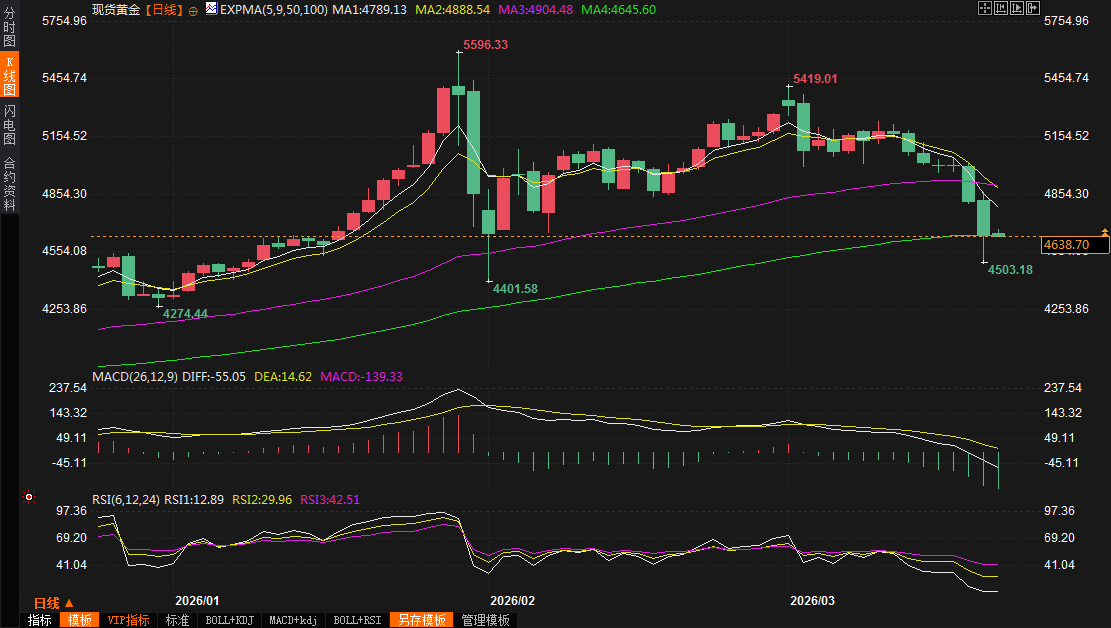
(Spot gold daily chart, source: FX678)
At 07:35 Beijing time, spot gold was trading at $4639.98 per ounce.
Middle East conflict escalates: Oil prices surge to nearly $120, inflation specter returns to markets.
The root of all the turmoil points to the escalating energy crisis in the Middle East. Israel's precise strike on Iran's South Pars gas field provoked a fierce retaliation from Iran—energy facilities across the Middle East were attacked one after another, from Qatar's largest natural gas plant to refineries in Saudi Arabia and Kuwait, none were spared. Brent crude oil prices once approached the $120 mark, and although they gave back their gains at the end of the session, they remained above the $100 mark, closing at $107.79 per barrel on Thursday. This supply shock came so swiftly that it directly pushed up global energy costs, causing inflation expectations to spread rapidly like wildfire.
Gold has traditionally been a safe haven from inflation and geopolitical turmoil, but this time, the situation has completely reversed. High oil prices have not only failed to stimulate gold, but have also fueled market concerns that inflation will remain high for an extended period.
TD Securities commodity strategist Daniel Ghali points out that institutional investors bought gold heavily over the past year due to concerns about currency devaluation, but the logic supporting such trades is rapidly weakening. In the short term, downside risks remain significant, and even though gold is still below the support level of the bullish trend, there is considerable room for a pullback.
Central banks take a hard line: unchanged interest rates + hawkish signals instantly reduce gold's appeal to zero.
In the same week that gold prices collapsed, central banks in almost all major developed economies held meetings, and without exception, interest rates remained unchanged.
The European Central Bank kept interest rates unchanged but explicitly warned that soaring oil prices would cast a shadow over the eurozone's growth and inflation prospects; the Bank of Japan, while leaning towards tightening policy, also held its rates steady; the Bank of England unanimously voted to keep borrowing costs unchanged, with some policymakers even hinting at possible further rate hikes in the future; the Federal Reserve also kept interest rates in the 3.50%-3.75% range on Wednesday and predicted that inflation would rise and unemployment would remain stable this year, with only one symbolic rate cut.
Standard Chartered's global head, Steve Englander, bluntly stated: "Every central bank governor in the world is asking themselves, how much credibility do I still have?"
They are all closely monitoring the enormous uncertainty brought about by the Middle East energy shock, but unanimously prioritize inflation risk. Gold's biggest "enemy"—high interest rates—is thus firmly locked in. Because gold does not generate interest, its holding cost becomes exceptionally expensive in an environment of persistently high borrowing costs, naturally diminishing its attractiveness significantly.
Meanwhile, although the dollar index fell 1.1% to 99.20 on Thursday, it remained near a 10-month high. Investors flocked to safe-haven US assets, causing short-term US Treasury yields to surge: the two-year yield touched a seven-month high of 3.96% at one point, closing at 3.782%; the five-year and ten-year yields also hit recent highs. The market has almost completely erased expectations of a Fed rate cut this year—interest rate futures indicate only 7 basis points of room for rate cuts this year, and even zero rate cuts in the first half of 2027. All of this has dimmed gold's "anti-inflation" aura.
Market ripple effects: Silver and platinum prices both fell, and stock and bond markets both came under pressure.
The decline in gold prices is not isolated. Spot silver plunged 3.5% to $72.76, having earlier fallen more than 12% to $65.50 per ounce; platinum fell 2.7% to $1966, and palladium also declined 2% to $1446. SP Angel analysts pointed out that this wave of profit-taking was not unexpected—after the strong rise in gold prices in 2025, traders were eager to lock in profits to meet margin calls, while simultaneously turning to trading hydrocarbons such as crude oil as market volatility intensified.
US stocks were also dragged down: the S&P 500 fell 0.27%, the Nasdaq fell 0.28%, and the Dow Jones Industrial Average fell 0.44%. Tech giants such as Micron, Tesla, and Nvidia all retreated, and volatile oil prices made investors uneasy. The bond market showed a "bear market flattening" pattern, with the spread between two-year and ten-year yields narrowing to 36.4 basis points at one point. Short-term interest rates rose much faster than long-term rates, reflecting a complete reassessment of the Federal Reserve's easing path.
In their report, Goldman Sachs analysts summarized that the seven G10 central bank meetings over the past two days yielded no major surprises. All central banks unanimously emphasized that the upside risks to inflation far outweighed the downside risks to growth, with the only difference being the degree of these risks. This Middle East energy crisis has become a "new black swan" event for global financial markets.
In-depth analysis by experts: Institutional logic is weakening, and there is significant room for short-term correction.
Several analysts have issued warnings. Daniel Ghali emphasized that gold still faces downward pressure in the short term. Zachary Griffiths, director of CreditSights, pointed out that the Federal Reserve may have to cut interest rates sometime in 2026, but current consumer purchasing power is rapidly weakening due to high oil prices, and central banks will prioritize combating inflation in the short term. Analysts in North Carolina also cautioned that while the labor market is resilient, high oil prices have begun to erode disposable income, with the one-year inflation swap rate surging to a six-month high of 3.3%, far exceeding the actual CPI data of 2.4% in February.
While demand was robust at the 10-year Treasury Inflation-Protected Securities (TIPS) auction, the winning bid rate was slightly higher than expected, reflecting market concerns about high inflation. Gold's former status as an institutional favorite is being ruthlessly stripped away by the high-interest-rate environment.
Gold's Future Outlook: Bullish Support Remains, Buying Opportunities May Emerge After Pullback
Despite the sharp short-term decline, analysts generally believe that the long-term bullish logic for gold has not completely collapsed. Geopolitical risks remain, and the Middle East conflict could escalate further at any time; the devaluation pressure on the global monetary system has not disappeared either. As long as the oil price shock eases, or central banks are forced to shift to easing in 2026, gold is still expected to resume its upward trajectory. The current key support level is still clearly visible, and although the pullback potential is significant, it also provides a potential buying opportunity for rational investors.
Of course, risks cannot be ignored: if the war with Iran continues to escalate, oil prices continue to rise, and central banks further strengthen their hawkish stance, gold may continue to face downward pressure. Investors need to closely monitor Brent crude oil prices, subsequent statements from the Federal Reserve, and changes in inflation data.
Gold investment is at a historical crossroads.
This double whammy of high interest rates and high inflation triggered by the Middle East conflict has plunged the once-king of safe-haven assets into a seven-day losing streak. But as history has repeatedly shown, crises often breed opportunities. Once the market has digested this round of panic, and when central bank signals show a subtle shift, gold may usher in a new round of strong rebound.
(Spot gold daily chart, source: FX678)
At 07:35 Beijing time, spot gold was trading at $4639.98 per ounce.
- Risk Warning and Disclaimer
- The market involves risk, and trading may not be suitable for all investors. This article is for reference only and does not constitute personal investment advice, nor does it take into account certain users’ specific investment objectives, financial situation, or other needs. Any investment decisions made based on this information are at your own risk.