The Fed's hawkish shift, coupled with a stronger dollar, strengthens signals of a medium-term correction in gold prices.
2026-03-20 09:27:28
After a significant surge, the international gold market has recently experienced a marked correction, with spot gold (XAU/USD) trading under pressure around $4640 during the Asian session. The core factor driving this round of gold price declines is not a single variable, but rather the combined effect of macroeconomic policy expectations, the liquidity environment, and market sentiment. From a macroeconomic perspective, the Federal Reserve maintained interest rates unchanged at its latest policy meeting, but released a clearly hawkish signal, especially Chairman Jerome Powell's statement that the policy committee had discussed the possibility of another rate hike. This statement significantly altered the market's assessment of the future path of monetary policy.

Against this backdrop, the US dollar index found support and strengthened, directly suppressing gold prices, which are denominated in US dollars. It's important to emphasize that one of the key drivers of the previous gold price increase was the market's pre-pricing of an interest rate cut cycle , but this logic is currently being revised. As soaring energy prices push up inflation expectations, the likelihood of the Federal Reserve maintaining high interest rates or even tightening them again has increased, causing the market to once again focus on gold's "interest rate sensitive attribute."
Meanwhile, the continued rise in crude oil prices has exacerbated market concerns about a rebound in inflation. Against the backdrop of ongoing tensions in the Middle East, high energy prices have not only raised global inflation expectations but also weakened market confidence in loose monetary policies. In this environment, gold no longer simply benefits from safe-haven demand but is instead under pressure due to rising real interest rate expectations. In other words, the market is currently shifting from a "safe-haven driven" to an "interest rate driven" model .
From a market behavior perspective, this round of decline is also accompanied by a clear liquidity squeeze. Increased volatility in global financial markets has led investors to sell highly liquid assets, including gold, to cope with margin requirements. As Paul Surguy, Head of Investments at Kingswood Group, pointed out, the market has entered a "liquidity-first" phase, with investors inclined to sell the most readily convertible assets to obtain cash. This selling is not entirely based on fundamentals but rather a passive behavior driven by funding needs, creating a short-term impact on gold.
However, from another perspective, geopolitical risks have not disappeared; on the contrary, they continue to escalate. Iranian Foreign Minister Abbas Araghchi stated that Iran would show "no restraint" should its energy facilities be attacked again, while Saudi Foreign Minister Faisal bin Farhan Al Saud also warned that military action could not be ruled out. This means that the situation in the Middle East remains highly uncertain, potentially providing support for gold. However, judging from the current market reaction, safe-haven funds are flowing more towards the US dollar than gold, indicating a temporary shift in asset preferences.
From a technical perspective, on the daily chart, gold was previously in a clear uptrend, but formed a temporary top after reaching around $4800. It has now broken below short-term moving average support, and the trend is weakening. The key support level below is currently at the psychological level of $4600 ; a decisive break below this level could lead to a further decline towards the $4450 area. Looking at momentum indicators, the RSI has rapidly retreated from overbought territory, indicating that the previous rally was significantly overextended and is currently in a correction phase.
From a 4-hour chart perspective, gold has formed a clear descending channel structure, with both highs and lows trending lower, indicating a relatively clear downtrend. Short-term resistance is located in the $4680-$4700 range, while support is concentrated around $4580. A break below this level could trigger accelerated declines in the short term; conversely, a hold above $4700 could lead to a technical rebound.
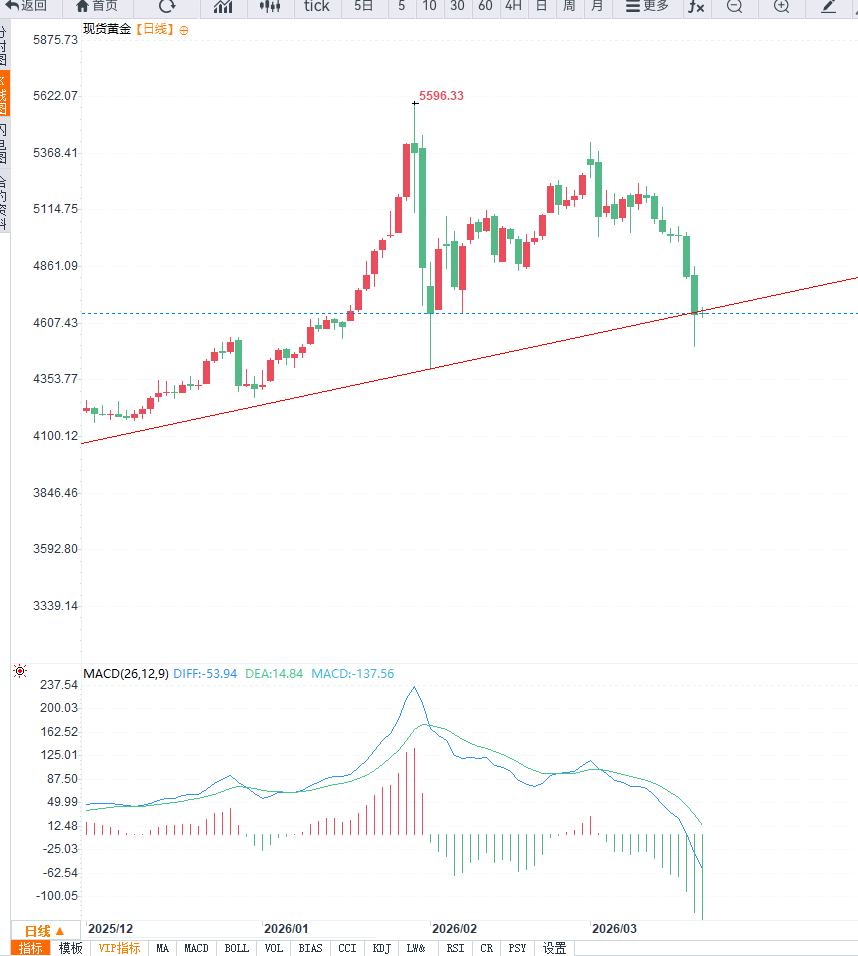
From both fundamental and technical perspectives, the current decline in gold prices is essentially a result of a combination of adjustments to expectations of interest rate cuts and a technical overbought correction . At the same time, the US dollar is attracting safe-haven funds, causing gold to revert to its commodity attributes for the time being. The previously accumulated "interest rate cut premium" is being gradually digested, which also means that the probability of a medium-term correction is increasing.
Editor's Summary:
The gold market is currently at a critical turning point. The macroeconomic logic has shifted from "easing expectations driving prices up" to "high interest rates constraining prices," becoming the core reason for the gold price adjustment . In the short term, a strong dollar and liquidity pressures will continue to suppress gold prices, but uncertainty in the Middle East situation still provides support at the bottom. In the medium term, if inflation remains high and the Federal Reserve maintains a hawkish stance, gold may enter a period of downward fluctuation; however, once policy expectations shift back to easing, gold prices still have the foundation to rebound.
Against this backdrop, the US dollar index found support and strengthened, directly suppressing gold prices, which are denominated in US dollars. It's important to emphasize that one of the key drivers of the previous gold price increase was the market's pre-pricing of an interest rate cut cycle , but this logic is currently being revised. As soaring energy prices push up inflation expectations, the likelihood of the Federal Reserve maintaining high interest rates or even tightening them again has increased, causing the market to once again focus on gold's "interest rate sensitive attribute."
Meanwhile, the continued rise in crude oil prices has exacerbated market concerns about a rebound in inflation. Against the backdrop of ongoing tensions in the Middle East, high energy prices have not only raised global inflation expectations but also weakened market confidence in loose monetary policies. In this environment, gold no longer simply benefits from safe-haven demand but is instead under pressure due to rising real interest rate expectations. In other words, the market is currently shifting from a "safe-haven driven" to an "interest rate driven" model .
From a market behavior perspective, this round of decline is also accompanied by a clear liquidity squeeze. Increased volatility in global financial markets has led investors to sell highly liquid assets, including gold, to cope with margin requirements. As Paul Surguy, Head of Investments at Kingswood Group, pointed out, the market has entered a "liquidity-first" phase, with investors inclined to sell the most readily convertible assets to obtain cash. This selling is not entirely based on fundamentals but rather a passive behavior driven by funding needs, creating a short-term impact on gold.
However, from another perspective, geopolitical risks have not disappeared; on the contrary, they continue to escalate. Iranian Foreign Minister Abbas Araghchi stated that Iran would show "no restraint" should its energy facilities be attacked again, while Saudi Foreign Minister Faisal bin Farhan Al Saud also warned that military action could not be ruled out. This means that the situation in the Middle East remains highly uncertain, potentially providing support for gold. However, judging from the current market reaction, safe-haven funds are flowing more towards the US dollar than gold, indicating a temporary shift in asset preferences.
From a technical perspective, on the daily chart, gold was previously in a clear uptrend, but formed a temporary top after reaching around $4800. It has now broken below short-term moving average support, and the trend is weakening. The key support level below is currently at the psychological level of $4600 ; a decisive break below this level could lead to a further decline towards the $4450 area. Looking at momentum indicators, the RSI has rapidly retreated from overbought territory, indicating that the previous rally was significantly overextended and is currently in a correction phase.
From a 4-hour chart perspective, gold has formed a clear descending channel structure, with both highs and lows trending lower, indicating a relatively clear downtrend. Short-term resistance is located in the $4680-$4700 range, while support is concentrated around $4580. A break below this level could trigger accelerated declines in the short term; conversely, a hold above $4700 could lead to a technical rebound.
From both fundamental and technical perspectives, the current decline in gold prices is essentially a result of a combination of adjustments to expectations of interest rate cuts and a technical overbought correction . At the same time, the US dollar is attracting safe-haven funds, causing gold to revert to its commodity attributes for the time being. The previously accumulated "interest rate cut premium" is being gradually digested, which also means that the probability of a medium-term correction is increasing.
Editor's Summary:
The gold market is currently at a critical turning point. The macroeconomic logic has shifted from "easing expectations driving prices up" to "high interest rates constraining prices," becoming the core reason for the gold price adjustment . In the short term, a strong dollar and liquidity pressures will continue to suppress gold prices, but uncertainty in the Middle East situation still provides support at the bottom. In the medium term, if inflation remains high and the Federal Reserve maintains a hawkish stance, gold may enter a period of downward fluctuation; however, once policy expectations shift back to easing, gold prices still have the foundation to rebound.
- Risk Warning and Disclaimer
- The market involves risk, and trading may not be suitable for all investors. This article is for reference only and does not constitute personal investment advice, nor does it take into account certain users’ specific investment objectives, financial situation, or other needs. Any investment decisions made based on this information are at your own risk.