Interest rate hikes are ineffective, but laissez-faire is even more painful: The Bank of Japan faces a painful choice.
2026-03-20 17:15:00
Japan has long hoped to achieve sustainable, moderate inflation in order to normalize its monetary policy. The surge in oil prices caused by the geopolitical conflict with Iran may seem to help it achieve its goal, but it has instead given rise to cost-push inflation, which is the last thing Japan wants to face.
As an economy that is almost entirely dependent on crude oil imports, Japan imports over 90% of its crude oil from the Middle East, and the vast majority of these imports must pass through the Strait of Hormuz. Escalating tensions in the Middle East have directly choked off its energy lifeline, pushing up import costs. Coupled with a weak yen, this has led to a rapid transmission of imported inflationary pressures to the production and consumption sectors.
Analysts estimate that the sharp rise in oil prices will push Japan's CPI up by 0.3%-0.7%, and energy, as a core production factor, will further amplify the upward pressure on overall prices.
Although Japan possesses strategic oil reserves sufficient to cover 254 days of consumption, which can provide temporary buffer against shocks, it is difficult to reverse the upward trend of supply-side inflation.
Japan's passive position regarding energy security was laid bare during the recent Japan-U.S. summit.
Japanese Prime Minister Sanae Takaichi and US President Donald Trump held a meeting at the White House for about an hour and a half. Trump pointed out that Japan relies on the Middle East for more than 90% of its crude oil imports, demanded that Japan take more responsibility for the safety of navigation in the Strait of Hormuz, which is already facing a de facto blockade, and expressed dissatisfaction with the United States for bearing the cost of the Strait's defense for a long time.
Takashi condemned Iran's attacks, emphasized the importance of de-escalating the situation, clarified that Japan faces legal restrictions on dispatching ships, and pledged to do its utmost to ensure the safety of shipping lanes within the legal framework.
Both sides reached an agreement on maintaining close communication regarding the security of the Strait of Hormuz, stable energy supply, and the situation in the Middle East. They also finalized plans to expand cooperation in U.S. energy production. Japan also proposed a joint project to stockpile U.S. crude oil in Japan, attempting to mitigate energy supply risks through diversification of procurement sources.
During the meeting, Trump did not demand an increase in defense spending, and both sides confirmed that they would advance several areas of cooperation to enhance the quality of the Japan-U.S. alliance.
Since exiting negative interest rates in 2024, the Bank of Japan has consistently pursued benign inflation driven by wages and demand, attempting to build a spiral of rising wages and prices. Sanae Takaichi has also explicitly urged the central bank to abandon raw material cost-driven inflation.
However, the reality is not optimistic. In 2025, Japan's real wages fell across the board year-on-year, with only a slight positive turn in January 2026.
Against the backdrop of sluggish wage growth, cost-push inflation will only squeeze residents' real purchasing power and drag down consumption recovery, completely deviating from the original intention of the central bank's policy.
Japan’s overall inflation has remained above the 2% target for 45 consecutive months, with only a slight decline in January. The Middle East conflict has brought a new round of upward risks.
Kazuo Ueda clearly stated that core inflation is rapidly approaching the 2% target, but rising prices must be matched with steady wage growth;
Meanwhile, the continued rise in oil prices will worsen Japan's terms of trade and suppress its economic performance.
This puts the Bank of Japan in a classic policy dilemma: raising interest rates can curb inflation and provide temporary support for the yen, but it will also damage the fragile economic recovery; maintaining loose monetary policy to support growth will allow cost-push imported inflation to spread, exacerbating the pressure on the yen to depreciate.
Market institutions generally believe that interest rate hikes mainly affect the demand side and have limited effect on curbing supply-driven inflation. The Bank of Japan is more likely to adopt a wait-and-see attitude rather than rush to raise interest rates.
To add to this, there are generally three main mechanisms for rising inflation. The first is demand-pull inflation, such as the price increases caused by booming consumption after the pandemic. This type of inflation can be prevented by raising interest rates.
Next comes imported inflation, which is essentially cost-push inflation, as seen in this case. Interest rate hikes are ineffective. Finally, there is excessive money supply, such as during the period when Japan's export-driven GDP accounted for a large proportion of its GDP, when manufacturers settled foreign exchange, leading to excessive money supply in the domestic market.
For yen trading, the current battle between bulls and bears has intensified significantly, and the core logic for the future market revolves around three key variables: first, the situation in the Middle East and the trend of oil prices, which directly determine the intensity of imported inflationary pressures; second, the outcome of Japan's spring wage negotiations, which is related to whether benign inflation can truly materialize; and third, the Bank of Japan's policy guidance in April, which will directly affect expectations of interest rate hikes and carry trade sentiment.
In the short term, the yen is supported by expectations of intervention and risk aversion, but in the medium term, it is constrained by the central bank's policy dilemma, its reliance on energy, and weak economic fundamentals. The exchange rate is likely to maintain a wide range of fluctuations, with the 158-160 range becoming the core level for the battle between bulls and bears.
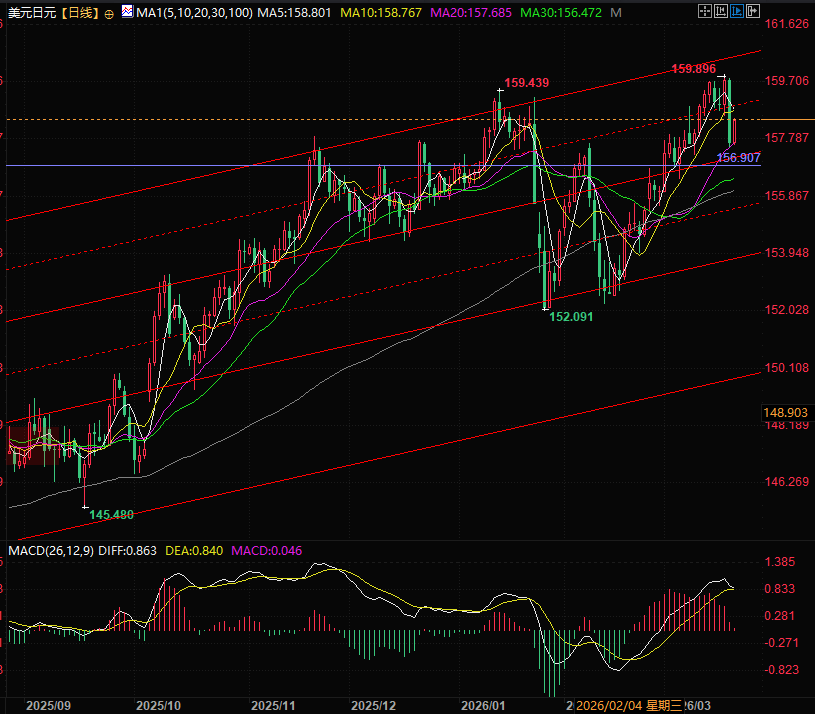
(USD/JPY daily chart, source: Switch a machine)
At 17:11 Beijing time, the USD/CNY exchange rate is currently at 15.53/54.
As an economy that is almost entirely dependent on crude oil imports, Japan imports over 90% of its crude oil from the Middle East, and the vast majority of these imports must pass through the Strait of Hormuz. Escalating tensions in the Middle East have directly choked off its energy lifeline, pushing up import costs. Coupled with a weak yen, this has led to a rapid transmission of imported inflationary pressures to the production and consumption sectors.
Analysts estimate that the sharp rise in oil prices will push Japan's CPI up by 0.3%-0.7%, and energy, as a core production factor, will further amplify the upward pressure on overall prices.
Although Japan possesses strategic oil reserves sufficient to cover 254 days of consumption, which can provide temporary buffer against shocks, it is difficult to reverse the upward trend of supply-side inflation.
Japan-U.S. summit: Japan's energy security under pressure, forced to seek diversification of U.S. energy sources.
Japan's passive position regarding energy security was laid bare during the recent Japan-U.S. summit.
Japanese Prime Minister Sanae Takaichi and US President Donald Trump held a meeting at the White House for about an hour and a half. Trump pointed out that Japan relies on the Middle East for more than 90% of its crude oil imports, demanded that Japan take more responsibility for the safety of navigation in the Strait of Hormuz, which is already facing a de facto blockade, and expressed dissatisfaction with the United States for bearing the cost of the Strait's defense for a long time.
Takashi condemned Iran's attacks, emphasized the importance of de-escalating the situation, clarified that Japan faces legal restrictions on dispatching ships, and pledged to do its utmost to ensure the safety of shipping lanes within the legal framework.
Both sides reached an agreement on maintaining close communication regarding the security of the Strait of Hormuz, stable energy supply, and the situation in the Middle East. They also finalized plans to expand cooperation in U.S. energy production. Japan also proposed a joint project to stockpile U.S. crude oil in Japan, attempting to mitigate energy supply risks through diversification of procurement sources.
During the meeting, Trump did not demand an increase in defense spending, and both sides confirmed that they would advance several areas of cooperation to enhance the quality of the Japan-U.S. alliance.
Wage growth is sluggish, and a virtuous cycle of inflation has yet to be formed.
Since exiting negative interest rates in 2024, the Bank of Japan has consistently pursued benign inflation driven by wages and demand, attempting to build a spiral of rising wages and prices. Sanae Takaichi has also explicitly urged the central bank to abandon raw material cost-driven inflation.
However, the reality is not optimistic. In 2025, Japan's real wages fell across the board year-on-year, with only a slight positive turn in January 2026.
Against the backdrop of sluggish wage growth, cost-push inflation will only squeeze residents' real purchasing power and drag down consumption recovery, completely deviating from the original intention of the central bank's policy.
Japan’s overall inflation has remained above the 2% target for 45 consecutive months, with only a slight decline in January. The Middle East conflict has brought a new round of upward risks.
The central bank is caught in a dilemma, unable to balance raising interest rates with stabilizing growth.
Kazuo Ueda clearly stated that core inflation is rapidly approaching the 2% target, but rising prices must be matched with steady wage growth;
Meanwhile, the continued rise in oil prices will worsen Japan's terms of trade and suppress its economic performance.
This puts the Bank of Japan in a classic policy dilemma: raising interest rates can curb inflation and provide temporary support for the yen, but it will also damage the fragile economic recovery; maintaining loose monetary policy to support growth will allow cost-push imported inflation to spread, exacerbating the pressure on the yen to depreciate.
Market institutions generally believe that interest rate hikes mainly affect the demand side and have limited effect on curbing supply-driven inflation. The Bank of Japan is more likely to adopt a wait-and-see attitude rather than rush to raise interest rates.
To add to this, there are generally three main mechanisms for rising inflation. The first is demand-pull inflation, such as the price increases caused by booming consumption after the pandemic. This type of inflation can be prevented by raising interest rates.
Next comes imported inflation, which is essentially cost-push inflation, as seen in this case. Interest rate hikes are ineffective. Finally, there is excessive money supply, such as during the period when Japan's export-driven GDP accounted for a large proportion of its GDP, when manufacturers settled foreign exchange, leading to excessive money supply in the domestic market.
The core logic of yen trading: Three major variables will dominate future market trends.
For yen trading, the current battle between bulls and bears has intensified significantly, and the core logic for the future market revolves around three key variables: first, the situation in the Middle East and the trend of oil prices, which directly determine the intensity of imported inflationary pressures; second, the outcome of Japan's spring wage negotiations, which is related to whether benign inflation can truly materialize; and third, the Bank of Japan's policy guidance in April, which will directly affect expectations of interest rate hikes and carry trade sentiment.
In the short term, the yen is supported by expectations of intervention and risk aversion, but in the medium term, it is constrained by the central bank's policy dilemma, its reliance on energy, and weak economic fundamentals. The exchange rate is likely to maintain a wide range of fluctuations, with the 158-160 range becoming the core level for the battle between bulls and bears.
(USD/JPY daily chart, source: Switch a machine)
At 17:11 Beijing time, the USD/CNY exchange rate is currently at 15.53/54.
- Risk Warning and Disclaimer
- The market involves risk, and trading may not be suitable for all investors. This article is for reference only and does not constitute personal investment advice, nor does it take into account certain users’ specific investment objectives, financial situation, or other needs. Any investment decisions made based on this information are at your own risk.