A chart: Baltic Dry Index remains flat, with divergent performance across ship types.
2026-03-20 23:08:39
Latest data shows that on March 20, 2026, the Baltic Dry Index (BDI) was 2056 points, a three-day low, down 0.05% from the previous day, marking the second consecutive day of decline (including zero growth). Looking at the short-term charts, the recent 11 BDI data points show: 6 positive increases, 5 negative increases, and 0 zero increases. Specifically, the Panamax Freight Index (BPI) was 1904 points, down 0.26% from the previous day; the Capesize Freight Index (BCI) was 2971 points, up 0.20%; and the Supramax Freight Index (BSI) was 1224 points, down 0.41%. For detailed 720-day and 10-year trend charts of the Baltic Dry Index and its three main sub-indices, please refer to the specially designed charts.
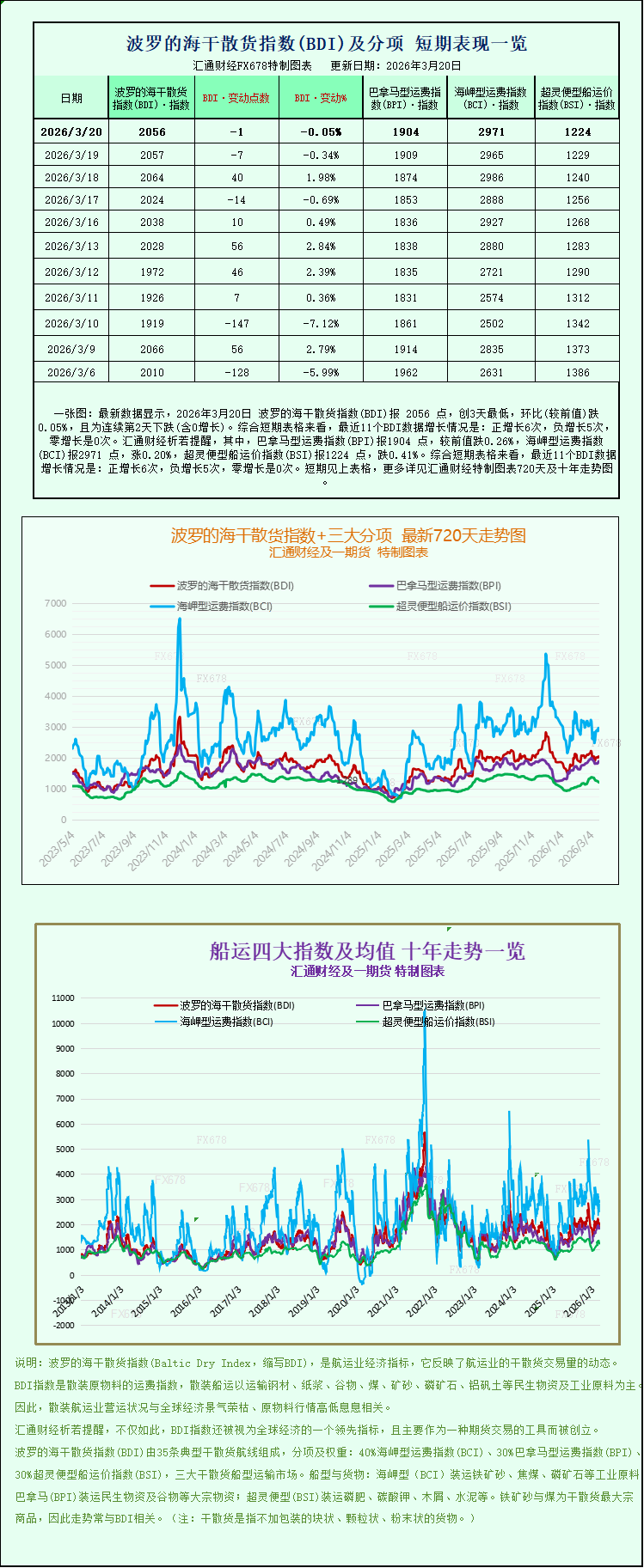
The Baltic Dry Index (which monitors global dry bulk shipping rates) remained largely stable on Friday. A slight increase in Capesize rates offset a slight decrease in Panamax and Supramax rates, resulting in limited overall fluctuations in the index.
The Baltic Dry Index, which tracks freight rates for the three main vessel types—Capesize, Panamax, and Supramax—fell slightly by 1 point to close at 2,056. Despite the small daily fluctuation, the index still rose overall this week, with a cumulative increase of 1.4%, demonstrating a relatively strong trend in the short term.
Looking at different vessel types, the Capesize index performed relatively well, rising 6 points, or 0.2%, to close at 2,971 points on the day. It also saw a significant increase of 3.2% this week, making it the best-performing vessel type. As a large-capacity dry bulk carrier, Capesize vessels mainly transport bulk raw materials such as iron ore and coal up to 150,000 tons. Their average daily profitability also rose, increasing by $49 to $23,438 in a single day, demonstrating strong profitability resilience.
In terms of market fundamentals, iron ore futures prices rose in tandem. On the one hand, the market anticipated that China's procurement restrictions on BHP Billiton's related products would soon be implemented, leading to expectations of a tightening supply. On the other hand, the steady recovery of domestic iron ore production further supported market demand expectations, providing fundamental support for the Capesize shipping market.
The Panamax index saw a slight pullback, falling 5 points, or 0.3%, to 1,904. This type of vessel primarily transports 60,000 to 70,000 tons of coal, grain, and other commodities, resulting in a decrease in average daily earnings of $45 to $17,132. However, looking at the weekly performance, Panamax vessels still recorded a 3.6% increase, and the short-term correction did not change the overall strong trend for the week.
The Supramax bulk carrier index also weakened, falling 5 points, or 0.4%, to close at 1,224 points. It has fallen 4.6% this week, performing weakly among the three major ship types and showing a clear divergence from the others.
Furthermore, the ongoing international geopolitical situation continues to disrupt the shipping market. Affected by the conflict in the Middle East, the safety of shipping through the Strait of Hormuz, a key global energy transport route, has become a major concern. Increased uncertainty in this passage, known as the "world's oil artery," has driven overall shipping and freight prices to maintain an upward trend, becoming a significant external factor supporting dry bulk freight rates.
The Baltic Dry Index (which monitors global dry bulk shipping rates) remained largely stable on Friday. A slight increase in Capesize rates offset a slight decrease in Panamax and Supramax rates, resulting in limited overall fluctuations in the index.
The Baltic Dry Index, which tracks freight rates for the three main vessel types—Capesize, Panamax, and Supramax—fell slightly by 1 point to close at 2,056. Despite the small daily fluctuation, the index still rose overall this week, with a cumulative increase of 1.4%, demonstrating a relatively strong trend in the short term.
Looking at different vessel types, the Capesize index performed relatively well, rising 6 points, or 0.2%, to close at 2,971 points on the day. It also saw a significant increase of 3.2% this week, making it the best-performing vessel type. As a large-capacity dry bulk carrier, Capesize vessels mainly transport bulk raw materials such as iron ore and coal up to 150,000 tons. Their average daily profitability also rose, increasing by $49 to $23,438 in a single day, demonstrating strong profitability resilience.
In terms of market fundamentals, iron ore futures prices rose in tandem. On the one hand, the market anticipated that China's procurement restrictions on BHP Billiton's related products would soon be implemented, leading to expectations of a tightening supply. On the other hand, the steady recovery of domestic iron ore production further supported market demand expectations, providing fundamental support for the Capesize shipping market.
The Panamax index saw a slight pullback, falling 5 points, or 0.3%, to 1,904. This type of vessel primarily transports 60,000 to 70,000 tons of coal, grain, and other commodities, resulting in a decrease in average daily earnings of $45 to $17,132. However, looking at the weekly performance, Panamax vessels still recorded a 3.6% increase, and the short-term correction did not change the overall strong trend for the week.
The Supramax bulk carrier index also weakened, falling 5 points, or 0.4%, to close at 1,224 points. It has fallen 4.6% this week, performing weakly among the three major ship types and showing a clear divergence from the others.
Furthermore, the ongoing international geopolitical situation continues to disrupt the shipping market. Affected by the conflict in the Middle East, the safety of shipping through the Strait of Hormuz, a key global energy transport route, has become a major concern. Increased uncertainty in this passage, known as the "world's oil artery," has driven overall shipping and freight prices to maintain an upward trend, becoming a significant external factor supporting dry bulk freight rates.
- Risk Warning and Disclaimer
- The market involves risk, and trading may not be suitable for all investors. This article is for reference only and does not constitute personal investment advice, nor does it take into account certain users’ specific investment objectives, financial situation, or other needs. Any investment decisions made based on this information are at your own risk.