The Strait of Hormuz has opened a crack, and 140 million barrels of oil are en route. When the market opens next Monday, can the bulls still hold on?
2026-03-21 14:43:31
This week, the global energy market entered a highly sensitive period of geopolitical maneuvering and technological adjustments. Affected by the continued escalation of the situation in the Middle East, Brent crude oil futures settled at their highest level since July 2022, with a weekly increase of 8.8%. The core conflict centers on navigation rights in the Strait of Hormuz and force majeure regarding Iraqi oil supplies. Although the US Treasury Department released already-shipped Iranian crude oil through a "temporary authorization" to alleviate supply pressure, Iran has strongly denied this, calling it merely "psychological reassurance." As the conflict between the US and Israel and Iran deepens, global oil supply faces structural losses. While market risk aversion has fluctuated in the short term due to external factors such as expectations of tariff increases, the fundamental premium logic of crude oil has shifted from short-term emergencies to long-term confrontation.

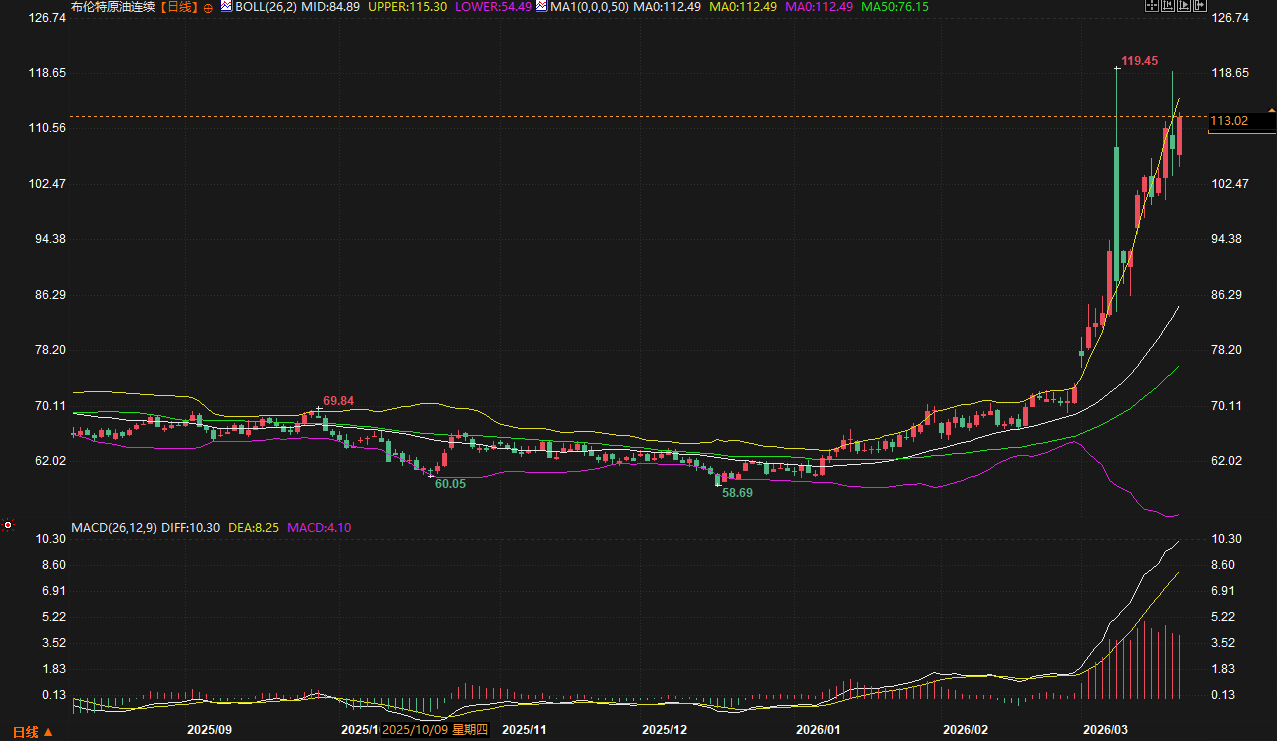
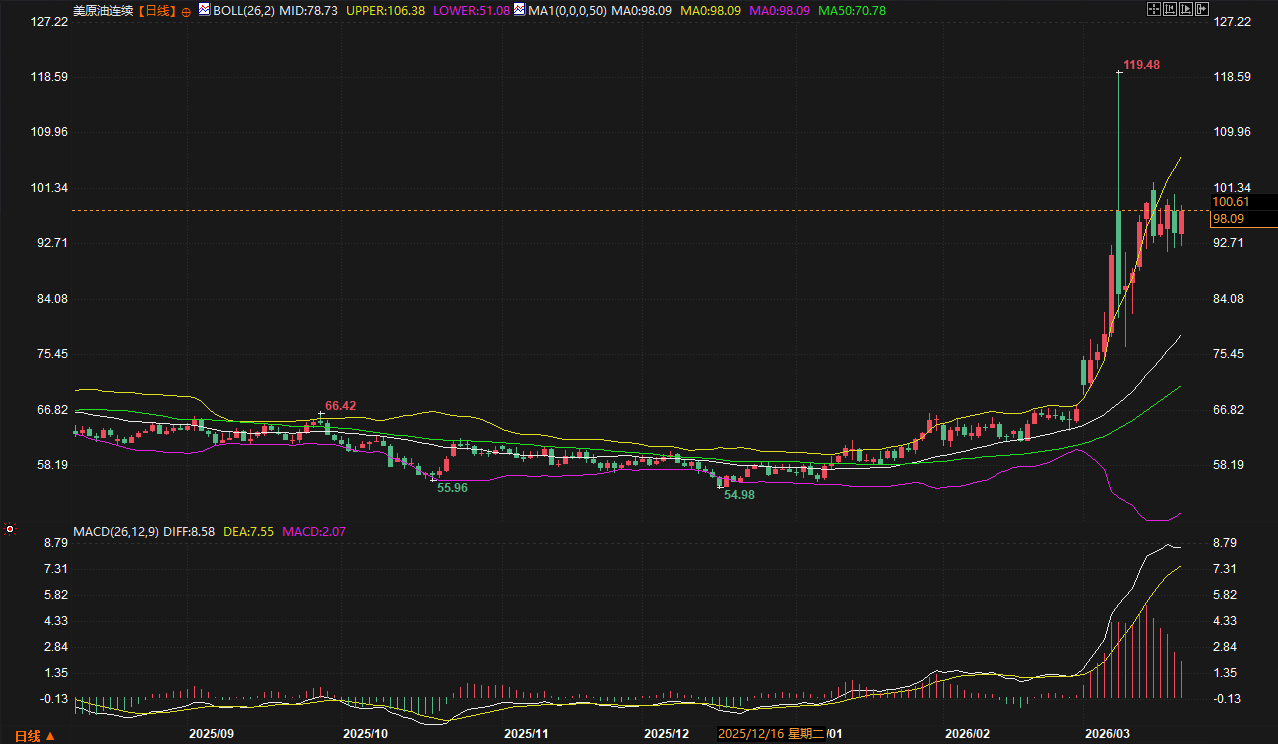
After a gap-up opening earlier this week, international oil prices remained range-bound at high levels. Brent crude oil performed particularly strongly, closing at $113.02 per barrel, reaching a high of $114.5 during the week, successfully stabilizing above the $110 mark. WTI crude oil traded within a wide range of $95-$102 during the week, closing at $98.09. Its price spread with Brent crude widened to its deepest level in 11 years, reflecting the extreme supply risks in non-US regions.
From a technical perspective, the moving average system shows a typical bullish alignment, but the MACD indicator histogram is shortening, indicating that the release of high-level momentum is coming to an end. The Bollinger Bands are in a state of extreme expansion, with the price running close to the upper band, suggesting that short-term volatility will remain high.
Diplomatic efforts in the Strait of Hormuz: According to Japanese media reports on Saturday, Iranian Foreign Minister Abdolrahyan stated that Tehran is ready to allow ships with ties to Japan to pass through the Strait of Hormuz. This statement comes four weeks after the strait was effectively closed due to the conflict between the US, Israel, and Iran. Currently, Japan relies on this shipping route for approximately 90% of its crude oil imports, and high oil prices have forced many countries to draw on their strategic oil reserves.
A US policy update: On April 20, the US Treasury Department's Office of Foreign Assets Control (OFAC) issued a general permit allowing Iranian oil already loaded onto ships that day to be delivered by April 19. US Treasury Secretary Bessenter stated that this move aimed to release approximately 140 million barrels of "en route" crude oil. However, the Iranian Oil Ministry quickly retaliated, denying the existence of a large amount of stranded crude oil and accusing the US of using false expectations to suppress oil prices.
Supply disruptions escalate: Iraq officially declared force majeure this week on all oil fields developed by foreign oil companies. With infrastructure damaged in the conflict, coupled with the deployment of thousands more US Marines to the Middle East, market expectations for a "short-term solution to the conflict" have been completely shattered.
Again Capital: The market is facing a "worst-case scenario." The force majeure declaration over Iraqi oil fields, coupled with the massive troop buildup in the Persian Gulf, means that the return of supplies via the Strait of Hormuz is a long way off.
Saxo Bank: The likelihood of a rapid decline in energy prices in the short term is extremely low. Given the substantial damage to production facilities, even with easing geopolitical tensions, the restoration of physical supply will take weeks or even months.
Market consensus: Most analysts believe that Trump's continued military pressure on Iran and his urging of allies to send warships have further exacerbated uncertainty in shipping lanes. The market has already fully priced in geopolitical premiums, and without further substantial production cuts, oil prices may enter a consolidation phase at current high levels.
In summary, the pricing power in the crude oil market this week was entirely driven by geopolitical tensions. Whether Iran's "olive branch" to Japan can translate into a substantial resumption of shipping routes remains constrained by the complex legal and military environment. The US's release of oil already en route has been interpreted by the market as a "drop in the bucket," insufficient to offset the supply gap caused by disruptions in Iraq and neighboring oil-producing countries. From an operational perspective, oil prices have entered a technically overbought zone, and short-term caution is warranted against a pullback due to fluctuations in risk aversion. In the long term, the reshaping of the energy supply chain will be the main theme of the financial markets in the first half of 2026, and the duration of the Strait of Hormuz's closure will directly determine the upper limit of global inflation.
Does Iran's statement that it is willing to allow Japanese ships to pass mean that the blockade of the Strait of Hormuz is being eased?
This statement leans more towards a "divide and conquer" strategy within geopolitical maneuvering. Iran is leveraging Japan's heavy dependence on energy to alleviate international pressure through targeted passage, effectively demanding that Japan play a mediating role in its alleged "illegal intrusion." However, given the current US military buildup in the Persian Gulf and the limitations imposed by Japanese law on overseas military operations, this "one-way passage" faces extremely high security verification risks in practice.
What impact will the U.S. Treasury Department's "authorization to sell 140 million barrels of crude oil" have on the market supply and demand balance?
The market reacted coldly, primarily due to doubts about the data's authenticity. Iran's direct denial revealed a significant information gap between the two sides regarding the scale of the "floating storage." Even if this crude oil exists, it represents only a one-time stockpile already "loaded," not an increase in volume. Given the incomplete opening of the Strait of Hormuz and continued damage to production, this short-term authorization seems more like a political statement from Washington in response to soaring domestic gasoline and diesel prices, unlikely to fundamentally reverse the supply-demand gap.
What fundamental change has Iraq's declaration of "force majeure" brought to the logic of crude oil pricing?
This signifies a shift in supply risk from "anticipation" to "substantial impairment." Force majeure typically implies exemption from contractual obligations, reflecting physical damage to oilfield infrastructure or export pipelines or their exposure to extreme military threats. This changes the previous market logic of pricing only in shipping route risks; now, the long-term premium for production cuts must be factored in. This is the primary reason why the Brent crude premium over WTI crude has continued to widen.
Given the current high-level consolidation pattern, does the bearish divergence signal presented by the technical indicators suggest that prices are about to reverse?
The current bearish divergence primarily reflects diminishing bullish momentum rather than a trend reversal. In extreme geopolitical environments, technical indicators often become less effective. As long as the Strait of Hormuz remains open, the bottom support for oil prices is very strong. The current high-level consolidation is more like the bulls digesting profits from the previous surge; unless there is a large-scale ceasefire or an unexpected increase in production from oil-producing countries, the potential for a deep correction is limited.
Detailed Review of the Crude Oil Market
1. Weekly Market Review
After a gap-up opening earlier this week, international oil prices remained range-bound at high levels. Brent crude oil performed particularly strongly, closing at $113.02 per barrel, reaching a high of $114.5 during the week, successfully stabilizing above the $110 mark. WTI crude oil traded within a wide range of $95-$102 during the week, closing at $98.09. Its price spread with Brent crude widened to its deepest level in 11 years, reflecting the extreme supply risks in non-US regions.
From a technical perspective, the moving average system shows a typical bullish alignment, but the MACD indicator histogram is shortening, indicating that the release of high-level momentum is coming to an end. The Bollinger Bands are in a state of extreme expansion, with the price running close to the upper band, suggesting that short-term volatility will remain high.
2. Summary of Economic Data and Geopolitical Events
Diplomatic efforts in the Strait of Hormuz: According to Japanese media reports on Saturday, Iranian Foreign Minister Abdolrahyan stated that Tehran is ready to allow ships with ties to Japan to pass through the Strait of Hormuz. This statement comes four weeks after the strait was effectively closed due to the conflict between the US, Israel, and Iran. Currently, Japan relies on this shipping route for approximately 90% of its crude oil imports, and high oil prices have forced many countries to draw on their strategic oil reserves.
A US policy update: On April 20, the US Treasury Department's Office of Foreign Assets Control (OFAC) issued a general permit allowing Iranian oil already loaded onto ships that day to be delivered by April 19. US Treasury Secretary Bessenter stated that this move aimed to release approximately 140 million barrels of "en route" crude oil. However, the Iranian Oil Ministry quickly retaliated, denying the existence of a large amount of stranded crude oil and accusing the US of using false expectations to suppress oil prices.
Supply disruptions escalate: Iraq officially declared force majeure this week on all oil fields developed by foreign oil companies. With infrastructure damaged in the conflict, coupled with the deployment of thousands more US Marines to the Middle East, market expectations for a "short-term solution to the conflict" have been completely shattered.
3. Summary of Analyst and Institutional Views
Again Capital: The market is facing a "worst-case scenario." The force majeure declaration over Iraqi oil fields, coupled with the massive troop buildup in the Persian Gulf, means that the return of supplies via the Strait of Hormuz is a long way off.
Saxo Bank: The likelihood of a rapid decline in energy prices in the short term is extremely low. Given the substantial damage to production facilities, even with easing geopolitical tensions, the restoration of physical supply will take weeks or even months.
Market consensus: Most analysts believe that Trump's continued military pressure on Iran and his urging of allies to send warships have further exacerbated uncertainty in shipping lanes. The market has already fully priced in geopolitical premiums, and without further substantial production cuts, oil prices may enter a consolidation phase at current high levels.
In summary, the pricing power in the crude oil market this week was entirely driven by geopolitical tensions. Whether Iran's "olive branch" to Japan can translate into a substantial resumption of shipping routes remains constrained by the complex legal and military environment. The US's release of oil already en route has been interpreted by the market as a "drop in the bucket," insufficient to offset the supply gap caused by disruptions in Iraq and neighboring oil-producing countries. From an operational perspective, oil prices have entered a technically overbought zone, and short-term caution is warranted against a pullback due to fluctuations in risk aversion. In the long term, the reshaping of the energy supply chain will be the main theme of the financial markets in the first half of 2026, and the duration of the Strait of Hormuz's closure will directly determine the upper limit of global inflation.
QA module
Does Iran's statement that it is willing to allow Japanese ships to pass mean that the blockade of the Strait of Hormuz is being eased?
This statement leans more towards a "divide and conquer" strategy within geopolitical maneuvering. Iran is leveraging Japan's heavy dependence on energy to alleviate international pressure through targeted passage, effectively demanding that Japan play a mediating role in its alleged "illegal intrusion." However, given the current US military buildup in the Persian Gulf and the limitations imposed by Japanese law on overseas military operations, this "one-way passage" faces extremely high security verification risks in practice.
What impact will the U.S. Treasury Department's "authorization to sell 140 million barrels of crude oil" have on the market supply and demand balance?
The market reacted coldly, primarily due to doubts about the data's authenticity. Iran's direct denial revealed a significant information gap between the two sides regarding the scale of the "floating storage." Even if this crude oil exists, it represents only a one-time stockpile already "loaded," not an increase in volume. Given the incomplete opening of the Strait of Hormuz and continued damage to production, this short-term authorization seems more like a political statement from Washington in response to soaring domestic gasoline and diesel prices, unlikely to fundamentally reverse the supply-demand gap.
What fundamental change has Iraq's declaration of "force majeure" brought to the logic of crude oil pricing?
This signifies a shift in supply risk from "anticipation" to "substantial impairment." Force majeure typically implies exemption from contractual obligations, reflecting physical damage to oilfield infrastructure or export pipelines or their exposure to extreme military threats. This changes the previous market logic of pricing only in shipping route risks; now, the long-term premium for production cuts must be factored in. This is the primary reason why the Brent crude premium over WTI crude has continued to widen.
Given the current high-level consolidation pattern, does the bearish divergence signal presented by the technical indicators suggest that prices are about to reverse?
The current bearish divergence primarily reflects diminishing bullish momentum rather than a trend reversal. In extreme geopolitical environments, technical indicators often become less effective. As long as the Strait of Hormuz remains open, the bottom support for oil prices is very strong. The current high-level consolidation is more like the bulls digesting profits from the previous surge; unless there is a large-scale ceasefire or an unexpected increase in production from oil-producing countries, the potential for a deep correction is limited.
- Risk Warning and Disclaimer
- The market involves risk, and trading may not be suitable for all investors. This article is for reference only and does not constitute personal investment advice, nor does it take into account certain users’ specific investment objectives, financial situation, or other needs. Any investment decisions made based on this information are at your own risk.