If the International Energy Agency releases more strategic petroleum reserves if necessary, can oil prices still rise?
2026-03-23 11:08:08
According to APP, International Energy Agency (IEA) Executive Director Fatih Birol said on Monday that, given the impact of the conflict in Iran , the agency is consulting with governments in Asia and Europe on whether to release more oil reserves, depending on the circumstances. Birol said, "We will certainly do so if necessary. We will examine various situations, conduct analyses, assess market conditions, and discuss with member countries."
On March 11, member countries of the International Energy Agency reached an agreement to release a record 400 million barrels of oil from strategic reserves to curb soaring global crude oil prices. Birol added that no specific crude oil price level would be set as a trigger for future releases. He described the Middle East crisis as "extremely serious," even surpassing the combined impact of the two oil crises of the 1970s and the conflict between Russia and Ukraine on natural gas. "The most crucial solution to this problem is to open the Strait of Hormuz ," he emphasized.
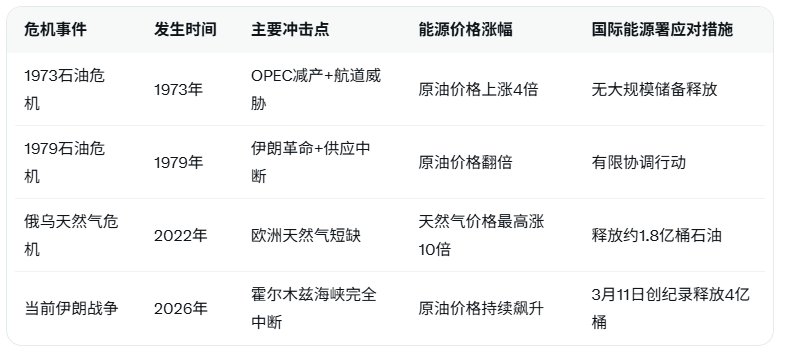
The core of this crisis lies in the de facto blockade of the Strait of Hormuz, a vital chokepoint for global oil trade. Approximately 20% of global crude oil shipments have been disrupted, directly leading to a structural supply shortage far exceeding any single historical event. While the crises of the 1970s primarily stemmed from OPEC production cuts, and the Russia-Ukraine conflict mainly impacted European natural gas, this current conflict, coupled with facility attacks and shipping lane closures, has resulted in record-breaking speed and breadth of energy price transmission. The International Energy Agency's release of 400 million barrels has already surpassed the 2022 record, aiming to rapidly inject liquidity into the market and prevent an uncontrolled surge in oil prices.
Comparison of the severity of historical energy crises
This release mechanism offers significantly greater flexibility: it is no longer anchored to a fixed price threshold, but rather based on real-time market analysis and consensus among member countries, reflecting the International Energy Agency's upgraded strategy in addressing complex geopolitical risks. In the short term, the additional reserve injection is expected to narrow the oil price fluctuation range by 10-15%, alleviating cost pressures on downstream refining, transportation, and manufacturing sectors.
As one of the world's largest crude oil importers, this major Asian nation relies on Middle Eastern shipping routes for more than half of its imports. If the strait remains closed, import costs will rise significantly, impacting industrial electricity prices, logistics costs, and consumer goods prices. Releasing strategic reserves can provide a buffer, alleviate inflationary pressures, and buy time for domestic energy transition.
Editor's Summary : Objectively speaking, the Iranian conflict has pushed global energy security to a historical tipping point. The International Energy Agency demonstrated its coordinated response capabilities through record-breaking reserve releases, but a fundamental solution still depends on the reopening of the Strait of Hormuz. Future market stability will depend on the pace of conflict de-escalation and the rhythm of reserve releases. Major importing economies, such as large Asian nations, need to simultaneously strengthen diversified procurement and domestic production capacity building to enhance long-term resilience.
On March 11, member countries of the International Energy Agency reached an agreement to release a record 400 million barrels of oil from strategic reserves to curb soaring global crude oil prices. Birol added that no specific crude oil price level would be set as a trigger for future releases. He described the Middle East crisis as "extremely serious," even surpassing the combined impact of the two oil crises of the 1970s and the conflict between Russia and Ukraine on natural gas. "The most crucial solution to this problem is to open the Strait of Hormuz ," he emphasized.
The core of this crisis lies in the de facto blockade of the Strait of Hormuz, a vital chokepoint for global oil trade. Approximately 20% of global crude oil shipments have been disrupted, directly leading to a structural supply shortage far exceeding any single historical event. While the crises of the 1970s primarily stemmed from OPEC production cuts, and the Russia-Ukraine conflict mainly impacted European natural gas, this current conflict, coupled with facility attacks and shipping lane closures, has resulted in record-breaking speed and breadth of energy price transmission. The International Energy Agency's release of 400 million barrels has already surpassed the 2022 record, aiming to rapidly inject liquidity into the market and prevent an uncontrolled surge in oil prices.
Comparison of the severity of historical energy crises
This release mechanism offers significantly greater flexibility: it is no longer anchored to a fixed price threshold, but rather based on real-time market analysis and consensus among member countries, reflecting the International Energy Agency's upgraded strategy in addressing complex geopolitical risks. In the short term, the additional reserve injection is expected to narrow the oil price fluctuation range by 10-15%, alleviating cost pressures on downstream refining, transportation, and manufacturing sectors.
As one of the world's largest crude oil importers, this major Asian nation relies on Middle Eastern shipping routes for more than half of its imports. If the strait remains closed, import costs will rise significantly, impacting industrial electricity prices, logistics costs, and consumer goods prices. Releasing strategic reserves can provide a buffer, alleviate inflationary pressures, and buy time for domestic energy transition.
Editor's Summary : Objectively speaking, the Iranian conflict has pushed global energy security to a historical tipping point. The International Energy Agency demonstrated its coordinated response capabilities through record-breaking reserve releases, but a fundamental solution still depends on the reopening of the Strait of Hormuz. Future market stability will depend on the pace of conflict de-escalation and the rhythm of reserve releases. Major importing economies, such as large Asian nations, need to simultaneously strengthen diversified procurement and domestic production capacity building to enhance long-term resilience.
- Risk Warning and Disclaimer
- The market involves risk, and trading may not be suitable for all investors. This article is for reference only and does not constitute personal investment advice, nor does it take into account certain users’ specific investment objectives, financial situation, or other needs. Any investment decisions made based on this information are at your own risk.