From Tokyo to Seoul, from crude oil to US Treasury bonds! Escalating US-Iran conflict triggers a chain reaction of asset price crashes globally.
2026-03-23 14:24:42
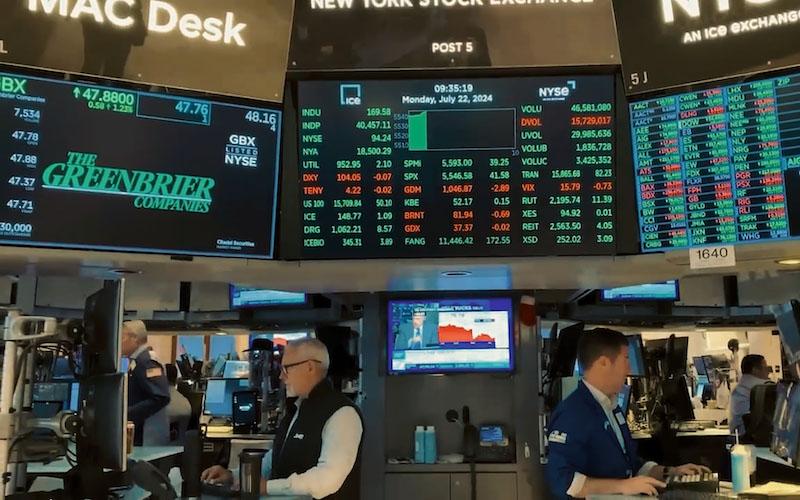
The conflict between the US, Israel, and Iran entered its fourth week, with escalating trade threats leading to a sharp sell-off of risk assets in Asian markets on Monday (March 23). Japan's Nikkei 225 index fell nearly 5% at one point; the Topix index dropped as much as 4.4%. South Korea's Kospi index plummeted over 6%, the Kosdaq small-cap index fell nearly 5%, and Kospi 200 futures briefly fell over 5%, triggering a trading halt. Australia's S&P/ASX 200 fell 2.4%, and Hong Kong's Hang Seng Index and mainland China's CSI 300 opened nearly 2% lower. The collective plunge in Asian stock markets reflects investors' extreme panic about the spillover effects of the Middle East energy crisis, with Japan and South Korea, heavily reliant on energy imports, suffering the most severe losses.
Trump issued a 48-hour ultimatum Saturday night, demanding that Iran unconditionally reopen the Strait of Hormuz, or he would destroy Iran's power grid. The ultimatum expired Monday night Washington time.
Iranian Parliament Speaker Qalibaf responded that if the US and Israel attack Iranian power plants, Iran will immediately retaliate against Gulf energy and water supply facilities, causing "irreversible" damage and leading to a "long-term rise" in oil prices.
Last Sunday, Kalibaf further warned that financial institutions holding U.S. Treasury bonds would become legitimate targets, treated the same as military bases, stating that "U.S. Treasury bonds are stained with the blood of Iranians." This escalation of financial warfare has greatly exacerbated market uncertainty, prompting investors to accelerate their withdrawal from risky assets .
US crude oil prices fluctuated wildly in early Asian trading on Monday, rising and then falling back. It jumped 3% to $101.50 per barrel at the start of the session, a new high since March 16, before quickly falling back to around $96.75 per barrel. During the Asian and European sessions, it fluctuated upwards and is currently trading around $100.09 per barrel, with a daily increase of about 1.88%.
The closure of most shipping routes in the Strait of Hormuz and the continued threat of mutual destruction of energy infrastructure have pushed up safe-haven premiums, with oil price rebounds reflecting renewed market concerns about supply disruptions. Although the potential success of Trump's ultimatum has provided some downward pressure, geopolitical risks have limited downside potential for oil prices.
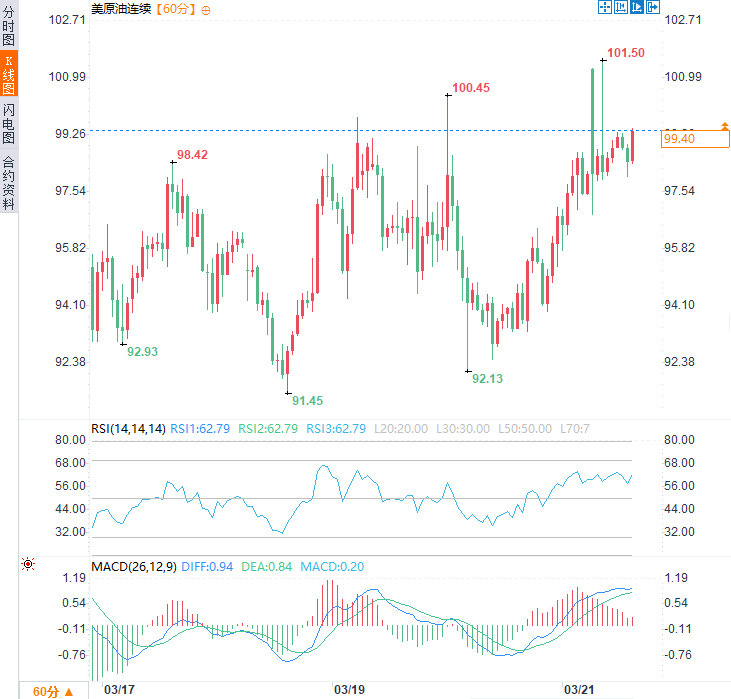
(US crude oil hourly chart, source: FX678)
Goldman Sachs has significantly raised its oil price forecast: Brent crude will average $110 in March and April (up from $98 previously), while WTI crude will average $98 in March and $105 in April. Goldman Sachs assumes that traffic in the Strait of Hormuz will remain at only 5% of normal levels for an extended period, gradually recovering over a month after six weeks.
Analysts believe prices will continue to rise during this period until investors are convinced that a prolonged disruption can be ruled out. The forecast highlights market concerns about a prolonged Straits crisis, and structurally high oil prices have become the mainstream expectation.
The spread between Brent and WTI crude oil prices has exceeded $14, marking its widest point in many years. Chris Verrone, chief market strategist at Strategas Research, said this spread may signal "the peak intensity of this oil crisis," and the high Brent price will prompt traders to price in a more persistent conflict.
The widening price gap reflects that supply disruptions in the Middle East have a far greater impact on international benchmarks than those in the United States, while import costs in Asia and Europe are higher, resulting in more significant imported inflationary pressures.
The conflict between Iran and the US has entered its fourth week, with both sides exchanging harsh words that have escalated into the financial sector. The Iranian parliament speaker has listed US debt holders as targets for attack, and the market is extremely tense after Trump's 48-hour ultimatum expired.
Asian stock markets were hit hard on Monday, with the Nikkei and KOSPI indices plunging more than 5% and South Korea temporarily halting trading, reflecting Asia's high dependence on energy imports and its sensitivity to the Middle East crisis.
Goldman Sachs raised its oil price forecast assuming a long-term flow rate of only 5% in the Hormuz region, and the Brent-WTI oil price spread widened to its widest in many years. Geopolitical risk premiums dominate the market, and Asian economic growth, inflation expectations, and monetary policy space all face severe challenges. If there is no diplomatic breakthrough in the conflict, persistently high oil prices and stock market volatility may become the "new normal."
At 14:24 Beijing time, US crude oil futures were trading at $100.12 per barrel.
Trump's 48-hour ultimatum is about to expire, and Iran has threatened to strike US debt holders.
Trump issued a 48-hour ultimatum Saturday night, demanding that Iran unconditionally reopen the Strait of Hormuz, or he would destroy Iran's power grid. The ultimatum expired Monday night Washington time.
Iranian Parliament Speaker Qalibaf responded that if the US and Israel attack Iranian power plants, Iran will immediately retaliate against Gulf energy and water supply facilities, causing "irreversible" damage and leading to a "long-term rise" in oil prices.
Last Sunday, Kalibaf further warned that financial institutions holding U.S. Treasury bonds would become legitimate targets, treated the same as military bases, stating that "U.S. Treasury bonds are stained with the blood of Iranians." This escalation of financial warfare has greatly exacerbated market uncertainty, prompting investors to accelerate their withdrawal from risky assets .
Oil prices remain volatile at high levels.
US crude oil prices fluctuated wildly in early Asian trading on Monday, rising and then falling back. It jumped 3% to $101.50 per barrel at the start of the session, a new high since March 16, before quickly falling back to around $96.75 per barrel. During the Asian and European sessions, it fluctuated upwards and is currently trading around $100.09 per barrel, with a daily increase of about 1.88%.
The closure of most shipping routes in the Strait of Hormuz and the continued threat of mutual destruction of energy infrastructure have pushed up safe-haven premiums, with oil price rebounds reflecting renewed market concerns about supply disruptions. Although the potential success of Trump's ultimatum has provided some downward pressure, geopolitical risks have limited downside potential for oil prices.
(US crude oil hourly chart, source: FX678)
Goldman Sachs significantly raised its oil price forecast, assuming that the Hormuz flow rate will remain at only 5% in the long term.
Goldman Sachs has significantly raised its oil price forecast: Brent crude will average $110 in March and April (up from $98 previously), while WTI crude will average $98 in March and $105 in April. Goldman Sachs assumes that traffic in the Strait of Hormuz will remain at only 5% of normal levels for an extended period, gradually recovering over a month after six weeks.
Analysts believe prices will continue to rise during this period until investors are convinced that a prolonged disruption can be ruled out. The forecast highlights market concerns about a prolonged Straits crisis, and structurally high oil prices have become the mainstream expectation.
The Brent-WTI crude oil price spread exceeded $14, setting a multi-year record.
The spread between Brent and WTI crude oil prices has exceeded $14, marking its widest point in many years. Chris Verrone, chief market strategist at Strategas Research, said this spread may signal "the peak intensity of this oil crisis," and the high Brent price will prompt traders to price in a more persistent conflict.
The widening price gap reflects that supply disruptions in the Middle East have a far greater impact on international benchmarks than those in the United States, while import costs in Asia and Europe are higher, resulting in more significant imported inflationary pressures.
Editor's Summary
The conflict between Iran and the US has entered its fourth week, with both sides exchanging harsh words that have escalated into the financial sector. The Iranian parliament speaker has listed US debt holders as targets for attack, and the market is extremely tense after Trump's 48-hour ultimatum expired.
Asian stock markets were hit hard on Monday, with the Nikkei and KOSPI indices plunging more than 5% and South Korea temporarily halting trading, reflecting Asia's high dependence on energy imports and its sensitivity to the Middle East crisis.
Goldman Sachs raised its oil price forecast assuming a long-term flow rate of only 5% in the Hormuz region, and the Brent-WTI oil price spread widened to its widest in many years. Geopolitical risk premiums dominate the market, and Asian economic growth, inflation expectations, and monetary policy space all face severe challenges. If there is no diplomatic breakthrough in the conflict, persistently high oil prices and stock market volatility may become the "new normal."
At 14:24 Beijing time, US crude oil futures were trading at $100.12 per barrel.
- Risk Warning and Disclaimer
- The market involves risk, and trading may not be suitable for all investors. This article is for reference only and does not constitute personal investment advice, nor does it take into account certain users’ specific investment objectives, financial situation, or other needs. Any investment decisions made based on this information are at your own risk.