Soaring inflation risks pressured gold prices, erasing year-to-date gains; is the decline just beginning?
2026-03-23 14:20:16
According to APP, spot gold touched $4,270.30 per ounce on Monday—a price below the closing price of the range, completely erasing all gains for the year. Meanwhile, the conflict with Iran in the Middle East has continued for four weeks, with the US and Iran again threatening each other with new attacks. Since the conflict began, rising oil prices have significantly increased inflation risks and drastically reduced the likelihood of the Federal Reserve and other central banks cutting interest rates in the near term. This is a direct negative for gold , which has fallen for eight consecutive trading days and just recorded its largest weekly drop since 1983.

While geopolitical conflicts typically boost safe-haven demand, this crisis has shifted the focus of market speculation by transmitting the crisis through energy prices to inflation expectations. The continued rise in crude oil futures has directly increased global production costs, forcing central banks to maintain higher interest rates for longer periods. As a non-yielding asset, gold's opportunity cost of holding it has increased dramatically, leading investors to accelerate profit-taking. Technically, prices have broken below several key moving averages, and increased trading volume indicates a concentrated release of selling pressure.
Capital.com analyst Kyle Rhoda recently stated that gold is poised for a short-term rebound due to technical reasons, largely depending on whether Trump delivers on his threat to strike Iranian power plants. If Trump's ultimatum fails to translate into concrete action within 48 hours, risk aversion could quickly recover; conversely, escalating conflict will further suppress gold prices.
Comparison of recent gold performance and driving factors
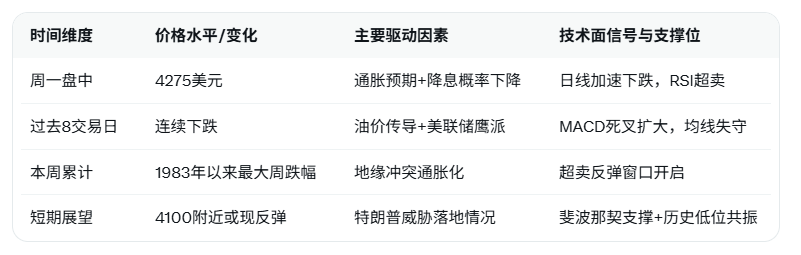
This adjustment further confirms the temporary vulnerability of gold in a stagflationary environment. If tensions in the Strait of Hormuz persist, energy costs will continue to push up inflation, central bank tightening will be prolonged, and gold prices may remain weak and volatile in the short term. However, once there are signs of easing tensions, a rapid technical correction following the accelerated decline on the daily chart will begin.
Editor's Summary : Objectively speaking, energy inflation triggered by the Iranian conflict has transcended traditional safe-haven logic, becoming the core force suppressing gold prices. Although prices plummeted to $4275, marking the largest weekly drop since 1983, the technical picture is severely oversold, with support around $4100 providing a clear window for a rebound. Global investors need to balance geopolitical risks and monetary policy expectations, flexibly adjusting their positions in conjunction with technical indicators.
While geopolitical conflicts typically boost safe-haven demand, this crisis has shifted the focus of market speculation by transmitting the crisis through energy prices to inflation expectations. The continued rise in crude oil futures has directly increased global production costs, forcing central banks to maintain higher interest rates for longer periods. As a non-yielding asset, gold's opportunity cost of holding it has increased dramatically, leading investors to accelerate profit-taking. Technically, prices have broken below several key moving averages, and increased trading volume indicates a concentrated release of selling pressure.
Capital.com analyst Kyle Rhoda recently stated that gold is poised for a short-term rebound due to technical reasons, largely depending on whether Trump delivers on his threat to strike Iranian power plants. If Trump's ultimatum fails to translate into concrete action within 48 hours, risk aversion could quickly recover; conversely, escalating conflict will further suppress gold prices.
Comparison of recent gold performance and driving factors
This adjustment further confirms the temporary vulnerability of gold in a stagflationary environment. If tensions in the Strait of Hormuz persist, energy costs will continue to push up inflation, central bank tightening will be prolonged, and gold prices may remain weak and volatile in the short term. However, once there are signs of easing tensions, a rapid technical correction following the accelerated decline on the daily chart will begin.
Editor's Summary : Objectively speaking, energy inflation triggered by the Iranian conflict has transcended traditional safe-haven logic, becoming the core force suppressing gold prices. Although prices plummeted to $4275, marking the largest weekly drop since 1983, the technical picture is severely oversold, with support around $4100 providing a clear window for a rebound. Global investors need to balance geopolitical risks and monetary policy expectations, flexibly adjusting their positions in conjunction with technical indicators.
- Risk Warning and Disclaimer
- The market involves risk, and trading may not be suitable for all investors. This article is for reference only and does not constitute personal investment advice, nor does it take into account certain users’ specific investment objectives, financial situation, or other needs. Any investment decisions made based on this information are at your own risk.