Finance and military intertwined? The US-Iran conflict escalates from mutual energy destruction to impacting the global financial system.
2026-03-23 14:17:53
Iranian Parliament Speaker Mohammad Bagher Ghalibaf warned on social media last Sunday (March 22) that financial institutions holding U.S. Treasury bonds would become legitimate targets, treated the same as military bases. He stated, "U.S. Treasury bonds are stained with the blood of Iranians," and that buying U.S. Treasury bonds is tantamount to "buying a blow to headquarters and assets."
This warning includes the financial sector in the scope of Iranian retaliation, effectively binding the economic and military spheres together. It aims to maximize the cost of pressuring the US, deter global investors and financial institutions, and further isolate the US financial system.
Energy tensions persisted in the market, and international oil prices fluctuated higher during the Asian and European sessions on Monday (March 23). Currently, it is trading at $99.75 per barrel, up about 1.5%. At the beginning of the session, it jumped 3% to $101.50 per barrel, a new high since March 16, before quickly falling back to $96.75 per barrel.
On Saturday night, Trump issued a bombshell ultimatum demanding that Iran reopen the Strait of Hormuz unconditionally and without threat within 48 hours, or the United States would destroy Iran's power grid, starting with the 2,868-megawatt Damavand power plant near Tehran. The ultimatum expired Monday night Washington time.
Israeli Prime Minister Benjamin Netanyahu publicly expressed his support: "We will act together and keep it as secret as possible." Iran responded that if the US and Israel attack Iranian power plants, it will immediately retaliate against Gulf energy and water infrastructure, causing "irreversible" damage and leading to a "long-term rise" in oil prices.
With the ultimatum expiring, the market is paying close attention to whether the US will deliver on its threats and the potential intensity of Iranian retaliation.
Last weekend, Iranian missiles struck Arad and other cities in southern Israel, triggering air raid sirens in multiple locations. Strong missile activity was reported in Jerusalem and central Israel, with at least eight sites hit by missile fragments or explosives.
As the conflict enters its fourth week, the Israeli military announced on Monday a large-scale strike on infrastructure in Tehran, the Iranian capital, with explosions heard in multiple locations earlier in the day. Iran continues to launch missiles and drones at Israel and Gulf states, extending the conflict far beyond its borders.
Kuwait and the United Arab Emirates confirmed on Monday that they intercepted an Iranian missile and drone attack, while air raid sirens sounded in Bahrain. The Saudi Ministry of Defense reported detecting two ballistic missiles in the direction of Riyadh; one was intercepted, and the other landed in an uninhabited area.
Iran has targeted US military assets and energy facilities in the Gulf states for retaliation, and the region's air defense system has been frequently activated, leading to a comprehensive escalation of tensions.
Crude oil prices continued to fluctuate at high levels on Monday, with concerns about supply arising from Iran's closure of most shipping routes through the Strait of Hormuz and the threat of mutual destruction of energy infrastructure.
However, the market is also weighing the potential success of Trump's ultimatum, with the conflict continuing for the fourth week and the global energy market in an extremely fragile state.
The US-Iran conflict has entered its fourth week. The Iranian parliament speaker has included financial institutions that purchase US Treasury bonds in his list of targets. After Trump's 48-hour ultimatum expired, both sides exchanged harsh words, escalating the energy conflict to a full-blown level. Israel and Gulf states have been frequently attacked by missiles, and most shipping through the Strait of Hormuz has been shut down, jeopardizing one-fifth of the world's oil transport lifeline. Oil prices are fluctuating at high levels, with geopolitical risk premiums once again dominating the market.
Iran's dual-track retaliatory strategy of "financial and military" counters the US and Israel's "energy infrastructure strikes," escalating the conflict from a regional war into a global energy and financial security crisis. In the short term, the window for diplomatic mediation is extremely narrow, oil prices and inflation expectations are both under pressure, and global economic growth faces a new round of "oil shock" threats. Investors need to be highly vigilant about the systemic risks that could be triggered by the large-scale destruction of energy facilities in extreme scenarios.
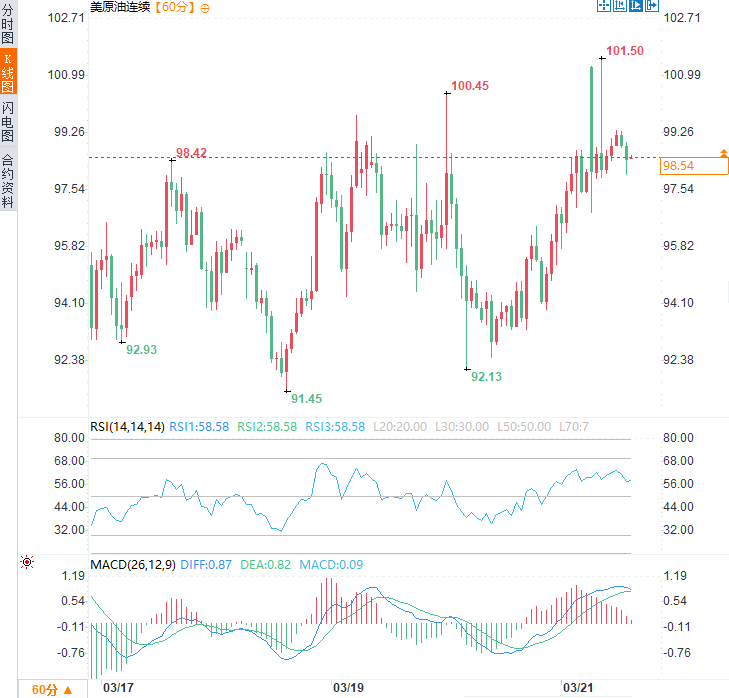
(US crude oil hourly chart, source: FX678)
At 14:17 Beijing time, US crude oil futures were trading at $99.84 per barrel.
This warning includes the financial sector in the scope of Iranian retaliation, effectively binding the economic and military spheres together. It aims to maximize the cost of pressuring the US, deter global investors and financial institutions, and further isolate the US financial system.
Energy tensions persisted in the market, and international oil prices fluctuated higher during the Asian and European sessions on Monday (March 23). Currently, it is trading at $99.75 per barrel, up about 1.5%. At the beginning of the session, it jumped 3% to $101.50 per barrel, a new high since March 16, before quickly falling back to $96.75 per barrel.
Trump's 48-hour ultimatum is about to end.
On Saturday night, Trump issued a bombshell ultimatum demanding that Iran reopen the Strait of Hormuz unconditionally and without threat within 48 hours, or the United States would destroy Iran's power grid, starting with the 2,868-megawatt Damavand power plant near Tehran. The ultimatum expired Monday night Washington time.
Israeli Prime Minister Benjamin Netanyahu publicly expressed his support: "We will act together and keep it as secret as possible." Iran responded that if the US and Israel attack Iranian power plants, it will immediately retaliate against Gulf energy and water infrastructure, causing "irreversible" damage and leading to a "long-term rise" in oil prices.
With the ultimatum expiring, the market is paying close attention to whether the US will deliver on its threats and the potential intensity of Iranian retaliation.
Israel attacked by Iranian missiles, sirens sounded in multiple locations.
Last weekend, Iranian missiles struck Arad and other cities in southern Israel, triggering air raid sirens in multiple locations. Strong missile activity was reported in Jerusalem and central Israel, with at least eight sites hit by missile fragments or explosives.
As the conflict enters its fourth week, the Israeli military announced on Monday a large-scale strike on infrastructure in Tehran, the Iranian capital, with explosions heard in multiple locations earlier in the day. Iran continues to launch missiles and drones at Israel and Gulf states, extending the conflict far beyond its borders.
Kuwait, UAE, and Bahrain intercept Iranian missiles and drones
Kuwait and the United Arab Emirates confirmed on Monday that they intercepted an Iranian missile and drone attack, while air raid sirens sounded in Bahrain. The Saudi Ministry of Defense reported detecting two ballistic missiles in the direction of Riyadh; one was intercepted, and the other landed in an uninhabited area.
Iran has targeted US military assets and energy facilities in the Gulf states for retaliation, and the region's air defense system has been frequently activated, leading to a comprehensive escalation of tensions.
Oil prices fluctuated at high levels
Crude oil prices continued to fluctuate at high levels on Monday, with concerns about supply arising from Iran's closure of most shipping routes through the Strait of Hormuz and the threat of mutual destruction of energy infrastructure.
However, the market is also weighing the potential success of Trump's ultimatum, with the conflict continuing for the fourth week and the global energy market in an extremely fragile state.
Editor's Summary
The US-Iran conflict has entered its fourth week. The Iranian parliament speaker has included financial institutions that purchase US Treasury bonds in his list of targets. After Trump's 48-hour ultimatum expired, both sides exchanged harsh words, escalating the energy conflict to a full-blown level. Israel and Gulf states have been frequently attacked by missiles, and most shipping through the Strait of Hormuz has been shut down, jeopardizing one-fifth of the world's oil transport lifeline. Oil prices are fluctuating at high levels, with geopolitical risk premiums once again dominating the market.
Iran's dual-track retaliatory strategy of "financial and military" counters the US and Israel's "energy infrastructure strikes," escalating the conflict from a regional war into a global energy and financial security crisis. In the short term, the window for diplomatic mediation is extremely narrow, oil prices and inflation expectations are both under pressure, and global economic growth faces a new round of "oil shock" threats. Investors need to be highly vigilant about the systemic risks that could be triggered by the large-scale destruction of energy facilities in extreme scenarios.
(US crude oil hourly chart, source: FX678)
At 14:17 Beijing time, US crude oil futures were trading at $99.84 per barrel.
- Risk Warning and Disclaimer
- The market involves risk, and trading may not be suitable for all investors. This article is for reference only and does not constitute personal investment advice, nor does it take into account certain users’ specific investment objectives, financial situation, or other needs. Any investment decisions made based on this information are at your own risk.