Geopolitics alone is not enough to boost gold prices.
2026-03-23 16:02:06
Geopolitical tensions continue to support gold prices, but recent price movements suggest that geopolitical factors alone are no longer sufficient to drive a sustained rise.
Macroeconomic factors, particularly real yields, the dollar exchange rate, and interest rate expectations, remain key constraints limiting further gains in gold prices.
The demand for safe-haven assets has been overshadowed by higher energy prices, a stronger dollar, and shifts in interest rate expectations.
Despite the escalation of the war with Iran, gold prices have fallen by about 14% since the conflict began, highlighting that macroeconomic factors, particularly interest rates, the US dollar, and cross-asset allocation, continue to dominate short-term price dynamics.
This pattern is consistent with previous shock events: in the early stages, the demand for liquidity often exceeds the demand for safe haven.
The gold market's reaction in 2022 provides a useful reference point. Gold prices initially rose after Russia's invasion of Ukraine, but this rally gradually subsided as the inflationary shocks transmitted to interest rates, the dollar, and investor flows.
More broadly, geopolitical events alone rarely drive gold prices sustainably; the key lies in how these shocks affect inflation, monetary policy, and the US dollar. In the short term, a stronger dollar and gold's high liquidity make it a reliable source of funds during periods of stress.
Escalating geopolitical tensions have driven up energy prices, increased the risk of persistently high inflation, and complicated the path of monetary easing.
A prolonged environment of "higher and longer" interest rates will keep real yields high, posing a headwind for gold. Last week, the Federal Reserve kept interest rates unchanged, with Chairman Powell emphasizing that further easing requires clearer progress on inflation; however, some economists still expect two 25-basis-point rate cuts later this year (September and December).
Nevertheless, the stagflationary backdrop (slower growth accompanied by persistent inflation) will continue to support gold in the medium to long term.
Central banks continue to support gold demand, but the pace of purchases has slowed.
Data from the World Gold Council shows that net purchases in January totaled 5 tonnes, well below the 2025 monthly average of 27 tonnes, reflecting weak momentum at the start of the year. Nevertheless, fund flows still indicate continued structural interest: purchases from Uzbekistan were offset by sales from Russia, while new buyers such as Malaysia and the potential return of South Korean banks suggest that the demand base is gradually expanding.
While official sector demand remains structurally supportive (reflecting the continued trend of reserve management moving away from the dollar), it is unlikely to drive short-term price volatility. Central banks may selectively increase reserve holdings during periods of price weakness, but short-term price movements will still be primarily driven by investment flows.
ETF flows remain a key driver of gold demand. Continued outflows in recent weeks have put pressure on prices, with holdings giving back most of the gains made earlier this year since the start of the Iran nuclear deal. Historically, ETF position changes have been closely correlated with gold prices and expectations regarding US monetary policy.
If the Fed turns to cutting rates later this year, it could trigger a new round of inflows and support prices, while a “higher and longer” interest rate environment could make ETF outflows continue to be a headwind.
Despite the increased short-term risks, we remain constructive on the overall outlook for gold.
Gold is still up about 6% year-to-date, making the market susceptible to profit-taking. However, any deeper pullback could attract buying, especially from central banks and long-term investors.
Ultimately, the direction of gold depends less on mere geopolitical headlines and more on how those events shape inflation, monetary policy expectations, and real interest rates.
Currently, the driving force behind gold prices is still macroeconomic factors, rather than simply geopolitics.
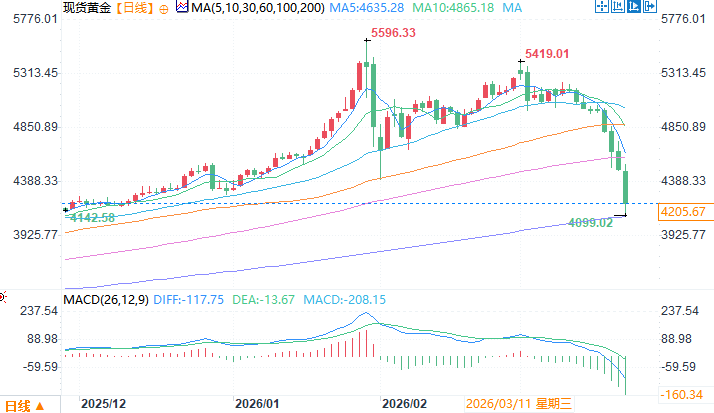
Spot gold daily chart source: EasyForex
At 15:41 Beijing time on March 23, spot gold was trading at $4205.67 per ounce.
Macroeconomic factors, particularly real yields, the dollar exchange rate, and interest rate expectations, remain key constraints limiting further gains in gold prices.
The demand for safe-haven assets has been overshadowed by higher energy prices, a stronger dollar, and shifts in interest rate expectations.
Macro forces overshadow geopolitics
Despite the escalation of the war with Iran, gold prices have fallen by about 14% since the conflict began, highlighting that macroeconomic factors, particularly interest rates, the US dollar, and cross-asset allocation, continue to dominate short-term price dynamics.
This pattern is consistent with previous shock events: in the early stages, the demand for liquidity often exceeds the demand for safe haven.
The gold market's reaction in 2022 provides a useful reference point. Gold prices initially rose after Russia's invasion of Ukraine, but this rally gradually subsided as the inflationary shocks transmitted to interest rates, the dollar, and investor flows.
More broadly, geopolitical events alone rarely drive gold prices sustainably; the key lies in how these shocks affect inflation, monetary policy, and the US dollar. In the short term, a stronger dollar and gold's high liquidity make it a reliable source of funds during periods of stress.
Energy prices complicate the inflation outlook
Escalating geopolitical tensions have driven up energy prices, increased the risk of persistently high inflation, and complicated the path of monetary easing.
A prolonged environment of "higher and longer" interest rates will keep real yields high, posing a headwind for gold. Last week, the Federal Reserve kept interest rates unchanged, with Chairman Powell emphasizing that further easing requires clearer progress on inflation; however, some economists still expect two 25-basis-point rate cuts later this year (September and December).
Nevertheless, the stagflationary backdrop (slower growth accompanied by persistent inflation) will continue to support gold in the medium to long term.
Central bank demand remains supported, but the pace of purchases may slow.
Central banks continue to support gold demand, but the pace of purchases has slowed.
Data from the World Gold Council shows that net purchases in January totaled 5 tonnes, well below the 2025 monthly average of 27 tonnes, reflecting weak momentum at the start of the year. Nevertheless, fund flows still indicate continued structural interest: purchases from Uzbekistan were offset by sales from Russia, while new buyers such as Malaysia and the potential return of South Korean banks suggest that the demand base is gradually expanding.
While official sector demand remains structurally supportive (reflecting the continued trend of reserve management moving away from the dollar), it is unlikely to drive short-term price volatility. Central banks may selectively increase reserve holdings during periods of price weakness, but short-term price movements will still be primarily driven by investment flows.
ETF outflows drag down gold prices
ETF flows remain a key driver of gold demand. Continued outflows in recent weeks have put pressure on prices, with holdings giving back most of the gains made earlier this year since the start of the Iran nuclear deal. Historically, ETF position changes have been closely correlated with gold prices and expectations regarding US monetary policy.
If the Fed turns to cutting rates later this year, it could trigger a new round of inflows and support prices, while a “higher and longer” interest rate environment could make ETF outflows continue to be a headwind.
The outlook remains constructive, but short-term risks have increased.
Despite the increased short-term risks, we remain constructive on the overall outlook for gold.
Gold is still up about 6% year-to-date, making the market susceptible to profit-taking. However, any deeper pullback could attract buying, especially from central banks and long-term investors.
Ultimately, the direction of gold depends less on mere geopolitical headlines and more on how those events shape inflation, monetary policy expectations, and real interest rates.
Currently, the driving force behind gold prices is still macroeconomic factors, rather than simply geopolitics.
Spot gold daily chart source: EasyForex
At 15:41 Beijing time on March 23, spot gold was trading at $4205.67 per ounce.
- Risk Warning and Disclaimer
- The market involves risk, and trading may not be suitable for all investors. This article is for reference only and does not constitute personal investment advice, nor does it take into account certain users’ specific investment objectives, financial situation, or other needs. Any investment decisions made based on this information are at your own risk.