Gold prices plunged 8% in a single day, a repeat of the Middle East gold redemption crisis 43 years ago.
2026-03-23 15:44:22
On Monday (March 23), during the Asian and European trading sessions, spot gold experienced an extreme price movement, briefly surging before plummeting.
After a slight rebound of 0.5% at the open, the market began a continuous decline, with the intraday drop once soaring to 8.27%, pushing market panic selling to its peak.
The United States and Iran exchanged harsh words, with Trump declaring that if Iran does not fully open the Strait of Hormuz within 48 hours, the United States will attack and destroy several of its power plants, starting with the largest one.
Meanwhile, Iran responded strongly. The Central Command of the Iranian Armed Forces, Hatem Anbia, emphasized that, according to previous warnings issued by Iran, if Iran's fuel and energy infrastructure is attacked by an enemy, all energy infrastructure, information technology systems, and desalination facilities of the United States and its allies in the region will become targets.
The market pre-priced in rising global inflation caused by escalating geopolitical conflicts, resulting in gold experiencing its most dramatic single-day reversal in years, catching global investors off guard.

The Fed's hawkish shift became the immediate trigger.
One of the key drivers behind this round of precious metal price crashes is the policy signals from the Federal Reserve.
After the Federal Reserve kept interest rates unchanged, Chairman Powell publicly warned that soaring oil prices could lead to a resurgence of inflation and confirmed that the policy committee had discussed the possibility of raising interest rates again.
This clear hawkish stance raised investors' bets on the Fed restarting interest rate hikes to 50%, prompting traders to urgently reassess the path of monetary policy. This led to a weakening of the stock market, rising US Treasury yields, and a sharp decline in the attractiveness of non-interest-bearing gold.
A reversal in trading logic triggered a stampede of funds.
Gold prices have repeatedly hit new highs over the past year, with a cumulative increase of 60% in the last 12 months, leaving many institutional and individual investors with substantial unrealized profits.
At the time, the logic of selling the US dollar index and central banks increasing their gold holdings was prevalent. However, the dollar index has now returned to around 100, and Middle Eastern countries have begun to sell gold due to reduced oil revenues. When crowded trades encounter a trend reversal, selling becomes an inevitable choice: on the one hand, funds with risk budgets and volatility limits accelerate the closing of positions to lock in profits.
On the other hand, funds continued to flow into US Treasury bonds and cash instruments with positive real returns, and some funds in the Middle East even sold gold and flowed back to the US dollar. The resonance of multiple fund behaviors triggered a stampede of selling.
History is repeating itself: The Middle East "gold for cash" crisis of 43 years ago is recurring.
The current plunge in gold prices is strikingly similar to the historic collapse of March 1983, with the specter of that crisis from 43 years ago resurfacing.
In February 1983, British and Norwegian oil producers took the lead in lowering oil prices, forcing OPEC to follow suit and causing the global crude oil market to deteriorate sharply due to oversupply.
Major oil-producing countries in the Middle East have seen a sharp decline in oil revenues, forcing them to sell off large amounts of their gold reserves to raise cash, which directly triggered a collapse in gold prices.
According to a report in The New York Times at the time, gold prices plummeted by more than $105 in less than a week, with a single-day drop of up to $42.50.
It recorded its biggest single-day drop in nearly three years, and the impact also spread to commodities such as copper, grains, and soybeans.
Historical data shows that this week's plunge in gold prices is the most severe since the 1983 "gold for cash" crisis. During that crisis, Middle Eastern countries sold off their gold reserves, and the proceeds flowed into short-term investment instruments, triggering a chain reaction of forced liquidations.
Today, the combination of hawkish expectations from the Federal Reserve and volatility in the energy market forces the market to be wary of the risk of history repeating itself.
Market ripple effects: From mining stocks to the global financial environment
The dramatic repricing of gold prices has quickly spread to the stock market: major gold mining stocks such as Newmont and Freeport-McMoRan have become the worst-performing stocks in the S&P 500, with the Van Eyck Gold Mining ETF plunging about 7% in a single day; the world's largest gold ETF, SPDR Gold Trust, experienced millions of dollars in redemptions within hours of opening, potentially marking its largest single-day net outflow since the end of February. For mining companies whose profits are highly dependent on gold prices and whose valuations already reflect high price expectations, this is a painful valuation reshaping.
Besides the capital market, the macroeconomic signals from the gold price crash are equally crucial: First, the wealth effect in regions with large physical gold holdings, such as Asia and the Middle East, may be weakened; second, central banks in various countries that have been buying gold heavily in recent years are paying close attention to whether they will adjust their gold purchase pace or increase their holdings when prices are low; and third, high real yields and a strong US dollar will tighten the global financial environment, directly affecting financing costs in emerging markets and cross-border capital flows.
This round of sharp decline is reshaping the landscape of the precious metals sector: silver and other precious metals are weakening in tandem with gold, and the volatility is spreading rapidly; if mining companies reassess the sustainability of high gold prices, they may postpone or adjust their capital expenditure plans, affecting mining equipment suppliers and service providers; and alternative strategies that combine physical gold, mining stocks and derivatives for hedging may be favored by investors who prefer proactive risk control.
The current panic selling in gold presents a theoretically good opportunity to buy on dips.
However, the road ahead remains fraught with uncertainty: First, there is the risk of policy uncertainty. If high oil prices lead to persistently high inflation, the Federal Reserve may raise interest rates rather than lower them, continuing to suppress non-interest-bearing precious metals. Second, there is the geopolitical uncertainty. The escalation or easing of the conflict in Iran will have drastically different effects on inflation and growth expectations. Third, there are technical risks. Gold prices have risen sharply in the previous period, and positions and leverage remain at high levels, which may trigger more forced liquidations.
From a technical perspective, spot gold has fallen below the 0.382 level, and the price is expected to fluctuate around 4150. There is a chance of a rebound if it falls below 4150, but if the price continues to fluctuate weakly, it may continue to pull back to around 3800.
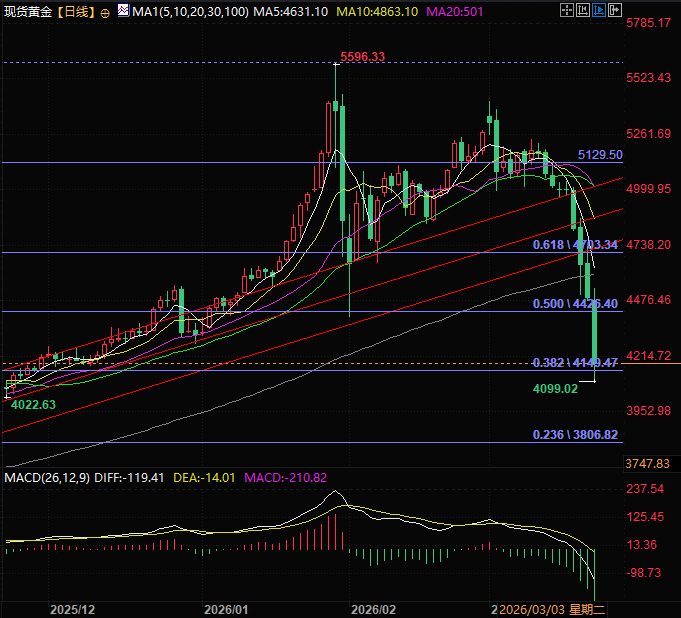
(Spot gold daily chart, source: FX678)
At 15:42 Beijing time, spot gold was trading at $4,192 per ounce.
After a slight rebound of 0.5% at the open, the market began a continuous decline, with the intraday drop once soaring to 8.27%, pushing market panic selling to its peak.
The United States and Iran exchanged harsh words, with Trump declaring that if Iran does not fully open the Strait of Hormuz within 48 hours, the United States will attack and destroy several of its power plants, starting with the largest one.
Meanwhile, Iran responded strongly. The Central Command of the Iranian Armed Forces, Hatem Anbia, emphasized that, according to previous warnings issued by Iran, if Iran's fuel and energy infrastructure is attacked by an enemy, all energy infrastructure, information technology systems, and desalination facilities of the United States and its allies in the region will become targets.
The market pre-priced in rising global inflation caused by escalating geopolitical conflicts, resulting in gold experiencing its most dramatic single-day reversal in years, catching global investors off guard.
The core trigger for the plunge: a combination of a hawkish Federal Reserve and a stampede of funds.
The Fed's hawkish shift became the immediate trigger.
One of the key drivers behind this round of precious metal price crashes is the policy signals from the Federal Reserve.
After the Federal Reserve kept interest rates unchanged, Chairman Powell publicly warned that soaring oil prices could lead to a resurgence of inflation and confirmed that the policy committee had discussed the possibility of raising interest rates again.
This clear hawkish stance raised investors' bets on the Fed restarting interest rate hikes to 50%, prompting traders to urgently reassess the path of monetary policy. This led to a weakening of the stock market, rising US Treasury yields, and a sharp decline in the attractiveness of non-interest-bearing gold.
A reversal in trading logic triggered a stampede of funds.
Gold prices have repeatedly hit new highs over the past year, with a cumulative increase of 60% in the last 12 months, leaving many institutional and individual investors with substantial unrealized profits.
At the time, the logic of selling the US dollar index and central banks increasing their gold holdings was prevalent. However, the dollar index has now returned to around 100, and Middle Eastern countries have begun to sell gold due to reduced oil revenues. When crowded trades encounter a trend reversal, selling becomes an inevitable choice: on the one hand, funds with risk budgets and volatility limits accelerate the closing of positions to lock in profits.
On the other hand, funds continued to flow into US Treasury bonds and cash instruments with positive real returns, and some funds in the Middle East even sold gold and flowed back to the US dollar. The resonance of multiple fund behaviors triggered a stampede of selling.
History is repeating itself: The Middle East "gold for cash" crisis of 43 years ago is recurring.
The current plunge in gold prices is strikingly similar to the historic collapse of March 1983, with the specter of that crisis from 43 years ago resurfacing.
In February 1983, British and Norwegian oil producers took the lead in lowering oil prices, forcing OPEC to follow suit and causing the global crude oil market to deteriorate sharply due to oversupply.
Major oil-producing countries in the Middle East have seen a sharp decline in oil revenues, forcing them to sell off large amounts of their gold reserves to raise cash, which directly triggered a collapse in gold prices.
According to a report in The New York Times at the time, gold prices plummeted by more than $105 in less than a week, with a single-day drop of up to $42.50.
It recorded its biggest single-day drop in nearly three years, and the impact also spread to commodities such as copper, grains, and soybeans.
Historical data shows that this week's plunge in gold prices is the most severe since the 1983 "gold for cash" crisis. During that crisis, Middle Eastern countries sold off their gold reserves, and the proceeds flowed into short-term investment instruments, triggering a chain reaction of forced liquidations.
Today, the combination of hawkish expectations from the Federal Reserve and volatility in the energy market forces the market to be wary of the risk of history repeating itself.
Market ripple effects: From mining stocks to the global financial environment
The dramatic repricing of gold prices has quickly spread to the stock market: major gold mining stocks such as Newmont and Freeport-McMoRan have become the worst-performing stocks in the S&P 500, with the Van Eyck Gold Mining ETF plunging about 7% in a single day; the world's largest gold ETF, SPDR Gold Trust, experienced millions of dollars in redemptions within hours of opening, potentially marking its largest single-day net outflow since the end of February. For mining companies whose profits are highly dependent on gold prices and whose valuations already reflect high price expectations, this is a painful valuation reshaping.
Besides the capital market, the macroeconomic signals from the gold price crash are equally crucial: First, the wealth effect in regions with large physical gold holdings, such as Asia and the Middle East, may be weakened; second, central banks in various countries that have been buying gold heavily in recent years are paying close attention to whether they will adjust their gold purchase pace or increase their holdings when prices are low; and third, high real yields and a strong US dollar will tighten the global financial environment, directly affecting financing costs in emerging markets and cross-border capital flows.
This round of sharp decline is reshaping the landscape of the precious metals sector: silver and other precious metals are weakening in tandem with gold, and the volatility is spreading rapidly; if mining companies reassess the sustainability of high gold prices, they may postpone or adjust their capital expenditure plans, affecting mining equipment suppliers and service providers; and alternative strategies that combine physical gold, mining stocks and derivatives for hedging may be favored by investors who prefer proactive risk control.
Summary and Technical Analysis:
The current panic selling in gold presents a theoretically good opportunity to buy on dips.
However, the road ahead remains fraught with uncertainty: First, there is the risk of policy uncertainty. If high oil prices lead to persistently high inflation, the Federal Reserve may raise interest rates rather than lower them, continuing to suppress non-interest-bearing precious metals. Second, there is the geopolitical uncertainty. The escalation or easing of the conflict in Iran will have drastically different effects on inflation and growth expectations. Third, there are technical risks. Gold prices have risen sharply in the previous period, and positions and leverage remain at high levels, which may trigger more forced liquidations.
From a technical perspective, spot gold has fallen below the 0.382 level, and the price is expected to fluctuate around 4150. There is a chance of a rebound if it falls below 4150, but if the price continues to fluctuate weakly, it may continue to pull back to around 3800.
(Spot gold daily chart, source: FX678)
At 15:42 Beijing time, spot gold was trading at $4,192 per ounce.
- Risk Warning and Disclaimer
- The market involves risk, and trading may not be suitable for all investors. This article is for reference only and does not constitute personal investment advice, nor does it take into account certain users’ specific investment objectives, financial situation, or other needs. Any investment decisions made based on this information are at your own risk.