The resilience of the US dollar remains to be seen amid the implicit pressure of energy taxes.
2026-03-23 17:56:41
On Monday, March 23, the US dollar index traded near the 100 mark during the European session, while WTI crude oil prices approached $100 per barrel. This energy price level is becoming a market focus. Deutsche Bank economists recently emphasized that the US is relatively protected in terms of economic growth due to its status as a net energy exporter, but inflationary pressures cannot be ignored. If oil prices remain at this level, it could provide a significant upward boost to the consumer price index. Given the current backdrop of a 2.4% year-on-year CPI in February, traders are assessing the potential impact of this development on monetary policy expectations and the US dollar index.

The United States became a net energy exporter in 2019, and its exports are projected to reach a record high in 2024, exceeding imports by approximately 9.26 trillion British thermal units (Btu). Increased producer profits lead to higher tax revenues, which to some extent offset the additional energy costs faced by consumers—the so-called energy tax effect. Amidst the Middle East conflict, the direct drag on US economic growth is relatively small compared to major importing regions like Europe and Asia. The recent rebound in oil prices, accompanied by a moderate strengthening of the US dollar index, confirms this logic.
According to Deutsche Bank estimates, a WTI crude oil price reaching $100 per barrel would increase the overall CPI by approximately 1.25 percentage points, potentially pushing the May reading to around 4%. The current US Consumer Price Index (CPI) recorded an annualized rate of 2.4% in February, and the rebound in energy prices has already begun to manifest in sub-categories such as gasoline, with the national average gasoline price rising to around $3.9 per gallon. Direct transmission primarily occurs through transportation and household energy spending, while indirect transmission involves cost pass-throughs by businesses and supply chain adjustments.
The data comparison table is as follows:
Traders need to distinguish between the evolution of overall and core inflation. A sustained rise in overall inflation driven by energy could alter market perceptions of price stability, even if core indicators remain relatively moderate. This repricing process will directly impact the dynamics of interest rate derivatives and the foreign exchange market.
Energy price-driven inflation primarily affects the US dollar index through expectations of Federal Reserve policy. If inflationary pressures resurface, the market may postpone the timing of Fed rate cuts or adjust its expectations for final interest rates, leading to a rise in US Treasury yields, especially at the short end, thus enhancing the dollar's attractiveness. Simultaneously, other currencies in the basket face more severe energy shocks, and the growth prospects of import-dependent economies such as the Eurozone are under pressure; their relative currency weakness directly boosts the US dollar index.
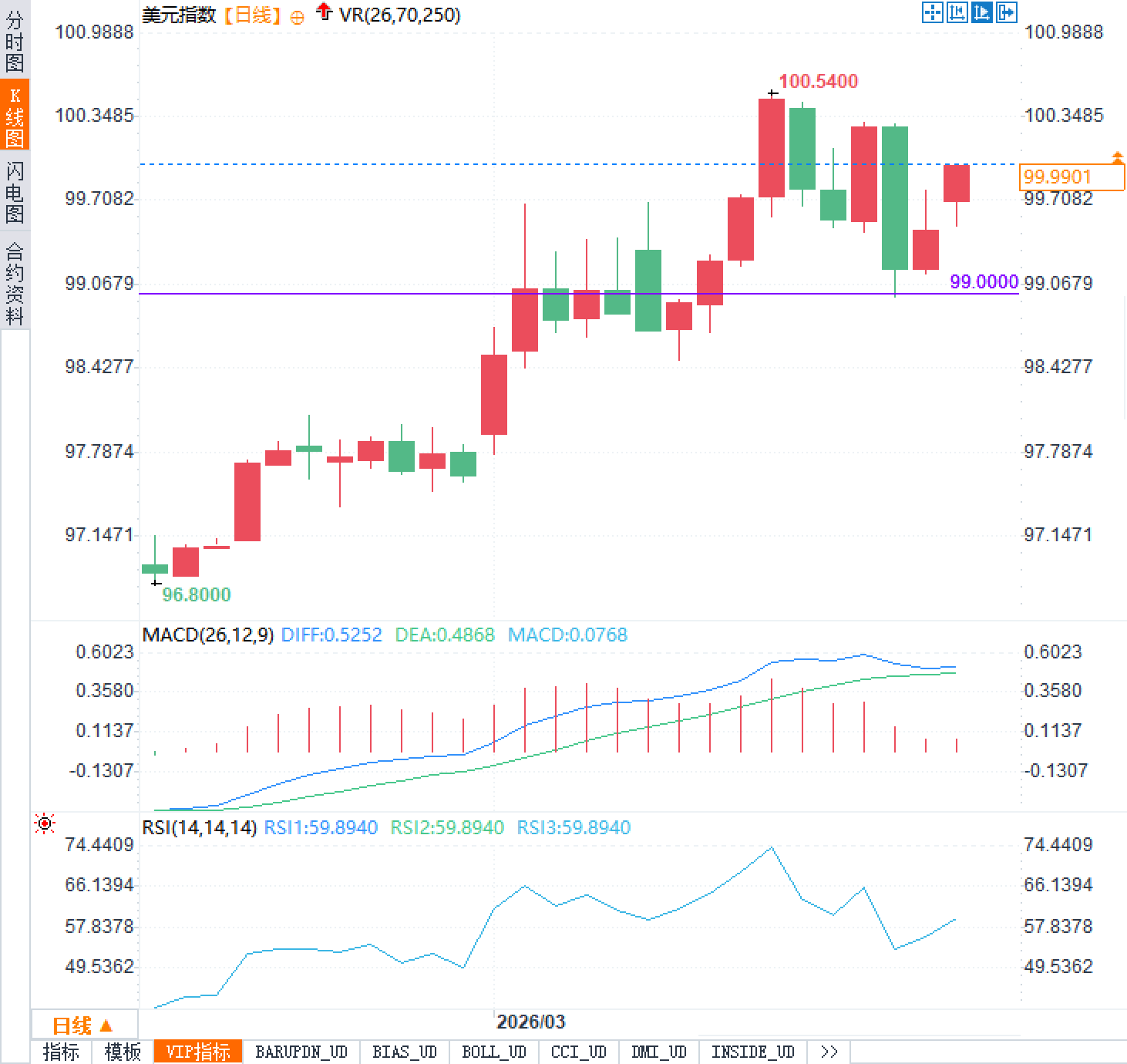
Recent observations show that the correlation coefficient between oil prices and the US dollar index is close to 0.87, far exceeding historical norms. This simultaneous correlation reflects the combined effect of demand for safe-haven assets and relative advantages in fundamentals. The Canadian dollar, with a 9.1% weighting in the currency pair due to oil exports, may have some potential for appreciation, but the overall effect, dominated by the euro, still leans towards a stronger US dollar.
Deutsche Bank specifically points out that when oil prices rise to the $130-150/barrel range, the growth impact may become non-linear. Persistent high energy costs will increase overall input costs, suppress consumption and investment, and affect the US export sector through global demand feedback. At this point, balancing inflation and growth becomes more difficult, policy uncertainty increases, and the volatility of the US dollar index may be amplified.
Other risks include unforeseen supply-side events, a synchronized global economic slowdown on the demand side, and differing central bank coordination. The future trajectory of the US dollar index depends on the balance of these factors.
The growth buffer provided by the US energy export status
The United States became a net energy exporter in 2019, and its exports are projected to reach a record high in 2024, exceeding imports by approximately 9.26 trillion British thermal units (Btu). Increased producer profits lead to higher tax revenues, which to some extent offset the additional energy costs faced by consumers—the so-called energy tax effect. Amidst the Middle East conflict, the direct drag on US economic growth is relatively small compared to major importing regions like Europe and Asia. The recent rebound in oil prices, accompanied by a moderate strengthening of the US dollar index, confirms this logic.
Quantitative assessment of inflationary pressures triggered by rising oil prices
According to Deutsche Bank estimates, a WTI crude oil price reaching $100 per barrel would increase the overall CPI by approximately 1.25 percentage points, potentially pushing the May reading to around 4%. The current US Consumer Price Index (CPI) recorded an annualized rate of 2.4% in February, and the rebound in energy prices has already begun to manifest in sub-categories such as gasoline, with the national average gasoline price rising to around $3.9 per gallon. Direct transmission primarily occurs through transportation and household energy spending, while indirect transmission involves cost pass-throughs by businesses and supply chain adjustments.
The data comparison table is as follows:
| Oil price level | Potential CPI increase | Time Node |
|---|---|---|
| Approximately $100 per barrel | +1.25 percentage points | It may be close to 4% in May. |
| $130-150 per barrel | Significantly higher | Non-linear growth risks emerge |
The mechanism by which changes in inflation expectations affect the US dollar index
Energy price-driven inflation primarily affects the US dollar index through expectations of Federal Reserve policy. If inflationary pressures resurface, the market may postpone the timing of Fed rate cuts or adjust its expectations for final interest rates, leading to a rise in US Treasury yields, especially at the short end, thus enhancing the dollar's attractiveness. Simultaneously, other currencies in the basket face more severe energy shocks, and the growth prospects of import-dependent economies such as the Eurozone are under pressure; their relative currency weakness directly boosts the US dollar index.
Recent observations show that the correlation coefficient between oil prices and the US dollar index is close to 0.87, far exceeding historical norms. This simultaneous correlation reflects the combined effect of demand for safe-haven assets and relative advantages in fundamentals. The Canadian dollar, with a 9.1% weighting in the currency pair due to oil exports, may have some potential for appreciation, but the overall effect, dominated by the euro, still leans towards a stronger US dollar.
Potential risks and the evolution of high oil price scenarios
Deutsche Bank specifically points out that when oil prices rise to the $130-150/barrel range, the growth impact may become non-linear. Persistent high energy costs will increase overall input costs, suppress consumption and investment, and affect the US export sector through global demand feedback. At this point, balancing inflation and growth becomes more difficult, policy uncertainty increases, and the volatility of the US dollar index may be amplified.
Other risks include unforeseen supply-side events, a synchronized global economic slowdown on the demand side, and differing central bank coordination. The future trajectory of the US dollar index depends on the balance of these factors.
Frequently Asked Questions
Question 1: Why can the United States' net energy export status buffer growth shocks?
A: As an exporting country, high oil prices boost domestic production and fiscal revenue, offsetting some of the additional consumer spending. Compared to importing countries, the US economy is more resilient overall. This relative advantage indirectly supports the stability of the US dollar index through policy expectations and capital flows, especially when import-dependent currencies such as the euro are under pressure, resulting in better exchange rate performance.
Question 2: How is the 1.25 percentage point impact of a $100/barrel oil price on the CPI calculated and realized?
A: Deutsche Bank estimates, based on historical transmission models, that this is directly reflected in the energy sub-index and spreads to the overall index. From the current 2.4%, if it remains high, it could approach 4% in May. Gasoline prices have already shown signs of rising, validating the transmission path. Traders can track this pulse through the energy component of the CPI, which accounts for approximately 7%.
Question 3: What is the core lesson this scenario teaches for US dollar index traders?
A: Inflationary pressures may reinforce the Fed's tightening stance, raising yields and benefiting the dollar against major currencies. Recent high correlations suggest oil prices are a new driver, but a reversal due to non-linear risks within high oil price ranges should be noted. The key is to monitor the Fed's dot plot adjustments and the steepening of the yield curve, both of which jointly determine the short-term support level for the dollar index.
- Risk Warning and Disclaimer
- The market involves risk, and trading may not be suitable for all investors. This article is for reference only and does not constitute personal investment advice, nor does it take into account certain users’ specific investment objectives, financial situation, or other needs. Any investment decisions made based on this information are at your own risk.