A liquidity war is unfolding, with the dollar soaring amidst the conflict.
2026-03-23 17:59:03
The US dollar index continued to rebound during the Asian and European sessions on Monday (March 23), currently trading around 100.07, up 0.57%.
As the threat of retaliation in the Middle East continues to escalate, market risk appetite has cooled significantly, and safe-haven funds have shifted across the board to dollar assets.
Last Thursday, the dollar closed with its first weekly decline since the outbreak of the conflict with Iran, while inflationary pressures from soaring oil prices are forcing central banks around the world to collectively turn hawkish.
The market's expectations for a de-escalation of tensions in the Gulf were completely shattered over the weekend: Trump threatened to strike Iran's power grid, Tehran responded strongly by threatening to retaliate against neighboring countries' energy and water facilities, oil shipping in the Strait of Hormuz faces the continued risk of closure, air raid sirens sounded throughout Israel, the geopolitical conflict has entered a new phase, and the United States is also considering increasing its troop deployment.

The core driver of this round of dollar rebound is the repricing of global monetary policy triggered by the Middle East conflict pushing up oil prices.
Before the outbreak of the US-Iran conflict in late February, the market generally priced in two interest rate cuts by the Federal Reserve this year; now the consensus has completely shifted, and even one interest rate cut this year has become a pipe dream, with major central banks around the world tightening their policies in unison.
The Federal Reserve held rates steady last week, with Chairman Powell stating that he could not assess the breadth and duration of the economic impact of the war, and revealing that the committee had discussed the possibility of another rate hike.
The European Central Bank warned of the risk of rising inflation due to energy prices, the Bank of England kept interest rates unchanged, and the Bank of Japan also left room for a rate hike in April.
Higher interest rate expectations directly boost the attractiveness of dollar assets: the yield on the 10-year US Treasury note climbed to 4.4055%, a new high in nearly eight months.
Compared to currencies such as the euro and the yen, the US dollar's interest rate differential continues to widen, and coupled with its safe-haven attributes, it has become the preferred choice for funds.
Against the backdrop of escalating geopolitical conflicts, the gold market experienced an unprecedented and sharp sell-off, completely deviating from the traditional logic of safe-haven assets.
Gold prices have fallen for several consecutive days, with this week's decline marking the worst drop since 1983. On some trading days, prices broke through key support levels, almost erasing all gains for the year.
This sell-off was not caused by geopolitical risks themselves, but rather by the conflict reinforcing the strength of the US dollar and global dollar liquidity pressures, while opportunity costs have further increased. Specifically, oil prices are pushing up inflation, central banks are maintaining high interest rates or even considering raising them, and the opportunity cost of holding non-interest-bearing gold has increased significantly, making high-yield assets such as US Treasury bonds more valuable for allocation.
Subsequently, cross-currency basis swaps expanded, increasing the pressure on dollar funding. Middle Eastern institutions and oil-producing countries prioritized selling gold in exchange for dollar liquidity, recreating the market logic of "gold for cash" in 1983.
Fund flow shift: Investors redeemed gold ETFs on a large scale and reduced speculative long positions on COMEX, with funds shifting to US dollar cash and US Treasury bonds, and the demand for safe-haven assets being entirely met by the US dollar.
Rodrigo Cattel, a foreign exchange strategist at National Australia Bank, points out that the current trading logic is clear: net energy beneficiaries are significantly outperforming net energy losers.
Europe and Japan are highly dependent on energy imports, and high oil prices continue to push up imported inflation and economic pressures, while monetary fundamentals continue to weaken.
If the Middle East conflict drags on, the euro and yen will face greater depreciation pressure; while the US dollar, benefiting from the US's energy self-sufficiency advantage, will demonstrate stronger resilience and safe-haven value during the crisis.
In the short term, as long as the geopolitical conflict in the Middle East does not show any substantial easing, the continued high oil prices will continue to push up inflation stickiness, making it difficult for the Federal Reserve to shift to easing. Its hawkish stance and the strong dollar pattern are unlikely to reverse in the short term, and gold will still face downward pressure from high real interest rates and a strong dollar.
As one of the top three most influential indices in the market, the US dollar index continues to be favored by the market due to the high yield and high liquidity of the US dollar, while traders need to closely monitor the performance of US Treasury yields.
From a medium- to long-term perspective, if geopolitical conflicts continue to escalate and evolve into a global stagflation environment, or if concerns about the US debt problem and fiscal sustainability intensify, coupled with the rise of the "de-dollarization" narrative, the credit and exchange rate of the US dollar will gradually come under pressure and weaken.
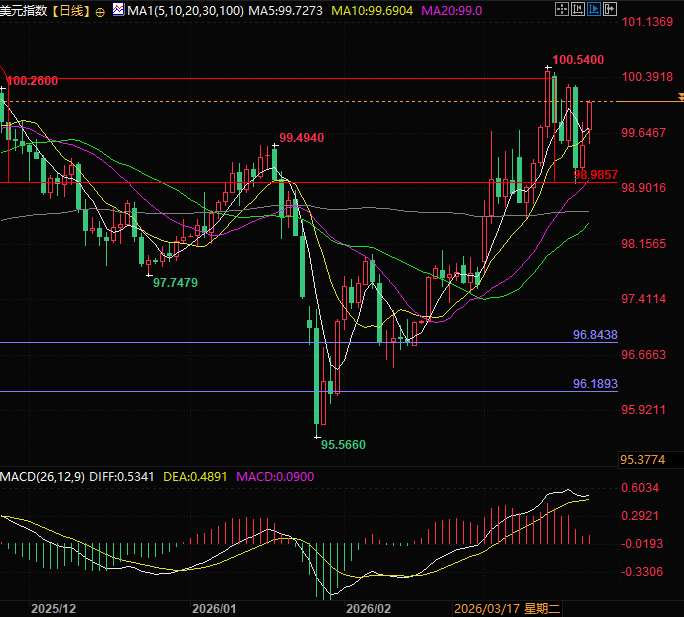
(US Dollar Index Daily Chart, Source: FX678)
At 17:56 Beijing time, the US dollar index is currently at 100.06.
As the threat of retaliation in the Middle East continues to escalate, market risk appetite has cooled significantly, and safe-haven funds have shifted across the board to dollar assets.
Last Thursday, the dollar closed with its first weekly decline since the outbreak of the conflict with Iran, while inflationary pressures from soaring oil prices are forcing central banks around the world to collectively turn hawkish.
The market's expectations for a de-escalation of tensions in the Gulf were completely shattered over the weekend: Trump threatened to strike Iran's power grid, Tehran responded strongly by threatening to retaliate against neighboring countries' energy and water facilities, oil shipping in the Strait of Hormuz faces the continued risk of closure, air raid sirens sounded throughout Israel, the geopolitical conflict has entered a new phase, and the United States is also considering increasing its troop deployment.
Core logic: The central bank's hawkish shift highlights the advantage of the dollar interest rate differential.
The core driver of this round of dollar rebound is the repricing of global monetary policy triggered by the Middle East conflict pushing up oil prices.
Before the outbreak of the US-Iran conflict in late February, the market generally priced in two interest rate cuts by the Federal Reserve this year; now the consensus has completely shifted, and even one interest rate cut this year has become a pipe dream, with major central banks around the world tightening their policies in unison.
The Federal Reserve held rates steady last week, with Chairman Powell stating that he could not assess the breadth and duration of the economic impact of the war, and revealing that the committee had discussed the possibility of another rate hike.
The European Central Bank warned of the risk of rising inflation due to energy prices, the Bank of England kept interest rates unchanged, and the Bank of Japan also left room for a rate hike in April.
Higher interest rate expectations directly boost the attractiveness of dollar assets: the yield on the 10-year US Treasury note climbed to 4.4055%, a new high in nearly eight months.
Compared to currencies such as the euro and the yen, the US dollar's interest rate differential continues to widen, and coupled with its safe-haven attributes, it has become the preferred choice for funds.
An unusual phenomenon: Gold is being sold off as the market chases dollar liquidity.
Against the backdrop of escalating geopolitical conflicts, the gold market experienced an unprecedented and sharp sell-off, completely deviating from the traditional logic of safe-haven assets.
Gold prices have fallen for several consecutive days, with this week's decline marking the worst drop since 1983. On some trading days, prices broke through key support levels, almost erasing all gains for the year.
This sell-off was not caused by geopolitical risks themselves, but rather by the conflict reinforcing the strength of the US dollar and global dollar liquidity pressures, while opportunity costs have further increased. Specifically, oil prices are pushing up inflation, central banks are maintaining high interest rates or even considering raising them, and the opportunity cost of holding non-interest-bearing gold has increased significantly, making high-yield assets such as US Treasury bonds more valuable for allocation.
Subsequently, cross-currency basis swaps expanded, increasing the pressure on dollar funding. Middle Eastern institutions and oil-producing countries prioritized selling gold in exchange for dollar liquidity, recreating the market logic of "gold for cash" in 1983.
Fund flow shift: Investors redeemed gold ETFs on a large scale and reduced speculative long positions on COMEX, with funds shifting to US dollar cash and US Treasury bonds, and the demand for safe-haven assets being entirely met by the US dollar.
Non-US currencies diverge: Currencies of energy-affected countries continue to face pressure.
Rodrigo Cattel, a foreign exchange strategist at National Australia Bank, points out that the current trading logic is clear: net energy beneficiaries are significantly outperforming net energy losers.
Europe and Japan are highly dependent on energy imports, and high oil prices continue to push up imported inflation and economic pressures, while monetary fundamentals continue to weaken.
If the Middle East conflict drags on, the euro and yen will face greater depreciation pressure; while the US dollar, benefiting from the US's energy self-sufficiency advantage, will demonstrate stronger resilience and safe-haven value during the crisis.
Market Outlook: Continued US Dollar Strength Expected; Close Attention to Three Key Variables
In the short term, as long as the geopolitical conflict in the Middle East does not show any substantial easing, the continued high oil prices will continue to push up inflation stickiness, making it difficult for the Federal Reserve to shift to easing. Its hawkish stance and the strong dollar pattern are unlikely to reverse in the short term, and gold will still face downward pressure from high real interest rates and a strong dollar.
As one of the top three most influential indices in the market, the US dollar index continues to be favored by the market due to the high yield and high liquidity of the US dollar, while traders need to closely monitor the performance of US Treasury yields.
From a medium- to long-term perspective, if geopolitical conflicts continue to escalate and evolve into a global stagflation environment, or if concerns about the US debt problem and fiscal sustainability intensify, coupled with the rise of the "de-dollarization" narrative, the credit and exchange rate of the US dollar will gradually come under pressure and weaken.
(US Dollar Index Daily Chart, Source: FX678)
At 17:56 Beijing time, the US dollar index is currently at 100.06.
- Risk Warning and Disclaimer
- The market involves risk, and trading may not be suitable for all investors. This article is for reference only and does not constitute personal investment advice, nor does it take into account certain users’ specific investment objectives, financial situation, or other needs. Any investment decisions made based on this information are at your own risk.