March 24th Financial Breakfast: Amidst the realities and uncertainties of US-Iran negotiations, gold prices stage a sharp V-shaped rebound as they battle again for the $4500 mark; oil prices plummet nearly 11%.
2026-03-24 07:24:51
On Tuesday (March 24, Beijing time) in early Asian trading, spot gold was trading around $4,436 per barrel. Gold prices fell below $4,100 per ounce on Monday, marking their ninth consecutive day of decline. However, gold prices narrowed their losses and returned above $4,400 per ounce after Trump announced a five-day delay in the strikes against Iranian power plants and stated that the US was consulting with Tehran on ending the war. US crude oil was trading around $89 per barrel. Oil prices plummeted nearly 11% on Monday. Although Trump stated that the US and Iran had consulted and reached an agreement on "key issues," Iran denied this. The market is focused on further statements and actions from Iran.

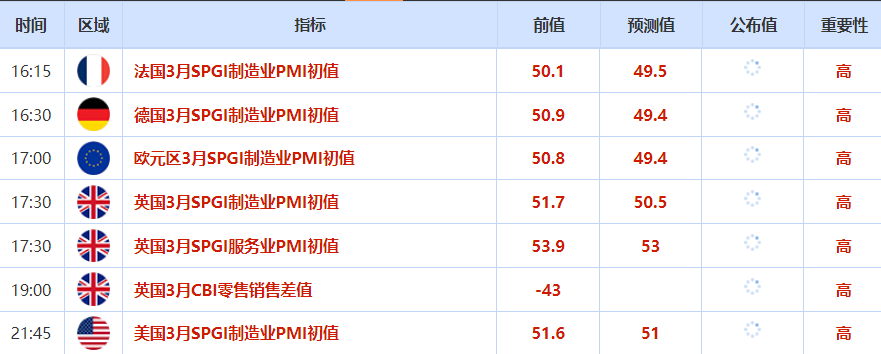
Reserve Bank of New Zealand Governor Brehman delivered a speech.
U.S. stocks closed up more than 1% on Monday, with the three major indexes recording their biggest one-day gain since February 6, as U.S. President Trump ordered the military to postpone strikes on Iranian power plants after saying he had had "productive talks" with Tehran, and oil prices fell more than 10%, providing a significant boost to the stock market.
Although the Iranian parliament speaker subsequently denied that any talks had been held, causing market gains to narrow from earlier highs, the overall market remained strong, with the Dow Jones Industrial Average closing up 1.38% at 46,208.47, the S&P 500 up 1.15% at 6,581.00, and the Nasdaq Composite up 1.38% at 21,946.76.
The market volatility index VIX retreated after hitting a two-week high in early trading. All 11 major sectors of the S&P 500 rose, with cyclical sectors such as consumer discretionary rising by 2.46%. Oil-price-sensitive airline and cruise operator stocks rebounded significantly, and bank stocks also recovered some lost ground.
Meanwhile, investors' expectations for a December rate hike by the Federal Reserve fell to about 13%, and the small-cap Russell 2000 index outperformed large-cap stocks, closing up 2.3%.
This week, market focus will shift to speeches by Federal Reserve officials, business activity surveys, and consumer confidence indices.
Gold prices pared losses on Monday, recovering from an intraday plunge of more than 8% to close down 1.8% at $4,407.06 an ounce, but still fell for the ninth consecutive trading day. This followed news that US President Trump had ordered a five-day delay in the strikes against Iranian power plants and stated that the US was in talks with Tehran to end the war. This news triggered a sharp drop in oil prices and a weaker dollar, making dollar-denominated gold more cost-effective for investors holding other currencies.
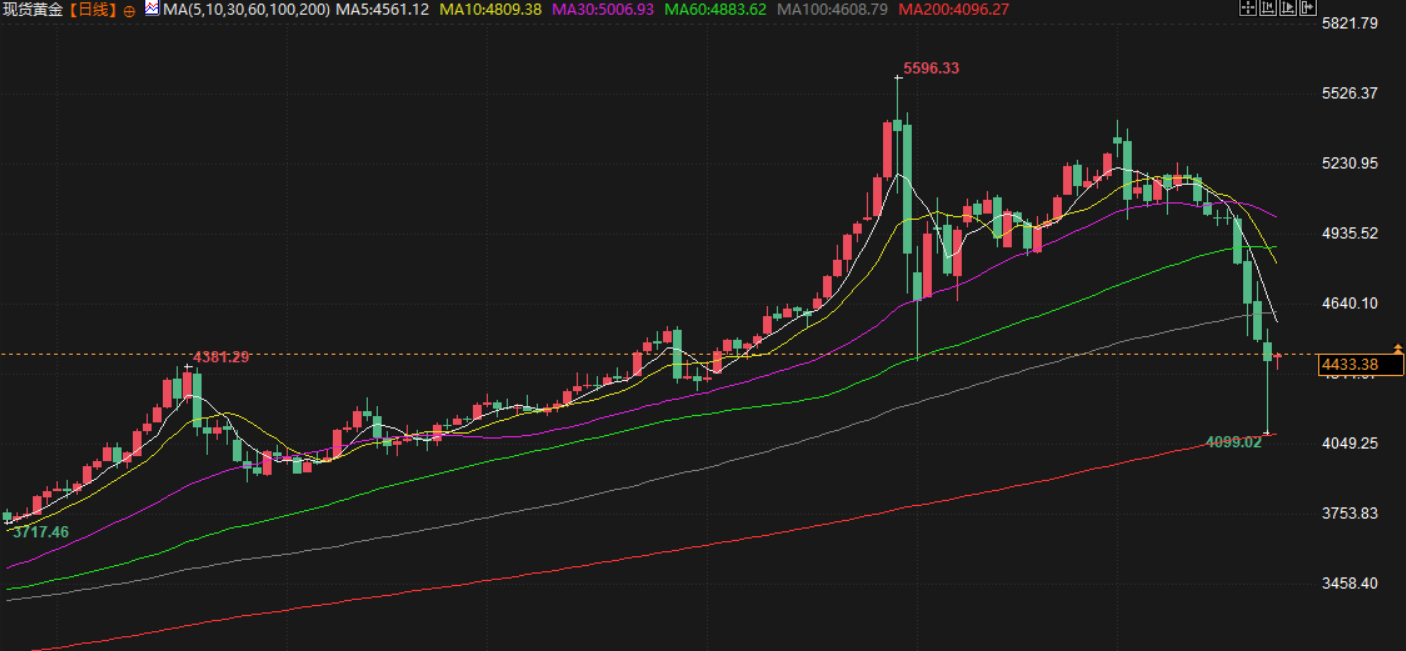
The director of metals trading at High Ridge Futures pointed out that the overnight sell-off was mainly driven by continued long position liquidation fueled by expectations of interest rate hikes, while Trump's post on Truth Social triggered a widespread market reversal. Although gold has traditionally been considered a safe-haven asset and an inflation hedge, recent energy price increases due to the situation in Iran have reinforced expectations that interest rates will remain high for an extended period, increasing the opportunity cost of holding non-interest-bearing metals and putting downward pressure on gold prices.
Spot silver rose 2.5% to $69.47, platinum fell 2.7%, and palladium rose 1.7%.
Oil prices plunged about 11% on Monday, with Brent crude futures closing down 10.9% at $99.94 a barrel and WTI crude futures falling 10.3% to $88.13 a barrel, after US President Trump said he had ordered a five-day delay in military strikes against Iranian power plants and that the US and Iran had held consultations the previous day and reached an agreement on "key issues," potentially ending the four-week-long war soon.
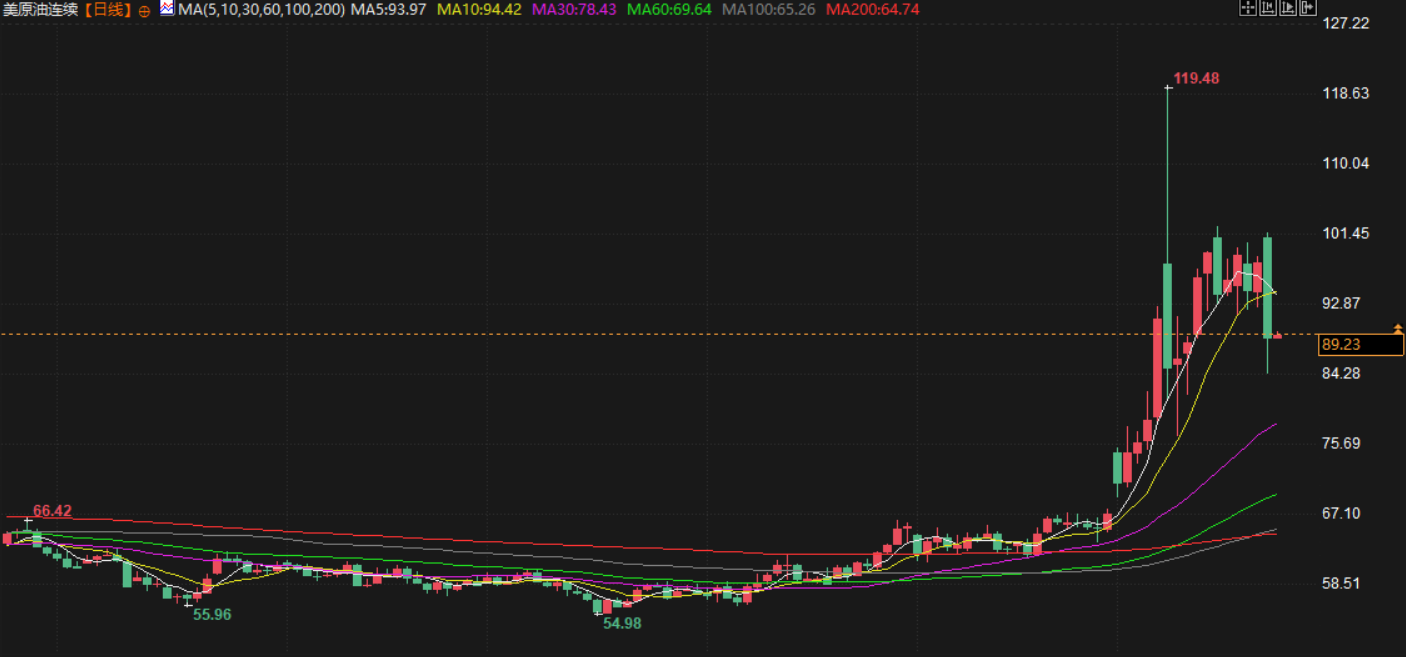
Oil prices fell nearly 15% at one point during the session, before the decline narrowed after Iran announced it would launch a new round of attacks on Israel and other targets in the Middle East and denied negotiating with the United States.
The sharp fluctuations in recent weeks have pushed crude oil futures volatility to its highest level since April 2022. Analysts estimate that the Middle East is losing between 7 million and 10 million barrels of oil per day. The head of the International Energy Agency said that the severity of this crisis exceeds the combined impact of the two oil crises of the 1970s and the Russia-Ukraine war on the natural gas market.
The U.S. Energy Secretary said the likelihood of releasing more oil from the Strategic Petroleum Reserve is extremely low, while the Japanese government is considering intervention in the crude oil futures market.
The dollar fell against most major currencies on Monday, with the dollar index dropping 0.4% to 99.08, as US President Trump said he had asked the military to postpone strikes on Iranian power plants and energy infrastructure for five days and said the US and Iran had held "productive talks," easing short-term market concerns about further supply shocks and giving a slight boost to risk assets.
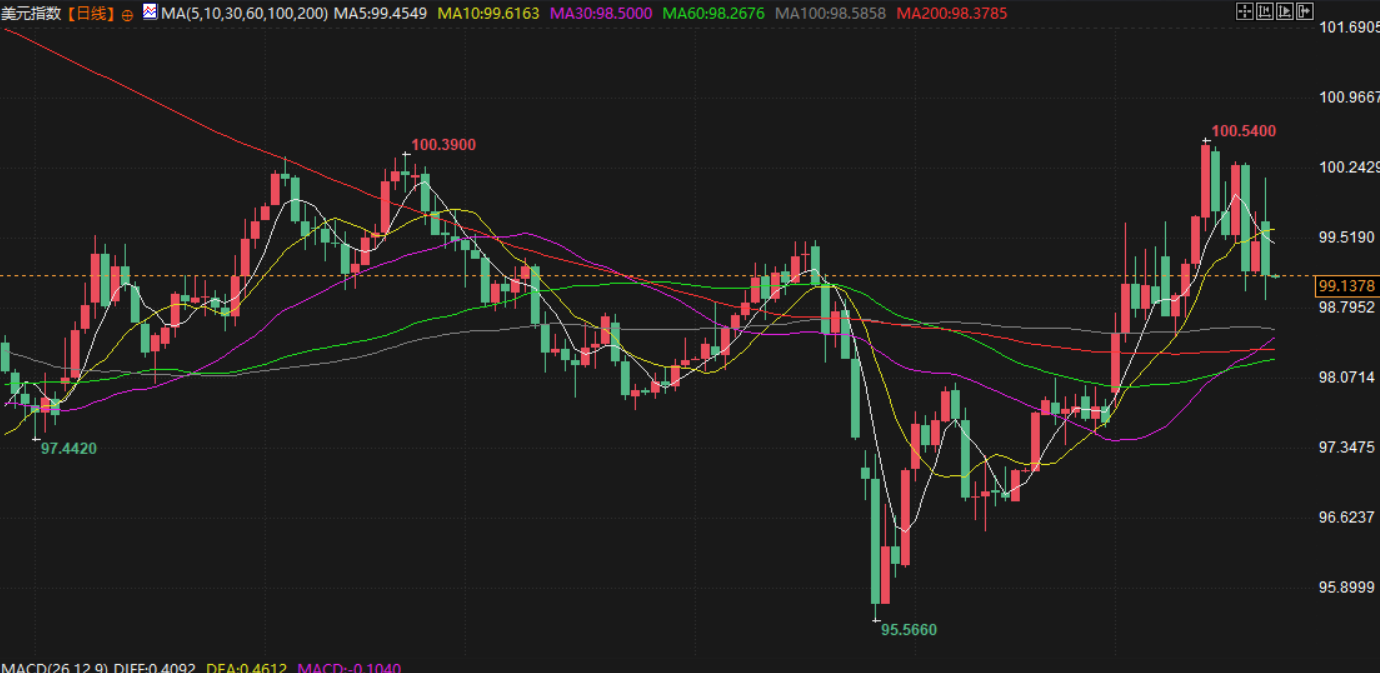
Although the Iranian Foreign Ministry subsequently denied the talks and stated that the conditions for ending the war remained unchanged, the market still tends to believe that there was some kind of communication between the two sides.
The euro rose 0.4% against the dollar to $1.1616, its highest level since March 11; the dollar fell 0.6% against the yen to 158.30 yen, retreating from the key warning level of 160 yen; and the pound rose 0.71% to $1.3436, a new high since March 10.
Global stock and energy markets rebounded sharply following Trump's remarks, with US Treasury yields falling from multi-month highs and Brent crude oil prices dropping by about 12%. Analysts pointed out that it is too early to assert that the conflict has passed its peak before the situation becomes clearer, but the market has begun to sense a more encouraging outlook.
Sources say Trump approved action against Iran after speaking with Netanyahu.
On March 23 local time, sources revealed that Israeli Prime Minister Benjamin Netanyahu spoke by phone with US President Donald Trump less than 48 hours before the joint US-Israel strike against Iran. The sources indicated that at the time the call was made, Trump had not yet decided when or under what circumstances the US would intervene. (CCTV News)
Trump ignores Iran's denials and claims they have had a perfect dialogue
US President Donald Trump told the media on March 23 that the US and Iran had held "strong" and "perfect" talks, reaching key points of an agreement that, if all goes well, would end the conflict. However, Iran repeatedly denied having talks with the US that day. Trump claimed the US had destroyed much of Iran's infrastructure and that "it's very difficult to get information from Iran." Trump stated that the US had spoken with the Iranian leadership, "talking with what we consider to be one of the most respected leaders." When asked if the Iranian representative involved in the negotiations was Supreme Leader Mojtaba Khamenei, Trump said, "No." Trump also claimed that "Iran initiated the call" because of "concerns about the US bombing of power plants." When asked who would control oil in the future, and whether Iran would still control oil transportation, Trump said it might be jointly controlled by him and "the next Supreme Leader of Iran." According to US and Israeli media reports, the US was in talks with Iranian Parliament Speaker Qassem Ghalibaf. However, this report has been denied by Ghalibaf himself. Iranian media reports indicate that the US is spreading fake news about these negotiations in an attempt to assassinate Ghalibaf and sow division within Iran. (CCTV International News)
Iranian media claimed the US was spreading disinformation to assassinate the Iranian parliament speaker.
Iran's Fars News Agency, citing sources, reported on March 23 that the so-called "negotiations between Iranian Parliament Speaker Ghalibaf and the United States" were completely false, and one of the purposes of fabricating this false information was to create conditions for Ghalibaf's assassination. The source said that the purpose of fabricating the negotiations also included discrediting Ghalibaf, inciting division within Iran, and stirring up public sentiment. The source stated that Iranian officials unanimously agreed that the fighting would continue until Iran achieves its objectives and the aggressors repent. Earlier that day, US President Trump stated that the US had spoken with an Iranian "leader" and reached an agreement on key points, but that the person was not Iran's Supreme Leader. According to US and Israeli media reports, the US is indeed in talks with Ghalibaf. (CCTV International News)
Trump sets deadline; US troop surge to arrive on the same day.
On March 23, local time, the Wall Street Journal, citing two U.S. officials, reported that thousands of U.S. Marines are scheduled to arrive in the Middle East on March 27. This date is the new "deadline" set by U.S. President Trump for Iran to reopen the Strait of Hormuz. The report stated that the amphibious assault ship USS Tripoli, the amphibious dock landing ship USS New Orleans, and approximately 2,200 Marines from the 31st Marine Expeditionary Unit, stationed in Japan, will enter the area of responsibility of U.S. Central Command on February 27. However, this force will need several more days to reach the Strait of Hormuz. The U.S. Department of Defense has also ordered another Marine Corps unit to be deployed to the Central Command area of responsibility: the 11th Marine Expeditionary Unit, aboard the USS Boxer and stationed in California. This unit will depart several weeks later and arrive in the Central Command area of responsibility several weeks after departure. (CCTV International News)
Iranian official: Trump has no right to set conditions or deadlines for negotiations.
A senior Iranian official stated that US President Trump has no authority to set conditions or deadlines for negotiations. The official said that messages have been exchanged between Iran and the US through Egypt and Turkey aimed at easing tensions, but the US has not yet accepted Iran's two core conditions: compensation for damages and an acknowledgment of its aggression against Iran. The official also indicated that the issues of closing the Strait of Hormuz and laying mines remain among Iran's preparedness options for potential actions. (CCTV News)
The Iranian military claims it has effectively controlled the Strait of Hormuz.
On March 23 local time, a spokesperson for the Hatem Anbia Central Command of the Iranian Armed Forces stated that Iran has gained the initiative in the relevant waters of the Persian Gulf and the Gulf of Oman, and has effectively controlled the Strait of Hormuz. The spokesperson stated that based on its current capabilities, Iran has no need to lay mines in the Persian Gulf, but will take all necessary measures to ensure security if necessary. He also stated that the Iranian Armed Forces are capable of maintaining security in the Persian Gulf with the cooperation of regional countries, and that countries outside the region have no right to interfere. (CCTV News)
Iranian sources say they are prepared to respond strongly to attacks on critical infrastructure.
On the 23rd local time, a senior Iranian security source stated that despite US propaganda, Iran is prepared to respond forcefully should its critical infrastructure be attacked. The source said Iran's assessment of the current battlefield situation remains unchanged, and that any action targeting infrastructure, even a small or symbolic one, would provoke a response several times greater given the ongoing airstrikes against Iran. He also stated that Iran has the capability to maintain the operation of infrastructure such as power plants and believes any such attack is doomed to failure. (CCTV News)
Iranian Foreign Ministry: No negotiations with the US, position on the Strait of Hormuz remains unchanged.
Iranian Foreign Ministry spokesman Baghae said on the 23rd that Iran had received information from some friendly countries in recent days regarding a US request to negotiate an end to the conflict, and had responded according to its principled position. Baghae stated that in its response, Iran warned of the potential consequences of attacks on its critical infrastructure and emphasized that any action against Iran's energy infrastructure would be met with a "decisive, immediate, and effective" response from the Iranian armed forces. He also pointed out that Iran had not held any negotiations with the US during the past 24 days of conflict, and Iran's position on the Strait of Hormuz issue and the conditions for ending the conflict remained unchanged. (CCTV News)
Goldman Sachs has raised its estimate of the probability of a US recession to 30%.
Goldman Sachs said the probability of a U.S. recession within the next 12 months has risen to 30% due to soaring oil and gas prices, an increase of 5 percentage points from its previous forecast. The energy price shock, coupled with tighter financial conditions caused by the Middle East conflict and the fading effects of President Trump's major tax laws passed last summer, prompted Goldman Sachs Chief Economist Hatzius to raise his baseline year-end unemployment rate forecast to 4.6%. Goldman Sachs still expects the Federal Reserve to cut interest rates in September and December. The bank also expects U.S. GDP growth in the second half of this year to be below trend, with an annualized growth rate expected to be between 1.25% and 1.75%. Goldman Sachs raised its oil price forecast for this year earlier on Monday due to ongoing disruptions to energy transport through the Strait of Hormuz. The bank said the conflict will push up global inflation and reduce global GDP growth by 0.4 percentage points, but in the worst-case scenario, the impact on GDP could double or even triple.
State Intellectual Property Office: Nearly 9,000 high-growth SMEs selected for key support.
On March 23, the State Council Information Office held a press conference to introduce the implementation of the Special Action Plan for Patent Transformation and Utilization (2023-2025). Hu Wenhui, Deputy Director of the State Intellectual Property Office, stated that in supporting enterprise growth, the plan implements a patent industrialization promotion program for SMEs, selecting nearly 9,000 high-growth SMEs for focused support. These SMEs receive a comprehensive package of intellectual property support policies and related financial support measures, including patent navigation, priority examination, and rights protection, creating model examples to encourage more SMEs to attract investment and grow through innovation. (Xinhua News Agency)
The State Intellectual Property Office reported that the total transaction value of technology contracts involving patents nationwide reached 1.18 trillion yuan in 2025, a year-on-year increase of 18.8%.
On March 23, the State Council Information Office held a press conference to introduce the implementation of the Special Action Plan for Patent Transformation and Utilization (2023-2025). Hu Wenhui, Deputy Director of the State Intellectual Property Office, stated that the benefits of patent transformation and utilization are being released at an accelerated pace. Since the implementation of the special action plan, the number of patent transfer and licensing registrations nationwide has reached 1.458 million, a year-on-year increase of 48%, with universities and research institutions seeing a 105.6% increase. In 2025, the total transaction value of technology contracts involving patents nationwide is expected to reach 1.18 trillion yuan, a year-on-year increase of 18.8%. (Xinhua News Agency)
Key Focus Today
Reserve Bank of New Zealand Governor Brehman delivered a speech.
stock market
U.S. stocks closed up more than 1% on Monday, with the three major indexes recording their biggest one-day gain since February 6, as U.S. President Trump ordered the military to postpone strikes on Iranian power plants after saying he had had "productive talks" with Tehran, and oil prices fell more than 10%, providing a significant boost to the stock market.
Although the Iranian parliament speaker subsequently denied that any talks had been held, causing market gains to narrow from earlier highs, the overall market remained strong, with the Dow Jones Industrial Average closing up 1.38% at 46,208.47, the S&P 500 up 1.15% at 6,581.00, and the Nasdaq Composite up 1.38% at 21,946.76.
The market volatility index VIX retreated after hitting a two-week high in early trading. All 11 major sectors of the S&P 500 rose, with cyclical sectors such as consumer discretionary rising by 2.46%. Oil-price-sensitive airline and cruise operator stocks rebounded significantly, and bank stocks also recovered some lost ground.
Meanwhile, investors' expectations for a December rate hike by the Federal Reserve fell to about 13%, and the small-cap Russell 2000 index outperformed large-cap stocks, closing up 2.3%.
This week, market focus will shift to speeches by Federal Reserve officials, business activity surveys, and consumer confidence indices.
Gold Market
Gold prices pared losses on Monday, recovering from an intraday plunge of more than 8% to close down 1.8% at $4,407.06 an ounce, but still fell for the ninth consecutive trading day. This followed news that US President Trump had ordered a five-day delay in the strikes against Iranian power plants and stated that the US was in talks with Tehran to end the war. This news triggered a sharp drop in oil prices and a weaker dollar, making dollar-denominated gold more cost-effective for investors holding other currencies.
The director of metals trading at High Ridge Futures pointed out that the overnight sell-off was mainly driven by continued long position liquidation fueled by expectations of interest rate hikes, while Trump's post on Truth Social triggered a widespread market reversal. Although gold has traditionally been considered a safe-haven asset and an inflation hedge, recent energy price increases due to the situation in Iran have reinforced expectations that interest rates will remain high for an extended period, increasing the opportunity cost of holding non-interest-bearing metals and putting downward pressure on gold prices.
Spot silver rose 2.5% to $69.47, platinum fell 2.7%, and palladium rose 1.7%.
oil market
Oil prices plunged about 11% on Monday, with Brent crude futures closing down 10.9% at $99.94 a barrel and WTI crude futures falling 10.3% to $88.13 a barrel, after US President Trump said he had ordered a five-day delay in military strikes against Iranian power plants and that the US and Iran had held consultations the previous day and reached an agreement on "key issues," potentially ending the four-week-long war soon.
Oil prices fell nearly 15% at one point during the session, before the decline narrowed after Iran announced it would launch a new round of attacks on Israel and other targets in the Middle East and denied negotiating with the United States.
The sharp fluctuations in recent weeks have pushed crude oil futures volatility to its highest level since April 2022. Analysts estimate that the Middle East is losing between 7 million and 10 million barrels of oil per day. The head of the International Energy Agency said that the severity of this crisis exceeds the combined impact of the two oil crises of the 1970s and the Russia-Ukraine war on the natural gas market.
The U.S. Energy Secretary said the likelihood of releasing more oil from the Strategic Petroleum Reserve is extremely low, while the Japanese government is considering intervention in the crude oil futures market.
Foreign exchange market
The dollar fell against most major currencies on Monday, with the dollar index dropping 0.4% to 99.08, as US President Trump said he had asked the military to postpone strikes on Iranian power plants and energy infrastructure for five days and said the US and Iran had held "productive talks," easing short-term market concerns about further supply shocks and giving a slight boost to risk assets.
Although the Iranian Foreign Ministry subsequently denied the talks and stated that the conditions for ending the war remained unchanged, the market still tends to believe that there was some kind of communication between the two sides.
The euro rose 0.4% against the dollar to $1.1616, its highest level since March 11; the dollar fell 0.6% against the yen to 158.30 yen, retreating from the key warning level of 160 yen; and the pound rose 0.71% to $1.3436, a new high since March 10.
Global stock and energy markets rebounded sharply following Trump's remarks, with US Treasury yields falling from multi-month highs and Brent crude oil prices dropping by about 12%. Analysts pointed out that it is too early to assert that the conflict has passed its peak before the situation becomes clearer, but the market has begun to sense a more encouraging outlook.
International News
Sources say Trump approved action against Iran after speaking with Netanyahu.
On March 23 local time, sources revealed that Israeli Prime Minister Benjamin Netanyahu spoke by phone with US President Donald Trump less than 48 hours before the joint US-Israel strike against Iran. The sources indicated that at the time the call was made, Trump had not yet decided when or under what circumstances the US would intervene. (CCTV News)
Trump ignores Iran's denials and claims they have had a perfect dialogue
US President Donald Trump told the media on March 23 that the US and Iran had held "strong" and "perfect" talks, reaching key points of an agreement that, if all goes well, would end the conflict. However, Iran repeatedly denied having talks with the US that day. Trump claimed the US had destroyed much of Iran's infrastructure and that "it's very difficult to get information from Iran." Trump stated that the US had spoken with the Iranian leadership, "talking with what we consider to be one of the most respected leaders." When asked if the Iranian representative involved in the negotiations was Supreme Leader Mojtaba Khamenei, Trump said, "No." Trump also claimed that "Iran initiated the call" because of "concerns about the US bombing of power plants." When asked who would control oil in the future, and whether Iran would still control oil transportation, Trump said it might be jointly controlled by him and "the next Supreme Leader of Iran." According to US and Israeli media reports, the US was in talks with Iranian Parliament Speaker Qassem Ghalibaf. However, this report has been denied by Ghalibaf himself. Iranian media reports indicate that the US is spreading fake news about these negotiations in an attempt to assassinate Ghalibaf and sow division within Iran. (CCTV International News)
Iranian media claimed the US was spreading disinformation to assassinate the Iranian parliament speaker.
Iran's Fars News Agency, citing sources, reported on March 23 that the so-called "negotiations between Iranian Parliament Speaker Ghalibaf and the United States" were completely false, and one of the purposes of fabricating this false information was to create conditions for Ghalibaf's assassination. The source said that the purpose of fabricating the negotiations also included discrediting Ghalibaf, inciting division within Iran, and stirring up public sentiment. The source stated that Iranian officials unanimously agreed that the fighting would continue until Iran achieves its objectives and the aggressors repent. Earlier that day, US President Trump stated that the US had spoken with an Iranian "leader" and reached an agreement on key points, but that the person was not Iran's Supreme Leader. According to US and Israeli media reports, the US is indeed in talks with Ghalibaf. (CCTV International News)
Trump sets deadline; US troop surge to arrive on the same day.
On March 23, local time, the Wall Street Journal, citing two U.S. officials, reported that thousands of U.S. Marines are scheduled to arrive in the Middle East on March 27. This date is the new "deadline" set by U.S. President Trump for Iran to reopen the Strait of Hormuz. The report stated that the amphibious assault ship USS Tripoli, the amphibious dock landing ship USS New Orleans, and approximately 2,200 Marines from the 31st Marine Expeditionary Unit, stationed in Japan, will enter the area of responsibility of U.S. Central Command on February 27. However, this force will need several more days to reach the Strait of Hormuz. The U.S. Department of Defense has also ordered another Marine Corps unit to be deployed to the Central Command area of responsibility: the 11th Marine Expeditionary Unit, aboard the USS Boxer and stationed in California. This unit will depart several weeks later and arrive in the Central Command area of responsibility several weeks after departure. (CCTV International News)
Iranian official: Trump has no right to set conditions or deadlines for negotiations.
A senior Iranian official stated that US President Trump has no authority to set conditions or deadlines for negotiations. The official said that messages have been exchanged between Iran and the US through Egypt and Turkey aimed at easing tensions, but the US has not yet accepted Iran's two core conditions: compensation for damages and an acknowledgment of its aggression against Iran. The official also indicated that the issues of closing the Strait of Hormuz and laying mines remain among Iran's preparedness options for potential actions. (CCTV News)
The Iranian military claims it has effectively controlled the Strait of Hormuz.
On March 23 local time, a spokesperson for the Hatem Anbia Central Command of the Iranian Armed Forces stated that Iran has gained the initiative in the relevant waters of the Persian Gulf and the Gulf of Oman, and has effectively controlled the Strait of Hormuz. The spokesperson stated that based on its current capabilities, Iran has no need to lay mines in the Persian Gulf, but will take all necessary measures to ensure security if necessary. He also stated that the Iranian Armed Forces are capable of maintaining security in the Persian Gulf with the cooperation of regional countries, and that countries outside the region have no right to interfere. (CCTV News)
Iranian sources say they are prepared to respond strongly to attacks on critical infrastructure.
On the 23rd local time, a senior Iranian security source stated that despite US propaganda, Iran is prepared to respond forcefully should its critical infrastructure be attacked. The source said Iran's assessment of the current battlefield situation remains unchanged, and that any action targeting infrastructure, even a small or symbolic one, would provoke a response several times greater given the ongoing airstrikes against Iran. He also stated that Iran has the capability to maintain the operation of infrastructure such as power plants and believes any such attack is doomed to failure. (CCTV News)
Iranian Foreign Ministry: No negotiations with the US, position on the Strait of Hormuz remains unchanged.
Iranian Foreign Ministry spokesman Baghae said on the 23rd that Iran had received information from some friendly countries in recent days regarding a US request to negotiate an end to the conflict, and had responded according to its principled position. Baghae stated that in its response, Iran warned of the potential consequences of attacks on its critical infrastructure and emphasized that any action against Iran's energy infrastructure would be met with a "decisive, immediate, and effective" response from the Iranian armed forces. He also pointed out that Iran had not held any negotiations with the US during the past 24 days of conflict, and Iran's position on the Strait of Hormuz issue and the conditions for ending the conflict remained unchanged. (CCTV News)
Goldman Sachs has raised its estimate of the probability of a US recession to 30%.
Goldman Sachs said the probability of a U.S. recession within the next 12 months has risen to 30% due to soaring oil and gas prices, an increase of 5 percentage points from its previous forecast. The energy price shock, coupled with tighter financial conditions caused by the Middle East conflict and the fading effects of President Trump's major tax laws passed last summer, prompted Goldman Sachs Chief Economist Hatzius to raise his baseline year-end unemployment rate forecast to 4.6%. Goldman Sachs still expects the Federal Reserve to cut interest rates in September and December. The bank also expects U.S. GDP growth in the second half of this year to be below trend, with an annualized growth rate expected to be between 1.25% and 1.75%. Goldman Sachs raised its oil price forecast for this year earlier on Monday due to ongoing disruptions to energy transport through the Strait of Hormuz. The bank said the conflict will push up global inflation and reduce global GDP growth by 0.4 percentage points, but in the worst-case scenario, the impact on GDP could double or even triple.
Domestic News
State Intellectual Property Office: Nearly 9,000 high-growth SMEs selected for key support.
On March 23, the State Council Information Office held a press conference to introduce the implementation of the Special Action Plan for Patent Transformation and Utilization (2023-2025). Hu Wenhui, Deputy Director of the State Intellectual Property Office, stated that in supporting enterprise growth, the plan implements a patent industrialization promotion program for SMEs, selecting nearly 9,000 high-growth SMEs for focused support. These SMEs receive a comprehensive package of intellectual property support policies and related financial support measures, including patent navigation, priority examination, and rights protection, creating model examples to encourage more SMEs to attract investment and grow through innovation. (Xinhua News Agency)
The State Intellectual Property Office reported that the total transaction value of technology contracts involving patents nationwide reached 1.18 trillion yuan in 2025, a year-on-year increase of 18.8%.
On March 23, the State Council Information Office held a press conference to introduce the implementation of the Special Action Plan for Patent Transformation and Utilization (2023-2025). Hu Wenhui, Deputy Director of the State Intellectual Property Office, stated that the benefits of patent transformation and utilization are being released at an accelerated pace. Since the implementation of the special action plan, the number of patent transfer and licensing registrations nationwide has reached 1.458 million, a year-on-year increase of 48%, with universities and research institutions seeing a 105.6% increase. In 2025, the total transaction value of technology contracts involving patents nationwide is expected to reach 1.18 trillion yuan, a year-on-year increase of 18.8%. (Xinhua News Agency)
- Risk Warning and Disclaimer
- The market involves risk, and trading may not be suitable for all investors. This article is for reference only and does not constitute personal investment advice, nor does it take into account certain users’ specific investment objectives, financial situation, or other needs. Any investment decisions made based on this information are at your own risk.