Gold Trading Alert: Trump's One Sentence Triggers a Dramatic Reversal in the Gold Market; Will It Surge or Continue to Collapse?
2026-03-24 07:39:55
Amid escalating geopolitical conflicts in the Middle East, gold, as a traditional safe-haven asset, should have shone brightly amidst the looming threat of war. However, Monday (March 23) saw a dramatic turn of events. Initially, market panic was ignited by Trump's ultimatum over the weekend to strike Iranian energy facilities within 48 hours. International oil prices surged, inflation expectations rose sharply, the prospect of a Federal Reserve rate cut dimmed, and the US dollar index strengthened. Spot gold suffered a severe blow, plummeting by more than 8.7% at one point, hitting a low of around $4099 per ounce, approaching the 200-day moving average support and marking a four-month low. It also closed lower for the ninth consecutive trading day, recording its worst weekly performance since 1983.
However, just when investors were almost in despair, Trump suddenly posted on social media, announcing that due to "productive" talks with Iran, the strikes against Iranian power plants and energy infrastructure would be postponed for five days. This news was like cold water extinguishing the raging fire in the oil market, causing oil prices to plummet by more than 10%, the dollar index to fall rapidly, and gold prices to rebound dramatically, with the decline narrowing significantly. In the end, spot gold closed at around $4406.64 per ounce, and the futures settlement price was $4407.30.
On Tuesday (March 24) in early Asian trading, spot gold fluctuated slightly higher. It fell as much as 0.7% to $4,360 per ounce at the start of the session, but quickly rebounded and is currently up 0.6%, trading around $4,430 per ounce.
On Monday (March 23), the market was shrouded in gloom at the start of trading. This stemmed from Trump's 48-hour ultimatum to Iran, threatening military strikes against its energy facilities. This volatile statement dramatically heightened global investors' fears of a massive energy supply disruption.
This fear was directly reflected in oil prices. International oil prices surged in early trading, with Brent crude briefly approaching record highs. The surge in oil prices quickly triggered a chain reaction in the market. As the "lifeblood" of the global economy, the runaway rise in energy prices means that the specter of inflation will once again loom. The market logic has become clear and direct: higher energy costs will push up overall prices, which will force the Federal Reserve to maintain high interest rates for a longer period, or even reconsider raising interest rates, in order to curb potentially runaway inflation.
Thus began a "repricing" of Federal Reserve interest rate expectations. The US dollar index, as a safe-haven currency and the most interest rate-sensitive currency, reacted first, rising sharply. However, for gold, this was a perfect storm. Although gold is considered a traditional inflation hedge, in the current market environment, it is more directly affected by interest rate expectations. Since gold itself does not generate interest, the opportunity cost of holding it is closely related to the risk-free rate (usually referenced to US Treasury yields). When the market begins to bet that the Federal Reserve will not cut interest rates or may even raise them, the opportunity cost of holding gold soars, and investors sell gold and embrace the dollar or US Treasury bonds instead.
Spot gold plummeted in this sell-off, falling more than 8.7% at one point to a staggering low of $4,099.02 per ounce. This was not only a four-month low but also brought it close to the key technical support level of the 200-day moving average. Last week, gold prices had already recorded their worst weekly performance since 1983, and Monday's sharp drop undoubtedly pushed it into an even deeper abyss. David Meger, director of metals trading at High Ridge Futures, accurately described the situation: "The overnight sell-off was a continuation of long position liquidation over the past few trading days, mainly driven by expectations of interest rate hikes." The market seemed to have already decided that the bear market for gold had only just begun.
Just when the market had almost accepted that high oil prices and high interest rates would become the new normal, a dramatic scene unfolded just hours later.
Early Monday morning Eastern Time, Trump dropped a bombshell on his self-created social media platform, Truth Social. He announced that the United States and Iran had held "very good and productive" talks on the issue of "completely and thoroughly ending hostilities in the Middle East." Based on this, he ordered a five-day postponement of his previously threatened strikes against Iranian power plants.
This news instantly ignited global markets, with an impact no less significant than a "financial tsunami," only in the completely opposite direction.
First, the crude oil market plummeted. The war premium that had previously supported rising oil prices evaporated instantly, as the market perceived a significant reduction in the risk of large-scale attacks on energy facilities leading to supply disruptions in the short term. Brent crude prices fell rapidly from their highs, dropping by more than 10% at one point, breaking below the key psychological level of $100 per barrel.
The US dollar followed suit. As oil prices fell, market concerns about runaway inflation eased considerably. This meant the Federal Reserve might no longer need to be so hawkish, and the market began pricing in expectations of a rate cut this year. The dollar index quickly gave back all its previous gains, turning from positive to negative.
Most notably, gold staged a remarkable comeback. With the weakening dollar, dollar-denominated gold became more cost-effective for investors holding other currencies. Simultaneously, the easing of geopolitical risks, while reducing short-term safe-haven demand for gold, more importantly reversed the core logic driving the previous decline in gold prices—expectations of interest rate hikes. The decline in US Treasury yields from multi-month highs reduced the opportunity cost of holding gold, providing a much-needed respite. Gold prices rebounded rapidly from their intraday lows, narrowing the decline from over 8% to 2% at the close, staging a textbook "V-shaped" reversal.
However, this reversal was not without its flaws. Even as Trump's statement was still resonating, rebuttals from Tehran followed. Iranian Parliament Speaker Mohammad Baqer Qalibaf bluntly called it "fake news" on social media, mocking the move as an "attempt to manipulate financial markets." The Iranian Foreign Ministry also denied having any direct dialogue with the United States.
One side claims the talks were "productive," while the other vehemently denies it, leaving the market with a huge question mark. Was Trump's statement overly optimistic, or a carefully orchestrated "expectation management" tactic? Does Iran's denial mean there's still a risk of escalation? Currently, although direct talks haven't been confirmed, reports indicate that intermediaries from Egypt, Pakistan, and Gulf states are conveying messages that direct talks could take place as early as this week in Islamabad. This suggests that communication channels haven't completely closed, but have become more complex.
This uncertainty means that market volatility is far from over. As Bob Doll, chief investment officer at Crossmark Global Investments, stated, "Market volatility may continue, and everything depends on oil prices. In the short term, other factors are not important to investors. Therefore, when oil prices fall, the stock market rises; and vice versa." Market nerves remain on edge, and any developments regarding the situation in Iran could trigger another round of sharp fluctuations in asset prices.
Looking back at these dramatic 24 hours, we can clearly see that the core driver of the current market is singular – geopolitical risks and the resulting inflationary expectations. The correlation between gold, crude oil, the US dollar, and US Treasury yields has reached an unprecedented level of closeness.
Gold's "V-shaped" price movement perfectly illustrates its dual nature in the current macroeconomic environment. When the market focus is on the direct safe-haven demand stemming from geopolitical conflicts, gold rises; but when the focus shifts to the "inflation-interest rate hike" logic triggered by the conflict, gold plummets due to rising interest rates. Monday's market was the ultimate manifestation of the latter logic, and ended with a partial correction of the former logic following Trump's remarks.
This rollercoaster market has served as a wake-up call for investors: in extreme market conditions driven by a single event, any position is extremely vulnerable. A single social media post from Trump was enough to render all technical analysis and fundamental forecasts instantly ineffective. The market's focus is now entirely on the next moves by Trump and Iran, and how Federal Reserve officials will interpret these developments. For gold, while it has temporarily escaped the abyss of a "four-month low," the road ahead remains shrouded in uncertainty. Whether it can truly bottom out and rebound depends on whether the Middle East crisis is genuinely easing or merely a brief respite in the eye of the storm.
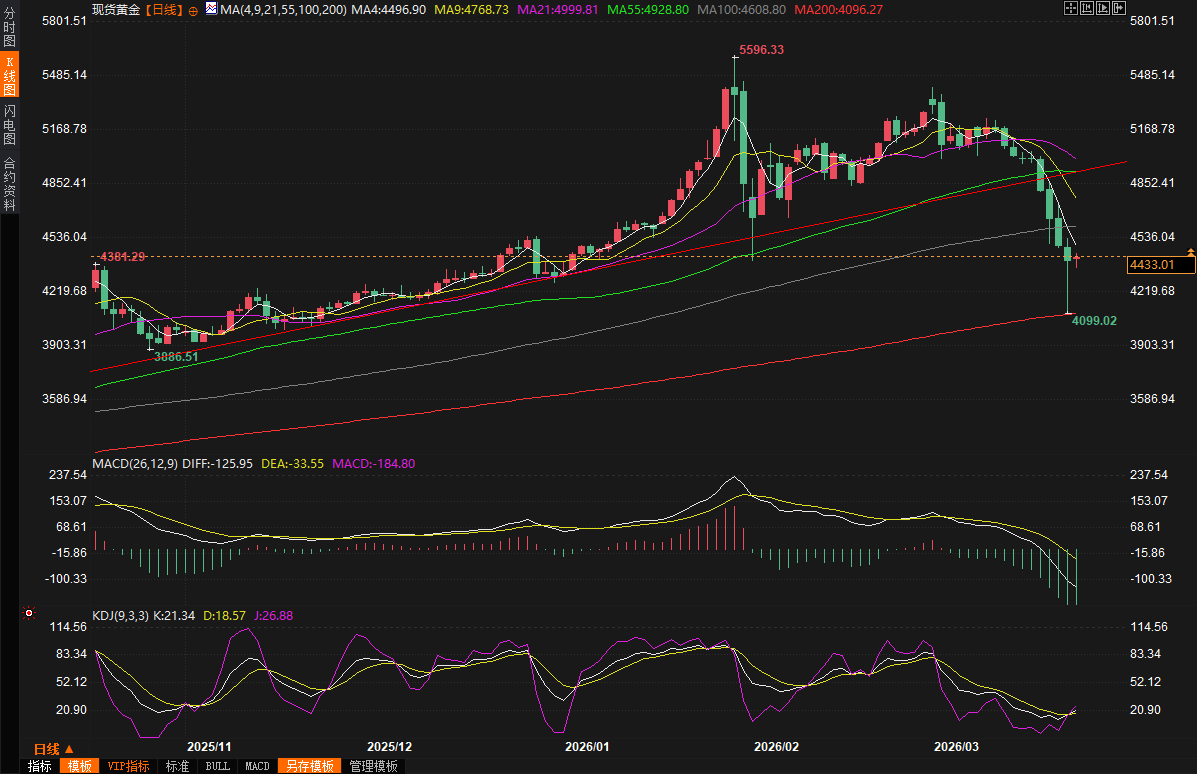
(Spot gold daily chart, source: FX678)
At 07:38 Beijing time, spot gold was trading at $4428.57 per ounce.
However, just when investors were almost in despair, Trump suddenly posted on social media, announcing that due to "productive" talks with Iran, the strikes against Iranian power plants and energy infrastructure would be postponed for five days. This news was like cold water extinguishing the raging fire in the oil market, causing oil prices to plummet by more than 10%, the dollar index to fall rapidly, and gold prices to rebound dramatically, with the decline narrowing significantly. In the end, spot gold closed at around $4406.64 per ounce, and the futures settlement price was $4407.30.
On Tuesday (March 24) in early Asian trading, spot gold fluctuated slightly higher. It fell as much as 0.7% to $4,360 per ounce at the start of the session, but quickly rebounded and is currently up 0.6%, trading around $4,430 per ounce.
I. On the Eve of the Storm: Energy Panic Ignites Inflation Expectations, Gold Faces Its Darkest Hour
On Monday (March 23), the market was shrouded in gloom at the start of trading. This stemmed from Trump's 48-hour ultimatum to Iran, threatening military strikes against its energy facilities. This volatile statement dramatically heightened global investors' fears of a massive energy supply disruption.
This fear was directly reflected in oil prices. International oil prices surged in early trading, with Brent crude briefly approaching record highs. The surge in oil prices quickly triggered a chain reaction in the market. As the "lifeblood" of the global economy, the runaway rise in energy prices means that the specter of inflation will once again loom. The market logic has become clear and direct: higher energy costs will push up overall prices, which will force the Federal Reserve to maintain high interest rates for a longer period, or even reconsider raising interest rates, in order to curb potentially runaway inflation.
Thus began a "repricing" of Federal Reserve interest rate expectations. The US dollar index, as a safe-haven currency and the most interest rate-sensitive currency, reacted first, rising sharply. However, for gold, this was a perfect storm. Although gold is considered a traditional inflation hedge, in the current market environment, it is more directly affected by interest rate expectations. Since gold itself does not generate interest, the opportunity cost of holding it is closely related to the risk-free rate (usually referenced to US Treasury yields). When the market begins to bet that the Federal Reserve will not cut interest rates or may even raise them, the opportunity cost of holding gold soars, and investors sell gold and embrace the dollar or US Treasury bonds instead.
Spot gold plummeted in this sell-off, falling more than 8.7% at one point to a staggering low of $4,099.02 per ounce. This was not only a four-month low but also brought it close to the key technical support level of the 200-day moving average. Last week, gold prices had already recorded their worst weekly performance since 1983, and Monday's sharp drop undoubtedly pushed it into an even deeper abyss. David Meger, director of metals trading at High Ridge Futures, accurately described the situation: "The overnight sell-off was a continuation of long position liquidation over the past few trading days, mainly driven by expectations of interest rate hikes." The market seemed to have already decided that the bear market for gold had only just begun.
II. Plot Twist: Trump's Late-Night Talk Instantly Restructures Market Logic
Just when the market had almost accepted that high oil prices and high interest rates would become the new normal, a dramatic scene unfolded just hours later.
Early Monday morning Eastern Time, Trump dropped a bombshell on his self-created social media platform, Truth Social. He announced that the United States and Iran had held "very good and productive" talks on the issue of "completely and thoroughly ending hostilities in the Middle East." Based on this, he ordered a five-day postponement of his previously threatened strikes against Iranian power plants.
This news instantly ignited global markets, with an impact no less significant than a "financial tsunami," only in the completely opposite direction.
First, the crude oil market plummeted. The war premium that had previously supported rising oil prices evaporated instantly, as the market perceived a significant reduction in the risk of large-scale attacks on energy facilities leading to supply disruptions in the short term. Brent crude prices fell rapidly from their highs, dropping by more than 10% at one point, breaking below the key psychological level of $100 per barrel.
The US dollar followed suit. As oil prices fell, market concerns about runaway inflation eased considerably. This meant the Federal Reserve might no longer need to be so hawkish, and the market began pricing in expectations of a rate cut this year. The dollar index quickly gave back all its previous gains, turning from positive to negative.
Most notably, gold staged a remarkable comeback. With the weakening dollar, dollar-denominated gold became more cost-effective for investors holding other currencies. Simultaneously, the easing of geopolitical risks, while reducing short-term safe-haven demand for gold, more importantly reversed the core logic driving the previous decline in gold prices—expectations of interest rate hikes. The decline in US Treasury yields from multi-month highs reduced the opportunity cost of holding gold, providing a much-needed respite. Gold prices rebounded rapidly from their intraday lows, narrowing the decline from over 8% to 2% at the close, staging a textbook "V-shaped" reversal.
III. Aftermath and Suspicion: The False "Peace" and the Fragile Balance of the Market
However, this reversal was not without its flaws. Even as Trump's statement was still resonating, rebuttals from Tehran followed. Iranian Parliament Speaker Mohammad Baqer Qalibaf bluntly called it "fake news" on social media, mocking the move as an "attempt to manipulate financial markets." The Iranian Foreign Ministry also denied having any direct dialogue with the United States.
One side claims the talks were "productive," while the other vehemently denies it, leaving the market with a huge question mark. Was Trump's statement overly optimistic, or a carefully orchestrated "expectation management" tactic? Does Iran's denial mean there's still a risk of escalation? Currently, although direct talks haven't been confirmed, reports indicate that intermediaries from Egypt, Pakistan, and Gulf states are conveying messages that direct talks could take place as early as this week in Islamabad. This suggests that communication channels haven't completely closed, but have become more complex.
This uncertainty means that market volatility is far from over. As Bob Doll, chief investment officer at Crossmark Global Investments, stated, "Market volatility may continue, and everything depends on oil prices. In the short term, other factors are not important to investors. Therefore, when oil prices fall, the stock market rises; and vice versa." Market nerves remain on edge, and any developments regarding the situation in Iran could trigger another round of sharp fluctuations in asset prices.
Conclusion: When the tide goes out, who is swimming naked?
Looking back at these dramatic 24 hours, we can clearly see that the core driver of the current market is singular – geopolitical risks and the resulting inflationary expectations. The correlation between gold, crude oil, the US dollar, and US Treasury yields has reached an unprecedented level of closeness.
Gold's "V-shaped" price movement perfectly illustrates its dual nature in the current macroeconomic environment. When the market focus is on the direct safe-haven demand stemming from geopolitical conflicts, gold rises; but when the focus shifts to the "inflation-interest rate hike" logic triggered by the conflict, gold plummets due to rising interest rates. Monday's market was the ultimate manifestation of the latter logic, and ended with a partial correction of the former logic following Trump's remarks.
This rollercoaster market has served as a wake-up call for investors: in extreme market conditions driven by a single event, any position is extremely vulnerable. A single social media post from Trump was enough to render all technical analysis and fundamental forecasts instantly ineffective. The market's focus is now entirely on the next moves by Trump and Iran, and how Federal Reserve officials will interpret these developments. For gold, while it has temporarily escaped the abyss of a "four-month low," the road ahead remains shrouded in uncertainty. Whether it can truly bottom out and rebound depends on whether the Middle East crisis is genuinely easing or merely a brief respite in the eye of the storm.
(Spot gold daily chart, source: FX678)
At 07:38 Beijing time, spot gold was trading at $4428.57 per ounce.
- Risk Warning and Disclaimer
- The market involves risk, and trading may not be suitable for all investors. This article is for reference only and does not constitute personal investment advice, nor does it take into account certain users’ specific investment objectives, financial situation, or other needs. Any investment decisions made based on this information are at your own risk.