













Japan's inflation fell to 1.3%, a near three-year low, while rising risks in the Middle East kept the US dollar/yen exchange rate high.
2026-03-24 09:45:25
On Tuesday during Asian trading hours, the USD/JPY pair maintained its strength, trading around 158.55, continuing its recent upward trend. The core driver of this rally was lower-than-expected Japanese inflation data, which further weakened market confidence in the Bank of Japan's policy normalization, thus putting pressure on the yen.

According to data released by Statistics Japan, Japan's national consumer price index (CPI) rose 1.3% year-on-year in February, lower than the previous month's 1.5% , marking the lowest level since March 2022 and significantly below the Bank of Japan's 2% inflation target. This data indicates that domestic inflationary momentum in Japan is continuing to weaken, and the foundation for economic recovery remains fragile.
Looking at the breakdown of data, Japan's core CPI (excluding fresh food) rose 1.6% year-on-year, lower than the previous value of 2.0% and also lower than the market expectation of 1.7% . Meanwhile, the "core CPI," which further excludes energy prices, rose 2.5% year-on-year, also a decline from the previous 2.6% . This series of data points to a common trend: the inflation structure is cooling across the board, and it's not just a short-term effect of falling energy prices.
Weakening inflation directly limits the Bank of Japan's room for further policy tightening. In the current environment, the Bank of Japan is more likely to maintain an accommodative stance to support economic growth. This policy expectation gap has reignited carry trades between the US dollar and the Japanese yen, thus supporting a continued rise in the USD/JPY exchange rate.
Meanwhile, the external environment also significantly impacts exchange rate trends. Recent developments in the Middle East have heightened market concerns about energy supply disruptions. If the conflict continues or escalates, oil prices could rise again, pushing up global inflation expectations. Against this backdrop, the US dollar, as the world's primary safe-haven and pricing currency, tends to receive support, while the traditional safe-haven attributes of the Japanese yen are significantly weakened in the current interest rate differential environment.
It is noteworthy that US President Donald Trump recently stated that he would give Iran five days to advance negotiations, but Iran quickly denied this claim and emphasized that the conflict would continue. This inconsistency in policy signals has exacerbated market uncertainty and made funds more inclined to hold dollar assets to hedge against potential risks.
In addition, the market will closely watch the upcoming preliminary reading of the US S&P Global Purchasing Managers' Index (PMI) for March. Strong data will further reinforce expectations of US economic resilience, thus supporting a stronger dollar; conversely, weak data could disrupt the current upward trend.
Overall, the current foreign exchange market logic has shifted from being driven by a single data source to being driven by a triple factor: inflation, interest rate differentials, and geopolitical risks. With Japanese inflation continuing to decline, the yen lacks significant upward momentum in the short term, while the US dollar maintains a relatively strong position supported by multiple factors.
From a technical perspective, the daily chart shows that USD/JPY remains within an upward channel, with the price consistently trading above the moving average system, maintaining an overall bullish trend. The key resistance level is currently around 159.50 ; a decisive break above this level could lead to a further test of the 160 psychological level . Support lies in the 157.00 area; a break below this level could trigger a short-term pullback. From a momentum perspective, the RSI indicator remains high but has not yet shown significant divergence, indicating that bullish momentum continues.
On the 4-hour chart, the exchange rate is showing an upward trend with fluctuations. Short-term moving averages are in a bullish alignment, and the price has repeatedly found support at these moving averages, indicating stable buying power. Current short-term resistance is concentrated in the 158.80-159.00 range ; a break above this level would open up further upside potential. Short-term support is located around 157.80 ; a break below this level could trigger a technical correction. Meanwhile, the MACD indicator is running above the zero line, suggesting that the short-term trend remains biased towards the upside, but momentum has slightly slowed, and the risk of consolidation at higher levels should be noted.
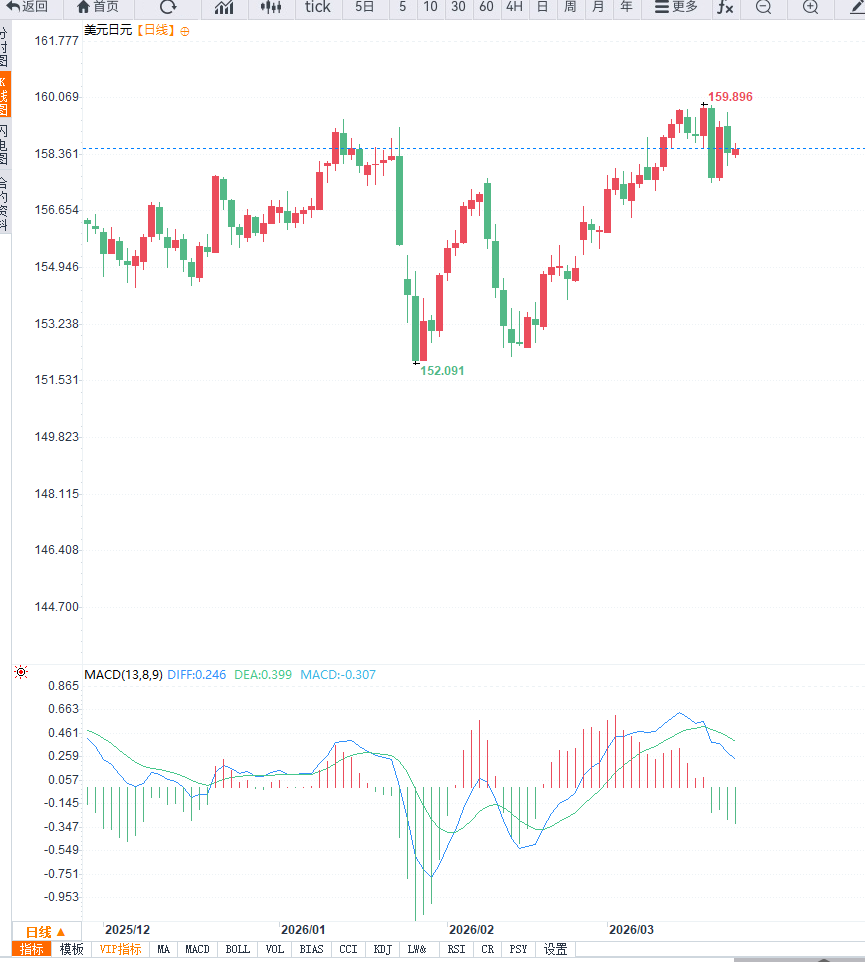
Editor's Summary : Overall, persistently lower-than-expected Japanese inflation is the core factor driving the yen's weakness, while uncertainty in the Middle East and anticipated US economic data have reinforced the dollar's relative advantage. In the short term, USD/JPY still has upward momentum, but market volatility may intensify as the exchange rate approaches key psychological levels. Future trends will depend on US economic data performance and any substantial changes in the geopolitical situation. Investors should be wary of the risk of a pullback from high levels and pay attention to the medium-term trend guidance provided by changes in interest rate differentials.
According to data released by Statistics Japan, Japan's national consumer price index (CPI) rose 1.3% year-on-year in February, lower than the previous month's 1.5% , marking the lowest level since March 2022 and significantly below the Bank of Japan's 2% inflation target. This data indicates that domestic inflationary momentum in Japan is continuing to weaken, and the foundation for economic recovery remains fragile.
Looking at the breakdown of data, Japan's core CPI (excluding fresh food) rose 1.6% year-on-year, lower than the previous value of 2.0% and also lower than the market expectation of 1.7% . Meanwhile, the "core CPI," which further excludes energy prices, rose 2.5% year-on-year, also a decline from the previous 2.6% . This series of data points to a common trend: the inflation structure is cooling across the board, and it's not just a short-term effect of falling energy prices.
Weakening inflation directly limits the Bank of Japan's room for further policy tightening. In the current environment, the Bank of Japan is more likely to maintain an accommodative stance to support economic growth. This policy expectation gap has reignited carry trades between the US dollar and the Japanese yen, thus supporting a continued rise in the USD/JPY exchange rate.
Meanwhile, the external environment also significantly impacts exchange rate trends. Recent developments in the Middle East have heightened market concerns about energy supply disruptions. If the conflict continues or escalates, oil prices could rise again, pushing up global inflation expectations. Against this backdrop, the US dollar, as the world's primary safe-haven and pricing currency, tends to receive support, while the traditional safe-haven attributes of the Japanese yen are significantly weakened in the current interest rate differential environment.
It is noteworthy that US President Donald Trump recently stated that he would give Iran five days to advance negotiations, but Iran quickly denied this claim and emphasized that the conflict would continue. This inconsistency in policy signals has exacerbated market uncertainty and made funds more inclined to hold dollar assets to hedge against potential risks.
In addition, the market will closely watch the upcoming preliminary reading of the US S&P Global Purchasing Managers' Index (PMI) for March. Strong data will further reinforce expectations of US economic resilience, thus supporting a stronger dollar; conversely, weak data could disrupt the current upward trend.
Overall, the current foreign exchange market logic has shifted from being driven by a single data source to being driven by a triple factor: inflation, interest rate differentials, and geopolitical risks. With Japanese inflation continuing to decline, the yen lacks significant upward momentum in the short term, while the US dollar maintains a relatively strong position supported by multiple factors.
From a technical perspective, the daily chart shows that USD/JPY remains within an upward channel, with the price consistently trading above the moving average system, maintaining an overall bullish trend. The key resistance level is currently around 159.50 ; a decisive break above this level could lead to a further test of the 160 psychological level . Support lies in the 157.00 area; a break below this level could trigger a short-term pullback. From a momentum perspective, the RSI indicator remains high but has not yet shown significant divergence, indicating that bullish momentum continues.
On the 4-hour chart, the exchange rate is showing an upward trend with fluctuations. Short-term moving averages are in a bullish alignment, and the price has repeatedly found support at these moving averages, indicating stable buying power. Current short-term resistance is concentrated in the 158.80-159.00 range ; a break above this level would open up further upside potential. Short-term support is located around 157.80 ; a break below this level could trigger a technical correction. Meanwhile, the MACD indicator is running above the zero line, suggesting that the short-term trend remains biased towards the upside, but momentum has slightly slowed, and the risk of consolidation at higher levels should be noted.
Editor's Summary : Overall, persistently lower-than-expected Japanese inflation is the core factor driving the yen's weakness, while uncertainty in the Middle East and anticipated US economic data have reinforced the dollar's relative advantage. In the short term, USD/JPY still has upward momentum, but market volatility may intensify as the exchange rate approaches key psychological levels. Future trends will depend on US economic data performance and any substantial changes in the geopolitical situation. Investors should be wary of the risk of a pullback from high levels and pay attention to the medium-term trend guidance provided by changes in interest rate differentials.
- Risk Warning and Disclaimer
- The market involves risk, and trading may not be suitable for all investors. This article is for reference only and does not constitute personal investment advice, nor does it take into account certain users’ specific investment objectives, financial situation, or other needs. Any investment decisions made based on this information are at your own risk.

